

Travel guide from India
Australia
Australia is a long flight south-east of India, with non-stop services on some routes and one-stop connections on Asian and Gulf airlines to Sydney, Melbourne, Brisbane and Perth. It is the world's sixth-largest country and its seasons run opposite to India's, with summer from December to February; people come for Sydney's harbour, Melbourne's food and cricket, the Great Barrier Reef, Uluru and wildlife from koalas to penguins. Vegetarians eat well in Sydney and Melbourne, and Sydney's Harris Park is a 'Little India', but options thin out in the outback.
- Best time
- Dec–Feb
- First trip
- 11–14 nights
- Visa
- Visa needed, 90 days
- Return flights
- from ₹35,297 ●
- Chennai, checked in the last 48 h
Places to visit in Australia
12 places in the order you would meet them on a first trip. Tap one for what to do there.
Sydney
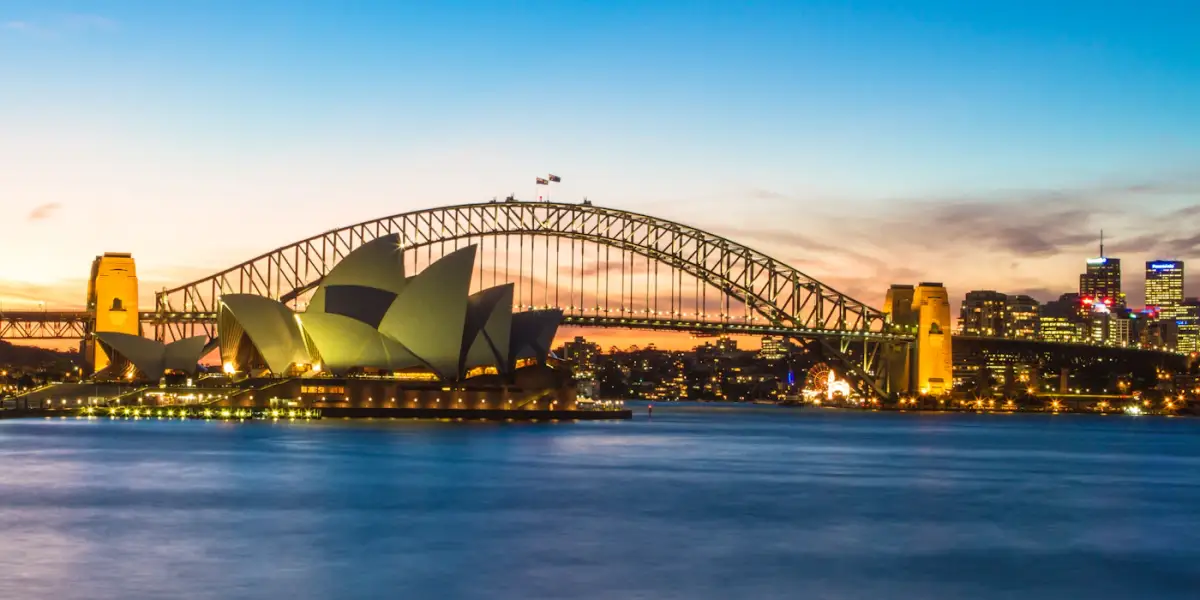
CityThe harbour city: Opera House, a walk over the Harbour Bridge, ferry rides, surf beaches and Harris Park's Little India.
3–4 nightsabout 30 min by train from Sydney airportBest Sep–Mar
Sydney
CityThe harbour city: Opera House, a walk over the Harbour Bridge, ferry rides, surf beaches and Harris Park's Little India.
Sydney is built around a large natural harbour, with the Opera House and the Harbour Bridge facing each other across Circular Quay, the city's main ferry terminal, and The Rocks, where British settlement started in 1788, right beside them. Ocean beaches such as Bondi and Manly are a short bus or ferry ride from the centre, and the airport is about 9 km away with a direct train line into the city.
What to do in Sydney
- Sydney Opera House and the Botanic Garden. Take a guided tour of Jørn Utzon's World Heritage-listed building, opened in 1973, then walk through the Royal Botanic Garden to Mrs Macquarie's Chair, a sandstone seat cut by convicts, for the view of the Opera House with the bridge behind it.
- Walk across the Harbour Bridge. The world's largest steel arch bridge has joined the city to the North Shore since 1932; cross on foot from The Rocks for harbour views, or join a guided climb over the arch.
- Ferry to Manly. The half-hour ride from Circular Quay passes the Opera House and heads towards the harbour mouth before docking at Manly, where a pedestrian street leads to the surf beach.
- Bondi to Coogee coastal walk. A 6 km path along the sandstone cliffs from Bondi past Tamarama, Bronte and Clovelly to Coogee; from May to November, look out for migrating whales.
- Eat in Harris Park, Sydney's Little India. Next to Parramatta in the west, reached by train or river ferry, Wigram Street and its side streets are packed with Indian restaurants and snack stalls, some in heritage-listed cottages; Parramatta, with its World Heritage-listed Old Government House, is within walking distance.
Sydney works all year, but it is at its liveliest in the warm months from November to March, and spring (from September) is mild enough for the coastal walks; winter (June to August) is cooler, with fewer crowds.
Sources: Tourism Australia: Guide to Sydney, Tourism Australia: 4 days in Sydney, Sydney.com (Destination NSW): 3-day itinerary for first-time visitors, Sydney.com (Destination NSW): Circular Quay, Sydney.com (Destination NSW): Bondi, Sydney.com (Destination NSW): Day trip to Parramatta, Sydney.com (Destination NSW): Western Sydney street food, Wikivoyage: Sydney, Wikivoyage: Australia, Tourism Australia: Getting here, flights from India to Australia, Tourism Australia: Getting around Australia, Tourism Australia: How to get to Australia's most iconic cities and destinations, Tourism Australia: How long do I need for my trip to Australia?, Tourism Australia: The ultimate trip to Australia (checked 14 Oct)
Blue Mountains (Katoomba and Leura)
Hill countrySandstone cliffs, the Three Sisters, waterfalls and bushwalks above forested valleys, about two hours west of Sydney.
1 nightabout 2 h from Sydney airportBest Oct–Nov
Blue Mountains (Katoomba and Leura)
Hill countrySandstone cliffs, the Three Sisters, waterfalls and bushwalks above forested valleys, about two hours west of Sydney.
West of Sydney, the World Heritage-listed Blue Mountains are a high sandstone plateau cut by deep, forested valleys, with lookouts, waterfalls and more than 140 km of walking tracks in the national park. Katoomba and Leura, the main villages, are about two hours from Sydney by car or train; the highlights fit into a long day trip, but plenty of visitors stay a night or two.
What to do in Blue Mountains (Katoomba and Leura)
- Echo Point and the Three Sisters. The main lookout faces three weathered sandstone peaks above the Jamison Valley, a declared Aboriginal Place of the Gundungurra and Darug peoples; the short Three Sisters walk takes you closer.
- Scenic World. Ride the railway and cable cars down into the Jamison Valley and back up, then cross between the clifftops on the skyway.
- Prince Henry Cliff walk or the Giant Stairway. Follow the cliff edge from Echo Point past a string of lookouts to Leura Cascades, or go down the Giant Stairway beside the Three Sisters and return along the valley floor.
- Govetts Leap at Blackheath. A lookout over the sheer walls of the Grose Valley, where Bridal Veil falls drops about 180 m; the Grand Canyon track nearby is a challenging 3- to 4-hour loop past creeks and waterfalls.
- Leura village and its gardens. Browse the cafés and craft shops of Leura, next to Katoomba, ideally in autumn or spring when the cool-climate gardens are at their most colourful.
Late spring (October and November) is warm and dry for bushwalking; May and the winter months can also be good, but winters are chilly with occasional light snow.
Sources: Tourism Australia: Guide to the Blue Mountains, NSW National Parks: Blue Mountains National Park, NSW National Parks: Echo Point lookout (Three Sisters), NSW National Parks: Govetts Leap lookout, NSW National Parks: Grand Canyon track, Wikivoyage: Blue Mountains, Tourism Australia: The ultimate trip to Australia (checked 14 Oct)
Melbourne
CityLaneway cafés and street art, the MCG where Test cricket began, big galleries, trams and easy day trips.
3 nightsabout 30 min from Melbourne airportBest Mar–May, Sep–Nov
Melbourne
CityLaneway cafés and street art, the MCG where Test cricket began, big galleries, trams and easy day trips.
Melbourne, Australia's second-largest city, sits on the Yarra River with a walkable centre of laneways and arcades full of cafés and street art, and trams running out to the beach suburbs. It is sport-mad, home to the Melbourne Cricket Ground, and has Indian restaurants throughout the city, with most of the vegetarian Indian places in outer suburbs such as Dandenong. The weather can change several times in one day, so pack layers whatever the season.
What to do in Melbourne
- Laneways and street art. Wander Hosier Lane for its painted walls, then find coffee in narrow lanes such as Degraves Street.
- Tour the MCG. Australia's biggest stadium, a 10-minute walk from the centre, was founded in 1853 and hosted the first Test match in 1877 and the first one-day international in 1971; guided tours walk the boundary, and the Australian Sports Museum tells its history.
- Queen Victoria Market. Melbourne's big market spreads over two city blocks; come hungry and browse the produce and food stalls.
- Galleries and museums. See the National Gallery of Victoria and the domed La Trobe Reading Room of the State Library; with children, Melbourne Museum and ACMI are good bets.
- Botanic gardens and St Kilda by tram. Ride a tram to the Royal Botanic Gardens Victoria, then on to St Kilda's beach and pier for the evening.
Spring and autumn (September to November, March to May) are the most comfortable seasons, with neither summer's heat nor winter's chill; June to August can get quite chilly.
Sources: Tourism Australia: Guide to Melbourne, Tourism Australia: 3 days in Melbourne, Visit Melbourne: Air, getting here and around, Melbourne Cricket Ground: About the MCG, Melbourne Cricket Ground: MCG tours, Wikivoyage: Melbourne, Tourism Australia: How to get to Australia's most iconic cities and destinations (checked 14 Oct)
Phillip Island
WildlifeDay tripLittle penguins waddling ashore at dusk, koalas from treetop boardwalks and fur seals, about two hours from Melbourne.
2 h from Melbourne airportBest Nov–Mar
Phillip Island
WildlifeDay tripLittle penguins waddling ashore at dusk, koalas from treetop boardwalks and fur seals, about two hours from Melbourne.
Phillip Island lies at the mouth of Western Port, joined to the mainland by a bridge, and has the world's largest colony of little penguins, which come ashore every night of the year. It makes a long day trip from Melbourne, planned so that the day ends at the Penguin Parade around sunset; public transport on the island is limited, so drive or join a tour.
What to do in Phillip Island
- Penguin Parade. Watch hundreds of little penguins come in from the sea and waddle up Summerland Beach to their burrows, seen from grandstands and boardwalks.
- Koala Conservation Reserve. Two treetop boardwalks bring you level with koalas in the gum trees, and wallabies and echidnas live in the bush around them.
- Seal-watching cruise. Boat trips head out to see one of Australia's largest fur seal colonies; in autumn (March to May) the pups are in the water practising to hunt.
- Cape Woolamai. Walk the rugged headland of Cape Woolamai for its pink granite cliffs and long golden beach.
- Churchill Island Heritage Farm. Just off Phillip Island, this working farm keeps its old homestead buildings, with daily farm activities and walking trails around the bay.
Warm weather from November to March suits the walks, beaches and wildlife best, the Penguin Parade included; winter (June to August) is the low season.
Sources: Tourism Australia: Guide to Phillip Island, Tourism Australia: The best day trips from Melbourne, Phillip Island Nature Parks: Penguin Parade, Phillip Island Nature Parks: Koala Conservation Reserve, Phillip Island Nature Parks: Churchill Island Heritage Farm, Phillip Island Nature Parks: Getting there, Wikivoyage: Phillip Island (checked 14 Oct)
Great Ocean Road (Lorne to the Twelve Apostles)
BeachA cliff-hugging coastal drive past surf towns, koalas and rainforest to the limestone stacks of the Twelve Apostles.
1–2 nightsabout 2 h from Melbourne airportBest Dec–Feb
Great Ocean Road (Lorne to the Twelve Apostles)
BeachA cliff-hugging coastal drive past surf towns, koalas and rainforest to the limestone stacks of the Twelve Apostles.
The Great Ocean Road runs for about 243 km along Victoria's south-west coast from Torquay, just over an hour from Melbourne; it was built from 1919 by some 3,000 soldiers back from the First World War and dedicated as a war memorial. It winds along the cliffs past surf beaches and seaside towns such as Lorne and Apollo Bay, cuts inland through the forests of the Otways, then returns to the sea at the Twelve Apostles. A long day from Melbourne covers the eastern end, but it is better over a couple of days, sleeping in Lorne, Apollo Bay or Port Campbell.
What to do in Great Ocean Road (Lorne to the Twelve Apostles)
- Twelve Apostles and Loch Ard Gorge. Limestone stacks stand off the cliffs where the sea has worn away caves and arches; despite the name only eight remain, and Loch Ard Gorge, a small beach among rock formations and caves, is five minutes further on.
- Koalas at Kennett River. About half an hour past Lorne, koalas doze in the gum trees along the main road; take the short Koala Walk and keep looking up.
- Waterfalls of the Otways. Detour inland to Hopetoun Falls, about 30 m high, and the grove of tall Californian redwoods near Beech Forest.
- Torquay and Bells Beach. The road officially starts in the surf town of Torquay, and Bells Beach just beyond is one of Australia's famous surfing beaches.
- Lorne and Apollo Bay. Break the drive in Lorne, with its kilometre-long beach and pier, or Apollo Bay, one of the larger towns and known for its seafood, both with plenty of places to stay.
The road is scenic all year, but summer (December to February) brings the clearest skies over the cliffs; June to August is the low season.
Sources: Tourism Australia: Guide to the Great Ocean Road, Tourism Australia: 10 secret must-stop places on the Great Ocean Road, Tourism Australia: The best day trips from Melbourne, Visit Melbourne: 12 Apostles, Visit Melbourne: Great Ocean Road, Wikivoyage: Great Ocean Road (checked 14 Oct)
Cairns and the Great Barrier Reef
WildlifeDay boats out to the Great Barrier Reef, rainforest at Kuranda and the Daintree, and a warm, dry winter.
3–4 nightsabout 3 h by flight from Brisbane airportBest May–Oct
Cairns and the Great Barrier Reef
WildlifeDay boats out to the Great Barrier Reef, rainforest at Kuranda and the Daintree, and a warm, dry winter.
Cairns is a laid-back tropical city and the main gateway to the Great Barrier Reef, a UNESCO-listed reef system stretching some 2,300 km down the Queensland coast, and to the World Heritage rainforest of the Wet Tropics. Day boats leave early in the morning and return in the late afternoon, and the city has no swimming beach of its own, just a lagoon pool on the Esplanade. Port Douglas, a beach town about an hour's drive north, is an alternative base closer to the Daintree.
What to do in Cairns and the Great Barrier Reef
- Snorkel or dive the outer reef. Day boats tie up at pontoons or sandy cays on the reef, where you swim among corals, turtles and some of its 1,600 kinds of fish; in stinger season snorkellers and divers wear full-body suits, and glass-bottom boats suit non-swimmers.
- Green or Fitzroy Island. Both islands are within about 45 minutes of Cairns by ferry and welcome day visitors, an easy island day without a long boat ride.
- Kuranda by Skyrail or train. Ride the Skyrail cableway over the rainforest, stopping to see Barron Falls, or the scenic railway through Barron Gorge, up to the hill village of Kuranda, about 25 km from Cairns.
- Daintree Rainforest and Mossman Gorge. About 77 km north of Cairns, Mossman Gorge has walks led by Kuku Yalanji guides, the area's traditional custodians; further on, a car ferry crosses the Daintree River to the rainforest coast of Cape Tribulation.
- Esplanade Lagoon. A large, shallow lagoon pool on the waterfront, at most 1.5 m deep, where families cool off when stingers keep people out of the sea.
May to October is the dry season, with warm sunny days and low rainfall, though stinger season can begin in October; November to April is the wet season of heavy rain, storms and possible cyclones, when snorkellers and divers on the reef must wear full-body suits.
Sources: Tourism Australia: Guide to Cairns, Tourism Australia: Guide to the Great Barrier Reef, Tourism Australia: The best day trips on the Great Barrier Reef, Tourism Australia: Guide to the Daintree Rainforest, Tourism Australia: Australia's seasons, Tourism Australia: When is the best time to visit Australia?, Tourism Australia: The ultimate trip to Australia, Tourism Australia: Getting around Australia, Wikivoyage: Cairns, Wikivoyage: Great Barrier Reef (checked 14 Oct)
Brisbane
CityA sunny river city with a man-made beach at South Bank, koalas at Lone Pine and ferries to the sand islands.
1–2 nightsabout 30 min by train from Brisbane airport
Brisbane
CityA sunny river city with a man-made beach at South Bank, koalas at Lone Pine and ferries to the sand islands.
Brisbane, Queensland's capital, winds along the Brisbane River, with hot, humid summers and mild, mostly sunny winters. South Bank, across the river from the centre on the site of Expo '88, has parklands and a man-made beach, with the Queensland Museum and the state art galleries next door, and the river ferries, including the CityCats, are a pleasant way to see the city. It pairs naturally with the Gold Coast, a little over an hour south by train.
What to do in Brisbane
- South Bank and the Cultural Precinct. Swim at the man-made beach in the riverside parklands, then visit the Queensland Art Gallery and the Gallery of Modern Art next door.
- Lone Pine Koala Sanctuary. Cruise up the river from the city to Lone Pine, home to more than 130 koalas, where you also meet kangaroos and other native animals.
- Mount Coot-tha. Walk the botanic gardens at its foot, then drive or hike to the summit for a view over the city, at its best around sunset.
- Story Bridge climb. Guided climbs over the steel bridge look out across the skyline to Moreton Bay.
- A day on a sand island. Ferries cross Moreton Bay to Moreton Island and North Stradbroke Island for surf beaches and dunes; from June to November humpback whales pass through the bay.
Sources: Tourism Australia: Guide to Brisbane, Visit Brisbane: Brisbane's ultimate holiday itinerary, Wikivoyage: Brisbane, Wikivoyage: Brisbane Airport, Wikivoyage: Gold Coast (checked 14 Oct)
Gold Coast
BeachPatrolled surf beaches, Australia's big theme parks, koala sanctuaries and rainforest in the hills behind.
2–3 nightsabout 1 h 30 min from Brisbane airport
Gold Coast
BeachPatrolled surf beaches, Australia's big theme parks, koala sanctuaries and rainforest in the hills behind.
The Gold Coast is a long strip of high-rise resort towns and surf beaches south of Brisbane, with more than 50 km of council-maintained ocean beaches, busy Surfers Paradise as its hub and more laid-back Burleigh Heads and Coolangatta to the south. The big theme parks sit in the northern suburbs, and inland rises the rainforested hinterland of Tamborine Mountain and Lamington National Park. With around 300 sunny days a year, you are likely to get beach weather whenever you go.
What to do in Gold Coast
- Theme parks. Dreamworld, Warner Bros. Movie World, Sea World and the Wet'n'Wild and WhiteWater World water parks are all on the Gold Coast; Dreamworld also has Bengal and Sumatran tigers and hundreds of Australian animals.
- Swim between the flags. Surfers Paradise has lifeguard flags every few hundred metres; swim only between them, and take small children to the calm, patrolled water of Tallebudgera Creek.
- Burleigh Heads. Walk Burleigh's bush tracks for the views, then watch surfers ride its well-known breaks.
- Currumbin Wildlife Sanctuary. Meet koalas, kangaroos and native birds at this sanctuary by the southern beaches.
- The hinterland. Drive up to Tamborine Mountain for lookouts and rainforest walks, or to the Natural Bridge in the Numinbah Valley, a rock pool and waterfall where glow-worms shine after dark; Lamington is part of the Gondwana Rainforests World Heritage Area.
Sources: Tourism Australia: Guide to the Gold Coast, Tourism Australia: Gold Coast theme parks, Tourism Australia: 3 days on the Gold Coast, Wikivoyage: Gold Coast, Wikivoyage: Australia, Visit Brisbane: Brisbane's ultimate holiday itinerary, Wikivoyage: Brisbane Airport (checked 14 Oct)
The Whitsundays (Airlie Beach)
IslandSailing among 74 reef islands, the white silica sand of Whitehaven Beach and Heart Reef seen from the air.
2–3 nightsabout 2 h 30 min by flight from Brisbane airportBest Sep–Nov
The Whitsundays (Airlie Beach)
IslandSailing among 74 reef islands, the white silica sand of Whitehaven Beach and Heart Reef seen from the air.
The Whitsundays are a group of 74 islands off the Queensland coast, part of the Great Barrier Reef and mostly national park, reached from the mainland town of Airlie Beach or from Hamilton Island, a resort island with its own airport where cars are not allowed and people get around by golf buggy. Days are spent on the water, on ferries, day cruises, sailing trips and scenic flights. Jellyfish keep people out of the sea off Airlie from about October to May, so swim in the town's lifeguarded lagoon instead.
What to do in The Whitsundays (Airlie Beach)
- Whitehaven Beach and Hill Inlet. The sand here is almost pure silica; climb to the lookout over Hill Inlet, at one end of the beach, for the view across the inlet.
- Sail the islands. Join a day or overnight sailing trip, or charter a yacht and skipper it yourself, known as bareboating.
- Snorkel the reef. Cruises run out to the coral, where you can snorkel or dive among turtles, fish and clams.
- Heart Reef from the air. This heart-shaped coral formation is seen on scenic seaplane or helicopter flights; some flights also land for a snorkel and a stop at Whitehaven.
- Conway National Park. Tropical rainforest and waterfalls close to Airlie Beach, for a day off the water.
Spring (September to November) is the pick, with steady sunshine and low humidity, though stingers can keep people out of the sea from about October; January to March is the wet season, and humpback whales arrive from June to August.
Sources: Tourism Australia: Guide to the Whitsundays, Tourism Australia: Guide to Airlie Beach, Tourism Australia: Guide to Hamilton Island, Tourism Australia: The best day trips on the Great Barrier Reef, Wikivoyage: Whitsunday Islands, Wikivoyage: Airlie Beach, Wikivoyage: Hamilton Island (checked 14 Oct)
Uluru and Kata Tjuta
HeritageThe great red rock at sunrise and sunset, the domes of Kata Tjuta and Anangu culture in the desert heart of Australia.
2 nightsabout 3 h by flight from Melbourne airportBest May–Sep
Uluru and Kata Tjuta
HeritageThe great red rock at sunrise and sunset, the domes of Kata Tjuta and Anangu culture in the desert heart of Australia.
Uluru, once called Ayers Rock, is a sandstone monolith about half a billion years old that rises 348 m above the desert plain of Central Australia, and nearby Kata Tjuta is a cluster of 36 domes rising up to 546 m. Both lie in a national park owned by its Aboriginal Traditional Owners, the Anangu, and run jointly with Parks Australia; UNESCO lists it as a World Heritage site for its cultural as well as its natural values. Visitors stay at Yulara, the resort town outside the park, which has its own airport with direct flights from Sydney, Melbourne, Brisbane and Cairns.
What to do in Uluru and Kata Tjuta
- Sunrise and sunset at Uluru. The rock's colours shift most in the low light of dawn and dusk; watch from the park's designated viewing areas.
- Walk around the base. Uluru is 9.4 km around; walk all or part of the base in the cool of the morning to see rock art, caves and rare plants up close, keeping to the marked tracks.
- Valley of the Winds and Walpa Gorge. At Kata Tjuta, walk between the domes on the Valley of the Winds track, or into Walpa Gorge, a narrow creek valley with wildflowers and wallabies.
- Cultural Centre. Learn about Anangu law (Tjukurpa), stories and culture at the park's Cultural Centre before exploring.
- Respect the rock. The climb was closed for good in October 2019 in line with Anangu law; do not enter or photograph sacred sites, and greet people with 'palya'.
May to September is the cool, dry season, with daytime temperatures of about 20–30°C; October to April is the hotter, wetter low season.
Sources: Tourism Australia: Guide to Uluru and Kata Tjuta, Parks Australia: Uluru, Parks Australia: Kata Tjuta, Parks Australia: Amazing facts about Uluru-Kata Tjuta, Parks Australia: World heritage, Parks Australia: Uluru climb closure, Parks Australia: Respecting Culture, Parks Australia: Getting here, Parks Australia: Staying safe, Wikivoyage: Yulara, Tourism Australia: 3 days at Uluru and Kata Tjuta, Tourism Australia: The ultimate trip to Australia (checked 14 Oct)
Perth and Fremantle
CityAustralia's sunniest capital: Indian Ocean sunsets, Kings Park views and the old port of Fremantle.
2–3 nights20 min from Perth airportBest Sep–Nov
Perth and Fremantle
CityAustralia's sunniest capital: Indian Ocean sunsets, Kings Park views and the old port of Fremantle.
Perth, the capital of Western Australia and the country's sunniest capital city, sits on the Swan River beside the Indian Ocean, with 19 sandy beaches along its coast and the huge Kings Park above the centre. Fremantle, the historic port city, is about 25 minutes away by train, with convict-era buildings, markets and ferries to Rottnest Island. Perth is four to five hours' flight from the east coast, so on a shorter trip it is best seen on its own rather than added to an east-coast loop.
What to do in Perth and Fremantle
- Kings Park and Botanic Garden. Among the world's largest inner-city parks, its 400 hectares of bushland and gardens on Mount Eliza look out over the city towers and the Swan River.
- Sunset at Cottesloe. Watch the sun go down over the Indian Ocean from Cottesloe or another of the city's ocean beaches.
- Fremantle Prison and the West End. Built by convicts in the 1850s and used as a jail until 1991, it is Western Australia's only World Heritage-listed building, seen on guided tours; afterwards walk the heritage-listed streets of the West End.
- Fremantle Markets and Bathers Beach. The market hall has traded since 1897; finish at the Fishing Boat Harbour or the calm water of Bathers Beach for sunset.
- Swan Valley. Western Australia's oldest wine region, about 25 minutes' drive from the city, also has chocolate and cheese makers and a wildlife park with koalas and kangaroos.
Spring (September to November) is dry and warm, with humpback whales passing along the coast; summer (December to February) is hot and dry, and winter (June to August) mild.
Sources: Tourism Australia: Guide to Perth, Tourism Australia: The best day trips from Perth, Tourism Western Australia: Perth, Tourism Western Australia: Fremantle, Wikivoyage: Perth Airport, Tourism Australia: How to get to Australia's most iconic cities and destinations, Tourism Australia: Getting around Australia, Tourism Australia: How long do I need for my trip to Australia? (checked 14 Oct)
Rottnest Island
IslandQuokkas, 63 beaches and snorkel trails on an island you explore by bike, half an hour by ferry from Fremantle.
1 nightabout 1 h 30 min by boat from Perth airport
Rottnest Island
IslandQuokkas, 63 beaches and snorkel trails on an island you explore by bike, half an hour by ferry from Fremantle.
Rottnest Island, Wadjemup to the Whadjuk Noongar people, is a nature reserve 19 km off the coast, about 11 km long and ringed by 63 beaches and 20 bays, with no cars for visitors: you get around by bike, on foot or by bus. It is best known for the quokka, a small marsupial that appears to smile and is found only in Western Australia; 17th-century Dutch sailors took them for big rats, which is how the island got its name. Ferries take about 30 minutes from Fremantle and 90 from Perth, so it works as a day trip, but staying a night gives the best chance of seeing quokkas, which are most active after dark.
What to do in Rottnest Island
- Meet the quokkas. Look for them around the Thomson Bay settlement, especially towards evening; baby quokkas can be spotted from April to December.
- Cycle the island. Hire a bike or e-bike and ride the paved paths between the bays, or use the hop-on hop-off bus that loops the island.
- Snorkel trails. Parker Point and Little Salmon Bay on the south coast have marked snorkel trails over coral and seagrass; Little Salmon Bay's sheltered water suits less confident swimmers.
- Beaches for swimming. The Basin, a clear pool scooped out of the reef near the settlement, is a favourite swim; shallow, reef-sheltered Little Parakeet Bay suits small children, and Thomson Bay has a roped-off swimming area.
- Wadjemup Museum and Bathurst Lighthouse. The museum, developed with an Aboriginal reference group, tells the island's history, including its stories of imprisonment; the white lighthouse at Bathurst Point first shone in 1900.
Sources: Tourism Australia: Guide to Rottnest Island, Tourism Australia: The best day trips from Perth, Tourism Western Australia: Rottnest Island, Wikivoyage: Rottnest Island (checked 14 Oct)
A first trip: 11–14 nights
- Sydney · 3–4n
- →Blue Mountains (Katoomba and Leura) · 1n
- →Melbourne · 3n
- →Phillip Island
- →Great Ocean Road (Lorne to the Twelve Apostles) · 1–2n
- →Cairns and the Great Barrier Reef · 3–4n
Fly into Sydney for the harbour and a night in the Blue Mountains, fly on to Melbourne for a day with Phillip Island's penguins and a night or two on the Great Ocean Road, then finish on the reef at Cairns and fly home via Brisbane. October suits most of this loop, with spring in Sydney, Melbourne and the Blue Mountains while the reef is still in its dry season (stinger season can start in October); from December to February the Great Ocean Road and Phillip Island are at their best but Cairns is in its wet, stinger season, so swap it for Brisbane and the Gold Coast.
Getting around
Australia is huge, so pick one coast for a first trip and fly between regions: Sydney to Melbourne or Brisbane is about 1.5 hours by air against nine or ten hours by road, Sydney to Cairns about three hours, Sydney to Perth four to five, and Sydney, Melbourne or Brisbane to Uluru about three. Places that pair well are Sydney with the Blue Mountains, Melbourne with Phillip Island and the Great Ocean Road, Brisbane with the Gold Coast, Cairns with the reef, and Perth with Rottnest Island. The big cities have good trains, Melbourne its trams, and Sydney, Brisbane and Perth their harbour or river ferries, but the Blue Mountains, the Great Ocean Road and Uluru are easiest with a hire car (Australians drive on the left) or on a tour.
When to go
Brisbane month by month: weather and fares →Melbourne month by month: weather and fares →Perth month by month: weather and fares →Sydney month by month: weather and fares →Peak Shoulder Off-season
Tourism Australia calls summer (December to February) the time for Sydney's beaches, autumn the mildest season and winter (June to August) cool with a rainy June; spring days are warm with lower humidity than summer. Winter is rated off-season on temperature alone and stays fine for sightseeing.
Flights to Australia from India
Visa for Indian passports
Indian passport holders need a visa for Australia before travel. Allow about 35 days for a first-time application. Visitor visa (subclass 600) online via ImmiAccount; most decided within about 5 weeks.
Before you book, check the Ministry of External Affairs travel advisories for the latest guidance.
Australia: questions
What are the best places to visit in Australia?
Sydney: The harbour city: Opera House, a walk over the Harbour Bridge, ferry rides, surf beaches and Harris Park's Little India. Blue Mountains (Katoomba and Leura): Sandstone cliffs, the Three Sisters, waterfalls and bushwalks above forested valleys, about two hours west of Sydney. Melbourne: Laneway cafés and street art, the MCG where Test cricket began, big galleries, trams and easy day trips. Phillip Island: Little penguins waddling ashore at dusk, koalas from treetop boardwalks and fur seals, about two hours from Melbourne. Great Ocean Road (Lorne to the Twelve Apostles): A cliff-hugging coastal drive past surf towns, koalas and rainforest to the limestone stacks of the Twelve Apostles. Cairns and the Great Barrier Reef: Day boats out to the Great Barrier Reef, rainforest at Kuranda and the Daintree, and a warm, dry winter. Brisbane: A sunny river city with a man-made beach at South Bank, koalas at Lone Pine and ferries to the sand islands. Gold Coast: Patrolled surf beaches, Australia's big theme parks, koala sanctuaries and rainforest in the hills behind. The Whitsundays (Airlie Beach): Sailing among 74 reef islands, the white silica sand of Whitehaven Beach and Heart Reef seen from the air. Uluru and Kata Tjuta: The great red rock at sunrise and sunset, the domes of Kata Tjuta and Anangu culture in the desert heart of Australia. Perth and Fremantle: Australia's sunniest capital: Indian Ocean sunsets, Kings Park views and the old port of Fremantle. Rottnest Island: Quokkas, 63 beaches and snorkel trails on an island you explore by bike, half an hour by ferry from Fremantle.
How many days do you need for Australia?
A first trip takes about 11–14 nights: Sydney (3–4 nights), Blue Mountains (Katoomba and Leura) (1 night), Melbourne (3 nights), Phillip Island (1 night), Great Ocean Road (Lorne to the Twelve Apostles) (1–2 nights), Cairns and the Great Barrier Reef (3–4 nights). Fly into Sydney for the harbour and a night in the Blue Mountains, fly on to Melbourne for a day with Phillip Island's penguins and a night or two on the Great Ocean Road, then finish on the reef at Cairns and fly home via Brisbane. October suits most of this loop, with spring in Sydney, Melbourne and the Blue Mountains while the reef is still in its dry season (stinger season can start in October); from December to February the Great Ocean Road and Phillip Island are at their best but Cairns is in its wet, stinger season, so swap it for Brisbane and the Gold Coast.
What is the best time to visit Australia?
Peak season is Dec–Feb. Tourism Australia calls summer (December to February) the time for Sydney's beaches, autumn the mildest season and winter (June to August) cool with a rainy June; spring days are warm with lower humidity than summer. Winter is rated off-season on temperature alone and stays fine for sightseeing.
Do Indians need a visa for Australia?
Indian passport holders need a visa for Australia before travel. Allow about 35 days for a first-time application. Visitor visa (subclass 600) online via ImmiAccount; most decided within about 5 weeks.
How much is a flight to Australia from India?
The lowest return fare FlyBun has seen in the last 14 days is ₹35,297, Chennai to Perth, for March 2027 departures. Fares change daily.
Places and things to do are written by FlyBun from official tourism, heritage and park sources, linked under each place, last checked 14 Oct. We leave out entry fees and opening hours because they change; check them before you go.
Watch a route and FlyBun alerts you free when its fare drops.