

Travel guide from India
Austria
Austria is a long-haul flight from India, and Vienna is the usual way in. The country is small enough for a train-based trip that pairs imperial Vienna and Mozart's Salzburg with lake villages, Alpine valleys and glacier peaks, and the same places switch from swimming and hiking in summer to skiing and Christmas markets in winter. Vegetarians do well in the cities, where most menus have meat-free dishes, but traditional country inns cook heavily with meat, so ask; note that sweet mains such as Kaiserschmarren are made with egg.
- Best time
- May–Sep, Dec
- First trip
- 8–10 nights
- Visa
- Visa needed, 90 days
- Return flights
- from ₹42,599 ●
- Delhi, checked in the last 48 h
Places to visit in Austria
8 places in the order you would meet them on a first trip. Tap one for what to do there.
Vienna
CityHabsburg palaces, the Ringstrasse, coffee houses and big art museums, about 20 minutes by train from the airport.
3–4 nights20 min by train from Vienna airportBest Nov–Dec
Vienna
CityHabsburg palaces, the Ringstrasse, coffee houses and big art museums, about 20 minutes by train from the airport.
Vienna was the seat of the Habsburgs, and its 1st district, wrapped by the 19th-century Ringstrasse boulevard, holds the Gothic St Stephen's Cathedral, the Hofburg palace, the State Opera and the major museums; the historic centre joined UNESCO's World Heritage list in 2001. Further out are Schönbrunn Palace, the Prater with its giant Ferris wheel, and vineyards on the green edges of the city.
What to do in Vienna
- Schönbrunn Palace and gardens. The Habsburgs' old hunting estate grew into a summer palace, given its present look after Maria Theresa made it her summer residence in 1743; walk up through the baroque gardens to the Gloriette for the view over the city, and visit the zoo in the park, founded in 1752 and the oldest in the world.
- The Hofburg and the Sisi Museum. The old imperial palace in the centre holds the private rooms of Emperor Franz Joseph and Empress Elisabeth, the crown jewels in the Imperial Treasury and the Spanish Riding School.
- Round the Ringstrasse by tram. Ordinary trams 1 and 2 run along the grand 19th-century ring road, past the State Opera, the Kunsthistorisches Museum and the other monumental buildings that line it.
- Sit in a coffee house. Viennese coffee house culture is on UNESCO's intangible heritage list; coffee comes on a silver tray with a glass of water, and Sachertorte or Gugelhupf are the classic cakes to order with it.
- The Prater and the Giant Ferris Wheel. The wheel has turned over the Prater since 1897 and tops out at about 65 m, and next to the funfair the Green Prater's meadows and long tree-lined avenue make an easy walk.
Christmas markets fill Vienna's squares, from Rathausplatz to Schönbrunn and the Belvedere, from November until Christmas, and a few stay open into early January.
Sources: Austria Tourism: Vienna, Austria Tourism: Vienna sights, Austria Tourism: Schönbrunn Palace, Austria Tourism: Hofburg Palace, Austria Tourism: Giant Ferris Wheel, Austria Tourism: Coffeehouse culture, Austria Tourism: UNESCO World Heritage Sites, Austria Tourism: Christmas markets, Austria Tourism: Wine taverns in Vienna, Austria Tourism: Vegan and vegetarian, Vienna Tourist Board: Important information for airport travellers, Vienna Tourist Board: Viennese cafés, ÖBB: Train connections in Austria, Wikivoyage: Vienna, Wikivoyage: Austria (checked 14 Oct)
Wachau valley (Melk and Dürnstein)
HeritageDay tripDanube vineyards, the baroque abbey at Melk, Dürnstein's castle ruin and a river boat ride, as a day out from Vienna.
about 1 h 30 min by train from Vienna airportBest Apr–Oct
Wachau valley (Melk and Dürnstein)
HeritageDay tripDanube vineyards, the baroque abbey at Melk, Dürnstein's castle ruin and a river boat ride, as a day out from Vienna.
The Wachau is the stretch of the Danube between Melk and Krems, where terraced vineyards and apricot orchards run down to the river past wine villages and castle ruins; UNESCO added it to the World Heritage list in 2000. Austria Tourism lists it among the day trips from Vienna, about an hour away by train, and it is easy to see by boat or bike between the abbey at one end and the old town of Krems at the other.
What to do in Wachau valley (Melk and Dürnstein)
- Melk Abbey. Benedictine monks have lived here since 1089, and the present baroque abbey, built between 1702 and 1746 to Jakob Prandtauer's design, has a library of more than 100,000 volumes and a frescoed Marble Hall.
- Boat down the Danube. Scheduled boats link Melk and Krems in season, and the run downstream from Melk is about half as long as the trip upstream.
- Dürnstein. A village of narrow lanes below the ruined castle where Richard the Lionheart was held prisoner over the winter of 1192–93, after he was captured on his way home from the Third Crusade.
- Wine taverns and apricots. Winemakers serve their own Grüner Veltliner and Riesling with cold food at Heurigen taverns, and the valley's apricots, protected by name in the EU, turn up in jams, liqueurs and dumplings.
- Cycle the Danube path. Cycle paths follow both banks, and riding the roughly 40 km downstream from Melk to Krems takes about three hours.
Scheduled boats between Melk and Krems sail from about late March to early November, depending on the season.
Sources: Austria Tourism: Wachau Valley, Austria Tourism: Melk Abbey, Austria Tourism: Vienna (day trips), Austria Tourism: UNESCO World Heritage Sites, Danube Lower Austria Tourism: Shipping, Danube Lower Austria Tourism: Wachau apricot, Danube Lower Austria Tourism: World Heritage Wachau, Wikivoyage: Wachau, Wikivoyage: Melk, Wikivoyage: Krems (checked 14 Oct)
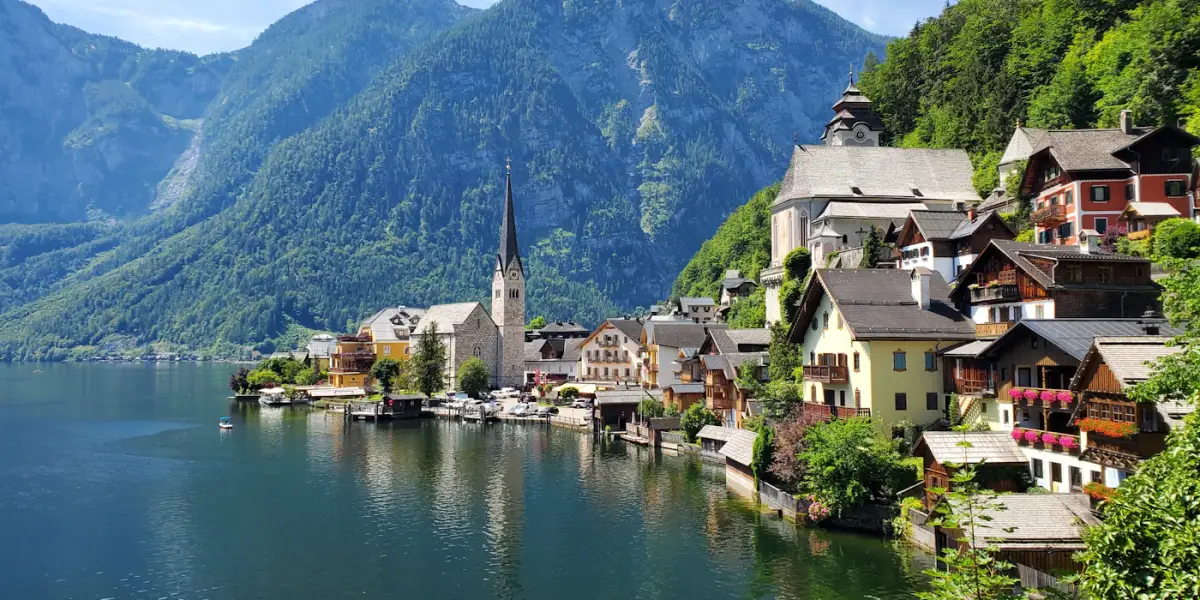
Hallstatt and Lake Hallstatt
HeritageA lakeside village below steep mountains, next to the world's oldest salt mine, with ice caves and lookouts nearby.
1–2 nightsabout 4 h by train from Vienna airportBest Jun–Sep
Hallstatt and Lake Hallstatt
HeritageA lakeside village below steep mountains, next to the world's oldest salt mine, with ice caves and lookouts nearby.
Hallstatt is a village of fewer than a thousand people squeezed between Lake Hallstatt and the mountainside, at the heart of the Hallstatt-Dachstein/Salzkammergut cultural landscape, a UNESCO World Heritage Site since 1997. Salt has been mined in the high valley above it since the Bronze Age, and an Iron Age culture, the Hallstatt period, is named after the village. Around a million visitors come each year, many for only a few hours, and the railway station is on the far shore, a short boat ride across the lake.
What to do in Hallstatt and Lake Hallstatt
- Salt mine and Skywalk. A funicular climbs to the high valley, where a viewing platform hangs about 200 m above the rooftops, and tours of the world's oldest salt mine include a mine train, miners' slides and an underground salt lake; it stays cool inside, so take a jacket.
- The bone house. In the charnel house beside the Catholic church, bones removed when graves were reused are stacked in rows, and many of the skulls are painted with flowers and the family name.
- 5fingers viewing platform. In summer, an easy walk of about 20 minutes from the upper station of the Krippenstein cable car, which starts in Obertraun, leads to a platform reaching out over a 400 m drop, with Hallstatt and the lake far below.
- Dachstein Giant Ice Cave. Open in the summer season, guided tours of about 50 minutes pass ice formations and the hall where cave bear bones were found; it is about -2 °C inside, so wear warm clothes and sturdy shoes.
- Lake Gosau. In Gosau, another of the World Heritage villages, a mostly flat path circles the front lake beneath the Dachstein in about 1 to 1.5 hours.
Austria Tourism rates June to September as the ideal time for a lakes-and-mountains trip, with the lakes warm enough for a dip and the trails open for hiking.
Sources: Dachstein Salzkammergut tourism board: Hallstatt, Dachstein Salzkammergut tourism board: Lake Gosau, Salzkammergut Tourism: Arrival, Salzwelten: Hallstatt salt mine and Skywalk, Dachstein Krippenstein: 5fingers, Dachstein Krippenstein: Dachstein Giant Ice Cave, Austria Tourism: Salzkammergut, Austria Tourism: UNESCO World Heritage Sites, Austria Tourism: Lakes and mountains, Wikivoyage: Hallstatt (checked 14 Oct)
Salzburg
CityMozart's baroque birthplace under a hilltop fortress, with Sound of Music sites and an ice-cave day trip.
2 nightsabout 3 h by train from Vienna airportBest Nov–Dec
Salzburg
CityMozart's baroque birthplace under a hilltop fortress, with Sound of Music sites and an ice-cave day trip.
Salzburg's old town lies between the Salzach river and the Mönchsberg and Festungsberg hills; in the 1600s its prince-archbishops reshaped it on Roman lines, its many churches earned it the nickname 'Rome of the North', and it joined UNESCO's World Heritage list in 1996. Mozart was born here in 1756, the city puts on the Salzburg Festival in summer, and the real Trapp family behind The Sound of Music lived here, with the film shot in and around the city.
What to do in Salzburg
- Hohensalzburg Fortress. Begun in 1077 and never taken by foreign troops, it is one of the biggest intact castles in Central Europe; walk up or take the funicular that has run since 1892 for a view over the domes and the river.
- Getreidegasse and Mozart's birthplace. The old town's main lane is hung with ornate metal guild signs, and No. 9, where Mozart was born, is a museum with his own violin and clavichord and a reconstructed 18th-century apartment.
- Mirabell Gardens. The baroque garden lines up on the cathedral and the fortress, and its Pegasus fountain and steps are where Maria and the children sing 'Do-Re-Mi' in The Sound of Music.
- Hellbrunn's trick fountains. An archbishop's summer palace from 1612–1615 on the city's southern side, where hidden jets still spray visitors at unexpected spots, which children in particular enjoy; the fountains run from early April to early November.
- Ice cave at Werfen. Eisriesenwelt in the Tennengebirge is the world's biggest ice cave, stretching more than 42 km; guided tours run from May to October, it is around 0 °C inside even in summer, and the route has many stairs.
From the end of November the Christkindlmarkt fills the squares by the cathedral and the Residenz, with more Advent markets at Hellbrunn, on Mirabell Square and up at the fortress.
Sources: Tourismus Salzburg: UNESCO World Heritage, Tourismus Salzburg: Hohensalzburg Fortress, Tourismus Salzburg: Getreidegasse, Tourismus Salzburg: Mozart's Birthplace, Tourismus Salzburg: Mirabell Palace and Gardens, Tourismus Salzburg: Hellbrunn Palace and Trick Fountains, Tourismus Salzburg: The Sound of Music, Tourismus Salzburg: Advent in Salzburg, Tourismus Salzburg: Ice caves in Werfen, Austria Tourism: Salzburg, Austria Tourism: Sights in Austria, ÖBB: Vienna to Salzburg by train, Wikivoyage: Salzburg, Wikivoyage: Hallstatt (checked 14 Oct)
Innsbruck
CityTyrol's capital: a medieval old town with the Golden Roof and cable cars up to 2,300 m from the city centre.
2 nightsabout 4 h 30 min by train from Vienna airport
Innsbruck
CityTyrol's capital: a medieval old town with the Golden Roof and cable cars up to 2,300 m from the city centre.
Innsbruck, the capital of Tyrol, sits in the Inn valley with the rock walls of the Nordkette rising straight behind its colourful old-town houses. Emperor Maximilian I moved his court here in the 1490s, the city hosted the Winter Olympics in 1964 and 1976, and a dozen ski areas lie around it, so it works as a base in summer and winter alike.
What to do in Innsbruck
- The Golden Roof and the old town. The balcony roof built by Emperor Maximilian I shines with 2,657 gilded copper tiles above Herzog-Friedrich-Strasse, in the middle of the medieval lanes.
- Up the Nordkette. The Hungerburg funicular climbs from the city centre and the Nordkette cable cars carry on towards the Top of Innsbruck viewpoint at 2,334 m, the last stretch on foot, with the city spread out below.
- Bergisel ski jump. Zaha Hadid's tower replaced the jump used for the 1964 and 1976 Olympics; walk the 450 steps or ride the funicular to the top for the view over Innsbruck.
- Hofkirche and Ambras Castle. The court church holds Maximilian I's tomb monument, ringed by larger-than-life bronze figures, and Ambras Castle displays the 16th-century collection of curiosities that Austria Tourism calls the world's first museum.
- Swarovski Crystal Worlds. In Wattens, east of the city, André Heller's crystal-filled Chambers of Wonder lie underground behind a 17 m giant, opened in 1995 for the firm's 100th anniversary.
Sources: Austria Tourism: Innsbruck, Austria Tourism: Innsbruck in winter, Austria Tourism: Swarovski Crystal Worlds, ÖBB: Vienna to Innsbruck by train, ÖBB: Train connections in Austria, Wikivoyage: Innsbruck (checked 14 Oct)
Zell am See and Kaprun
Hill countryA lake town below the Schmittenhöhe, with summer snow on the Kitzsteinhorn glacier and the Grossglockner road nearby.
2–3 nightsabout 4 h 30 min by train from Vienna airportBest Jun–Sep
Zell am See and Kaprun
Hill countryA lake town below the Schmittenhöhe, with summer snow on the Kitzsteinhorn glacier and the Grossglockner road nearby.
Zell am See is a resort town on a peninsula in Lake Zell, with its own mountain, the Schmittenhöhe, rising behind it, and neighbouring Kaprun is the gateway to the Kitzsteinhorn, a 3,203 m glacier peak whose lifts run in summer and winter. Summer means swimming, boat trips and high-altitude walks; winter means three ski areas, and the glacier usually has skiing from October into early summer. The railway station is in the centre of Zell am See, with a few direct trains from Vienna.
What to do in Zell am See and Kaprun
- Kitzsteinhorn glacier. Cable cars from Kaprun reach Gipfelwelt 3000 and the Top of Salzburg platform at 3,029 m, with snow to play in even in high summer, a gallery inside the mountain and, on clear days, a view of the Grossglockner.
- Swim and sail on Lake Zell. Three lidos sit around the lake, which reaches about 23 °C in summer, and excursion boats cross between piers or circle the whole lake.
- Schmittenhöhe. Gondolas from town climb Zell's 1,965 m home mountain for walks with views over the lake and up to 30 peaks above 3,000 m; in winter it is a family ski area.
- Grossglockner High Alpine Road. The 48 km pass road starts at Fusch, about 25 minutes' drive away, and climbs through 36 hairpins to the Kaiser-Franz-Josefs-Höhe, facing Austria's highest mountain (3,798 m) and the Pasterze glacier; snow closes it from early November to early May.
- Kaprun's high mountain reservoirs. Buses and Europe's largest open inclined lift take you up to two turquoise reservoirs at over 2,000 m, with summer tours inside the 107 m Mooserboden dam wall.
Austria Tourism names June to September as the best months for mountain lakes, hiking and cycling in the Alps.
Sources: Zell am See-Kaprun Tourism: Zell am See, Zell am See-Kaprun Tourism: Kitzsteinhorn, Zell am See-Kaprun Tourism: Kitzsteinhorn in summer, Zell am See-Kaprun Tourism: Lidos, Zell am See-Kaprun Tourism: Boat trips, Zell am See-Kaprun Tourism: Schmittenhöhe, Zell am See-Kaprun Tourism: Grossglockner High Alpine Road, Zell am See-Kaprun Tourism: High mountain reservoirs, Zell am See-Kaprun Tourism: Arrival, Zell am See-Kaprun Tourism: Direct train services, Austria Tourism: Zell am See-Kaprun, Austria Tourism: Lakes and mountains, Tourismus Salzburg: Grossglockner High Alpine Road, Wikivoyage: Zell am See (checked 14 Oct)
St. Anton am Arlberg
Hill countryWhere Alpine skiing began: a ski village on the main railway line, in Austria's largest connected ski area.
3–5 nightsabout 5 h 30 min by train from Vienna airportBest Dec–Mar
St. Anton am Arlberg
Hill countryWhere Alpine skiing began: a ski village on the main railway line, in Austria's largest connected ski area.
St. Anton is a village on the Tyrol side of the Arlberg that calls itself the birthplace of Alpine skiing, and the world's first ski school opened here in 1922. It is part of Ski Arlberg, Austria's largest connected ski area, with more than 300 km of groomed runs; its name was made on steep and off-piste skiing, though ski schools take complete beginners. The village centre is a pedestrian zone and its railway station is served by long-distance trains, so you can arrive without a car.
What to do in St. Anton am Arlberg
- Ski the Arlberg. One lift pass covers more than 300 km of groomed pistes and about 200 km of off-piste runs, and the descents from the Schindlergrat and the 2,811 m Valluga are among the best known in the Alps.
- Learn where ski school began. Hannes Schneider started the world's first ski school here in 1922, and the village's schools still teach group and private classes for every age and level.
- Winter walks and tobogganing. Non-skiers have 17 winter and snowshoe walking routes, about 80 km in all, and a 4 km natural toboggan run.
- St. Anton museum. Villa Trier, built around 1910, tells the story of the first skiers, the Arlberg railway tunnel and the village's past.
- Summer hiking. Lifts run up towards the Valluga in summer and more than 400 km of marked trails head into the Verwall and Lechtal Alps; the Arlberg Trail crosses the region in three stages over 43 km.
Austria's ski season runs from early December to late March; mid-January usually has the best snow, while the Christmas to New Year week and February are the most crowded.
Sources: St. Anton am Arlberg Tourism: Skiing, St. Anton am Arlberg Tourism: Learning how to ski, St. Anton am Arlberg Tourism: Winter holidays in St. Anton, St. Anton am Arlberg Tourism: Hiking, Museum St. Anton am Arlberg, Austria Tourism: Arlberg, Austria Tourism: Sights in Austria, Wikivoyage: St. Anton, Wikivoyage: Winter sports in Austria (checked 14 Oct)
Graz
CityAustria's second city: a UNESCO-listed old town under the Schlossberg clock tower, farmers' markets and Styrian food.
1–2 nightsabout 3 h by train from Vienna airport
Graz
CityAustria's second city: a UNESCO-listed old town under the Schlossberg clock tower, farmers' markets and Styrian food.
Graz, the capital of Styria and Austria's second-largest city, has a red-roofed old town of Gothic churches, Renaissance courtyards and baroque houses that is a UNESCO World Heritage Site together with Eggenberg Palace. Modern buildings such as the Kunsthaus sit beside it, the city is a UNESCO City of Design, and Styrian farm produce, from pumpkin seed oil to runner beans, fills its markets. Trains from Vienna take about 2 hours 40 minutes over the Semmering line.
What to do in Graz
- Schlossberg and the Clock Tower. Climb the 260 steps, ride the funicular or take the lift inside the hill to the Clock Tower, whose bigger hand shows the hours, and come down by the underground slide.
- Eggenberg Palace. The Eggenberg family's baroque residence, begun in 1625, stands in grounds that became a landscape garden in the 1800s and was added to the city's UNESCO listing in 2010.
- Kunsthaus and the Murinsel. The Kunsthaus art museum, nicknamed 'the friendly alien', and the Murinsel, a shell-shaped platform floating on the Mur, are the city's best-known modern landmarks.
- Farmers' markets. Kaiser-Josef-Platz and Lendplatz, two of the biggest of the city's roughly 20 markets, sell farmhouse bread, apples, scarlet runner beans and pumpkin seed oil, with breakfast stalls and cafés around them.
- Ride the Semmering railway. Trains from Vienna cross the Semmering pass on a line built from 1848 in six years, on UNESCO's list since 1998 and described by Austria Tourism as the first high-mountain railway anywhere; sit on the left going south.
Sources: Austria Tourism: Graz, Austria Tourism: UNESCO World Heritage Sites, Graz Tourism: Graz in 24 hours, Graz Tourism: Farmers' markets, ÖBB: Vienna to Graz by train, ÖBB: Train connections in Austria, Wikivoyage: Graz (checked 14 Oct)
A first trip: 8–10 nights
- Vienna · 3–4n
- →Wachau valley (Melk and Dürnstein)
- →Hallstatt and Lake Hallstatt · 1–2n
- →Salzburg · 2n
- →Innsbruck · 2n
Land in Vienna and give a day to the Wachau's river, vineyards and abbey, then take the train west to Hallstatt (changing at Attnang-Puchheim), go on by bus via Bad Ischl to Salzburg, and finish in Innsbruck, which has direct trains back to Vienna airport. From June to September add Zell am See and Kaprun between Salzburg and Innsbruck for the lake and the glacier; from December to March swap in St. Anton for skiing, and from November the old towns fill with Christmas markets.
Getting around
Trains are the backbone. ÖBB trains leave Vienna for Salzburg twice an hour and fast Railjets run hourly to Innsbruck, trains to Graz run almost every half hour, and long-distance trains call at the station under Vienna airport, so Salzburg and Innsbruck can be reached from the airport without changing. Lake and mountain villages such as Hallstatt are reached by regional trains and buses from the main line, and the cities are easy to get around by tram, bus and, in Vienna, the U-Bahn.
Peak Shoulder Off-season
The Vienna Tourist Board describes cold winters around 0°C, warm to hot summers around 30°C and no rainy season, and says the city is worth visiting all year. Ratings here follow temperature, with December rated peak for the Advent markets rather than the weather.
Flights to Austria from India
Visa for Indian passports
Indian passport holders need a visa for Austria before travel. Allow about 40 days for a first-time application. Schengen visa via VFS; one visa covers the whole Schengen area.
Before you book, check the Ministry of External Affairs travel advisories for the latest guidance.
Austria: questions
What are the best places to visit in Austria?
Vienna: Habsburg palaces, the Ringstrasse, coffee houses and big art museums, about 20 minutes by train from the airport. Wachau valley (Melk and Dürnstein): Danube vineyards, the baroque abbey at Melk, Dürnstein's castle ruin and a river boat ride, as a day out from Vienna. Hallstatt and Lake Hallstatt: A lakeside village below steep mountains, next to the world's oldest salt mine, with ice caves and lookouts nearby. Salzburg: Mozart's baroque birthplace under a hilltop fortress, with Sound of Music sites and an ice-cave day trip. Innsbruck: Tyrol's capital: a medieval old town with the Golden Roof and cable cars up to 2,300 m from the city centre. Zell am See and Kaprun: A lake town below the Schmittenhöhe, with summer snow on the Kitzsteinhorn glacier and the Grossglockner road nearby. St. Anton am Arlberg: Where Alpine skiing began: a ski village on the main railway line, in Austria's largest connected ski area. Graz: Austria's second city: a UNESCO-listed old town under the Schlossberg clock tower, farmers' markets and Styrian food.
How many days do you need for Austria?
A first trip takes about 8–10 nights: Vienna (3–4 nights), Wachau valley (Melk and Dürnstein) (1 night), Hallstatt and Lake Hallstatt (1–2 nights), Salzburg (2 nights), Innsbruck (2 nights). Land in Vienna and give a day to the Wachau's river, vineyards and abbey, then take the train west to Hallstatt (changing at Attnang-Puchheim), go on by bus via Bad Ischl to Salzburg, and finish in Innsbruck, which has direct trains back to Vienna airport. From June to September add Zell am See and Kaprun between Salzburg and Innsbruck for the lake and the glacier; from December to March swap in St. Anton for skiing, and from November the old towns fill with Christmas markets.
What is the best time to visit Austria?
Peak season is May–Sep, Dec. The Vienna Tourist Board describes cold winters around 0°C, warm to hot summers around 30°C and no rainy season, and says the city is worth visiting all year. Ratings here follow temperature, with December rated peak for the Advent markets rather than the weather.
Do Indians need a visa for Austria?
Indian passport holders need a visa for Austria before travel. Allow about 40 days for a first-time application. Schengen visa via VFS; one visa covers the whole Schengen area.
How much is a flight to Austria from India?
The lowest return fare FlyBun has seen in the last 14 days is ₹42,599, Delhi to Vienna, for February 2027 departures. Fares change daily.
Places and things to do are written by FlyBun from official tourism, heritage and park sources, linked under each place, last checked 14 Oct. We leave out entry fees and opening hours because they change; check them before you go.
Watch a route and FlyBun alerts you free when its fare drops.