

Travel guide from India
Bali
Bali is a longer flight from India than Thailand or Sri Lanka, and its clocks run two and a half hours ahead of IST. It is a Hindu island in mostly Muslim Indonesia, and Indian visitors will recognise Vishnu, Shiva and the Ramayana in its temples and dances, though Balinese Hinduism has gone its own way and, unlike many Hindus in India, almost all Balinese eat meat. The south has the beaches and sunset temples, the centre has rice terraces, volcanoes and Ubud's arts, and fast boats run out to the islands offshore.
- Best time
- Jun–Sep
- First trip
- 5–6 nights
- Visa
- Visa on arrival, 30 days
- Return flights
- from ₹25,123 ●
- Chennai, checked in the last 48 h
Places to visit in Bali
14 places in the order you would meet them on a first trip. Tap one for what to do there.
Seminyak and Kuta
BeachThe beach base near the airport: Kuta for surf lessons and nightlife, Seminyak for spas, boutiques and sunsets.
2–3 nightsabout 30 min from Bali airportBest Jun–Sep
Seminyak and Kuta
BeachThe beach base near the airport: Kuta for surf lessons and nightlife, Seminyak for spas, boutiques and sunsets.
Kuta, Legian and Seminyak run together along one long beach on the south-west coast, just north of the airport. Kuta is the busy, cheaper end, with surf schools on the sand and the island's main party strip on Jalan Legian; Seminyak, further north, is quieter and more upmarket, known for its restaurants, spas and designer shops. Traffic along the strip is slow, so stay close to where you plan to spend your evenings.
What to do in Seminyak and Kuta
- Surf lesson on Kuta Beach. The long sandy beach has no rocks or coral close in, which makes it the usual place for beginners, and surf schools and beach instructors are everywhere.
- Sunset on Seminyak Beach. The grey-sand beach north of Legian is noticeably quieter than Kuta and known for its sunsets, watched from the sand or the beachfront bars.
- Pura Petitenget. A small beachside temple, there since at least the 16th century, that is one link in the chain of sea temples between Uluwatu and Tanah Lot and holds large ceremonies on the sand.
- Shopping on Jalan Laksmana. Seminyak's designer boutiques and small labels cluster on Jalan Laksmana, Petitenget Street and the main Seminyak road.
- Waterbom with children. One of the largest water parks in Asia is a short walk from Kuta Beach.
June to September is the driest, least humid stretch on the coast; at the peak of the wet season in December and January, runoff can wash rubbish onto the southern beaches.
Sources: Indonesia Travel: Seminyak, the truly best experiences, Indonesia Travel: Visiting Bali soon? Read this first, Bali Tourism Office: Pantai Kuta, Wikivoyage: Kuta, Wikivoyage: Seminyak, Wikivoyage: Bali (checked 14 Oct)
Tanah Lot
HeritageDay tripBali's best-known sea temple, on a rock in the surf, built for the sea god and busiest at sunset.
about 1 h 30 min from Bali airport
Tanah Lot
HeritageDay tripBali's best-known sea temple, on a rock in the surf, built for the sea god and busiest at sunset.
Tanah Lot is a temple on a rocky outcrop just off the Tabanan coast, north-west of Seminyak, said to have been founded in the 16th century by the Javanese priest Dang Hyang Nirartha and dedicated to the sea god Bhatara Segara. It is one of the most photographed sights on the island and the classic sunset trip from the southern beaches, so expect crowds and a long lane of souvenir stalls between the car park and the shore.
What to do in Tanah Lot
- Sunset from the cliff. A footpath leads to the raised cliff just south of the temple, the best place to watch the sun go down behind the rock.
- Cross to the rock at low tide. The temple can only be reached on foot when the tide is out; come early in the morning for a calmer visit without the sunset crowds.
- Pura Batu Bolong. A second sea temple on a jutting, hollowed-out rock nearby, described as Tanah Lot's twin, is one of several small temples around the site.
- Time it for the odalan. The temple's anniversary comes round every 210 days near Galungan and Kuningan, when lines of women carry offerings on their heads to the rock.
- Coconut on the cliff top. The cliff-top cafés are better for a chilled young coconut and the view than for a full meal.
Sources: Indonesia Travel: Tanah Lot, Indonesia Travel: 11 must-visit temples in Bali, Indonesia Travel: 24 hours guide for first-timers in Bali, Wikivoyage: Tanah Lot (checked 14 Oct)
Uluwatu and the Bukit
HeritageDay tripCliff-top temple with a sunset Kecak dance of the Ramayana, white-sand coves below and seafood suppers at Jimbaran.
about 1 h from Bali airportBest Jun–Sep
Uluwatu and the Bukit
HeritageDay tripCliff-top temple with a sunset Kecak dance of the Ramayana, white-sand coves below and seafood suppers at Jimbaran.
The Bukit is the dry limestone peninsula at Bali's southern tip, beyond the airport. Its best-known sight is Pura Luhur Uluwatu, one of the island's key directional temples, on a cliff about 70 m above the Indian Ocean, where the Kecak dance retells the Ramayana at sunset. Below the cliffs are small white-sand beaches and the island's best surf breaks, and Jimbaran Bay, on the way back north, is known for grilled seafood on the sand.
What to do in Uluwatu and the Bukit
- Kecak at Uluwatu temple. A chorus of men chanting 'cak' around a fire carries the story of Rama, Sita, Hanuman and Ravana as the sun sets over the sea.
- Watch the monkeys. Macaques in the temple woods snatch sunglasses and phones; a sarong and sash are needed to enter and are lent at the gate, and the inner sanctum is open only to Hindu worshippers.
- Garuda Wisnu Kencana. A cultural park dominated by a 121 m statue of Vishnu riding Garuda, visible across the south, with Balinese dance shows; go in the cooler late afternoon.
- Pandawa Beach. A white-sand beach reached by a road cut through high cliffs, with statues of the five Pandava brothers of the Mahabharata set into the rock along the way down.
- Seafood on Jimbaran Bay. Grilled-seafood restaurants in three clusters set their tables on the sand of this sheltered, swimmable bay in time for sunset.
June to September is the driest stretch, and the Bukit gets far less rain than the rest of Bali, so it often stays sunny even in the wet months.
Sources: Indonesia Travel: The dramatic Kecak dance, Indonesia Travel: Pura Luhur Uluwatu (Indonesian), Indonesia Travel: 11 must-visit temples in Bali, Bali Tourism Office: Pura Uluwatu, Bali Tourism Office: Pantai Pandawa, Bali Tourism Office: Garuda Wisnu Kencana, Wikivoyage: Bukit Peninsula, Wikivoyage: Jimbaran, Wikivoyage: Bali (checked 14 Oct)
Nusa Penida
IslandDay tripA fast-boat day trip to towering sea cliffs, the T-rex headland at Kelingking and snorkelling with manta rays.
about 2 h by boat from Bali airportBest Apr–Oct
Nusa Penida
IslandDay tripA fast-boat day trip to towering sea cliffs, the T-rex headland at Kelingking and snorkelling with manta rays.
Nusa Penida is the largest of the three islands off Bali's south-east coast, a dry, hilly limestone island whose west and south sides are sheer cliffs with few beaches you can reach by land. Most visitors come for the day, crossing by fast boat from Sanur and touring by car or scooter. Roads are rough and several beach paths are steep and risky, so pick a few sights rather than trying to see them all.
What to do in Nusa Penida
- Kelingking viewpoint. The headland shaped like a T-rex is the island's signature view; the path down to the beach is a steep, rough cliff descent meant only for the fit.
- Broken Beach. A natural rock arch around a turquoise pool about 3 km north-west of Kelingking; stay out of the water at high tide, when waves break over the rim.
- Snorkel at Crystal Bay or Manta Point. Crystal Bay's clear water is good for snorkelling from the beach, and boat trips go out to Manta Point to swim with manta rays.
- Atuh and Diamond beaches. On the east coast, stairs lead down the cliffs to white-sand coves; Atuh is the first beach on the island to catch the morning sun.
- Goa Giri Putri cave temple. Hindu and Buddhist shrines fill a large limestone cave on the east coast, entered by a short climb from the road; a sarong is required.
Go in the dry season, April to October; the crossing is open sea, and bad weather can make it rough or stop the boats.
Sources: Indonesia Travel: Nusa Penida, beaches, harbour access and tips, Indonesia Travel: Kelingking Beach, Indonesia Travel: Nusa islands guide, Indonesia Travel: Sanur Beach, Wikivoyage: Nusa Penida (checked 14 Oct)
Ubud
HeritageBali's cultural centre: nightly dance, a sacred monkey forest, rice-field walks and plenty of vegetarian cafés.
3 nightsabout 1 h 30 min from Bali airportBest Apr–Sep
Ubud
HeritageBali's cultural centre: nightly dance, a sacred monkey forest, rice-field walks and plenty of vegetarian cafés.
Ubud, in the foothills of central Bali, is the island's centre of painting, dance and crafts, a cluster of villages spread over river gorges and rice fields around the old royal palace. Its name comes from ubad, Balinese for medicine, after the healing plants that once grew here. It is cooler than the coast and its main streets are jammed with traffic, but a few minutes' walk off them brings you to paddies and quiet lanes.
What to do in Ubud
- Sacred Monkey Forest. Some 700 long-tailed macaques live among the forest temples at the south end of Jalan Monkey Forest; carry no food and keep a grip on bags and sunglasses.
- Dance at the royal palace. Traditional dances are staged almost every night at Puri Saren, the old palace in the centre, and Kecak versions of the Ramayana run at Pura Dalem.
- Pura Taman Saraswati. A water temple in the middle of town dedicated to Saraswati, goddess of learning and the arts, approached past a pond of pink lotuses.
- Rice-field walks. The Campuhan ridge path and the quieter Sweet Orange and Kajeng walks start close to the centre and are best early, before the heat.
- Eat vegetarian. Ubud is full of vegetarian and vegan cafés; elsewhere, assume local dishes and sambal contain meat or shrimp paste unless you are told otherwise.
Showers can come in any month in the hills, but April to September is the drier half of the year; January and February, the depth of the wet season, are the months to avoid.
Sources: Indonesia Travel: Find serenity in Ubud, Indonesia Travel: The dramatic Kecak dance, Indonesia Travel: 24 hours guide for first-timers in Bali, Wikivoyage: Ubud, Wikivoyage: Bali (dietary restrictions) (checked 14 Oct)
Tegallalang and Tirta Empul
HeritageDay tripUbud's classic day out: terraced rice valleys, the holy spring pools of Tirta Empul and cliff-cut royal shrines.
1 h 30 min from Bali airport
Tegallalang and Tirta Empul
HeritageDay tripUbud's classic day out: terraced rice valleys, the holy spring pools of Tirta Empul and cliff-cut royal shrines.
North and east of Ubud the land rises into the terraced rice valleys of Tegallalang and on towards Tampaksiring, home to sacred sites around a thousand years old. Tirta Empul is a spring temple dedicated to Vishnu, whose springs legend says Indra struck from the ground, and Gunung Kawi has 11th-century royal shrines carved into a river cliff. The terraces are watered by subak, the island's old system of farmers' co-operatives that share water through temple rituals.
What to do in Tegallalang and Tirta Empul
- Walk down into Tegallalang. About 20 minutes' drive north of Ubud; go early and cross the stream into the terraces rather than only looking from the road, allowing 30 minutes to an hour and a half.
- Bathe at Tirta Empul. Visitors may join the melukat purification, wading in a rented sarong along the rows of stone spouts; two spouts are kept for cleansing the dead and are not used by the living.
- Gunung Kawi. Eleventh-century shrines cut into the walls of a river valley, thought to honour King Anak Wungsu, reached down 371 steps through rice fields.
- Goa Gajah. The 9th-century Elephant Cave, about 15 minutes from Ubud, has a carved demon-mouth entrance, a Ganesha statue inside and old bathing pools in front.
- Look for the subak. Indonesia Travel traces the irrigation system to the sage Rsi Markandeya in the 8th century, and the water temples hold festivals timed to the rice-growing cycle.
Sources: Indonesia Travel: Tegallalang Rice Terrace, Indonesia Travel: A guide to the holy springs of Tirta Empul, Indonesia Travel: 11 must-visit temples in Bali, Indonesia Travel: The amazing Jatiluwih rice terraces (subak), Bali Tourism Office: Goa Gajah (Elephant Cave) Temple, Bali Tourism Office: Gunung Kawi Temple, Wikivoyage: Ubud (checked 14 Oct)
Mount Batur and Kintamani
Hill countryDay tripA pre-dawn climb up an active volcano for sunrise over Lake Batur, with Mount Agung on the skyline.
about 2 h 30 min from Bali airportBest May–Sep
Mount Batur and Kintamani
Hill countryDay tripA pre-dawn climb up an active volcano for sunrise over Lake Batur, with Mount Agung on the skyline.
Kintamani is the highland area on the edge of the vast Batur caldera, some 1,500 m above the sea, looking across to the active cone of Mount Batur (1,717 m) and the crescent of Lake Batur below it. The usual visit is a guided pre-dawn climb of about two hours to watch the sun come up behind Mount Agung, then a soak in the hot springs by the lake. Few visitors stay up here; most are driven up from Ubud or the south in the small hours and come back down the same day.
What to do in Mount Batur and Kintamani
- Sunrise climb. Climbs are made with a local guide; the trail from Toya Bungkah is shadier than the one across the lava fields from Pura Jati, and it is cold on top before dawn, so bring a warm jacket.
- Pura Ulun Danu Batur. Bali's second most important temple after Besakih, honouring Vishnu and the lake goddess Dewi Danu, rebuilt on the caldera rim after a 1926 eruption destroyed the old site below.
- Penelokan viewpoint. The roadside on the caldera rim, whose name means 'place to look', takes in the volcano, the lake and the black lava flows in a single view.
- Hot springs at Toya Bungkah. Lakeside hot-spring pools at the foot of the climb are the usual place to warm up and rest afterwards.
- Penglipuran village. On the way up through Bangli, this traditional village of bamboo-roofed houses along a wide, tidy street is a common stop.
Clear skies are likeliest from May to September, with July and August the steadiest for sunrise; Wikivoyage advises against climbing in the wettest months, December to February, when the paths get slippery.
Sources: Indonesia Travel: 7 Kintamani tourist attractions, Indonesia Travel: A refreshing hot drink at Kintamani, Bali Tourism Office: Gunung Batur, Bali Tourism Office: Pura Batur, Wikivoyage: Kintamani (checked 14 Oct)
Canggu
BeachSurf beaches backed by rice fields north of Seminyak, with cafés, beach clubs and Tanah Lot close by.
2–3 nights45 min from Bali airportBest Jun–Sep
Canggu
BeachSurf beaches backed by rice fields north of Seminyak, with cafés, beach clubs and Tanah Lot close by.
Canggu is the 8 km stretch of coast north of Seminyak, from Berawa past Batu Bolong and Echo Beach to Pererenan, where rice paddies still run almost down to the black-sand beaches. Until about 2010 it was mostly farmland; now its lanes are lined with villas, cafés and beach clubs popular with surfers and long-stay remote workers, and the traffic is bad. The beaches are better for surfing and sunsets than for swimming.
What to do in Canggu
- Learn to surf at Berawa. Berawa's mellow waves break along a long beach and suit beginners, while Echo Beach, further up the coast, has reef breaks for experienced surfers.
- Sunset at Batu Bolong. The beach below the cliff-top Pura Batu Bolong is lined with cafés and surfboard rentals and is the area's main gathering point at sunset.
- Cycle the rice-field lanes. Away from the beach Canggu is still partly rural, and guesthouses rent bicycles for exploring the paddies and village life; watch out for cars.
- Beach clubs and cafés. Beachfront clubs with pools and music fill up for sunset, and the cafés are known for vegan smoothie bowls.
- Evening at Tanah Lot. The sea temple is about 25 minutes' drive north, close enough for a sunset visit.
June to September is the driest, least humid stretch on the coast; in December and January, the wettest months, runoff can wash rubbish onto the south-west beaches.
Sources: Indonesia Travel: Canggu Beach, Indonesia Travel: Reasons why Canggu is the best choice for a short trip, Indonesia Travel: Pantai Batu Bolong (Indonesian), Indonesia Travel: Echo Beach Canggu (Indonesian), Indonesia Travel: Pantai Canggu (Indonesian), Wikivoyage: Canggu, Wikivoyage: Bali (checked 14 Oct)
Nusa Dua
BeachGated resort enclave with calm white-sand beaches, a long seafront path and water sports at Tanjung Benoa.
2–3 nightsabout 30 min from Bali airportBest Jun–Sep
Nusa Dua
BeachGated resort enclave with calm white-sand beaches, a long seafront path and water sports at Tanjung Benoa.
Nusa Dua is a purpose-built enclave of large beach resorts on the east side of the Bukit peninsula, laid out from 1974 behind security gates and about half an hour from the airport. Its white-sand beaches are long and safe for swimming, which makes it a common choice for families who want a quiet resort stay, though it feels less Balinese than the rest of the island.
What to do in Nusa Dua
- Seafront walk. A paved path runs about 7 km along the beach from the south of the enclave to the Tanjung Benoa spit, best in the early morning.
- Water sports at Tanjung Benoa. Parasailing, jet skis and banana boats are booked on the beach or through hotels; to see turtles, go to the government-run centre on Serangan rather than the 'Turtle Island' boat trips sold here.
- Pura Nusa Dharma. Nusa Dua means 'two islands', after the two small headlands off the coast, one of which carries this Hindu shrine built in 1948.
- Geger beach and the Pasifika Museum. The public beach just west of the enclave keeps more local character, and the museum nearby shows art from Bali, Asia and the Pacific.
June to September is the driest stretch on the coast, and the Bukit peninsula gets far less rain than the rest of Bali year-round.
Sources: Indonesia Travel: Nusa Dua, Bali Tourism Office: Pantai Nusa Dua, Wikivoyage: Nusa Dua, Wikivoyage: Bali (Turtle Island scam) (checked 14 Oct)
Sanur
BeachCalm, quiet east-coast beach with a 5 km seafront path, sunrise walks and the boats to Nusa Penida.
2–3 nights40 min from Bali airportBest Jun–Sep
Sanur
BeachCalm, quiet east-coast beach with a 5 km seafront path, sunrise walks and the boats to Nusa Penida.
Sanur is a long-established, planned, low-key town on the east coast just outside Denpasar, where most hotels are large and set in spacious gardens. Its calm water and long paved seafront make it popular with older travellers and families, and because it faces east the day starts with sunrise over the sea. The harbour at the end of Jalan Matahari Terbit is where most boats to Nusa Penida and Nusa Lembongan leave.
What to do in Sanur
- Sunrise on the seafront path. A paved path runs about 5 km along the beach, shared by walkers and cyclists, and is at its best at sunrise; bicycles are rented all along it.
- Swim and snorkel. The sea off Sanur is calm enough for swimming, and snorkelling gear and canoes are rented on the beach.
- Pura Blanjong. The temple holds a stone pillar inscribed in the 10th century, one of the oldest written records on Bali.
- Mangrove boardwalks. Two boardwalks run through a 600-hectare mangrove forest south of town, an easy half-day with children.
- Day trips to the Nusa islands. Fast boats to Nusa Penida and Nusa Lembongan leave from Sanur harbour, so this is the handiest base for an island day.
June to September is the driest, least humid stretch on the coast; from December to March the west monsoon brings heavy showers, usually late in the day.
Sources: Indonesia Travel: Sanur Beach, Indonesia Travel: Visiting Bali soon? Read this first, Wikivoyage: Sanur, Wikivoyage: Nusa Penida, Wikivoyage: Bali (checked 14 Oct)
Bedugul and Jatiluwih
Hill countryDay tripCool lake highlands: the Ulun Danu Beratan water temple and Jatiluwih's UNESCO-listed rice terraces.
about 2 h from Bali airportBest Apr–Oct
Bedugul and Jatiluwih
Hill countryDay tripCool lake highlands: the Ulun Danu Beratan water temple and Jatiluwih's UNESCO-listed rice terraces.
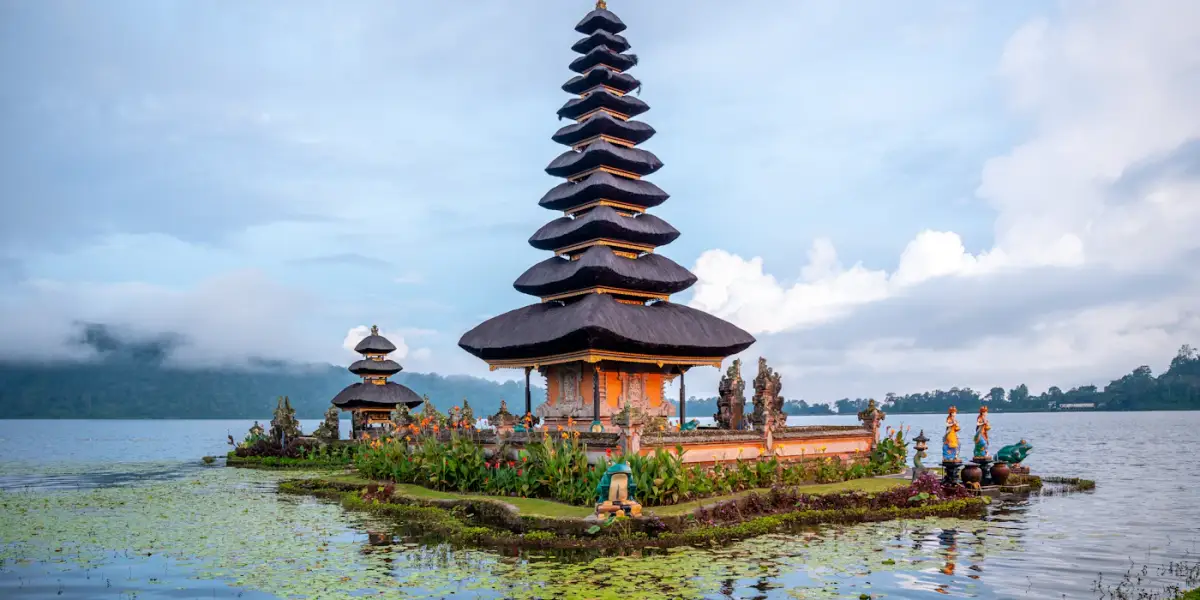
Bedugul is the cool, often misty highland around three crater lakes in the mountains of central Bali. Its landmark is Pura Ulun Danu Beratan, the lake temple whose eleven-tiered shrine seems to float on the water and which coordinates the irrigation of much of the island. The rice terraces of Jatiluwih, on the slopes of Mount Batukaru and part of Bali's UNESCO-listed subak landscape, fit into the same day.
What to do in Bedugul and Jatiluwih
- Pura Ulun Danu Beratan. Rebuilt in 1633 for the lake goddess Dewi Danu, with shrines to Shiva and Vishnu; come early, when mist hangs on the lake and the crowds are thin.
- Walk Jatiluwih's terraces. Trails run from a two-hour stroll to a full day's trek through terraces under Mount Batukaru, recognised by UNESCO in 2012 as part of Bali's subak landscape.
- Bali Botanic Garden. One of Indonesia's four official botanical gardens covers about 160 hectares at Candikuning, with self-guided walks and close to a hundred recorded bird species.
- Lakes Buyan and Tamblingan, and Munduk. West of Bedugul, the twin lakes and the hill village of Munduk, with its clove and coffee plantations and waterfalls, make a quieter add-on or an overnight stop.
Indonesia Travel recommends the dry season, April to October, for the highlands and the north; cloud and showers are possible in the mountains in any month.
Sources: Indonesia Travel: Ulun Danu Beratan, Indonesia Travel: The amazing Jatiluwih rice terraces, Indonesia Travel: Subak, UNESCO World Heritage, Indonesia Travel: North Bali itinerary, Indonesia Travel: Discover Buleleng, Indonesia Travel: 11 must-visit temples in Bali, Bali Tourism Office: Beratan Lake Temple, Wikivoyage: Bedugul (checked 14 Oct)
Lovina
BeachCalm black-sand beaches on the quiet north coast, dawn dolphin trips and Bali's largest Buddhist monastery.
2 nightsabout 3 h from Bali airportBest Apr–Oct
Lovina
BeachCalm black-sand beaches on the quiet north coast, dawn dolphin trips and Bali's largest Buddhist monastery.
Lovina is a string of seven fishing villages along about 10 km of Bali's north coast, west of Singaraja, centred on Kalibukbuk. Its narrow black-sand beaches face a calm sea that is safe for swimming, unlike the surf of the south, and outside the July and August peak it is one of the quietest parts of the island. It is about three hours by road from the airport, and many people break the drive at Bedugul or Kintamani.
What to do in Lovina
- Dolphin boats at dawn. Fishermen's outriggers leave the beach before sunrise to look for dolphins; pick a boatman who keeps a respectful distance, and expect plenty of other boats.
- Brahma Vihara Arama. Bali's largest Buddhist monastery, about 30 minutes from Lovina, has gold Buddhas, a replica of Borobudur and wide views, with Balinese carving throughout.
- Banjar hot springs. Warm, sulphur-rich water pours from carved stone dragon mouths into pools in a garden close to the monastery.
- Gitgit and Sekumpul waterfalls. North Bali has most of the island's waterfalls, Sekumpul a cluster of falls dropping through jungle; paths get slippery in the rainy season.
- Sunset from the pier. Locals and visitors gather on the main pier each evening to watch the sun go down.
The dry season, April to October, brings sunny weather and a calmer sea for the dolphin trips.
Sources: Indonesia Travel: Lovina Beach Bali, Indonesia Travel: North Bali itinerary, Indonesia Travel: Discover Buleleng, Bali Tourism Office: Pantai Lovina, Wikivoyage: Lovina (checked 14 Oct)
Besakih and the east Bali temples
HeritageDay tripThe Mother Temple on Mount Agung, Lempuyang's 'gateway to heaven' and the Tirta Gangga water palace.
about 2 h from Bali airportBest Apr–Oct
Besakih and the east Bali temples
HeritageDay tripThe Mother Temple on Mount Agung, Lempuyang's 'gateway to heaven' and the Tirta Gangga water palace.
East Bali is dominated by Mount Agung, at 3,142 m the island's highest and holiest volcano, which Balinese legend says was formed from a piece of Mount Meru. Pura Besakih, on its slopes at about 900 m, is the Mother Temple of Balinese Hinduism, mentioned in an inscription from 1007 AD, and further east are the mountain temples of Lempuyang and the royal water palace of Tirta Gangga. It makes a long day by car from Ubud or the south, so start early.
What to do in Besakih and the east Bali temples
- Pura Besakih. Temples climb the mountainside in terraces around Pura Penataran Agung, with the three main ones dedicated to the supreme god, Brahma and Vishnu; non-Hindus stay out of the inner courtyards, and expect pushy requests for donations and guides at the entrance.
- Gateway to heaven at Lempuyang. At the lowest of seven temples on Mount Lempuyang, a split gate frames Mount Agung on a clear morning.
- Tirta Gangga water palace. Built in 1946 by the king of Karangasem and named for water from the Ganges, it is a garden of pools, fountains and statues where you can bathe, set among some of Bali's most photographed rice terraces.
- Full moon and festival days. Pilgrims crowd Besakih at full moon and for its temple festivals, when parts of the complex close to visitors; avoid big ceremonies unless you are invited.
The dry season, April to October, is the time for Agung's slopes; January and February bring heavy rain and sometimes floods and landslides.
Sources: Indonesia Travel: Pura Besakih, the revered Mother Temple, Indonesia Travel: 11 must-visit temples in Bali, Bali Tourism Office: Besakih Temple, Bali Tourism Office: Lempuyang Temple, Wikivoyage: Mount Agung, Wikivoyage: Tirta Gangga, Wikivoyage: Bali (checked 14 Oct)
Gili Islands
IslandThree car-free islands off Lombok: snorkel with turtles, cycle the sandy lanes and choose between party and peace.
2–3 nightsabout 3 h 30 min by boat from Bali airportBest May–Oct
Gili Islands
IslandThree car-free islands off Lombok: snorkel with turtles, cycle the sandy lanes and choose between party and peace.
The Gilis are three small islands off the north-west coast of Lombok, Bali's eastern neighbour, reached from Bali by fast boat. Gili Trawangan, the largest, has most of the hotels and bars and a reputation as the party island; Gili Meno, the smallest, is the quietest; and Gili Air, closest to Lombok, has the largest local community. There are no cars or motorbikes on any of them, only bicycles and pony carts, and their reefs are known for green turtles.
What to do in Gili Islands
- Snorkel with turtles. Green turtles are often seen on the reefs, some within swimming distance of the beach; hire gear by the shore or join a boat trip that stops at all three islands.
- Cycle round Gili Trawangan. The island takes about an hour to circle by bike, with pony carts the only other transport; stop on the west coast at dusk to watch the sun set behind Bali's Mount Agung.
- Night market on Trawangan. Stalls in front of the boat pier serve grilled fish, satay and rice dishes every evening.
- Island-hop by public boat. Shared boats link the three islands; never try to swim between them, because the currents are fierce and people have drowned.
- Respect island customs. Many islanders are Muslim, so cover up away from the beach, and ignore the drugs offered openly on Trawangan: Indonesian penalties are extremely harsh.
Rain falls mainly from November to April, much less than on Bali; July and August and December and January are the busiest months.
Sources: Indonesia Travel: Gili Trawangan and the Gilis, Indonesia Travel: Follow the action on Gili Trawangan, Indonesia Travel: Gili Trawangan tours, snorkelling and how to get there, Indonesia Travel: Gili Meno, Wikivoyage: Gili Islands, Wikivoyage: Bali (getting to Lombok) (checked 14 Oct)
A first trip: 5–6 nights
- Seminyak and Kuta · 2–3n
- →Tanah Lot
- →Uluwatu and the Bukit
- →Nusa Penida
- →Ubud · 3n
- →Tegallalang and Tirta Empul
- →Mount Batur and Kintamani
Spend the first nights on the beach in Seminyak or Kuta, with a sunset at Tanah Lot, an evening at Uluwatu for the Kecak dance and a boat day to Nusa Penida from Sanur, then move up to Ubud for the rice terraces, the Tirta Empul spring and a pre-dawn Mount Batur climb before driving back to the airport. Surfers can swap the beach base for Canggu and families for Nusa Dua or Sanur, the Gili Islands or Lovina add a few slower days at the end, and from December to February rain can wash out the Batur climb, while bad weather can cancel boat crossings in any season, so keep a spare day.
Getting around
Many first-time visitors hire a car with a driver by the day, which Wikivoyage calls the best option for a first visit, and use Grab or Gojek for short hops in the south, though local taxi drivers try to keep ride-hailing out of places such as Canggu, Jimbaran and Uluwatu. Traffic around Kuta, Seminyak, Denpasar and Ubud is heavy and temple processions sometimes fill the whole road, so group sights by area and leave slack in the day. Nusa Penida is a 30 to 45 minute fast-boat crossing from Sanur on the east coast, and fast boats to the Gili Islands leave from Serangan and Padang Bai.
When to go
Bali month by month: weather and fares →Peak Shoulder Off-season
Indonesia's tourism board puts the dry season at April to October and the wet season at November to March for Java and Bali. The climate table shows rain on 24-27 days a month from December to March and under ten days a month from June to September; July and August are also the European and Australian holiday crush, so prices peak then.
Flights to Bali from India
Visa for Indian passports
Indian passport holders can get a visa on arrival in Indonesia for up to 30 days. IDR 500,000 on arrival, extendable once. Buy the e-VOA online beforehand to skip queues.
Before you book, check the Ministry of External Affairs travel advisories for the latest guidance.
Bali: questions
What are the best places to visit in Bali?
Seminyak and Kuta: The beach base near the airport: Kuta for surf lessons and nightlife, Seminyak for spas, boutiques and sunsets. Tanah Lot: Bali's best-known sea temple, on a rock in the surf, built for the sea god and busiest at sunset. Uluwatu and the Bukit: Cliff-top temple with a sunset Kecak dance of the Ramayana, white-sand coves below and seafood suppers at Jimbaran. Nusa Penida: A fast-boat day trip to towering sea cliffs, the T-rex headland at Kelingking and snorkelling with manta rays. Ubud: Bali's cultural centre: nightly dance, a sacred monkey forest, rice-field walks and plenty of vegetarian cafés. Tegallalang and Tirta Empul: Ubud's classic day out: terraced rice valleys, the holy spring pools of Tirta Empul and cliff-cut royal shrines. Mount Batur and Kintamani: A pre-dawn climb up an active volcano for sunrise over Lake Batur, with Mount Agung on the skyline. Canggu: Surf beaches backed by rice fields north of Seminyak, with cafés, beach clubs and Tanah Lot close by. Nusa Dua: Gated resort enclave with calm white-sand beaches, a long seafront path and water sports at Tanjung Benoa. Sanur: Calm, quiet east-coast beach with a 5 km seafront path, sunrise walks and the boats to Nusa Penida. Bedugul and Jatiluwih: Cool lake highlands: the Ulun Danu Beratan water temple and Jatiluwih's UNESCO-listed rice terraces. Lovina: Calm black-sand beaches on the quiet north coast, dawn dolphin trips and Bali's largest Buddhist monastery. Besakih and the east Bali temples: The Mother Temple on Mount Agung, Lempuyang's 'gateway to heaven' and the Tirta Gangga water palace. Gili Islands: Three car-free islands off Lombok: snorkel with turtles, cycle the sandy lanes and choose between party and peace.
How many days do you need for Bali?
A first trip takes about 5–6 nights: Seminyak and Kuta (2–3 nights), Tanah Lot (1 night), Uluwatu and the Bukit (1 night), Nusa Penida (1 night), Ubud (3 nights), Tegallalang and Tirta Empul (1 night), Mount Batur and Kintamani (1 night). Spend the first nights on the beach in Seminyak or Kuta, with a sunset at Tanah Lot, an evening at Uluwatu for the Kecak dance and a boat day to Nusa Penida from Sanur, then move up to Ubud for the rice terraces, the Tirta Empul spring and a pre-dawn Mount Batur climb before driving back to the airport. Surfers can swap the beach base for Canggu and families for Nusa Dua or Sanur, the Gili Islands or Lovina add a few slower days at the end, and from December to February rain can wash out the Batur climb, while bad weather can cancel boat crossings in any season, so keep a spare day.
What is the best time to visit Bali?
Peak season is Jun–Sep. Indonesia's tourism board puts the dry season at April to October and the wet season at November to March for Java and Bali. The climate table shows rain on 24-27 days a month from December to March and under ten days a month from June to September; July and August are also the European and Australian holiday crush, so prices peak then.
Do Indians need a visa for Indonesia?
Indian passport holders can get a visa on arrival in Indonesia for up to 30 days. IDR 500,000 on arrival, extendable once. Buy the e-VOA online beforehand to skip queues.
How much is a flight to Bali from India?
The lowest return fare FlyBun has seen in the last 14 days is ₹24,705, Chennai to Bali, for April 2027 departures. Fares change daily.
Places and things to do are written by FlyBun from official tourism, heritage and park sources, linked under each place, last checked 14 Oct. We leave out entry fees and opening hours because they change; check them before you go.
Watch a route and FlyBun alerts you free when its fare drops.