

Travel guide from India
Belgium
Belgium is a small country in western Europe, a long-haul flight from India, bordered by France, the Netherlands, Germany and Luxembourg, with a coastline on the North Sea. Dutch-speaking Flanders in the north holds the old trading cities of Bruges, Ghent and Antwerp, French-speaking Wallonia in the south has the wooded hills of the Ardennes, and Brussels, the capital, hosts the headquarters of the European Union. Vegetarians do fine: many ordinary Brussels restaurants have at least one vegetarian dish, and Ghent's tourist board calls its city Europe's veggie capital.
- Best time
- May–Sep
- First trip
- 7–9 nights
- Visa
- Visa needed, 90 days
- Return flights
- from ₹46,624 ●
- Delhi, checked in the last 48 h
Places to visit in Belgium
8 places in the order you would meet them on a first trip. Tap one for what to do there.
Brussels
CityThe capital: the UNESCO-listed Grand-Place, the Atomium, the EU quarter, comic-strip murals, chocolate and waffles.
2–3 nights20 min by train from Brussels airportBest May–Jun
Brussels
CityThe capital: the UNESCO-listed Grand-Place, the Atomium, the EU quarter, comic-strip murals, chocolate and waffles.
Brussels is Belgium's capital and hosts NATO's headquarters and the main EU institutions; it is officially bilingual, so street and station names come in French and Dutch, and English gets you by in the tourist areas. From the small old centre around the Grand-Place the city climbs to the Royal Quarter and the museums of the Mont des Arts, and spreads east to the European Quarter. The airport train reaches the city in about 20 minutes.
What to do in Brussels
- Grand-Place. UNESCO lists the whole square, ringed by guild houses with gilded carvings, the flamboyant Gothic town hall with its tall tower and the Maison du Roi, which houses the Brussels City Museum.
- Manneken Pis and the Royal Galleries. A Manneken Pis has adorned a public fountain here since the 15th century, but the statue you see is a copy, as the original, stolen several times, is kept in the City Museum; close by, the covered Royal Galleries are where the filled chocolate called the praline was invented in 1912.
- Atomium and Mini-Europe. Built for the 1958 World's Fair, the 102 m Atomium's nine spheres model an iron crystal enlarged 165 billion times, with exhibitions inside and a view from the top sphere; a short walk away, Mini-Europe has scale models of some 350 European landmarks.
- The European Quarter. Learn how the EU works at the Parlamentarium beside the European Parliament and the House of European History in Leopold Park, then walk on to the Cinquantenaire arch, built for Belgium's 50th anniversary, whose roof gives a view over the city.
- Comic heroes on the walls. Since 1991, murals of comic heroes such as Tintin and Blake and Mortimer have spread across the city's walls, so a mural hunt suits children, with fries eaten with your fingers and waffles on the way.
May is often the month Brussels locals like best, with frequent sun and the first properly warm days, and June is similar, with daytime highs usually above 20°C.
Sources: Visit Brussels: Must-see attractions in Brussels, Visit Brussels: How to get to Brussels, Visit Brussels: The European Quarter, Visit Brussels: Brussels with the family, Visit Brussels: Brussels' culinary specialities, VISITFLANDERS: 48 hours in bustling Brussels, VISITFLANDERS: Travelling to, in and around Flanders, Wikivoyage: Brussels, Wikivoyage: Belgium (checked 14 Oct)
Waterloo
HeritageDay tripThe battlefield where Napoleon met his final defeat in 1815, with a lion-topped mound, a painted panorama and a museum.
about 1 h from Brussels airport
Waterloo
HeritageDay tripThe battlefield where Napoleon met his final defeat in 1815, with a lion-topped mound, a painted panorama and a museum.
On the fields near Waterloo, about 20 minutes from Brussels, Wellington's allied army and Blücher's Prussians beat Napoleon on 18 June 1815, ending his reign and more than two decades of war across Europe. The battlefield estate brings together a museum, a hill crowned by a lion, a painted panorama and a farm that saw some of the hardest fighting, and a full visit takes half a day or longer. Without a car, take a train to Braine-l'Alleud and a local bus to the site.
What to do in Waterloo
- Climb the Lion's Mound. 226 steps lead up the mound raised in the 1820s where the Prince of Orange is said to have been wounded, and an orientation table at the top helps you read the troop positions across the fields.
- Memorial 1815. The visitor centre's exhibition spreads over more than 2,000 m², with uniforms, a 33 m² model of the battlefield, a treasure hunt and a 4D film.
- The Panorama. A circular painting 110 m long and 12 m high wraps around you inside a building from 1912 and puts you in the middle of the fighting of 18 June.
- Hougoumont Farm. Meant as a French diversion against the allied right wing, the farm became the scene of the battle's most violent fighting; today it has four museum rooms and a video show.
Sources: Domain of the Battle of Waterloo 1815: Home, Domain of the Battle of Waterloo 1815: History of the site, Domain of the Battle of Waterloo 1815: The Lion's Mound, Domain of the Battle of Waterloo 1815: The Memorial 1815, Domain of the Battle of Waterloo 1815: Panorama, Domain of the Battle of Waterloo 1815: Hougoumont Farm, Domain of the Battle of Waterloo 1815: Practical information, Wikivoyage: Waterloo (checked 14 Oct)
Bruges
HeritageCanals, a belfry over the market square and a whole medieval centre on UNESCO's list, plus Flemish Primitive art.
2 nightsabout 1 h 30 min by train from Brussels airport
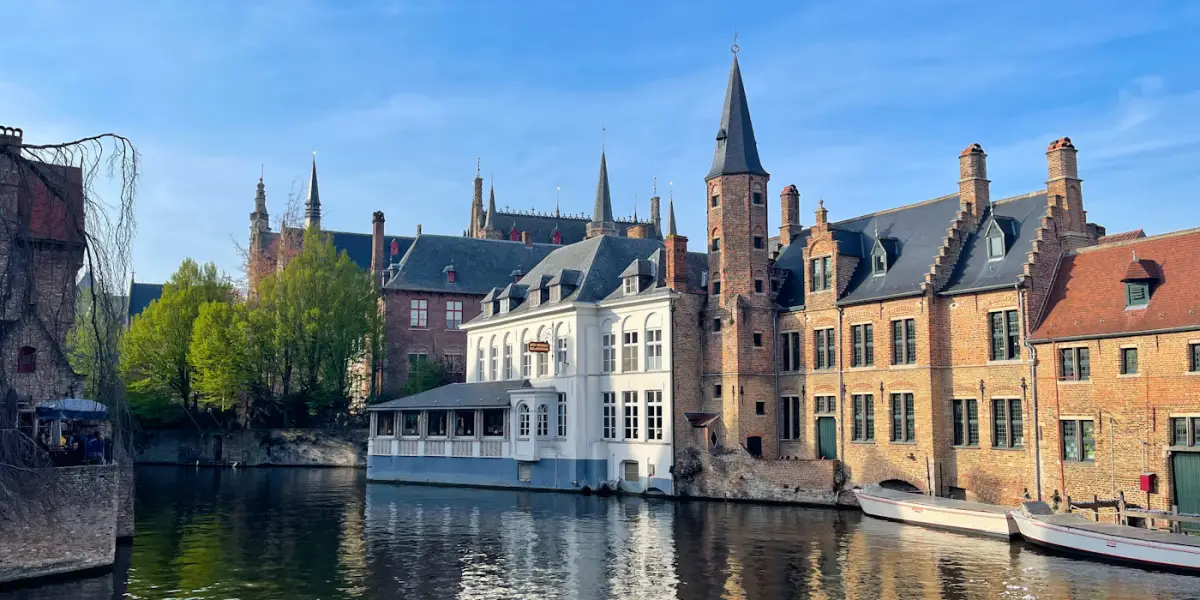
Bruges
HeritageCanals, a belfry over the market square and a whole medieval centre on UNESCO's list, plus Flemish Primitive art.
Bruges grew rich as one of medieval Europe's great trading cities and reached its peak in the 15th century, and so much of that town survived that UNESCO lists its entire historic centre. Canals, cobbled lanes and old brick houses fill a compact core about an hour from Brussels by train. The Markt and Burg squares get very crowded, so wander the quieter streets beyond them, and take a taxi from the station if you have a wheeled suitcase.
What to do in Bruges
- Climb the Belfry. 366 steps take you up the 83 m tower over the Markt, past the old treasury of city charters and the room where the carillonneur plays 47 bells, to a view across the city.
- Canal boat trip. Half-hour trips leave from five landing stages in the centre and all take one route, from Jan van Eyck Square to the Beguinage, passing the Rosary Quay and its view of the Belfry.
- The Burg and the Holy Blood. On the square that was the seat of city power for centuries stand the 14th-century city hall and the 12th-century Basilica of the Holy Blood, whose relic the Count of Flanders is said to have brought back from the Second Crusade.
- Michelangelo and the Flemish Primitives. The Church of Our Lady, whose tower is the city's tallest, holds Michelangelo's marble Madonna and Child, and the Groeninge Museum shows Jan van Eyck and Hans Memling, painters who worked here in the city's golden age.
- Beguinage and the Minnewater. Founded in 1245 and on UNESCO's list with other Flemish beguinages, its white houses around a garden lead on to the Minnewater, the 'Lake of Love', and its park.
Sources: Visit Bruges: Bruges, UNESCO World Heritage City, Visit Bruges: Belfort (Belfry) of Bruges, Visit Bruges: Bruges by boat, VISITFLANDERS: 48 hours in Bruges, a medieval romance, Wikivoyage: Bruges, Wikivoyage: Belgium (checked 14 Oct)
Ghent
CityA student city on two rivers, with its famous three towers, the Ghent Altarpiece and plenty of vegetarian food.
1–2 nightsabout 1 h by train from Brussels airport
Ghent
CityA student city on two rivers, with its famous three towers, the Ghent Altarpiece and plenty of vegetarian food.
Ghent stands where the Scheldt and the Leie meet, on the railway between Brussels and Bruges about half an hour from the capital, and direct trains also run to Brussels Airport. Thousands of students keep its medieval centre lively, and much of that centre is closed to cars. From the main station, Gent-Sint-Pieters, tram 1 reaches the Korenmarkt in about ten minutes.
What to do in Ghent
- Three towers and the Ghent Altarpiece. St Nicholas' Church, the Belfry and St Bavo's Cathedral make up the skyline, and the cathedral holds the van Eyck brothers' Adoration of the Mystic Lamb, unveiled in 1432, with augmented-reality glasses in the crypt to tell its story.
- View from St Michael's Bridge. Look along the Leie to the Graslei, the medieval harbour front, where a guildhall, a toll house and the grain weighers' house line the river.
- Castle of the Counts. Count Philip of Alsace modelled this castle on fortresses he had seen on crusade; later a court and a prison, it shows armour and weapons, its battlements give a view over the city, and the winding lanes of the old Patershol quarter lie around it.
- Ghent from the water. Guided boat trips on the rivers and canals show the old facades from a different angle, or you can rent a kayak or canoe and paddle the waterways yourself.
- Eat veggie. The city's campaign to skip meat and fish one day a week, Thursday Veggieday, grew into a wide choice of vegetarian and plant-based places; finish with cuberdons, purple cone-shaped sweets with a syrupy centre.
Sources: Visit Gent: Eat & drink, Visit Gent: Mystic Lamb, lights and delicacies, Visit Gent: Boat trips in Ghent, Visit Gent: Ghent specialties and sweets, Visit Gent: How to reach Ghent, VISITFLANDERS: 48 hours in Ghent, Europe's best-kept secret, Wikivoyage: Ghent (checked 14 Oct)
Antwerp
CityRubens' city: a cathedral hung with his paintings, a grand railway station, the diamond quarter, fashion and a big port.
2 nights35 min by train from Brussels airport
Antwerp
CityRubens' city: a cathedral hung with his paintings, a grand railway station, the diamond quarter, fashion and a big port.
Antwerp, Belgium's second-largest city, sits on the Scheldt and has one of the largest ports in Europe. It was home to the Baroque painter Peter Paul Rubens and, from the mid-1980s, to a famous group of fashion designers, and for centuries it has been one of the world's main diamond-trading centres, a business closely tied to India, where most diamonds are polished. Trains from Brussels Airport take about 35 minutes.
What to do in Antwerp
- Central Station and the diamond quarter. Known as the Railway Cathedral for its vaulted ceilings and grand hall, the 1905 station stands next to the Diamond Square Mile, where shop windows sparkle and rough stones leave for cutting and polishing in India and return as finished diamonds.
- Rubens in the cathedral. The Gothic Cathedral of Our Lady has a Baroque interior and four Rubens masterpieces, among them the triptychs of the Elevation of the Cross and the Descent from the Cross.
- Grote Markt and the Brabo fountain. In front of the UNESCO-listed Renaissance town hall, the fountain shows Brabo throwing the hand of the giant Antigoon into the Scheldt, the legend said to give Antwerp its name.
- MAS rooftop. In the Het Eilandje district by the Scheldt, the Museum aan de Stroom, the city museum, has a rooftop view over Antwerp that is best at sunset.
- The Jain temple in Wilrijk. In the Wilrijk district, a Jain temple beside the R11, worth seeing from outside, has become a city landmark, a striking exception among the mostly low-key prayer rooms of faiths that migrants from South Asia and beyond brought to Antwerp from the second half of the 20th century.
Sources: VISITFLANDERS: 48 hours in Antwerp, a grandiose experience, VISITFLANDERS: Travelling to, in and around Flanders, Antwerp World Diamond Centre: Antwerp diamond industry, Antwerp World Diamond Centre: Antwerp's diamond ties with India, City of Antwerp: Heilige huisjes, Open Monumentendag 2025, Wikivoyage: Antwerp (checked 14 Oct)
Leuven
CityDay tripA university town since 1425, with a richly carved Gothic town hall, a UNESCO-listed beguinage and a square of cafes.
about 30 min by train from Brussels airport
Leuven
CityDay tripA university town since 1425, with a richly carved Gothic town hall, a UNESCO-listed beguinage and a square of cafes.
Leuven, 25 km from Brussels and a short train ride from the airport, is shaped by its Catholic university, founded in 1425 and one of the oldest in Europe, which today has more than 50,000 students. The Oude Markt, lined with close to thirty cafes side by side, goes by the nickname 'the longest bar in Europe'. That closeness to the airport makes Leuven an easy last stop on the way to a flight home.
What to do in Leuven
- Town hall on the Grote Markt. Begun in 1439, the Brabantine Gothic town hall has 236 sculptures on its facade, so take time over the detail from the square.
- St Peter's Church. Across the square, the belfry of this 15th-century church is on UNESCO's list, and Dieric Bouts' Last Supper still hangs in the chapel it was painted for nearly 600 years ago.
- Great Beguinage. About 300 houses, a Gothic church and little bridges across the Dyle fill some three hectares in this UNESCO-listed enclave, where single women and widows once lived devout lives without taking vows.
- University Library tower. The neo-Renaissance library on Ladeuzeplein, rebuilt after damage in both world wars, has a tower with a panorama over the city.
- Kruidtuin. Laid out by the university for its medical students in 1738, Belgium's oldest botanical garden has a greenhouse of tropical and subtropical plants.
Sources: VISITFLANDERS: 48 hours in Leuven, VISITFLANDERS: Flemish destinations, Visit Leuven: Discover the highlights, Wikivoyage: Leuven, Wikivoyage: Belgium (checked 14 Oct)
Ypres (Ieper)
HeritageThe First World War town: the Menin Gate, with Indian soldiers among its names, the Last Post and war cemeteries.
1 nightabout 2 h 30 min by train from Brussels airport
Ypres (Ieper)
HeritageThe First World War town: the Menin Gate, with Indian soldiers among its names, the Last Post and war cemeteries.
Ypres, Ieper in Dutch, is a small town in Flanders that sat at the heart of the Ypres Salient, a front line of the First World War, and was in ruins by 1918; its great Cloth Hall was not fully rebuilt until the 1960s. Indian soldiers fought in the Salient from 1914, and many with no known grave are named on the Menin Gate alongside British, Canadian, Australian and South African dead. Train links are slow, so a night here works better than a rushed day trip.
What to do in Ypres (Ieper)
- Menin Gate. The memorial arch lists more than 54,000 missing soldiers of Australia, Canada, India, South Africa and the UK, among them Jemadar Kapur Singh of the 57th Wilde's Rifles, a 26-year-old Hindu officer who held his post to the end in 1914.
- The Last Post. The Last Post has been sounded under the gate almost every evening since 1928, apart from the Second World War, in tribute to the fallen, and anyone is welcome to attend quietly.
- In Flanders Fields Museum. In the rebuilt Cloth Hall, a poppy bracelet lets you follow four eyewitnesses of the war, with a separate route for children, and 231 more steps lead up the belfry for a view over the old battlefields.
- Tyne Cot Cemetery. Just outside town at Zonnebeke, the largest Commonwealth cemetery in the world has a long wall at the back carved with the names of still more missing soldiers.
- Walk or cycle the Salient. Trails trace the old front line from three starting points, the nearest at the Hooge Crater museum; the Menin Gate and Tyne Cot are among 27 Flemish war memorial sites on UNESCO's list.
Sources: VISITFLANDERS: 48 hours in Ypres, VISITFLANDERS: Behind the names on the Menin Gate, VISITFLANDERS: 27 WWI memorial sites in Flanders Fields recognised as UNESCO World Heritage, Commonwealth War Graves Commission: The history, design and unveiling of the Menin Gate, Commonwealth War Graves Commission: The Menin Gate Memorial restoration, Wikivoyage: Ypres (checked 14 Oct)
Dinant and the Meuse valley
HeritageDay tripA riverside town below a clifftop citadel, birthplace of the saxophone's inventor, at the gateway to the Ardennes.
about 2 h by train from Brussels airport
Dinant and the Meuse valley
HeritageDay tripA riverside town below a clifftop citadel, birthplace of the saxophone's inventor, at the gateway to the Ardennes.
Dinant, in French-speaking Wallonia, is squeezed between the river Meuse and a limestone cliff at the gateway to the Belgian Ardennes, and its name comes from Celtic words for 'sacred valley'. The invading German army all but destroyed the town in 1914, and its old quarter under the citadel was rebuilt to look as it did before. The sights sit close together, so it makes a good day trip from Brussels, about an hour and a half away by train.
What to do in Dinant and the Meuse valley
- The citadel. Climb the 408 steps from the collegiate church, or ride up, to the fortress rebuilt in 1821 more than 100 m above the Meuse, with a small arms museum and a wide view of town and river.
- Collegiate Church of Our Lady. The Gothic church on the riverbank, topped by an onion-shaped dome right under the cliff, replaced a Romanesque one that falling rocks destroyed in 1227.
- Maison de Monsieur Sax. Adolphe Sax, who patented the saxophone in 1846, was born in Dinant, and his birthplace is now a small museum on his life and work, with a statue of him on a bench outside.
- Bayard Rock. Just outside town a needle of rock stands by the river; legend says the hoof of Bayard, the giant horse of the Four Sons of Aymon, split it from the cliff, though it was really cut away under Louis XIV to make room for the road.
- Canoe the Lesse. Canoe and kayak trips run down the river Lesse near Dinant, and in summer boats cruise the Meuse past the town.
Sources: Visit Ardenne: Dinant, Explore Meuse (Namur and Dinant tourist office): 5 activities that cannot be missed, Explore Meuse: Sights and jewels in Namur, Dinant and the surrounding areas, Wikivoyage: Dinant, Wikivoyage: Belgium (checked 14 Oct)
A first trip: 7–9 nights
Start in Brussels with a half-day out to the Waterloo battlefield, then take the train west to Bruges and work back east through Ghent and Antwerp, stopping in Leuven, a short hop from the airport, on the way to the flight home. With time to spare, add a night in Ypres for the First World War memorials or a day in Dinant on the Meuse; May is often the month Brussels locals like best, and June is much the same.
Getting around
Belgium's national railway, called SNCB in French and NMBS in Dutch, links all the main cities, and in Flanders the train from one historic city to the next often takes under an hour, according to the Flemish tourism board. Brussels Airport has its own station, with trains to Brussels in about 20 minutes, Antwerp in 35 and Leuven in roughly a quarter of an hour, and some airport trains run on to Ghent and West Flanders; Dinant, in the Meuse valley, is about an hour and a half from Brussels on a line that branches off at Namur. Inside the old centres you mostly walk, though cobbles make wheeled suitcases hard going in Bruges.
Peak Shoulder Off-season
The visit.brussels site has no page describing tourist seasons, so these ratings are derived from NASA POWER climate normals: rain falls on 10 to 14 days in every month, so the split follows temperature, warm from May to September and cold from December to March. December is kept shoulder for the Winter Wonders market.
Flights to Belgium from India
Visa for Indian passports
Indian passport holders need a visa for Belgium before travel. Allow about 40 days for a first-time application. Schengen visa via VFS; one visa covers the whole Schengen area.
Before you book, check the Ministry of External Affairs travel advisories for the latest guidance.
Belgium: questions
What are the best places to visit in Belgium?
Brussels: The capital: the UNESCO-listed Grand-Place, the Atomium, the EU quarter, comic-strip murals, chocolate and waffles. Waterloo: The battlefield where Napoleon met his final defeat in 1815, with a lion-topped mound, a painted panorama and a museum. Bruges: Canals, a belfry over the market square and a whole medieval centre on UNESCO's list, plus Flemish Primitive art. Ghent: A student city on two rivers, with its famous three towers, the Ghent Altarpiece and plenty of vegetarian food. Antwerp: Rubens' city: a cathedral hung with his paintings, a grand railway station, the diamond quarter, fashion and a big port. Leuven: A university town since 1425, with a richly carved Gothic town hall, a UNESCO-listed beguinage and a square of cafes. Ypres (Ieper): The First World War town: the Menin Gate, with Indian soldiers among its names, the Last Post and war cemeteries. Dinant and the Meuse valley: A riverside town below a clifftop citadel, birthplace of the saxophone's inventor, at the gateway to the Ardennes.
How many days do you need for Belgium?
A first trip takes about 7–9 nights: Brussels (2–3 nights), Waterloo (1 night), Bruges (2 nights), Ghent (1–2 nights), Antwerp (2 nights), Leuven (1 night). Start in Brussels with a half-day out to the Waterloo battlefield, then take the train west to Bruges and work back east through Ghent and Antwerp, stopping in Leuven, a short hop from the airport, on the way to the flight home. With time to spare, add a night in Ypres for the First World War memorials or a day in Dinant on the Meuse; May is often the month Brussels locals like best, and June is much the same.
What is the best time to visit Belgium?
Peak season is May–Sep. The visit.brussels site has no page describing tourist seasons, so these ratings are derived from NASA POWER climate normals: rain falls on 10 to 14 days in every month, so the split follows temperature, warm from May to September and cold from December to March. December is kept shoulder for the Winter Wonders market.
Do Indians need a visa for Belgium?
Indian passport holders need a visa for Belgium before travel. Allow about 40 days for a first-time application. Schengen visa via VFS; one visa covers the whole Schengen area.
How much is a flight to Belgium from India?
The lowest return fare FlyBun has seen in the last 14 days is ₹46,624, Delhi to Brussels, for February 2027 departures. Fares change daily.
Places and things to do are written by FlyBun from official tourism, heritage and park sources, linked under each place, last checked 14 Oct. We leave out entry fees and opening hours because they change; check them before you go.
Watch a route and FlyBun alerts you free when its fare drops.