

Travel guide from India
Canada
Canada, the world's second-largest country, is a long way from India: direct flights from Delhi to Toronto take just over 15 hours. The east has Toronto, Niagara Falls, Montreal and French-speaking Québec City; the west has Vancouver and the lakes and peaks of the Rockies. Toronto and Vancouver have large South Asian communities, so Indian and vegetarian food is easy to find there, but away from the British Columbia coast winters are long and harsh.
- Best time
- Jun–Sep
- First trip
- 14–15 nights
- Visa
- Visa needed, 180 days
- Return flights
- from ₹81,012 ●
- Bangalore, checked in the last 48 h
Places to visit in Canada
10 places in the order you would meet them on a first trip. Tap one for what to do there.
Toronto
CityLakeside city of CN Tower views, island ferries, big museums and the chaat houses of Gerrard Street's Little India.
3 nights25 min by train from Toronto airportBest May–Jun, Sep–Oct
Toronto
CityLakeside city of CN Tower views, island ferries, big museums and the chaat houses of Gerrard Street's Little India.
Toronto sits on Lake Ontario and is the fourth-largest city in North America; more than half its people were born outside Canada, and some neighbourhoods put up street signs in several languages. Downtown has the CN Tower, the waterfront and the ferries to the Toronto Islands, and the UP Express train runs from Pearson Airport to Union Station in 25 minutes. Winters are cold, windy and at times snowy, with January averaging around -4°C.
What to do in Toronto
- CN Tower. Go up to the glass floor and the SkyPod for wide views over the city, ideally early in the morning or near sunset; thrill-seekers can try the EdgeWalk.
- Ferry to the Toronto Islands. A 15-minute ride from the terminal at the foot of Bay Street reaches a chain of 15 small islands with no private cars, beaches, bike paths, the Centreville rides for children and the best view back at the skyline.
- Royal Ontario Museum. Canada's largest museum of natural history and world cultures, with dinosaur skeletons, Egyptian mummies and galleries on Canada's First Peoples.
- St. Lawrence Market and the Distillery District. Browse the food stalls of a market that has been part of Toronto life for nearly 200 years, then walk to the car-free Distillery District, where cobbled lanes of Victorian buildings, once Canada's largest distillery, now hold galleries, shops and cafés.
- Little India and Brampton. The Gerrard India Bazaar on Gerrard Street East is lined with chaat houses and shops selling spices, jewellery and silks, with plenty for vegetarians; Brampton, just north-west of Pearson Airport, has a large Sikh and South Asian community.
Late spring, early summer and early autumn bring the best weather with fewer crowds; midsummer is warm, humid and the busiest time, and January averages about -4°C.
Sources: Destination Toronto: Must-see attractions, Destination Toronto: Iconic Toronto itinerary, Destination Toronto: Toronto Islands, Destination Toronto: Little India, Destination Toronto: Getting here, Wikivoyage: Toronto, Wikivoyage: Brampton, Wikivoyage: Toronto Pearson International Airport, Wikivoyage: Canada, Wikivoyage: Vancouver International Airport, Destination Canada: Getting around (checked 14 Oct)
Niagara Falls (Canadian side)
CityThree waterfalls seen from riverside parks, boat rides into the spray and the falls lit up every night of the year.
1 night1 h 30 min from Toronto airportBest Sep–Oct
Niagara Falls (Canadian side)
CityThree waterfalls seen from riverside parks, boat rides into the spray and the falls lit up every night of the year.
Niagara Falls, Ontario, faces the Horseshoe Falls, the American Falls and the Bridal Veil Falls across the Niagara River, with riverside parkland along the brink and a skyline of high-rise hotels and observation towers behind it. It calls itself the honeymoon capital of the world, and although plenty of people come for the day from Toronto, staying a night lets you see the falls lit up after dark. Toronto Pearson Airport is 125 km away, about an hour and a half by road.
What to do in Niagara Falls (Canadian side)
- Queen Victoria Park and the Horseshoe Falls. Walk the parkland along the Niagara Parkway, where most visitors get their first view of the falls, then follow the river to Table Rock, at the brink of the Horseshoe Falls.
- Boat into the mist. Boat cruises from the Canadian side take you into the mist below the falls, so expect to get wet; the boats stop for the winter once the river freezes.
- Journey Behind the Falls. Go down through tunnels to observation decks behind the falls, where the water sounds like thunder; in winter the mist freezes into ice formations around them.
- The falls lit up at night. Coloured lights play on all three falls every night of the year after sunset, seen from the parks along the parkway; they were first lit in 1860 for a visit by the Prince of Wales.
- Along the river to Niagara-on-the-Lake. Drive or cycle about 25 km north through the parkland beside the river, past the Botanical Gardens and Butterfly Conservatory, to Niagara-on-the-Lake, a town of colonial-style buildings among wineries that was once the capital of Upper Canada.
September is still mild, around 23°C, and the fall colours usually peak in the middle to end of October; by November it can drop to about 2°C.
Sources: Niagara Falls Tourism: Getting here, Niagara Falls Tourism: Falls experiences, Niagara Falls Tourism: Falls illumination, Niagara Falls Tourism: Autumn in Niagara Falls, Niagara Falls Tourism: Family fun itineraries, Destination Toronto: Niagara Falls day trips, Wikivoyage: Niagara Falls (Ontario), Wikivoyage: Niagara-on-the-Lake (checked 14 Oct)
Montreal
CityFrench-speaking city of cobbled Old Montreal, Mount Royal's lookout, busy markets and easy vegetarian eating.
2 nightsabout 30 min from Montreal airport
Montreal
CityFrench-speaking city of cobbled Old Montreal, Mount Royal's lookout, busy markets and easy vegetarian eating.
Montreal is a French-speaking city, but English works in hotels, restaurants and the main sights, and Hindi is among the many other languages you will hear. Its old quarter, Vieux-Montréal, has buildings going back to the late 17th century, while the lookout on Mount Royal gives the classic view over the downtown skyline. Summers are warm and sometimes humid and winters very cold, with about 2 m of snow a season, which is why so much of downtown is joined by underground walkways.
What to do in Montreal
- Vieux-Montréal and Notre-Dame Basilica. Wander the cobbled streets of the old town, where buildings date back to 1685, look inside Notre-Dame Basilica, then watch the street performers on Place Jacques-Cartier.
- Mount Royal Park. Walk the forest trails of the park laid out by Frederick Law Olmsted, who also designed New York's Central Park, up to the summit lookout over the skyline; give it at least two hours.
- Saint Joseph's Oratory. A major Catholic pilgrimage site crowned by a 97-metre dome; walk up its long staircase from Côte-des-Neiges metro for views over the north of the city.
- Jean-Talon Market and the Plateau. Taste seasonal Québec produce at Jean-Talon in Little Italy, the city's biggest public market, then stroll the Plateau's streets of colourful houses with outdoor spiral staircases.
- Eat like a Montrealer. Try the bagels, boiled in honey water before baking, and poutine, though the classic version comes with beef gravy; most menus have vegetarian options, and Indian restaurants cluster around Parc metro station.
Sources: Tourisme Montréal: 10 things to do in Montréal for first-time visitors, Tourisme Montréal: Montréal basics, a practical guide, Wikivoyage: Montreal, Wikivoyage: Canada (checked 14 Oct)
Québec City
HeritageThe only walled city north of Mexico: cobbled Old Québec, clifftop views of the St. Lawrence and Montmorency Falls.
2 nightsabout 3 h from Montreal airportBest Sep–Oct
Québec City
HeritageThe only walled city north of Mexico: cobbled Old Québec, clifftop views of the St. Lawrence and Montmorency Falls.
Founded by Samuel de Champlain in 1608, Québec City is the capital of the province of Québec and the birthplace of French North America, set on cliffs where the St. Lawrence River narrows. Its fortified old town, a UNESCO World Heritage Site since 1985, has the walled Upper Town on the clifftop and, below it, the Lower Town with Petit-Champlain and the Old Port. French is the everyday language, but staff in the tourist areas almost all speak English, and Montreal is about 250 km away.
What to do in Québec City
- Walk the ramparts. Follow 4.6 km of city walls past the Saint-Jean, Saint-Louis, Kent and Prescott gates, with views over the old town, the Citadelle and the Parliament Building.
- Dufferin Terrace and Petit-Champlain. Stroll the clifftop boardwalk above the river, which gets a toboggan run in winter, then go down to Petit-Champlain, among North America's oldest shopping streets, and Place Royale, where the city was founded.
- The Citadelle and the Plains of Abraham. See the star-shaped fortress the British built on Cap Diamant between 1820 and 1850, still used by a French-speaking army regiment, and the big park where the British took the city from the French in 1759.
- Montmorency Falls. Fifteen minutes from the old town, these 83 m falls are 30 m higher than Niagara; ride the cable car, cross the suspension bridge over the top and take the 487-step staircase, or come in winter to see the ice cone that builds up at the base.
- Île d'Orléans. Drive around this farming island, which has more than 600 restored historic buildings and old villages, stopping at farm stands for cider, wine, cheese and chocolate.
Fall colours are at their brightest from the end of September into early October; April to June is quieter, and from December to late March the city is under snow.
Sources: Québec City Tourism: Old Québec, Québec City Tourism: Must-see attractions, Québec City Tourism: First-time visitors, Québec City Tourism: Montmorency Falls Park, Québec City Tourism: Best time to visit, Québec City Tourism: History of Québec City, Québec City Tourism: Useful information, Wikivoyage: Quebec City, Wikivoyage: Montreal (checked 14 Oct)
Banff and Lake Louise
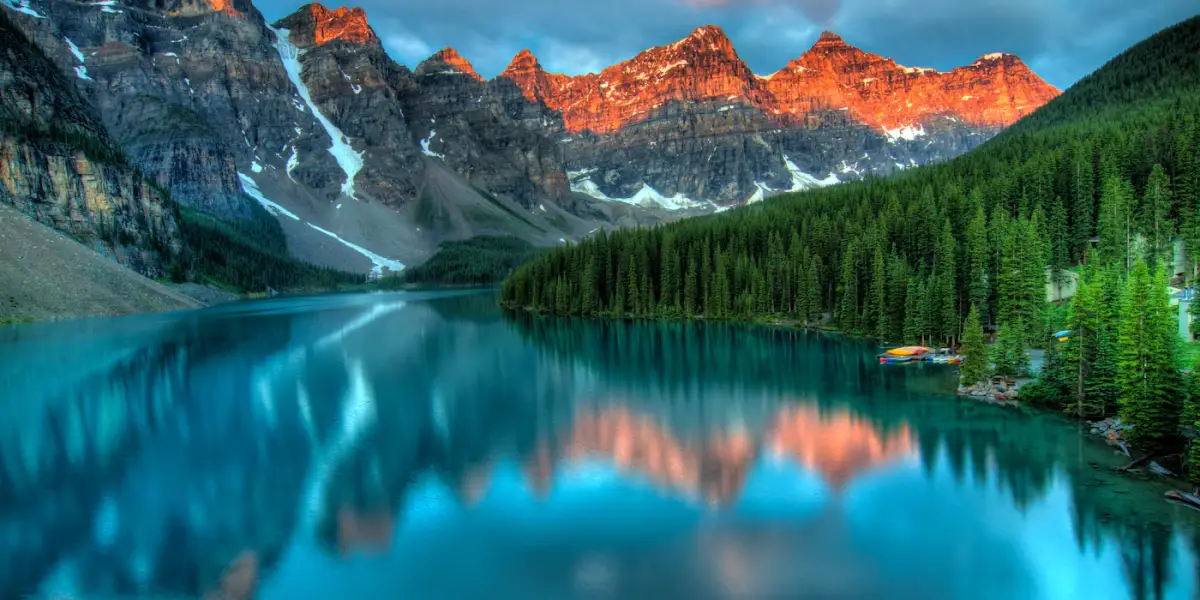
Hill countryTurquoise Lake Louise and Moraine Lake, Canada's first national park, hot springs, gondola views and wildlife.
3–4 nightsabout 3 h by flight from Vancouver airportBest Jun–Sep
Banff and Lake Louise
Hill countryTurquoise Lake Louise and Moraine Lake, Canada's first national park, hot springs, gondola views and wildlife.
Banff National Park, set up in 1885 as Canada's first national park, belongs to the Canadian Rocky Mountain Parks, a UNESCO World Heritage Site, with the town of Banff on the Bow River and the village of Lake Louise 56 km to the north-west. The nearest big airport is Calgary, a 90-minute drive away and a short flight from Vancouver. Grizzly and black bears, wolves and elk live throughout the park and can turn up even in the towns, so keep your distance and never feed any animal.
What to do in Banff and Lake Louise
- Lake Louise. Follow the lakeshore trail to the far end, where glacial creeks run in beneath the peaks, or paddle a canoe on the turquoise water in summer; in winter the frozen lake becomes an outdoor skating rink.
- Moraine Lake and the Rockpile. Climb the short Rockpile trail for the classic view across the lake to the Valley of the Ten Peaks; the road is closed to private cars, so go by Parks Canada shuttle, public transit or tour, and only from about June to mid-October.
- Johnston Canyon. Off the Bow Valley Parkway, steel catwalks run along the canyon walls past rushing waterfalls; in winter it becomes an easy ice walk to the frozen falls.
- Banff Gondola. Ride the gondola for a bird's-eye view over the town of Banff and the peaks around it.
- Hot springs and the Cave and Basin. Soak in the big hot pool of the Banff Upper Hot Springs, found in 1883, then see the springs where Canada's national parks began, now the Cave and Basin National Historic Site.
Come in summer for the lakes: the road to Moraine Lake is open to shuttles and tours only from June to around October, and in winter it becomes a cross-country ski track.
Sources: Parks Canada: Banff National Park, Parks Canada: Banff Park Museum and Cave and Basin national historic sites, Parks Canada: Visiting Lake Louise and Moraine Lake, Parks Canada: Wildlife in Banff National Park, Parks Canada: Plan your visit to Banff National Park, Banff & Lake Louise Tourism: Lake Louise, Banff & Lake Louise Tourism: Moraine Lake, Banff & Lake Louise Tourism: Must see Banff and Lake Louise, Banff & Lake Louise Tourism: Getting here, Banff & Lake Louise Tourism: Things to do in summer, Destination Canada: Discovering winter in Banff, Wikivoyage: Banff National Park, Wikivoyage: Lake Louise, Wikivoyage: Banff, Wikivoyage: Vancouver International Airport (checked 14 Oct)
Vancouver
CitySeawall walks around Stanley Park, Granville Island's market, North Shore mountains and Punjabi Market on Main Street.
3 nightsabout 30 min by train from Vancouver airportBest Jun–Aug
Vancouver
CitySeawall walks around Stanley Park, Granville Island's market, North Shore mountains and Punjabi Market on Main Street.
Vancouver, British Columbia's largest city, sits on the Pacific with the North Shore Mountains just across Burrard Inlet, so a beach and a mountain fit into the same day. It is mild by Canadian standards, with summers of about 15-25°C and grey, rainy winters that seldom bring snow to the city itself. A large South Asian population means Indian food, from chai and dosas to tandoori dishes, is easy to find, and the airport's SkyTrain line reaches downtown in about 25 minutes.
What to do in Vancouver
- Stanley Park seawall. Walk the 10 km seawall around the park in about three hours, or cycle it in just over one, past the totem poles at Brockton Point and beaches such as Second and Third Beach.
- Granville Island. A former industrial island on False Creek, turned into a public market in 1979, with food stalls, art and performance spaces in the old warehouses; the small False Creek ferries stop there.
- Gastown. Cobbled streets of brick buildings, a National Historic Site since 2009, with boutiques, cocktail bars and a steam clock built in 1977.
- The North Shore. Cross the Capilano Suspension Bridge, 137 m long and 70 m above the river, or ride the Grouse Mountain Skyride for views across the city; Lynn Canyon has a shorter, quieter suspension bridge.
- Punjabi Market and Surrey. Main Street between 41st and 49th Avenue has Punjabi food and clothes shops under street signs in Punjabi, and Surrey, about 45 minutes away, has the widest range of South Asian shops and restaurants in British Columbia.
Summer (June to August) is warm and mostly dry at about 15-25°C; winters are mild, around 0-10°C, but rainy, with snow on the nearby mountains for skiing.
Sources: Destination BC: Vancouver, Destination Canada: British Columbia, Destination Vancouver: Stanley Park, Destination Vancouver: Climate and weather, Destination Vancouver: Granville Island, Destination Vancouver: Gastown, Destination Vancouver: International cuisine, Destination Vancouver: Getting around, Wikivoyage: Vancouver, Wikivoyage: Vancouver International Airport, Wikivoyage: North Vancouver, Wikivoyage: Surrey (British Columbia) (checked 14 Oct)
Ottawa
CityCanada's capital: Parliament Hill, national museums and the UNESCO-listed Rideau Canal, a skating rink in winter.
1–2 nightsabout 2 h from Montreal airportBest May–Aug
Ottawa
CityCanada's capital: Parliament Hill, national museums and the UNESCO-listed Rideau Canal, a skating rink in winter.
Ottawa, picked by Queen Victoria as Canada's capital in 1857, sits where three rivers meet on the border between Ontario and Québec, with the city of Gatineau across the Ottawa River on the Québec side. It is about two hours' drive west of Montreal and four north-east of Toronto, with trains from both, and seven of Canada's nine national museums are in the capital region. Summers are hot with long sunny days, and winters bring heavy snow and hard cold.
What to do in Ottawa
- Parliament Hill. The seat of Canada's federal government stands above the Ottawa River; guided tours cover the Senate, the House of Commons and the East Block.
- Rideau Canal. Built between 1826 and 1832 and now a UNESCO World Heritage Site, the canal runs 202 km to Kingston and drops into the Ottawa River through a flight of stepped locks beside Parliament Hill.
- Skate the canal in winter. When the ice allows, usually from January to early March, 7.8 km of the canal through the city becomes the Rideau Canal Skateway, which the National Capital Commission calls the world's largest skating rink.
- National museums. Start with the National Gallery of Canada for art and the Canadian War Museum for the country's military history.
- ByWard Market. Just east of Parliament Hill, this historic farmers' market and shopping area is busy with stalls by day and with restaurants and bars at night.
More than a million tulips bloom across the city in May, and June to August brings long, hot, sunny days for festivals; winters are snowy and cold.
Sources: Ottawa Tourism: Top 10 things to do in Ottawa, Ottawa Tourism: About Ottawa, Ottawa Tourism: Getting here, Ottawa Tourism: Weather and seasons, Parks Canada: Rideau Canal National Historic Site, National Capital Commission: Rideau Canal Skateway, Destination Canada: Ottawa (checked 14 Oct)
Jasper and the Icefields Parkway
Hill countryA 232 km mountain road past glaciers and turquoise lakes to Jasper, a quieter park town with dark skies and elk.
2 nightsabout 5 h 30 min by flight from Vancouver airportBest Jul–Sep
Jasper and the Icefields Parkway
Hill countryA 232 km mountain road past glaciers and turquoise lakes to Jasper, a quieter park town with dark skies and elk.
Jasper National Park, the biggest of the Canadian Rockies' national parks, is joined to Lake Louise by the Icefields Parkway, one of the great mountain drives, which climbs past glaciers, waterfalls and lakes for 232 km. Jasper town, home to about 4,700 people and some four hours' drive north of Banff, is a calmer base; most people arrive via Edmonton, four hours to the east. The 2024 Jasper Wildfire hit the park and town, which are still rebuilding; Parks Canada has reopened many trails and areas, but some, including the road to Mount Edith Cavell, remain closed until further notice.
What to do in Jasper and the Icefields Parkway
- Drive the Icefields Parkway. Stop at Bow Lake and walk to the Peyto Lake viewpoint near Bow Summit, at 2,070 m the road's highest point; there is no mobile coverage and services are few, so fill up in Lake Louise or Jasper.
- Athabasca Glacier. At the Columbia Icefield, a short trail crosses rock laid bare as the glacier has shrunk since the 1800s to the edge of the ice; stay on the marked path, because the ice itself is unstable and dangerous.
- Sunwapta and Athabasca Falls. Short paths lead to viewpoints over both: the Sunwapta River crashes through a tight limestone gorge, and at Athabasca Falls the river pours into a canyon of swirling turquoise water.
- Maligne Lake. Take a boat trip out to Spirit Island on Maligne Lake, one of the areas Parks Canada reopened a few months after the wildfire.
- Stars and wildlife. Jasper is the world's second-largest dark sky preserve, so look up on clear nights, and watch for elk and bighorn sheep, which are easiest to spot early in the morning and in the evening.
Lakes are usually ice-free by late June and high trails clear of snow by mid-July; services on the parkway run only from early May to mid-October, and winter conditions last from early November to mid-June.
Sources: Parks Canada: Jasper National Park, Parks Canada: Icefields Parkway, Parks Canada: Getting to Jasper National Park, Parks Canada: What's open in Jasper National Park, Banff & Lake Louise Tourism: Lakes that are alternatives to Lake Louise, Tourism Jasper: Home, Wikivoyage: Jasper, Wikivoyage: Icefields Parkway, Wikivoyage: Vancouver International Airport (checked 14 Oct)
Whistler
Hill countryOne of North America's largest ski areas in winter, with gondola rides, lakes, bike trails and hikes in summer.
2 nightsabout 2 h 30 min from Vancouver airportBest Dec–Mar
Whistler
Hill countryOne of North America's largest ski areas in winter, with gondola rides, lakes, bike trails and hikes in summer.
Whistler is a resort village in the Coast Mountains, in the homelands of the Squamish and Lil̓wat Nations, reached from Vancouver up the Sea-to-Sky Highway along Howe Sound in about 1.5 to 2.5 hours. It grew up around the Whistler and Blackcomb ski mountains, now one resort, and hosted most of the skiing events of the 2010 Winter Olympics. In summer the same lifts carry hikers and mountain bikers, while others head for the valley's lakes and forest trails.
What to do in Whistler
- Ski Whistler Blackcomb. Two mountains with 37 lifts and more than 200 runs cover everything from beginner slopes to alpine bowls, with the main season from late November to late April.
- Gondola to the top. Ride the Whistler or Blackcomb gondola up from the village for wide views over the mountains, in summer as well as winter.
- Squamish Lil'wat Cultural Centre. Learn about the art, history and culture of the two First Nations whose land Whistler stands on.
- Brandywine Falls. On the drive up from Vancouver, a 10- to 15-minute walk leads to a viewing platform over a 70 m waterfall and its canyon.
- Lost Lake. In summer, swim from the beach of this lake, whose water is warmer than the others in the valley, or walk and cycle its trails, which become cross-country ski tracks in winter.
The ski season runs from late November to late April, with snow on the ground in the village from December; summer days can reach the high 20s, good for hiking and biking.
Sources: Destination BC: Whistler, Destination Canada: British Columbia, Wikivoyage: Whistler, Wikivoyage: Canada (checked 14 Oct)
Victoria (Vancouver Island)
CityBC's harbour capital on Vancouver Island: Butchart Gardens, orca-watching trips and Canada's oldest Chinatown.
1–2 nightsabout 3 h 30 min by boat from Vancouver airportBest Apr–Oct
Victoria (Vancouver Island)
CityBC's harbour capital on Vancouver Island: Butchart Gardens, orca-watching trips and Canada's oldest Chinatown.
Victoria, the capital of British Columbia, sits at the southern tip of Vancouver Island around an Inner Harbour busy with boats and floatplanes, with the Parliament Buildings and the Royal BC Museum close by. From Vancouver it is a 1 hour 35 minute ferry crossing from Tsawwassen to Swartz Bay, about half an hour's drive north of the city, or a short floatplane hop straight into the harbour. Destination Greater Victoria says it has Canada's mildest climate: winters are wet but mostly above freezing, and summer days reach about 24°C.
What to do in Victoria (Vancouver Island)
- Inner Harbour and the Royal BC Museum. Watch the floatplanes come in, see the Parliament Buildings, then explore the museum's Indigenous exhibits and its life-size woolly mammoths.
- Butchart Gardens. About 50 minutes from downtown by bus, these gardens fill a former limestone quarry, with more than a million bedding plants laid out in dozens of themed gardens.
- Whale watching. Three pods of orcas feed in the waters between Victoria and the mainland, and humpback, grey and minke whales pass through; boat trips have the best chance of whales from April to October.
- Chinatown and Fan Tan Alley. Walk under the Gate of Harmonious Interest into Canada's oldest Chinatown, then down Fan Tan Alley, billed as North America's narrowest street.
- Dallas Road and Beacon Hill Park. Walk or cycle the coastal path along Dallas Road, with the Olympic Mountains across the water, then wander Beacon Hill Park's ponds and gardens, where peacocks roam and children can pet goats at the farm.
April to October is the best time for whale-watching; summers are dry and comfortable at around 24°C, and most of the year's rain falls in the mild winter.
Sources: Destination Canada: Victoria, Destination Greater Victoria: Things to do for first-time visitors, Destination BC: Victoria, Destination Vancouver: Day trips, Wikivoyage: Victoria (British Columbia) (checked 14 Oct)
A first trip: 14–15 nights
- Toronto · 3n
- →Niagara Falls (Canadian side) · 1n
- →Montreal · 2n
- →Québec City · 2n
- →Banff and Lake Louise · 3–4n
- →Vancouver · 3n
Fly into Toronto for the city and a night at Niagara Falls, take the train to Montreal and Québec City, then fly west to Calgary for Banff and Lake Louise and finish in Vancouver; Ottawa fits between Toronto and Montreal, and Whistler or Victoria can be added at the end. June to September suits most of the loop, since the road to Moraine Lake is open only from about June to mid-October; late September and October bring fall colours in the east, while in winter the eastern cities are snowy and very cold and the Rocky Mountain lakes are frozen, so the west becomes a ski trip.
Getting around
Distances are huge, so fly between east and west: Toronto to Vancouver is a flight of more than four hours. In the east, VIA Rail trains link Toronto, Ottawa, Montreal and Québec City (about 5.25 hours from Toronto to Montreal, 2 from Ottawa to Montreal and 3.5 on to Québec City). For the Rockies, take the short flight from Vancouver to Calgary and drive 90 minutes to Banff; Whistler is reached from Vancouver by the Sea-to-Sky Highway, Victoria is a 1 hour 35 minute ferry crossing away, and outside the cities a hire car helps, with traffic driving on the right.
When to go
Montreal month by month: weather and fares →Toronto month by month: weather and fares →Vancouver month by month: weather and fares →Peak Shoulder Off-season
Destination Toronto describes spring for cherry blossoms (late April to early May) and quieter sights, summer as the late-night season with the Caribbean Carnival, Pride and the CNE, autumn for TIFF and Oktoberfest, and winter for Winterlicious and festive lights. The ratings follow the climate record: freezing from December to March, warm from June to September.
Flights to Canada from India
Visa for Indian passports
Indian passport holders need a visa for Canada before travel. Allow about 50 days for a first-time application. US green card holders need no visa or eTA. Visitor visa with VFS biometrics; about a month, plus passport stamping.
Before you book, check the Ministry of External Affairs travel advisories for the latest guidance.
Canada: questions
What are the best places to visit in Canada?
Toronto: Lakeside city of CN Tower views, island ferries, big museums and the chaat houses of Gerrard Street's Little India. Niagara Falls (Canadian side): Three waterfalls seen from riverside parks, boat rides into the spray and the falls lit up every night of the year. Montreal: French-speaking city of cobbled Old Montreal, Mount Royal's lookout, busy markets and easy vegetarian eating. Québec City: The only walled city north of Mexico: cobbled Old Québec, clifftop views of the St. Lawrence and Montmorency Falls. Banff and Lake Louise: Turquoise Lake Louise and Moraine Lake, Canada's first national park, hot springs, gondola views and wildlife. Vancouver: Seawall walks around Stanley Park, Granville Island's market, North Shore mountains and Punjabi Market on Main Street. Ottawa: Canada's capital: Parliament Hill, national museums and the UNESCO-listed Rideau Canal, a skating rink in winter. Jasper and the Icefields Parkway: A 232 km mountain road past glaciers and turquoise lakes to Jasper, a quieter park town with dark skies and elk. Whistler: One of North America's largest ski areas in winter, with gondola rides, lakes, bike trails and hikes in summer. Victoria (Vancouver Island): BC's harbour capital on Vancouver Island: Butchart Gardens, orca-watching trips and Canada's oldest Chinatown.
How many days do you need for Canada?
A first trip takes about 14–15 nights: Toronto (3 nights), Niagara Falls (Canadian side) (1 night), Montreal (2 nights), Québec City (2 nights), Banff and Lake Louise (3–4 nights), Vancouver (3 nights). Fly into Toronto for the city and a night at Niagara Falls, take the train to Montreal and Québec City, then fly west to Calgary for Banff and Lake Louise and finish in Vancouver; Ottawa fits between Toronto and Montreal, and Whistler or Victoria can be added at the end. June to September suits most of the loop, since the road to Moraine Lake is open only from about June to mid-October; late September and October bring fall colours in the east, while in winter the eastern cities are snowy and very cold and the Rocky Mountain lakes are frozen, so the west becomes a ski trip.
What is the best time to visit Canada?
Peak season is Jun–Sep. Destination Toronto describes spring for cherry blossoms (late April to early May) and quieter sights, summer as the late-night season with the Caribbean Carnival, Pride and the CNE, autumn for TIFF and Oktoberfest, and winter for Winterlicious and festive lights. The ratings follow the climate record: freezing from December to March, warm from June to September.
Do Indians need a visa for Canada?
Indian passport holders need a visa for Canada before travel. Allow about 50 days for a first-time application. US green card holders need no visa or eTA. Visitor visa with VFS biometrics; about a month, plus passport stamping.
How much is a flight to Canada from India?
The lowest return fare FlyBun has seen in the last 14 days is ₹74,303, Delhi to Toronto, for March 2027 departures. Fares change daily.
Places and things to do are written by FlyBun from official tourism, heritage and park sources, linked under each place, last checked 14 Oct. We leave out entry fees and opening hours because they change; check them before you go.
Watch a route and FlyBun alerts you free when its fare drops.