

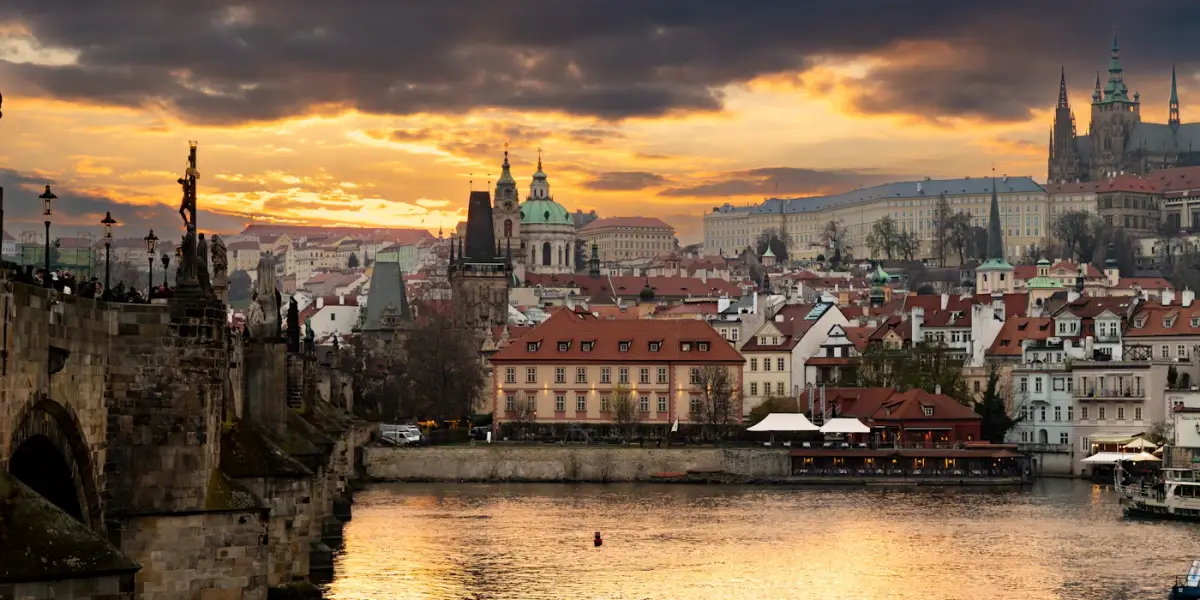
Travel guide from India
Czech Republic
The Czech Republic, also called Czechia, lies in Central Europe, a long flight north-west of India. Prague came through the Second World War almost undamaged, so its medieval core of cobbled lanes, bridges and spires survives, and within a few hours by train or bus are silver-mining and Renaissance towns, spa colonnades and sandstone rock country. Vegetarians manage better than the meaty local menu suggests: many restaurants list a few meat-free dishes and Prague has plenty of vegetarian and vegan bistros, but ask what a 'vegetarian' dish contains, as bacon or prawns can turn up.
- Best time
- May–Sep
- First trip
- 5–8 nights
- Visa
- Visa needed, 90 days
- Return flights
- from ₹46,126 ●
- Delhi, checked in the last 48 h
Places to visit in Czech Republic
8 places in the order you would meet them on a first trip. Tap one for what to do there.
Prague
CityThe capital: Old Town Square's astronomical clock, Charles Bridge, the Jewish Quarter and the Vyšehrad fort.
3–4 nightsabout 30 min from Prague airportBest Nov–Dec
Prague
CityThe capital: Old Town Square's astronomical clock, Charles Bridge, the Jewish Quarter and the Vyšehrad fort.
Prague, a city of about 1.2 million on both banks of the Vltava, was founded in the late 9th century and soon became the royal seat of Bohemia; under Charles IV in the 14th century it gained the New Town, a university and the stone bridge that now carries his name. Its compact historic centre came through the Second World War almost undamaged and is easy to explore on foot, though nearly every street is cobbled, so bring comfortable shoes. The airport is about 20 km north-west of the centre.
What to do in Prague
- Old Town Square and the Astronomical Clock. Prague's main square, founded in the 12th century, is framed by the Gothic Týn Church, the Baroque Church of St Nicholas and the Jan Hus memorial, and on the Old Town Hall's tower the medieval astronomical clock sets its twelve apostles in motion.
- Walk Charles Bridge. Charles IV laid the first stone in 1357 and the sandstone bridge was finished in 1402; towers guard both ends, 30 statues and groups of saints line the parapets, and by day buskers and artists fill it, while after dark it is lit by gas lamps.
- The Jewish Quarter (Josefov). The Old-New Synagogue, built in the 1270s and the oldest synagogue in Central Europe, has held services since the late 13th century except during the Nazi occupation, and the Old Jewish Cemetery nearby crowds over 12,000 gravestones into as many as 12 layers, among them Rabbi Löw's, linked to the legend of the Golem.
- Vyšehrad. Legend makes this rocky bluff over the Vltava the first seat of the Czech princes; inside the old ramparts are St Martin's, a rare Romanesque rotunda, the neo-Gothic basilica of Sts Peter and Paul, the Slavín national cemetery, and casemates that shelter original Baroque statues from Charles Bridge.
- Eat meat-free. Traditional menus keep a short meat-free section with dishes such as fried cheese and fruit dumplings, many ordinary restaurants will adapt a dish if you ask, and Prague has a long list of vegetarian and vegan bistros, including buffets where you pay by weight.
Advent markets spread across several Prague squares from late November through December, with the biggest on Old Town Square beside the largest lit Christmas tree in the country.
Sources: Prague City Tourism: Getting to Prague, Prague City Tourism: Old Town Square, Prague City Tourism: Old Town Hall with Astronomical Clock, Prague City Tourism: Charles Bridge, Prague City Tourism: Old-New Synagogue, Prague City Tourism: Old Jewish Cemetery, Prague City Tourism: Vyšehrad, CzechTourism: It's harvest time for vegetarians in Czechia, CzechTourism: Czech Christmas markets to visit this winter, CzechTourism: Travel info, Wikivoyage: Prague, Wikivoyage: Czech Republic (checked 14 Oct)
Prague Castle and the Lesser Town
HeritageDay tripThe castle hill: St Vitus Cathedral, Golden Lane, the Baroque Lesser Town and the funicular up Petřín.
about 30 min from Prague airport
Prague Castle and the Lesser Town
HeritageDay tripThe castle hill: St Vitus Cathedral, Golden Lane, the Baroque Lesser Town and the funicular up Petřín.
Prague Castle, founded in the late 9th century, housed Bohemia's princes and kings, and since 1918 has been the seat of the president; its churches, palaces and three courtyards cover 45 hectares above the left bank, and the city's tourism board calls it the largest castle complex in the world. Below it lies the Lesser Town (Malá Strana), founded in the 13th century and badly damaged in the Hussite wars, which is why its buildings are mostly Baroque. From the Old Town it is an easy walk across Charles Bridge.
What to do in Prague Castle and the Lesser Town
- St Vitus Cathedral. Begun in 1344 on the site of an older rotunda and only finished in 1929, the Gothic cathedral holds St Wenceslas's tomb in a chapel panelled with precious stones, a crypt of Bohemian kings, and the chamber where the crown jewels are kept under seven keys.
- Golden Lane. Tiny, brightly painted houses were built into the castle walls in the late 16th century and lived in until the Second World War; Franz Kafka worked in No. 22 in 1917, and several houses now show how their occupants once lived.
- St Nicholas Church, Lesser Town. Built for the Jesuits, mostly in the 18th century, this is Prague's best-known Baroque church; its dome rises almost 57 m inside, the highest interior in the city, and concerts are played on its 18th-century organ.
- Kampa and the Lennon Wall. Below Charles Bridge, the park island of Kampa sits between the Vltava and the Čertovka channel, where the big wheel of an old mill still turns, and a short walk away is the graffiti-covered Lennon Wall.
- Up Petřín Hill. A funicular climbs from Újezd to the green hill's gardens, playgrounds and mirror maze, and the 1891 lookout tower at the top, a loose one-fifth copy of the Eiffel Tower, has 299 steps to its viewing platform.
Sources: Prague City Tourism: Prague Castle, Prague City Tourism: Cathedral of St Vitus, St Wenceslas and St Adalbert, Prague City Tourism: Golden Lane, Prague City Tourism: St Nicholas Church at Malá Strana, Prague City Tourism: Kampa, Prague City Tourism: Petřín Tower, Prague City Tourism: Petřín Gardens, Prague City Tourism: Petřín funicular, Wikivoyage: Prague/Castle and Lesser Town, Wikivoyage: Prague (checked 14 Oct)
Kutná Hora
HeritageDay tripA medieval silver town with the Gothic St Barbara's Cathedral and the bone-decorated Sedlec Ossuary.
about 2 h by train from Prague airport
Kutná Hora
HeritageDay tripA medieval silver town with the Gothic St Barbara's Cathedral and the bone-decorated Sedlec Ossuary.
Kutná Hora, east of Prague in Central Bohemia, grew rich on silver in the Middle Ages, and its wealth and royal mint helped power the Bohemian kingdom, which is why it is still nicknamed the 'national treasury'. Its historic centre, with St Barbara's Cathedral and the Cathedral of the Assumption at Sedlec, has been on the UNESCO World Heritage list since 1995. Trains from Prague take about an hour, which makes it an easy day out.
What to do in Kutná Hora
- St Barbara's Cathedral. Named for the patron saint of miners, this late-Gothic church took some five centuries to complete, and the frescoes in its chapels include scenes of mining and minting coins.
- Sedlec Ossuary. In the chapel beneath the Cemetery Church of All Saints, the bones of about 40,000 people were arranged by František Rint in 1870 into a huge chandelier, a cross and the Schwarzenberg family's coat of arms.
- Cathedral of the Assumption, Sedlec. This former Cistercian abbey church, burnt in the 15th century, was rebuilt by Jan Blažej Santini in his Baroque Gothic style, and its unusually large windows earned it the name Cathedral of Light.
- The Italian Court. The old royal mint and residence, where Wenceslas II brought in experts from Florence to strike the first groschen, now has an exhibition on how coins were made.
- Plan the two ends of town. The ossuary and Sedlec cathedral are near the main station, while St Barbara's and the old centre are a few kilometres away, so walk between them or use the local bus or the short train to Kutná Hora město.
Sources: CzechTourism: Kutná Hora, CzechTourism: Church of St Barbara in Kutná Hora, CzechTourism: Ossuary in Sedlec near Kutná Hora, Wikivoyage: Kutná Hora, Wikivoyage: Prague, Prague City Tourism: Getting to Prague (checked 14 Oct)
Český Krumlov
HeritageA castle town in a tight loop of the Vltava, with painted houses, a Baroque theatre and summer rafting.
1–2 nightsabout 3 h 30 min from Prague airport
Český Krumlov
HeritageA castle town in a tight loop of the Vltava, with painted houses, a Baroque theatre and summer rafting.
Český Krumlov sits in the S-shaped bends of the Vltava in South Bohemia, about 180 km from Prague, below a castle that grew from a 13th-century Gothic fort into the second-largest castle complex in the country. The Rosenbergs, then the Eggenbergs and the Schwarzenbergs, held it for centuries, and its old centre, with around 300 listed buildings, has been a UNESCO World Heritage Site since 1992. The trip from Prague takes about three hours each way, so it is worth staying at least a night.
What to do in Český Krumlov
- Castle and chateau. Walk through the castle's five courtyards to its terraced Baroque garden, climb the 162 steps of the tower for the view over the river loop, and look for the bears kept in the castle moat.
- The Baroque theatre. Added to the castle in the late 17th century, the theatre survives with its stage machinery, orchestra pit, scenery and hundreds of costumes, and is counted among the most completely preserved Baroque theatres anywhere.
- Inner Town and Latrán. Inside the river loop, náměstí Svornosti is lined with painted Gothic, Renaissance and Baroque houses; across the river, Latrán, the quarter that grew up below the castle, leads up towards it.
- Museum Fotoatelier Seidel. The studio and home of the photographers Josef and František Seidel, father and son, keeps their cameras, glass negatives and furniture, and their pictures show life in this borderland about a century ago.
- Float the Vltava. In summer canoes and rafts drift down the river through town; rental firms take you to a starting point upstream and pick you up downstream, and the stretch through Český Krumlov alone takes about two hours.
Sources: CzechTourism: Český Krumlov, Český Krumlov tourism: Český Krumlov UNESCO, Český Krumlov tourism: State Castle and Chateau, Český Krumlov tourism: How to get to us, Český Krumlov tourism: Top 10 sights, Český Krumlov tourism: Český Krumlov with kids, Český Krumlov tourism: Boating restrictions on the Vltava, May-November 2026, Wikivoyage: Český Krumlov, Wikivoyage: Prague (checked 14 Oct)
Telč
HeritageDay tripA small Renaissance town whose arcaded square of tall-gabled houses is on the UNESCO list.
about 3 h from Prague airport
Telč
HeritageDay tripA small Renaissance town whose arcaded square of tall-gabled houses is on the UNESCO list.
Telč, a town of about 5,000 people in the Bohemian-Moravian Highlands, began as a moated fortress, and the fishponds around it kept the town from spreading, so its 16th-century square has changed little. The burghers competed to build the grandest gables, and the historic centre has been on the UNESCO World Heritage list since 1992. It suits a few hours' stop rather than a long stay, for example on the way between Český Krumlov and Brno.
What to do in Telč
- The square of gables. Walk the arcades around náměstí Zachariáše z Hradce and notice how many of the colourful front gables rise well above the roofs behind them, built to show off their owners' wealth.
- Telč Chateau. After a journey to Genoa, Zachariáš of Hradec rebuilt the Gothic castle as an Italian-style Renaissance home; inside are the carved coffered ceiling and family portraits of the Golden Hall, and children like the trophies in the Knights' and African halls.
- Chateau park. Beneath the chateau walls lies a 6-hectare English-style park with rare trees, a Classicist glasshouse and a linden that Zachariáš is said to have planted when his son was born.
- Row round the old town. Hire a rowing boat on the ponds that wrap around the old town and once served as its moat.
Sources: CzechTourism: Telč, CzechTourism: Chateau park in Telč, Wikivoyage: Telč (checked 14 Oct)
Brno
CityMoravia's capital: Mies van der Rohe's UNESCO-listed Villa Tugendhat, Špilberk Castle and wine country nearby.
1–2 nightsabout 3 h 30 min by train from Prague airport
Brno
CityMoravia's capital: Mies van der Rohe's UNESCO-listed Villa Tugendhat, Špilberk Castle and wine country nearby.
Brno, about 205 km from Prague, is the country's second-largest city and was the capital of Moravia for centuries; with some 89,000 students among about 400,000 people, it is a lively university town that is little known to tourists and easy on crowds. Its sights run from a 13th-century hilltop castle and a cathedral on Petrov hill to interwar modernist villas such as Villa Tugendhat, and the caves of the Moravian Karst and the vineyards of South Moravia are close. Direct trains from Prague take about two and a half hours.
What to do in Brno
- Villa Tugendhat. Ludwig Mies van der Rohe designed this UNESCO-listed family house at the end of the 1920s on a steel frame of cross-shaped pillars, with an onyx wall, windows that open electrically and an early form of air-conditioning.
- Špilberk Castle. King Ottokar II built the castle in the 13th century; it became a massive Baroque fortress in the 17th century and later a harsh prison, and its dark casemates are a popular visit today.
- Cathedral of Sts Peter and Paul. The twin-spired cathedral on Petrov hill is tied to a legend from the Swedish siege of 1645: told the attackers would leave if Brno held out until noon, the defenders rang the noon bell an hour early.
- Labyrinth under the Cabbage Market. Below the open-air market of Zelný trh, medieval cellars dug to store food survive as a labyrinth of passages, with a pillory and an alchemist's workshop on display.
- Day trips into Moravia. North of the city the Moravian Karst has stalactite caves and an underground river you travel by boat, and to the south lie the vineyards of South Moravia and the UNESCO-listed Lednice-Valtice landscape of palaces and follies.
Sources: CzechTourism: Brno, Wikivoyage: Brno, Wikivoyage: Prague (checked 14 Oct)
Karlovy Vary
CityThe grand spa town of hot springs and colonnades, where visitors sip the waters from porcelain spa cups.
1–2 nightsabout 2 h from Prague airport
Karlovy Vary
CityThe grand spa town of hot springs and colonnades, where visitors sip the waters from porcelain spa cups.
Karlovy Vary, also known as Carlsbad, lies in the wooded valley of the Teplá in West Bohemia, about 130 km west of Prague; legend says Charles IV found its hot springs while out hunting in the 14th century. It became one of Europe's fashionable spas, visited by Goethe, Beethoven and Peter the Great, and with the nearby spas of Františkovy Lázně and Mariánské Lázně it shares the UNESCO listing of the Great Spa Towns of Europe. Direct buses leave from Prague Airport's Terminal 1.
What to do in Karlovy Vary
- Walk the colonnades. Follow the Teplá past the stone Mill Colonnade, the largest in town, the carved wooden Market Colonnade and the cast-iron Park Colonnade, filling a porcelain spa cup at the springs along the way.
- The Hot Spring. At the Hot Spring Colonnade, a glass and concrete hall from 1975, the Vřídlo geyser throws water at more than 70°C up to about 12 m high.
- Funicular to the Diana tower. A funicular climbs to the Diana lookout tower, standing since 1914, with views over the town and the valleys, and a butterfly house and small zoo beside it.
- Spa wafers and porcelain. Buy warm spa wafers (lázeňské oplatky) in different flavours from street stands, and browse the town's porcelain and glass.
- Day out to Loket. About 14 km away, the small town of Loket sits on a rocky spur almost circled by the Ohře, with a square of old burgher houses and a Gothic castle above the river.
Sources: CzechTourism: Karlovy Vary, Karlovy Vary tourism: Colonnades and springs, Karlovy Vary tourism: 10 tips for the best places, Karlovy Vary tourism: Top lookout points, Karlovy Vary tourism: UNESCO member, Karlovy Vary tourism: 5 tips for trips in the surrounding area, CzechTourism: The town of Loket, Wikivoyage: Karlovy Vary, Wikivoyage: Prague (checked 14 Oct)
Bohemian Paradise (Český ráj)
Hill countrySandstone rock towns, castle ruins on old volcanic peaks and forest trails, north-east of Prague.
1–2 nightsabout 2 h from Prague airport
Bohemian Paradise (Český ráj)
Hill countrySandstone rock towns, castle ruins on old volcanic peaks and forest trails, north-east of Prague.
Bohemian Paradise is a hilly stretch of pine forest, sandstone towers and castles in North Bohemia, with Turnov and Jičín as its main gateway towns, about two hours from Prague by bus. It became the first protected landscape area in Czechoslovakia in 1955 and was the first place in the country named a UNESCO geopark. Marked paths wind between rock pillars up to 60 m tall, and the area has a long tradition of cutting precious stones, above all the deep red Bohemian garnet.
What to do in Bohemian Paradise (Český ráj)
- Prachov Rocks. Near Jičín, marked paths run through narrow clefts and gorges between tall sandstone towers to lookouts over this compact rock town, a nature reserve since 1933.
- Hrubá Skála and the Mouse Hole. From the chateau perched on the rocks about 6 km south-east of Turnov, a trail squeezes through the narrow Mouse Hole gorge to the Dragon Rocks, part of a rock town whose towers carry names such as the Conductor's Baton and the Lighthouse.
- Trosky Castle. The ruins of this 14th-century castle sit on two basalt pillars left from an old volcano, the stout Baba and the slender Panna, and are the symbol of the region.
- Kost Castle. This late-14th-century castle on a low rock above fishponds, whose dams could be broken to flood its approaches, is said to take its name from the Czech word for bone, and the story goes that even the Hussite general Jan Žižka could not take it.
- Garnets in Turnov. The Museum of Bohemian Paradise in Turnov covers the region's gem deposits and its history of stone cutting and jewellery making, including old pieces set with Bohemian garnets.
Sources: CzechTourism: Bohemian Paradise, UNESCO Geopark, CzechTourism: Ruins of Trosky Castle, CzechTourism: Kost Castle, CzechTourism: Hrubá Skála Château, CzechTourism: Jičín, CzechTourism: Museum of Jewellery Making in Turnov, Wikivoyage: Bohemian Paradise (checked 14 Oct)
A first trip: 5–8 nights
Base yourself in Prague for the Old Town, the castle district and a day out to Kutná Hora, take the bus south to Český Krumlov, break the journey east at Telč on the way to Brno, then ride the fast train back to Prague for the flight home. Come from late November for the Advent markets in Prague's squares; with more time, add the spa colonnades of Karlovy Vary, a bus ride west of Prague, or the rock towns of Bohemian Paradise to the north-east.
Getting around
Prague is the hub: from the airport, about 20 km north-west of the centre, buses connect with the metro and an express bus runs to the main railway station. Fast trains reach Brno in about two and a half hours and Kutná Hora in about an hour, while buses are the easier way to Český Krumlov (about three hours) and Karlovy Vary (about two, with buses leaving from the airport's Terminal 1). Telč takes longer: trains there are slow, so the quickest public route mixes train and bus; Bohemian Paradise's towns are served by buses and trains roughly every two hours.
Peak Shoulder Off-season
Prague City Tourism has no page describing tourist seasons, so these ratings are derived from NASA POWER climate normals: highs of 19 to 26°C from May to September, with June to August also the wettest months, and sub-zero nights from December to March. December is kept shoulder for the Christmas markets.
Flights to Czech Republic from India
Visa for Indian passports
Indian passport holders need a visa for Czech Republic before travel. Allow about 40 days for a first-time application. Schengen visa via VFS; one visa covers the whole Schengen area.
Before you book, check the Ministry of External Affairs travel advisories for the latest guidance.
Czech Republic: questions
What are the best places to visit in Czech Republic?
Prague: The capital: Old Town Square's astronomical clock, Charles Bridge, the Jewish Quarter and the Vyšehrad fort. Prague Castle and the Lesser Town: The castle hill: St Vitus Cathedral, Golden Lane, the Baroque Lesser Town and the funicular up Petřín. Kutná Hora: A medieval silver town with the Gothic St Barbara's Cathedral and the bone-decorated Sedlec Ossuary. Český Krumlov: A castle town in a tight loop of the Vltava, with painted houses, a Baroque theatre and summer rafting. Telč: A small Renaissance town whose arcaded square of tall-gabled houses is on the UNESCO list. Brno: Moravia's capital: Mies van der Rohe's UNESCO-listed Villa Tugendhat, Špilberk Castle and wine country nearby. Karlovy Vary: The grand spa town of hot springs and colonnades, where visitors sip the waters from porcelain spa cups. Bohemian Paradise (Český ráj): Sandstone rock towns, castle ruins on old volcanic peaks and forest trails, north-east of Prague.
How many days do you need for Czech Republic?
A first trip takes about 5–8 nights: Prague (3–4 nights), Prague Castle and the Lesser Town (1 night), Kutná Hora (1 night), Český Krumlov (1–2 nights), Telč (1 night), Brno (1–2 nights). Base yourself in Prague for the Old Town, the castle district and a day out to Kutná Hora, take the bus south to Český Krumlov, break the journey east at Telč on the way to Brno, then ride the fast train back to Prague for the flight home. Come from late November for the Advent markets in Prague's squares; with more time, add the spa colonnades of Karlovy Vary, a bus ride west of Prague, or the rock towns of Bohemian Paradise to the north-east.
What is the best time to visit Czech Republic?
Peak season is May–Sep. Prague City Tourism has no page describing tourist seasons, so these ratings are derived from NASA POWER climate normals: highs of 19 to 26°C from May to September, with June to August also the wettest months, and sub-zero nights from December to March. December is kept shoulder for the Christmas markets.
Do Indians need a visa for Czech Republic?
Indian passport holders need a visa for Czech Republic before travel. Allow about 40 days for a first-time application. Schengen visa via VFS; one visa covers the whole Schengen area.
How much is a flight to Czech Republic from India?
The lowest return fare FlyBun has seen in the last 14 days is ₹44,533, Delhi to Prague, for November 2026 departures. Fares change daily.
Places and things to do are written by FlyBun from official tourism, heritage and park sources, linked under each place, last checked 14 Oct. We leave out entry fees and opening hours because they change; check them before you go.
Watch a route and FlyBun alerts you free when its fare drops.