

Travel guide from India
Egypt
Egypt lies west of India across the Arabian Sea, a medium-haul flight to Cairo, its main gateway. Outside the thin green strip along the Nile the country is almost all desert, so a first trip follows the river, from the pyramids and medieval mosques of Cairo to the temples and royal tombs of Luxor and the temples of Aswan, with the Red Sea coast for reefs and beaches. Vegetarians eat well: everyday dishes such as koshari, ful and ta'ameya (Egyptian falafel) are meat-free, partly because Coptic Christian fast days call for vegan food, though stock and sauces can hide meat, so ask.
- Best time
- Nov–Mar
- First trip
- 10–13 nights
- Visa
- e-Visa, 30 days
- Return flights
- from ₹32,681 ●
- Mumbai, checked in the last 48 h
Places to visit in Egypt
10 places in the order you would meet them on a first trip. Tap one for what to do there.
Giza: the pyramids and the Grand Egyptian Museum
HeritageThe Great Pyramid, the Sphinx and the Grand Egyptian Museum's Tutankhamun galleries, all on Cairo's west side.
2–3 nightsabout 1 h 30 min from Cairo airportBest Nov–Mar
Giza: the pyramids and the Grand Egyptian Museum
HeritageThe Great Pyramid, the Sphinx and the Grand Egyptian Museum's Tutankhamun galleries, all on Cairo's west side.
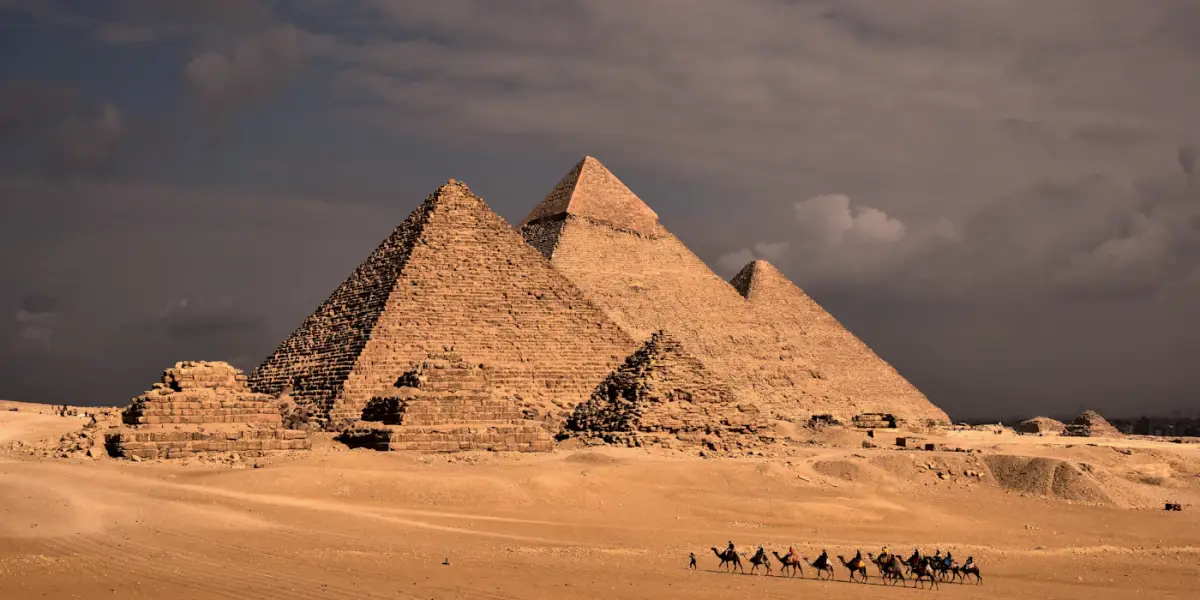
Giza is the city on the Nile's west bank facing Cairo, and on the desert plateau at its western edge stand the pyramids of the 4th-Dynasty kings Khufu, Khafre and Menkaure, with the Great Sphinx below them. The city now sprawls right up to the foot of the plateau, which has been kept clear of building, and with the Grand Egyptian Museum about 2 km away, the hotels along Pyramids Road make Giza a base in its own right.
What to do in Giza: the pyramids and the Grand Egyptian Museum
- The Great Pyramid. Khufu's pyramid, the oldest and largest of the three, was the tallest structure on earth for some 3,800 years and is the only one of the ancient world's Seven Wonders still standing; the passages inside up to the King's Chamber are steep, hot and cramped.
- The Sphinx and Khafre's pyramid. The Sphinx, a king's head on a lion's body carved straight out of the bedrock, sits beside the valley temple of Khafre, whose pyramid stands on higher ground and so looks as tall as his father's; it faces east, so come in the morning for photos.
- Walk the plateau. In the cool months the site is walkable if you are reasonably fit, so come early, head out west of the pyramids for the classic panorama, and settle the route and price of any camel or horse ride before you climb on.
- Queens' pyramids and nobles' tombs. Around the big three are small pyramids for the queens and mastaba tombs for nobles and royal relatives, several of them open to visitors and much quieter than the main monuments.
- Grand Egyptian Museum. About 2 km north-west of the pyramids, the museum, which bills itself as the world's largest devoted to a single civilisation, runs from prehistory to Greco-Roman times, with galleries of objects from Tutankhamun's tomb and a museum for Khufu's boats; allow at least four hours.
November to March is the best time, with daytime highs mostly below 26°C; spring can bring sandstorms, and summer heat can reach 38°C.
Sources: Experience Egypt (Egyptian Tourism Authority): Cairo & Giza, Ministry of Tourism and Antiquities: Giza Plateau, Ministry of Tourism and Antiquities: The Great Pyramid, Ministry of Tourism and Antiquities: The Great Sphinx, Ministry of Tourism and Antiquities: Pyramid complex of Khafre, Grand Egyptian Museum: official ticketing website, Wikivoyage: Cairo/Giza, Wikivoyage: Cairo, Wikivoyage: Cairo International Airport (checked 14 Oct)
Saqqara, Memphis and Dahshur
HeritageDay tripEgypt's first pyramid at Saqqara, the Bent and Red Pyramids at Dahshur and a colossal Ramesses II at Memphis.
about 1 h 30 min from Cairo airport
Saqqara, Memphis and Dahshur
HeritageDay tripEgypt's first pyramid at Saqqara, the Bent and Red Pyramids at Dahshur and a colossal Ramesses II at Memphis.
South of Giza, the desert edge was the burial ground of Memphis, Egypt's capital in the Early Dynastic period and the Old Kingdom, and its cemeteries run from Giza past Abusir and Saqqara to Dahshur. Saqqara alone stretches about 6 km and holds tombs from almost every age of ancient Egypt, while Dahshur, a military zone until 1996, gets far fewer visitors and less hassle than Giza. Many people see Saqqara, Memphis and Dahshur together in a day by hired car from Cairo or Giza.
What to do in Saqqara, Memphis and Dahshur
- Step Pyramid of Djoser. Six mastaba tombs stacked one on another for the 3rd-Dynasty king Djoser, designed by his architect Imhotep, make up Egypt's first pyramid and the oldest known Egyptian stone building.
- Nobles' tombs and the Serapeum. Old Kingdom officials' tombs such as those of Mereruka and Ti are covered in finely carved scenes of daily life, and the Serapeum's long underground corridors held the mummified Apis bulls, sacred to the god Ptah.
- Imhotep Museum. Six halls at Saqqara show statues, coffins and other finds from the site, including a reconstructed tomb with a mummy and its wooden coffin.
- Memphis open-air museum. Little of the old capital survives above ground in the village of Mit Rahina, but one of a pair of colossal statues of Ramesses II, about 10 m tall, lies under a roof in the small museum, while its twin has gone to the Grand Egyptian Museum.
- Dahshur's Bent and Red Pyramids. Both were built by Sneferu, Khufu's father: the Bent Pyramid changes angle partway up, and the Red Pyramid, the third-largest in Egypt, can be entered down a long sloping passage to corbel-roofed chambers, a climb that needs some fitness.
Sources: Ministry of Tourism and Antiquities: Memphis and its Necropolis, Ministry of Tourism and Antiquities: Saqqara, Ministry of Tourism and Antiquities: The Step Pyramid complex of Djoser, Ministry of Tourism and Antiquities: Serapeum, Ministry of Tourism and Antiquities: Imhotep Museum, Ministry of Tourism and Antiquities: Dahshur, Ministry of Tourism and Antiquities: The Red Pyramid, Ministry of Tourism and Antiquities: The Bent Pyramid, Wikivoyage: Saqqara, Wikivoyage: Memphis (Egypt), Wikivoyage: Dahshur (checked 14 Oct)
Luxor: Karnak and the Valley of the Kings
HeritageKarnak's forest of columns, Luxor Temple, and the painted royal tombs and temples across the river on the West Bank.
2 nightsabout 1 h 30 min by flight from Cairo airportBest Nov–Feb
Luxor: Karnak and the Valley of the Kings
HeritageKarnak's forest of columns, Luxor Temple, and the painted royal tombs and temples across the river on the West Bank.
Luxor stands on ancient Thebes, Egypt's religious capital in the Middle and New Kingdoms, and the Nile splits it in two. The modern town, with Karnak, Luxor Temple, the station and most hotels, is on the east bank; across the river, the West Bank holds the Valley of the Kings and the great mortuary temples, along with smaller, quieter hotels among the fields. Wikivoyage calls Luxor Egypt's hassle capital, so expect persistent touts; Aswan is much calmer.
What to do in Luxor: Karnak and the Valley of the Kings
- Karnak. Nearly every New Kingdom king added to the great temple of Amun, whose Great Hypostyle Hall holds 134 huge columns, the twelve down the middle 21 m tall; nearby rise Hatshepsut's obelisk of almost 30 m and the sacred lake where priests purified themselves.
- Luxor Temple and the Avenue of Sphinxes. About 3 km south of Karnak, Luxor Temple is fronted by colossal statues of Ramesses II and one of his two obelisks (the other has stood in Paris since 1836), and a sphinx-lined processional way about 2.7 km long joins the two temples.
- Valley of the Kings. From Thutmose I onwards, New Kingdom pharaohs were buried in hidden rock-cut tombs in this desert valley under a pyramid-shaped peak; Seti I's is the longest, Ramesses VI's has ceilings painted with the sky goddess Nut, and Tutankhamun's, the only royal tomb here found largely intact, is small and plainly decorated.
- Hatshepsut's temple and the West Bank. Hatshepsut's terraced temple at Deir el-Bahari faces Karnak across the river and shows her expedition to Punt; nearby are Ramesses III's well-preserved temple at Medinet Habu, the Ramesseum and the two huge statues of Amenhotep III called the Colossi of Memnon.
- Balloon at dawn, felucca at dusk. Hot-air balloons drift over the West Bank at sunrise, and in the late afternoon a felucca, the Nile's traditional sailing boat, is a calm way to watch the sun go down.
Winter, from November to early March, is the time to go; summer is extremely hot, and the change between the two is abrupt, with no real spring or autumn.
Sources: Experience Egypt (Egyptian Tourism Authority): Luxor, Ministry of Tourism and Antiquities: Ancient Thebes and its Necropolis, Ministry of Tourism and Antiquities: Karnak, Ministry of Tourism and Antiquities: Luxor Temple, Ministry of Tourism and Antiquities: Valley of the Kings, Ministry of Tourism and Antiquities: Tomb of Tutankhamun, Ministry of Tourism and Antiquities: Tomb of Ramesses VI (KV9), Ministry of Tourism and Antiquities: Hatshepsut Temple, Ministry of Tourism and Antiquities: The Temple of Medinet Habu, Wikivoyage: Luxor, Wikivoyage: Luxor/East Bank, Wikivoyage: Luxor/West Bank, Wikivoyage: Valley of the Kings (checked 14 Oct)
Nile cruise: Luxor to Aswan
HeritageDays on the river between Luxor and Aswan in a floating hotel, stopping at the temples of Edfu and Kom Ombo.
3–4 nightsabout 1 h 30 min by flight from Cairo airportBest Nov–Mar
Nile cruise: Luxor to Aswan
HeritageDays on the river between Luxor and Aswan in a floating hotel, stopping at the temples of Edfu and Kom Ombo.
Dozens of cruise boats work the Nile, most of them between Luxor and Aswan in either direction, on trips the tourism board puts at three to seven nights, stopping at the main temples along the way; the large boats run like five-star hotels. The alternatives under sail are the dahabiya, a two-masted boat that also plies Luxor to Aswan, and the felucca, a traditional wooden sailboat on which passengers eat and sleep, usually for two nights from Aswan down to Kom Ombo.
What to do in Nile cruise: Luxor to Aswan
- Temple of Horus at Edfu. Begun in 237 BC and finished 180 years later, the temple lay buried under the debris of later settlement for many centuries, which is why it is one of the most complete in Egypt; two granite falcons of Horus stand before its pylons.
- Kom Ombo. This temple is unusual in being built for two gods, the crocodile Sobek and the falcon Horus the Elder, with twin passages and twin sanctuaries, and a Roman-era relief on its walls shows what are thought to be surgical instruments.
- Crocodile Museum. Next to Kom Ombo temple, mummified Nile crocodiles, the longest 4.3 m, are shown with statues of Sobek and a model of a crocodile burial.
- Pick your boat. A big cruise ship is a floating hotel, a dahabiya is the luxury option under sail, and a felucca is the simplest, with meals and nights on board, so bring a sleeping bag, as winter nights on the river are cold.
- Watch the valley close in. South of Esna the limestone gives way to sandstone hills that squeeze the Nile into a narrow valley, so from the deck the fields form a thin green corridor between the river and the desert.
Egypt's mild winter runs from November to March, while summer, from May to September, is hot and dry.
Sources: Experience Egypt (Egyptian Tourism Authority): Useful information, Getting around, Ministry of Tourism and Antiquities: Temple of Edfu, Ministry of Tourism and Antiquities: Kom Ombo Temple, Ministry of Tourism and Antiquities: Crocodile Museum, Wikivoyage: Egypt, Wikivoyage: Upper Egypt, Wikivoyage: Felucca cruise on the Nile, Wikivoyage: Edfu, Wikivoyage: Kom Ombo, Wikivoyage: Luxor (checked 14 Oct)
Aswan
CityA calmer Nile town than Luxor, with felucca sails, the island temple of Philae, Nubian villages and Elephantine Island.
1–2 nightsabout 2 h by flight from Cairo airportBest Nov–Feb
Aswan
CityA calmer Nile town than Luxor, with felucca sails, the island temple of Philae, Nubian villages and Elephantine Island.
Aswan, Egypt's southernmost city, lies about 870 km south of Cairo at the First Cataract, where a bar of granite crossing the valley once stopped river traffic, just below the old Aswan Dam and the High Dam that holds back Lake Nasser. Throughout its history it was Egypt's southern gateway, where trade from Nubia entered the country, and Nubian villages remain on Elephantine and Seheyl islands. It is smaller and far more relaxed than Luxor, and the natural base for Philae and Abu Simbel.
What to do in Aswan
- Philae. Reached by boat, the temple of Isis on Agilkia island stayed in use until the reign of Justinian in the 6th century AD, among the last ancient Egyptian temples to do so; it was moved here from flooded Philae island in the UNESCO rescue of the 1960s.
- Felucca to the islands. Sail round Elephantine Island, with its Nubian villages, temple ruins and Nilometer, and on to the island Lord Kitchener turned into a botanical garden, full of birds and palms.
- A Nubian village. Visit a village such as Gharb Soheil for its brightly painted houses, and try hibiscus tea, served hot or cold, which has been drunk in Nubia since ancient times.
- Tombs of the Nobles. In the west-bank hills, rock-cut tombs of princes from the Old Kingdom onwards have lively paintings of daily life and inscriptions about journeys into Africa, and the climb to the nearby Kubbet el-Hawa shrine gives a wide view of the town and river.
- Nubian Museum and the Unfinished Obelisk. The Nubian Museum traces Nubia from prehistory to the flooding of its villages by Lake Nasser, and in the town's ancient granite quarries lies the cracked Unfinished Obelisk, which would have stood about 42 m tall.
Average highs run about 23–30°C from November to February but around 40–42°C from May to September, so winter is pleasantly warm and summer very hot.
Sources: Experience Egypt (Egyptian Tourism Authority): Aswan & Abu Simbel, Ministry of Tourism and Antiquities: Aswan, Ministry of Tourism and Antiquities: Philae, Ministry of Tourism and Antiquities: Elephantine, Ministry of Tourism and Antiquities: The Unfinished Obelisk, Ministry of Tourism and Antiquities: Nubia Museum, Wikivoyage: Aswan, Wikivoyage: Upper Egypt (checked 14 Oct)
Abu Simbel
HeritageDay tripRamesses II's two rock-cut temples beside Lake Nasser, moved uphill in the 1960s to save them from the rising water.
about 2 h 30 min by flight from Cairo airportBest Nov–Feb
Abu Simbel
HeritageDay tripRamesses II's two rock-cut temples beside Lake Nasser, moved uphill in the 1960s to save them from the rising water.
Abu Simbel is a small village in Nubia near Egypt's southern border, looking out over Lake Nasser, and its only draw is the pair of temples Ramesses II had cut into the cliff around 1264 BC. When the Aswan High Dam threatened to drown them, they were sawn into blocks and rebuilt higher up in 1968, in an international effort led by UNESCO. Few visitors stay more than a few hours: it is usually a day trip from Aswan, about three hours away by road, or by air.
What to do in Abu Simbel
- The Great Temple. Four seated colossi of Ramesses II, one of them broken by an ancient earthquake, front a hall of standing statues of the king that leads to a sanctuary where four gods sit, Ramesses himself among them.
- Sun in the sanctuary. The temple was laid out so precisely that on two days each year the sun's rays travel the length of the main hall and light up the statues in the innermost sanctuary.
- Temple of Nefertari. The smaller temple to the north honours the goddess Hathor and Ramesses' chief wife, Nefertari, whose statues on the facade are as large as her husband's, a rare honour.
- The man-made mountain. The temples once stood lower down, on sites now under the lake; the Great Temple was rebuilt in front of an artificial hill, a hollow dome made to look like solid rock from outside.
- Bring a warm layer. The wind off Lake Nasser can make Abu Simbel feel at least 10°C colder than Aswan, so in winter carry a jacket and scarf.
November to February is the best time; summer days are extremely hot, while winter days are warm and the nights mild.
Sources: Experience Egypt (Egyptian Tourism Authority): Aswan & Abu Simbel, Ministry of Tourism and Antiquities: Abu Simbel, Ministry of Tourism and Antiquities: Nubian Monuments from Abu Simbel to Philae, Wikivoyage: Abu Simbel, Wikivoyage: Upper Egypt (checked 14 Oct)
Cairo: Islamic and Coptic Cairo
CityMedieval mosques, Khan el-Khalili bazaar and the Citadel, plus Old Cairo's churches, synagogue and royal mummies.
2 nightsabout 1 h from Cairo airportBest Nov–Mar
Cairo: Islamic and Coptic Cairo
CityMedieval mosques, Khan el-Khalili bazaar and the Citadel, plus Old Cairo's churches, synagogue and royal mummies.
East of the modern downtown lies the walled city the Fatimids founded in 969, which holds most of Cairo's great Islamic monuments, its mosques, madrasas, gates and markets still lived in and traded around; to the south, the Coptic quarter of Old Cairo grew up on the foundations of a Roman fortress beside Fustat, Egypt's first Islamic capital. Both belong to UNESCO-listed Historic Cairo, and from hotels downtown or on Gezira island they are a short taxi or metro ride away.
What to do in Cairo: Islamic and Coptic Cairo
- Al-Muizz Street and Khan el-Khalili. Walk the old main street from Bab al-Futuh to Bab Zuwayla past 29 monuments from the 10th to the 19th centuries, among them the Qalawun complex, whose mausoleum is often called the most beautiful after the Taj Mahal, then lose yourself in the lanes of Khan el-Khalili bazaar, where bargaining is expected.
- The Citadel. Saladin began this fortress on the Muqattam hills in 1176 and Egypt's rulers lived in it until the 19th century; Muhammad Ali's 'Alabaster Mosque', built in the Turkish style, crowns it with the tallest minarets in Egypt and views across the city.
- Sultan Hasan and Ibn Tulun. Below the Citadel, the 14th-century mosque and madrasa of Sultan Hasan, one of the largest in Egypt, taught all four Sunni schools of law, and the 9th-century mosque of Ibn Tulun has a huge courtyard and a spiral minaret you can climb; shoes come off at the door of both.
- Coptic Cairo. From Mar Girgis metro station walk to the Hanging Church, built over the bastions of a Roman fort, the Abu Serga church linked with the Holy Family's flight into Egypt, the Ben Ezra Synagogue, Egypt's oldest, and the Coptic Museum.
- Royal mummies. At the National Museum of Egyptian Civilization in Old Cairo, the royal mummies lie in an underground hall, with galleries tracing the country from prehistory to the present.
November to March is the best time, with daytime highs mostly below 26°C; spring can bring sandstorms, and summer heat can reach 38°C.
Sources: Experience Egypt (Egyptian Tourism Authority): Cairo & Giza, Ministry of Tourism and Antiquities: Historic Cairo, Ministry of Tourism and Antiquities: Al-Muizz Street, Ministry of Tourism and Antiquities: Cairo Citadel, Ministry of Tourism and Antiquities: Muhammad Ali Mosque, Ministry of Tourism and Antiquities: Mosque and Madrasa of Sultan Hasan, Ministry of Tourism and Antiquities: Ahmad Ibn Tulun Mosque, Ministry of Tourism and Antiquities: Al-Fustat (Old Cairo), Ministry of Tourism and Antiquities: The Hanging Church, Ministry of Tourism and Antiquities: Church of Saint Sergius and Bacchus, Ministry of Tourism and Antiquities: Ben Ezra Synagogue, Ministry of Tourism and Antiquities: National Museum of Egyptian Civilization, Wikivoyage: Cairo, Wikivoyage: Cairo/Islamic Cairo, Wikivoyage: Cairo/Old Cairo, Wikivoyage: Egypt, Wikivoyage: Cairo International Airport (checked 14 Oct)
Alexandria
CityAlexander the Great's Mediterranean port: the sea-front Corniche, Qaitbay's fort, Roman ruins and a new library.
1–2 nightsabout 3 h 30 min from Cairo airportBest Mar–Jun, Sep–Nov
Alexandria
CityAlexander the Great's Mediterranean port: the sea-front Corniche, Qaitbay's fort, Roman ruins and a new library.
Founded by Alexander the Great in 331 BC, Alexandria was the capital of Ptolemaic and Roman Egypt and home of the ancient Lighthouse and Library, and today it is Egypt's second-largest city and biggest seaport. Little of the ancient city still stands, but its catacombs, Roman theatre and museums recall it, and a sea-front Corniche runs about 30 km along the shore. Egyptians crowd it in summer to escape the heat of Cairo, which is under three hours away by fast train.
What to do in Alexandria
- Citadel of Qaitbay. The Mamluk sultan Qaitbay built this sea fort in the 1470s on the ruins of the Lighthouse of Alexandria, counted among the ancient world's Seven Wonders, reusing its stone.
- Bibliotheca Alexandrina. A large modern library and research centre built on the site of the ancient Library, with several museums, exhibition halls and a planetarium; its antiquities museum runs from Pharaonic to Islamic times.
- Catacombs of Kom el-Shoqafa. A spiral stair leads down into this Roman-era burial complex, whose carvings blend Egyptian and Greek beliefs and styles; the lowest level is flooded by groundwater.
- Kom el-Dikka and Pompey's Pillar. In the centre, Kom el-Dikka has the only Roman theatre in Egypt and the floor mosaics of the Villa of the Birds, and the 25 m granite column misnamed Pompey's Pillar was actually raised for the emperor Diocletian in the late 290s AD.
- Seafood and Montaza. Eat at one of the city's seafood restaurants, and towards the eastern end of the Corniche walk in the gardens of Montaza, once the property of Muhammad Ali's royal family.
Spring (March to June) and autumn (September to November) are best; summers are hot, humid and busy, and winters mild with occasional rain.
Sources: Experience Egypt (Egyptian Tourism Authority): Alexandria, Ministry of Tourism and Antiquities: Alexandria, Ministry of Tourism and Antiquities: Qaitbay Fort, Ministry of Tourism and Antiquities: Kom el-Dikka, Wikivoyage: Alexandria (checked 14 Oct)
Hurghada
BeachA Red Sea resort for easy snorkelling and first dives, with boat days to the Giftun islands and dolphins.
3–4 nightsabout 1 h 30 min by flight from Cairo airport
Hurghada
BeachA Red Sea resort for easy snorkelling and first dives, with boat days to the Giftun islands and dolphins.
Hurghada grew from a small fishing village into one of Egypt's main beach resorts, a long strip of hotels on the Red Sea's mainland coast with sunshine all year. Many of its reefs lie miles offshore, so most snorkelling and diving trips go out by boat, and newer resorts such as El Gouna, Makadi Bay and Safaga use the same airport. Luxor is about four hours away by road, which makes Hurghada an easy add-on to a Nile trip.
What to do in Hurghada
- Giftun islands. Boats run out to Giftun, the largest of the islands off Hurghada, for white-sand beaches and snorkelling over the coral gardens around it.
- Learn to dive. Hurghada is especially popular with people who have little or no scuba experience, and local dive guides are used to taking beginners out to the reefs.
- Dolphins. Dolphins are known to race the boats around Giftun, and the dive site called Dolphin House is a popular place to swim near them in the wild.
- Reefs without getting wet. Glass-bottom boats and a tourist submarine let you see the coral and fish without diving.
- Into the desert. Quad bikes, buggies and jeeps head into the dunes behind the coast, often with a stop for tea in a Bedouin village or a camel ride.
Sources: Experience Egypt (Egyptian Tourism Authority): Hurghada, Wikivoyage: Hurghada, Wikivoyage: Upper Egypt (checked 14 Oct)
A first trip: 10–13 nights
- Giza: the pyramids and the Grand Egyptian Museum · 2–3n
- →Saqqara, Memphis and Dahshur
- →Luxor: Karnak and the Valley of the Kings · 2n
- →Nile cruise: Luxor to Aswan · 3–4n
- →Aswan · 1–2n
- →Abu Simbel
- →Cairo: Islamic and Coptic Cairo · 2n
Start in Giza for the pyramids and the Grand Egyptian Museum, with a day out to Saqqara, Memphis and Dahshur, then fly to Luxor and cruise upriver to Aswan, stopping at Edfu and Kom Ombo; Abu Simbel is a day trip from Aswan by road or air, and the flight back to Cairo leaves the last nights for the old Islamic and Coptic quarters. The loop works best from November to February (Cairo stays pleasant into March), since Upper Egypt is extremely hot in summer; add Hurghada or Sharm el-Sheikh for the Red Sea, or Alexandria in spring or autumn.
Getting around
Domestic flights, most of them about an hour long, link Cairo at least daily with Luxor, Aswan, Abu Simbel, Hurghada and Sharm el-Sheikh, while Alexandria is easiest by fast train, under three hours away. The main railway follows the Nile from Cairo to Luxor (about 10 hours, by day or on an overnight sleeper) and on to Aswan, while the Red Sea resorts have no trains and are reached by air or by long-distance bus. Uber, Careem and inDrive work in Cairo, Alexandria and Hurghada; in Luxor Careem works but Uber does not.
Peak Shoulder Off-season
Experience Egypt describes a moderate winter from November to March and a summer from May to September. Daytime highs pass 34°C from May and reach 39°C in July, so the pyramids become a dawn-only outing in those months; April and October sit in between.
Flights to Egypt from India
Visa for Indian passports
Indian passport holders need an e-visa for Egypt, applied for online before travel (allow about 10 days). Visa on arrival (US$30) with a valid, used US, UK or Schengen visa. e-Visa (US$30) at visa2egypt.gov.eg. Agencies report a travel agent letter of guarantee is also needed.
Before you book, check the Ministry of External Affairs travel advisories for the latest guidance.
Egypt: questions
What are the best places to visit in Egypt?
Giza: the pyramids and the Grand Egyptian Museum: The Great Pyramid, the Sphinx and the Grand Egyptian Museum's Tutankhamun galleries, all on Cairo's west side. Saqqara, Memphis and Dahshur: Egypt's first pyramid at Saqqara, the Bent and Red Pyramids at Dahshur and a colossal Ramesses II at Memphis. Luxor: Karnak and the Valley of the Kings: Karnak's forest of columns, Luxor Temple, and the painted royal tombs and temples across the river on the West Bank. Nile cruise: Luxor to Aswan: Days on the river between Luxor and Aswan in a floating hotel, stopping at the temples of Edfu and Kom Ombo. Aswan: A calmer Nile town than Luxor, with felucca sails, the island temple of Philae, Nubian villages and Elephantine Island. Abu Simbel: Ramesses II's two rock-cut temples beside Lake Nasser, moved uphill in the 1960s to save them from the rising water. Cairo: Islamic and Coptic Cairo: Medieval mosques, Khan el-Khalili bazaar and the Citadel, plus Old Cairo's churches, synagogue and royal mummies. Alexandria: Alexander the Great's Mediterranean port: the sea-front Corniche, Qaitbay's fort, Roman ruins and a new library. Hurghada: A Red Sea resort for easy snorkelling and first dives, with boat days to the Giftun islands and dolphins. Sharm el-Sheikh: Sinai's big Red Sea resort: reefs at Ras Mohammed, the Thistlegorm wreck and trips to St Catherine's Monastery.
How many days do you need for Egypt?
A first trip takes about 10–13 nights: Giza: the pyramids and the Grand Egyptian Museum (2–3 nights), Saqqara, Memphis and Dahshur (1 night), Luxor: Karnak and the Valley of the Kings (2 nights), Nile cruise: Luxor to Aswan (3–4 nights), Aswan (1–2 nights), Abu Simbel (1 night), Cairo: Islamic and Coptic Cairo (2 nights). Start in Giza for the pyramids and the Grand Egyptian Museum, with a day out to Saqqara, Memphis and Dahshur, then fly to Luxor and cruise upriver to Aswan, stopping at Edfu and Kom Ombo; Abu Simbel is a day trip from Aswan by road or air, and the flight back to Cairo leaves the last nights for the old Islamic and Coptic quarters. The loop works best from November to February (Cairo stays pleasant into March), since Upper Egypt is extremely hot in summer; add Hurghada or Sharm el-Sheikh for the Red Sea, or Alexandria in spring or autumn.
What is the best time to visit Egypt?
Peak season is Nov–Mar. Experience Egypt describes a moderate winter from November to March and a summer from May to September. Daytime highs pass 34°C from May and reach 39°C in July, so the pyramids become a dawn-only outing in those months; April and October sit in between.
Do Indians need a visa for Egypt?
Indian passport holders need an e-visa for Egypt, applied for online before travel (allow about 10 days). Visa on arrival (US$30) with a valid, used US, UK or Schengen visa. e-Visa (US$30) at visa2egypt.gov.eg. Agencies report a travel agent letter of guarantee is also needed.
How much is a flight to Egypt from India?
The lowest return fare FlyBun has seen in the last 14 days is ₹31,202, Mumbai to Cairo, for October 2026 departures. Fares change daily.
Places and things to do are written by FlyBun from official tourism, heritage and park sources, linked under each place, last checked 14 Oct. We leave out entry fees and opening hours because they change; check them before you go.
Watch a route and FlyBun alerts you free when its fare drops.