

Travel guide from India
France
France is a long-haul flight from India, and Paris's Charles de Gaulle airport has its own high-speed rail station, so you can land and be on a TGV to the regions the same day. A first trip usually pairs Paris and Versailles with the food city of Lyon, the papal city of Avignon and the Riviera around Nice, or swaps the south for the Loire châteaux and Mont-Saint-Michel. Traditional French menus lean on meat, but Paris has plenty of vegetarian and Indian restaurants.
- Best time
- Jun–Aug
- First trip
- 10–12 nights
- Visa
- Visa needed, 90 days
- Return flights
- from ₹44,443 ●
- Mumbai, checked in the last 48 h
Places to visit in France
10 places in the order you would meet them on a first trip. Tap one for what to do there.
Paris
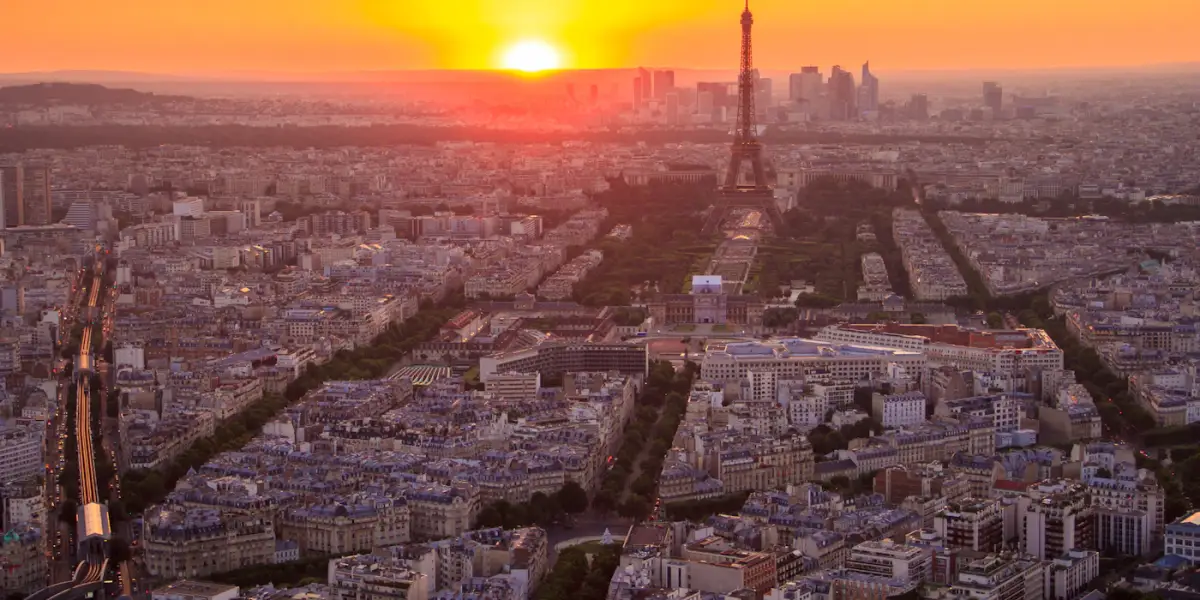
CityThe Eiffel Tower, the Louvre and Montmartre, with South Asian shops and Tamil food near Gare du Nord.
3–4 nightsabout 1 h by train from Paris airport
Paris
CityThe Eiffel Tower, the Louvre and Montmartre, with South Asian shops and Tamil food near Gare du Nord.
Paris grew up on the Seine around the Île de la Cité, where the city began some 2,000 years ago, and its neighbourhoods run from the student Latin Quarter on the Left Bank to Montmartre, which still feels like a hilltop village. The metro is usually the easiest way around, and the RER B train from Charles de Gaulle reaches Gare du Nord in about 35 minutes. Traditional French cooking is heavy on meat, but Paris is the easiest place in France to eat vegetarian; some cooks count fish as vegetarian, so say clearly what you do not eat.
What to do in Paris
- Eiffel Tower. Built for the 1889 Universal Exhibition on the Champ de Mars, it has a glass floor on its first level and views over the whole city from the top, and after dark it sparkles with lights.
- The Louvre and the Musée d'Orsay. The Louvre, a medieval fortress that became a royal palace and then a museum in 1793, holds the Mona Lisa, the Venus de Milo and the Winged Victory; across the river, the Orsay fills a railway station of 1900 with Impressionist paintings.
- Notre-Dame and the Île de la Cité. Walk the quays from the Pont Neuf to the Gothic cathedral, which reopened in December 2024 after five years of restoration that followed the 2019 fire.
- Montmartre and Sacré-Cœur. Climb past the painters and caricaturists of Place du Tertre to the Sacré-Cœur basilica, whose dome, 130 m above sea level, looks out across Paris.
- Little India around La Chapelle. Rue du Faubourg Saint-Denis, from Gare du Nord up to La Chapelle metro station, has South Asian grocers, clothes and jewellery shops, a mithai shop and Tamil and Pondicherry cooking, and the Passage Brady nearby is lined with Indian and Pakistani restaurants.
Sources: France.fr (Atout France, official tourism board): Paris, France.fr: Paris, what to do, what to see, France.fr: Eiffel Tower, the Iron Lady, France.fr: Louvre Museum, France.fr: The Orsay, from a train station to a museum, France.fr: Notre-Dame de Paris, France.fr: Notre-Dame de Paris, practical information, OUIGO (SNCF): Paris Aéroport Roissy-Charles de Gaulle station, Wikivoyage: Paris, Wikivoyage: Paris/10th arrondissement, Wikivoyage: Paris Charles de Gaulle Airport (checked 14 Oct)
Palace of Versailles
HeritageDay tripLouis XIV's palace: the Hall of Mirrors, gardens running to the Grand Canal and Marie-Antoinette's hamlet.
about 1 h 30 min by train from Paris airport
Palace of Versailles
HeritageDay tripLouis XIV's palace: the Hall of Mirrors, gardens running to the Grand Canal and Marie-Antoinette's hamlet.
Louis XIV turned his father's hunting lodge into the seat of the court and government in 1682, and it stayed the centre of royal power until the Revolution forced Louis XVI back to Paris in 1789. The palace has been a World Heritage site since 1979, and beyond its formal gardens lies a park of about 800 hectares. Versailles is about 20 km south-west of central Paris, around 45 minutes on the RER C, and Versailles Château–Rive Gauche station is a short walk from the palace.
What to do in Palace of Versailles
- Hall of Mirrors. The 73 m gallery with its 357 mirrors was mostly a passageway in Louis XIV's day, dressed up for the grandest receptions and the occasional ball.
- King's State Apartments. Seven linked salons where the court listened to music, danced and played billiards; the last, dedicated to Apollo, once held the king's silver throne.
- Gardens and the Grand Canal. From the central window of the Hall of Mirrors the view runs down André Le Nôtre's gardens to the 1,670 m Grand Canal, dug over 11 years, whose banks you can walk or cycle.
- Grand Trianon and Petit Trianon. Louis XIV built the pink-marble Grand Trianon from 1687 as a private retreat, and Louis XVI gave the neo-classical Petit Trianon to Marie-Antoinette in 1774.
- Queen's Hamlet. Marie-Antoinette's model village of 1783 to 1786, with a windmill and a dairy in the rustic style of Normandy, is reached through the Trianon estate or by the little train.
Sources: Palace of Versailles (official site): The Palace, Palace of Versailles: The Gardens, Palace of Versailles: The Park, Palace of Versailles: The Estate of Trianon, Palace of Versailles: Practical information, France.fr: 5 keys to understanding the Palace of Versailles, France.fr: Versailles, the palace behind a historic alliance, Wikivoyage: Versailles, Wikivoyage: Paris Charles de Gaulle Airport (checked 14 Oct)
Lyon
CityRoman theatres, Renaissance lanes with hidden passageways, the silk weavers' hill and Lyon's famous bouchon cooking.
2 nightsabout 2 h by train from Paris airport
Lyon
CityRoman theatres, Renaissance lanes with hidden passageways, the silk weavers' hill and Lyon's famous bouchon cooking.
Lyon began as Lugdunum, which the Romans set up on Fourvière hill in 43 BCE, and spread east across the peninsula where the Saône meets the Rhône; four of its historic districts, about 500 hectares, have been on the UNESCO list since 1998. The TGV takes about two hours from Paris, and direct trains run from Charles de Gaulle's station to Lyon Part-Dieu. The city sells itself on its food, served in traditional restaurants called bouchons.
What to do in Lyon
- Fourvière hill. Ride the funicular up from Vieux Lyon to the 19th-century basilica with its gilded mosaics and city view, then walk down past the two Roman theatres, the larger of which once held up to 10,000 people.
- Traboules of Vieux Lyon. Push open street doors into the passageways and courtyards that cut through Renaissance buildings from one street to the next; people live there, so keep your voice down.
- Croix-Rousse, the working hill. In the 19th century tens of thousands of silk weavers worked on this hill in buildings designed to house their looms, which now mixes weaving workshops, street art and long stairways.
- Eat in a bouchon. The classics are pike quenelles, Lyonnaise salad and praline tart, and the list also runs to charcuterie such as rosette sausage and andouillette, so vegetarians may do better in the city's other restaurants.
- Presqu'île and Rue Mercière. Between the two rivers, the Presqu'île holds Lyon's main shopping streets, and Rue Mercière is where the city goes out in the evening.
Sources: ONLYLYON Tourism (official Lyon tourist office): Lyon, UNESCO World Heritage site, ONLYLYON Tourism: The Old Lyon district, ONLYLYON Tourism: Lyon's traboules and courtyards, ONLYLYON Tourism: What to do on your first day in Lyon, ONLYLYON Tourism: Arriving by train, France.fr: Lyon, Wikivoyage: Lyon (checked 14 Oct)
Provence: Avignon and the Luberon
HeritageThe Popes' Palace and the broken bridge of Avignon, Roman sites, hilltop Luberon villages and summer lavender.
2–3 nightsabout 4 h by train from Paris airportBest Jun–Jul
Provence: Avignon and the Luberon
HeritageThe Popes' Palace and the broken bridge of Avignon, Roman sites, hilltop Luberon villages and summer lavender.
Avignon was the seat of the popes for much of the 14th century, and their palace and the old bridge over the Rhône are World Heritage sites. The TGV takes about 2 hours 40 minutes from Paris to Avignon TGV station, 6 km out of town, and a short train ride links it to the central station beside the old town. From here the Roman aqueduct of the Pont du Gard is about 30 km west, Arles is 17 minutes away by regional train, and the Luberon villages and lavender routes are explored by car or bike.
What to do in Provence: Avignon and the Luberon
- Palais des Papes. One of the largest Gothic buildings of medieval Europe, raised in under 20 years from 1335; chapels inside keep frescoes by Matteo Giovannetti, and the roof terraces look over the Rhône and the bridge.
- Pont d'Avignon. The 12th-century Saint-Bénezet bridge of the children's song now stops in mid-river, with just 4 of its 22 arches left after centuries of war and floods.
- Les Halles market. About 40 traders sell tapenade, herbes de Provence, candied fruit and fougasse under one roof, behind a façade covered by a living wall of plants.
- Pont du Gard and Arles. Day trips to the Roman aqueduct of the Pont du Gard and to Arles, full of Roman and Romanesque monuments, where Van Gogh lived and painted in 1888 and 1889.
- Luberon villages and lavender. Gordes piles its stone houses on a hill and Roussillon sits on ochre that colours it orange-red, and the Valensole plateau turns purple in early July.
Lavender flowers from the end of June through the summer, and cutting generally begins after mid-July, so aim for late June to mid-July.
Sources: Avignon Tourisme (official tourist office): Getting to and around Avignon, Avignon Tourisme: Avignon, city of the Popes, Avignon Tourisme: Pont d'Avignon, Avignon Tourisme: Avignon in 48 hours, France.fr: The Palais des Papes in Avignon, France.fr: The Pont d'Avignon, France.fr: Provence, what to do, what to see, France.fr: The 5-minute essential guide to French lavender, Wikivoyage: Avignon (checked 14 Oct)
Nice and the Côte d'Azur
BeachThe Promenade des Anglais, the old town's markets and socca, and trips along the coast to Èze, Villefranche and Monaco.
3 nightsabout 3 h by flight from Paris airportBest Jun–Sep
Nice and the Côte d'Azur
BeachThe Promenade des Anglais, the old town's markets and socca, and trips along the coast to Èze, Villefranche and Monaco.
Nice is the capital of the Côte d'Azur, and its seafront Promenade des Anglais curves for about 7 km around the Baie des Anges, the core of the 'Winter Resort Town of the Riviera' that UNESCO listed in 2021. The town beaches are pebble rather than sand, and regional trains and buses run along the coast to Villefranche, Èze, Monaco and Cannes. The TGV from Paris takes about five and a half hours against frequent daily flights, and tram line 2 links Nice airport with the city centre.
What to do in Nice and the Côte d'Azur
- Promenade des Anglais. Walk or cycle the seafront past palm trees and the famous blue chairs, and bring water shoes for the pebble beaches, which shelve steeply.
- Vieux-Nice and the Cours Saleya. The old town's narrow lanes of small restaurants and craft shops open onto the Cours Saleya market, piled with flowers, fruit, spices and Nice olives.
- Castle Hill. Climb the steps or take the lift up the Colline du Château, where the castle is long gone but the view sweeps over the bay, the old town's roofs and the port.
- Taste socca. Nice's street food includes socca, a chickpea-flour pancake baked over a wood fire, plus pissaladière onion tart, stuffed vegetables and the pan bagnat sandwich.
- Èze, Villefranche and Monaco. Buses run along the coast to the hilltop village of Èze, about half an hour away, whose cactus garden sits where a castle stood until 1706, and to the sandier beach at Villefranche; regional trains reach Monaco.
Summers are warm, dry and sunny with beach weather on most days and September usually stays warm; spring warms slowly, and it can feel wintry well into April.
Sources: Nice Côte d'Azur Tourism (official): Nice, Nice Côte d'Azur Tourism: What to do and see on a weekend in Nice, France.fr: Eze you like it on the Riviera, France.fr: Going to France by plane, Wikivoyage: Nice (checked 14 Oct)
Disneyland Paris
Theme parkTwo Disney parks with their own TGV station, about ten minutes by train from Charles de Gaulle.
1–2 nightsabout 30 min by train from Paris airportBest Jan–Mar, Oct–Nov
Disneyland Paris
Theme parkTwo Disney parks with their own TGV station, about ten minutes by train from Charles de Gaulle.
Disneyland Paris opened in 1992 at Marne-la-Vallée, about 35 km east of Paris, and has two theme parks: Disneyland Park, built around Sleeping Beauty Castle, and Disney Adventure World, which opened in 2002 as Walt Disney Studios. Its station, Marne-la-Vallée–Chessy, is right at the entrance, with TGVs from Charles de Gaulle taking about 10 minutes and RER A trains from central Paris. The resort has seven themed hotels, and vegetarian and vegan dishes are offered in its restaurants.
What to do in Disneyland Paris
- Sleeping Beauty Castle and Fantasyland. The pink, blue-spired castle, more than 50 m tall, leads into Fantasyland, the park's largest land, with its classic rides and princess meet-and-greets.
- Star Wars rides in Discoveryland. Hyperspace Mountain, an indoor roller coaster with a minimum height, is the land's highlight, and Star Tours is a 3D motion simulator with dozens of randomised scenes.
- Avengers Campus. In Disney Adventure World, the Marvel land has an indoor coaster ride alongside Iron Man and Captain Marvel and meet-and-greets with Marvel characters.
- Disney Village. The resort's shopping and entertainment street has restaurants, bars, shows and a cinema for the evenings.
The parks are busiest on Saturdays, in July and August, in French school holidays and in Christmas week; January to March and most of autumn are calmer, though the parks close earlier and some rides may be shut for refurbishment.
Sources: Wikivoyage: Disneyland Paris, France.fr: Disneyland Paris key figures (checked 14 Oct)
Loire Valley châteaux (Tours and Amboise)
HeritageRoyal Renaissance châteaux such as Chambord and Chenonceau, Leonardo da Vinci's last home and riverside cycle routes.
2 nightsabout 2 h by train from Paris airport
Loire Valley châteaux (Tours and Amboise)
HeritageRoyal Renaissance châteaux such as Chambord and Chenonceau, Leonardo da Vinci's last home and riverside cycle routes.
In the 15th and 16th centuries the kings of France settled their court along the Loire, and the Renaissance châteaux they and their nobles built line the river and its tributaries across a UNESCO-listed stretch of valley some 280 km long. Tours, about two hours from Charles de Gaulle by TGV, and Amboise make good bases; regional trains link the main towns and buses run out to some of the châteaux. The Loire à Vélo cycle route follows the river past vineyards and castles.
What to do in Loire Valley châteaux (Tours and Amboise)
- Château de Chambord. Francis I began turning this hunting estate into a showpiece in 1519; climb its double-spiral staircase, linked to Leonardo da Vinci's influence, up to roof terraces crowded with turrets and chimneys.
- Château de Chenonceau. Its galleries span the River Cher, and its gardens and rooms owe much to the women who ran it, among them Diane de Poitiers and Catherine de Médicis; the village station is only about 400 m away.
- Amboise and Clos Lucé. The royal château above the Loire holds Leonardo da Vinci's grave, and nearby Clos Lucé, where he spent his last three years, is a museum of his life with models of his inventions.
- Villandry gardens. The château of 1532 is best known for its themed gardens, including an ornamental vegetable garden and a green maze.
- Cycle the Loire à Vélo. The full route runs about 900 km, but shorter marked loops link one château to the next, and shops in many Loire towns hire bikes by the day.
Sources: Loire Valley Tourism (Centre-Val de Loire regional board): How to get here, Loire Valley Tourism: The Loire Valley, Loire Valley Tourism: The Loire Châteaux, France.fr: The Loire Valley, what to do, what to see, France.fr: 9 fascinating facts about the Château de Chambord, France.fr: Château de Chenonceau, Wikivoyage: Loire Valley, Wikivoyage: Tours, Wikivoyage: Amboise (checked 14 Oct)
Mont-Saint-Michel
HeritageA medieval abbey on a rock in a tidal bay with the highest tides in continental Europe, and guided barefoot bay walks.
1 nightabout 4 h 30 min by train from Paris airportBest Mar, Sep
Mont-Saint-Michel
HeritageA medieval abbey on a rock in a tidal bay with the highest tides in continental Europe, and guided barefoot bay walks.
Mont-Saint-Michel is a rocky islet in a wide bay on the Normandy coast, crowned by an abbey whose first sanctuary dates from the early 8th century and where Benedictine monks settled in 966; it has been on the UNESCO list since 1979. Cars stop at a mainland car park, and from there you walk across the bridge in about 45 minutes or ride the Le Passeur shuttle. From Paris it is a TGV to Rennes and then a bus of about 1 hour 10 minutes, and staying the night lets you see the village after the day visitors leave.
What to do in Mont-Saint-Michel
- The abbey and its cloister. Climb the Grande Rue and the abbey stairs to the Merveille, a 13th-century Gothic block whose cloister garden is ringed by 137 slender columns and opens onto the bay.
- West Terrace. From the abbey's terrace the bay spreads over nearly 500 km², with the islet of Tombelaine, salt-meadow sheep and, on clear days, the Chausey islands to the north.
- Ramparts at dawn and dusk. Once the crowds have gone the lanes and ramparts fall quiet, and the North Tower is the tourist office's pick for watching the sun rise over the bay.
- Cross the bay with a guide. Barefoot walks over the sands, from a short look at the quicksand to a 13 km round trip, must be led by a certified guide; never head out alone.
- Watch a spring tide. On the biggest tides the gap between low and high water reaches about 15 m and the sea comes in fast, cutting the Mount off as an island on about 20 days a year.
The most spectacular tides, when the sea surrounds the rock completely, come around the spring and autumn equinoxes.
Sources: Mont Saint-Michel Normandie tourist office: By train, plane and ferry, Mont Saint-Michel Normandie tourist office: By foot and bicycle, Mont Saint-Michel Normandie tourist office: Spend a night at the Mont Saint-Michel, Mont Saint-Michel Normandie tourist office: The high tides and the tidal bore, Mont Saint-Michel Normandie tourist office: The crossings of the bay, Abbey of Mont-Saint-Michel (Centre des monuments nationaux): The cloister, Abbey of Mont-Saint-Michel: The high tides, Abbey of Mont-Saint-Michel: The West Terrace, France.fr: Mont-Saint-Michel, wonder of the West, France.fr: A perfect family day out at Mont-Saint-Michel, Wikivoyage: Mont Saint-Michel (checked 14 Oct)
Strasbourg
CityA pink-sandstone cathedral, half-timbered Petite France on the canals, a big Christmas market and Alsace wine villages.
2 nightsabout 2 h 30 min by train from Paris airport
Strasbourg
CityA pink-sandstone cathedral, half-timbered Petite France on the canals, a big Christmas market and Alsace wine villages.
Strasbourg, the capital of Alsace on the border with Germany, keeps its old centre on the Grande Île, an island joined to the rest of the city by 21 bridges, and both the island and the Neustadt, built under German rule after 1871, are UNESCO-listed. Its food and buildings mix French and German traditions, from half-timbered houses to winstub bistros serving flammekueche and choucroute. TGVs run direct from Charles de Gaulle in about 2 hours 25 minutes, and Colmar, about an hour to the south with direct trains, is the gateway to the Alsace wine route.
What to do in Strasbourg
- Strasbourg Cathedral. Built of pink sandstone with a 142 m spire, it houses an astronomical clock brought back to life in 1842, and 330 steps lead up to a viewing platform over the city.
- Petite France. The old quarter of tanners and millers is all canals, locks and half-timbered houses; see it from the roof terrace of the Vauban dam, a 17th-century defensive weir.
- Boat trip on the Ill. Boats leave from below the Palais Rohan on a loop of the old centre or a longer route that also takes in the European quarter and its round European Parliament building.
- Christmas market in season. In the run-up to Christmas some 300 chalets fill Place Kléber, Place Broglie and the cathedral square, selling crafts, decorations, mulled wine and Alsatian Christmas biscuits.
- Colmar and the wine villages. Take a flat-bottomed boat through Colmar's Little Venice, then visit wine-route villages such as Eguisheim, Kaysersberg and Riquewihr.
Sources: France.fr: Strasbourg, France.fr: What to do and see in Strasbourg, France.fr: Strasbourg, France.fr: Colmar, Wikivoyage: Strasbourg, Wikivoyage: Colmar (checked 14 Oct)
Chamonix-Mont-Blanc
Hill countryA cable car to 3,842 m facing Mont Blanc, a rack railway to the Mer de Glace glacier, skiing and summer hikes.
2–3 nightsabout 7 h by train from Paris airport
Chamonix-Mont-Blanc
Hill countryA cable car to 3,842 m facing Mont Blanc, a rack railway to the Mer de Glace glacier, skiing and summer hikes.
Chamonix sits in a valley at the foot of Mont Blanc, close to where France, Italy and Switzerland meet, and it lived off farming until two Englishmen explored the glacier they named the Mer de Glace in 1741 and wrote about it back home, starting its tourist trade; two local men, Jacques Balmat and Michel Paccard, made the first ascent of Mont Blanc in 1786. Cable cars and a rack railway climb from the town to high viewpoints, with skiing in winter and hiking and paragliding in summer. It is a long way from Paris: most visitors fly into Geneva, about 90 km away, while from Paris you can go by train via Geneva and Martigny, or by train to Annecy and a bus to Saint-Gervais, to join the valley's mountain railway.
What to do in Chamonix-Mont-Blanc
- Aiguille du Midi. The cable car climbs in about 20 minutes to 3,842 m, where a glass box called Le Pas dans le Vide hangs over a 1,000 m drop; take warm layers, because the top is very cold and windy, summer included.
- Montenvers and the Mer de Glace. A rack railway climbs to 1,913 m above the Mer de Glace glacier, and a gondola takes you down towards an ice cave cut by hand into the glacier every year.
- Le Brévent. A gondola to Planpraz at 2,000 m and a cable car on to Le Brévent at 2,525 m give a full view of the Mont Blanc range; paragliders take off from Planpraz.
- Ski the valley. Five ski areas run from 1,035 m to 3,300 m, with gentle low slopes for beginners and children and steep, snow-sure terrain at Grands-Montets for experts.
- Panoramic Mont-Blanc gondola. In summer only, carry on from the top of the Aiguille du Midi over the Géant glacier towards Italy.
Sources: Chamonix-Mont-Blanc Valley tourist office: Aiguille du Midi cable car, Chamonix-Mont-Blanc Valley tourist office: Mer de Glace and Montenvers train, Chamonix-Mont-Blanc Valley tourist office: Brévent cable car, Chamonix-Mont-Blanc Valley tourist office: Chamonix-Mont-Blanc, Chamonix-Mont-Blanc Valley tourist office: Summer in the valley, Chamonix-Mont-Blanc Valley tourist office: Winter in the valley, Chamonix-Mont-Blanc Valley tourist office: Skiing, France.fr: Visit Chamonix-Mont-Blanc, Wikivoyage: Chamonix (checked 14 Oct)
A first trip: 10–12 nights
- Paris · 3–4n
- →Palace of Versailles
- →Lyon · 2n
- →Provence: Avignon and the Luberon · 2–3n
- →Nice and the Côte d'Azur · 3n
Land at Charles de Gaulle and base yourself in Paris with a day out at Versailles, then take the TGV south to Lyon and Avignon and on to Nice, and fly back to Paris for the flight home; Disneyland Paris, ten minutes from the airport by TGV, fits at either end. Late June to mid-July catches the Provence lavender in bloom and the Riviera in beach season; for a different first trip, swap the south for the Loire châteaux and Mont-Saint-Michel, or in winter for the ski slopes of Chamonix.
Getting around
High-speed TGV trains do most of the work: they stop at Charles de Gaulle's own station on the way to cities such as Lyon, Strasbourg, Rennes and Tours, from central Paris they reach the big regional cities in a few hours, and slower TER regional trains cover the smaller towns. Nice is about five and a half hours from Paris by TGV, and there are frequent daily flights between Paris and the Riviera. The Luberon villages, the lavender fields and the smaller Loire châteaux are explored by car, bike or local bus, and Mont-Saint-Michel is a bus ride from the TGV station at Rennes.
Peak Shoulder Off-season
Paris je t'aime's climate page gives summer highs of 23-26°C and calls spring and autumn the periods of moderate tourist numbers, advising a visit then to avoid high-season prices and summer heat. Winter highs are 7-9°C with December the wettest month, so November to February is the quiet, cheaper stretch.
Flights to France from India
Visa for Indian passports
Indian passport holders need a visa for France before travel. Allow about 45 days for a first-time application. Schengen visa via VFS; summer processing can take 4–8 weeks.
Before you book, check the Ministry of External Affairs travel advisories for the latest guidance.
France: questions
What are the best places to visit in France?
Paris: The Eiffel Tower, the Louvre and Montmartre, with South Asian shops and Tamil food near Gare du Nord. Palace of Versailles: Louis XIV's palace: the Hall of Mirrors, gardens running to the Grand Canal and Marie-Antoinette's hamlet. Lyon: Roman theatres, Renaissance lanes with hidden passageways, the silk weavers' hill and Lyon's famous bouchon cooking. Provence: Avignon and the Luberon: The Popes' Palace and the broken bridge of Avignon, Roman sites, hilltop Luberon villages and summer lavender. Nice and the Côte d'Azur: The Promenade des Anglais, the old town's markets and socca, and trips along the coast to Èze, Villefranche and Monaco. Disneyland Paris: Two Disney parks with their own TGV station, about ten minutes by train from Charles de Gaulle. Loire Valley châteaux (Tours and Amboise): Royal Renaissance châteaux such as Chambord and Chenonceau, Leonardo da Vinci's last home and riverside cycle routes. Mont-Saint-Michel: A medieval abbey on a rock in a tidal bay with the highest tides in continental Europe, and guided barefoot bay walks. Strasbourg: A pink-sandstone cathedral, half-timbered Petite France on the canals, a big Christmas market and Alsace wine villages. Chamonix-Mont-Blanc: A cable car to 3,842 m facing Mont Blanc, a rack railway to the Mer de Glace glacier, skiing and summer hikes.
How many days do you need for France?
A first trip takes about 10–12 nights: Paris (3–4 nights), Palace of Versailles (1 night), Lyon (2 nights), Provence: Avignon and the Luberon (2–3 nights), Nice and the Côte d'Azur (3 nights). Land at Charles de Gaulle and base yourself in Paris with a day out at Versailles, then take the TGV south to Lyon and Avignon and on to Nice, and fly back to Paris for the flight home; Disneyland Paris, ten minutes from the airport by TGV, fits at either end. Late June to mid-July catches the Provence lavender in bloom and the Riviera in beach season; for a different first trip, swap the south for the Loire châteaux and Mont-Saint-Michel, or in winter for the ski slopes of Chamonix.
What is the best time to visit France?
Peak season is Jun–Aug. Paris je t'aime's climate page gives summer highs of 23-26°C and calls spring and autumn the periods of moderate tourist numbers, advising a visit then to avoid high-season prices and summer heat. Winter highs are 7-9°C with December the wettest month, so November to February is the quiet, cheaper stretch.
Do Indians need a visa for France?
Indian passport holders need a visa for France before travel. Allow about 45 days for a first-time application. Schengen visa via VFS; summer processing can take 4–8 weeks.
How much is a flight to France from India?
The lowest return fare FlyBun has seen in the last 14 days is ₹41,200, Delhi to Paris, for October 2026 departures. Fares change daily.
Places and things to do are written by FlyBun from official tourism, heritage and park sources, linked under each place, last checked 14 Oct. We leave out entry fees and opening hours because they change; check them before you go.
Watch a route and FlyBun alerts you free when its fare drops.