

Travel guide from India
Germany
Germany is a long-haul flight from India, and Frankfurt and Munich, its two main hubs for intercontinental flights, sit at either end of the classic first trip. Between them lie the castle-lined Rhine gorge, half-timbered medieval towns, King Ludwig II's castles and the Bavarian Alps, all linked by fast, frequent trains. Vegetarians can manage: most restaurants have one or two meatless dishes, though places aimed at vegetarians are mostly in the bigger cities.
- Best time
- May–Sep
- First trip
- 8–11 nights
- Visa
- Visa needed, 90 days
- Return flights
- from ₹40,502 ●
- Mumbai, checked in the last 48 h
Places to visit in Germany
10 places in the order you would meet them on a first trip. Tap one for what to do there.
Frankfurt
CityGermany's finance capital: a skyscraper skyline, a rebuilt old town, riverside museums and apple-wine taverns.
1 nightabout 30 min by train from Frankfurt airport
Frankfurt
CityGermany's finance capital: a skyscraper skyline, a rebuilt old town, riverside museums and apple-wine taverns.
Frankfurt am Main is Germany's banking and trade-fair city, where a cluster of skyscrapers rises beside a small historic core around the Römerberg that was largely destroyed in the Second World War and carefully restored. The main sights are within walking distance on both banks of the Main, and the S-Bahn runs from the airport to the main station in about 20 minutes.
What to do in Frankfurt
- Römerberg and the Imperial Cathedral. The Römer, Frankfurt's old town hall, fronts the square, and Holy Roman emperors were crowned in St Bartholomew's Cathedral a few steps away in the 17th and 18th centuries.
- New Old Town. Finished in 2018 between the Römer and the cathedral, this small quarter has 35 houses, 15 of them faithful copies of buildings lost in the war, now holding cafés, shops and museums.
- Main Tower. The observation platform at the top of this tower in the banking district looks out over the skyline and across the whole Rhine-Main region.
- Museum Embankment. Museums line the banks of the Main here, led by the Städel, one of Germany's leading art galleries, with European art spanning about nine centuries.
- Apple wine in Sachsenhausen. Old taverns south of the river pour Ebbelwoi, the local apple wine, with Hessian dishes such as Grüne Soße, a thick sauce of eggs and seven to nine fresh herbs eaten with potatoes.
Sources: Frankfurt Tourism: Top 10 attractions, Frankfurt Tourism: Attractions, Frankfurt Tourism: New Old Town, Frankfurt Tourism: Arrival, Frankfurt Tourism: Frankfurt Christmas Market, Germany.travel (GNTB): Frankfurt, Wikivoyage: Frankfurt, Wikivoyage: Germany, Wikivoyage: Christmas markets (checked 14 Oct)
Rhine Valley (Bacharach and St. Goar)
HeritageThe castle-lined Rhine gorge: river boats, the Loreley rock, vineyard walks and small wine towns.
1–2 nightsabout 1 h 30 min by train from Frankfurt airportBest Apr–Oct
Rhine Valley (Bacharach and St. Goar)
HeritageThe castle-lined Rhine gorge: river boats, the Loreley rock, vineyard walks and small wine towns.
Between Bingen and Koblenz the Rhine winds through a deep, steep-sided gorge of vineyards and woods, and this stretch is a UNESCO World Heritage Site; the regional tourist board counts more than 60 castles, fortresses and palaces along the 120 km of river between Bingen and Remagen. Small wine towns line both banks, and Bacharach and St. Goar, on the west bank, are on the railway from Mainz; Bacharach is an hour to an hour and a half from Frankfurt Airport with one change.
What to do in Rhine Valley (Bacharach and St. Goar)
- Take a boat along the gorge. Boats call at the riverside towns from spring to autumn, passing the Loreley; sailing downstream (northwards) is quicker, so you can go one way by boat and return by train.
- The Loreley. This rock rises over a sharp bend in the river opposite St. Goar; a statue of the Lorelei stands on the bank at St. Goarshausen, and a footpath or shuttle bus climbs to the plateau and its visitor centre for the view.
- Rheinfels Castle. Work on this fortress above St. Goar began in 1245, and though only about a fifth of it survives, you can still explore its ramparts and underground passages; bring a torch.
- Bacharach and Stahleck Castle. Climb from the well-preserved medieval town to Stahleck, an 11th-century castle that is now a youth hostel, for a wide view of the river; Victor Hugo counted Bacharach among the world's prettiest towns.
- Walk a stretch of the castle trails. The Rheinburgenweg on the west bank and the Rheinsteig on the east each run for hundreds of kilometres along the hills above the river, passing castles and viewpoints.
River boats run from about April to October, with the most sailings from May to September; almost all cruises stop by November, and many inns close for the winter.
Sources: Romantic Rhine Tourism: Castles, palaces and fortresses at a glance, Romantic Rhine Tourism: Home, Germany.travel (GNTB): World Heritage family route (Loreley), Rüdesheim am Rhein tourism: Railway modernisation on the right bank, Wikivoyage: Middle Rhine Valley, Wikivoyage: Bacharach, Wikivoyage: Sankt Goar (checked 14 Oct)
Heidelberg
HeritageA castle ruin above the Neckar, Germany's oldest university, an 18th-century bridge and the Philosophers' Walk.
1 night1 h by train from Frankfurt airport
Heidelberg
HeritageA castle ruin above the Neckar, Germany's oldest university, an 18th-century bridge and the Philosophers' Walk.
Heidelberg lies where the Neckar valley opens out of the Odenwald hills onto the Rhine plain, its old town of narrow baroque streets squeezed between the river and the castle ruin on the slope above. Its university, founded in 1386, is the oldest in Germany, and the city came through the Second World War almost untouched by the bombing that wrecked many larger German city centres.
What to do in Heidelberg
- Heidelberg Castle. The ruined castle sits about 70 m above the Neckar, reached by steps or the mountain railway; its cellar holds a giant wine barrel that Germany's tourism board calls the largest in the world.
- Old Bridge and the old town. Cross the Karl Theodor Bridge, built in 1788, then follow the long pedestrian Hauptstraße to the Marktplatz and the Church of the Holy Spirit.
- Philosophers' Walk. This path on the north side of the river looks straight across the water to the oldest part of town.
- Up to the Königstuhl. The mountain railway carries on past the castle to the 568 m summit of the Königstuhl, which looks out over the city and the Rhine valley.
- The old university. The university museum on the old campus shows the Great Hall and the university's former student jail.
Sources: Heidelberg Marketing: Arrival and departure, Germany.travel (GNTB): Heidelberg, Wikivoyage: Heidelberg (checked 14 Oct)
Rothenburg ob der Tauber
HeritageA walled medieval town on the Romantic Road: towers and gates, a walk along the ramparts and the Plönlein.
1 nightabout 3 h by train from Frankfurt airport
Rothenburg ob der Tauber
HeritageA walled medieval town on the Romantic Road: towers and gates, a walk along the ramparts and the Plönlein.
Rothenburg sits high above the Tauber valley on the Romantic Road, roughly halfway between Frankfurt and Munich, and its old town is still ringed by a medieval wall with towers and gates. It grew rich as a self-governing imperial city in the 14th and 15th centuries; an air raid in 1945 destroyed about 45 percent of the walled town, which was rebuilt after the war.
What to do in Rothenburg ob der Tauber
- Walk the town wall. The roofed walkway along the 14th-century wall, about 2.5 km long, gives views over the rooftops; the stretch from the Spitaltor to the Klingentor takes about half an hour.
- The Plönlein. At this small triangular square a half-timbered house stands between the Siebers Tower of 1385 and the Kobolzell Gate of 1360, one of the most photographed corners in Germany.
- Market Square and the Town Hall Tower. Climb the 241 steps of the 13th-century tower, about 50 m high, for the best view over the old town.
- St. James' Church. Built between 1311 and 1485, the church holds the Holy Blood Altar carved by Tilman Riemenschneider.
- Try a Schneeball. The town's speciality is a ball of crisp shortcrust pastry sold in many flavours, a popular souvenir to carry home.
Sources: Rothenburg Tourism: Top 10, Rothenburg Tourism: Sights, Rothenburg Tourism: Journey through history, Rothenburg Tourism: Culinary, Rothenburg Tourism: Getting there, Germany.travel (GNTB): Rothenburg ob der Tauber, Germany.travel (GNTB): World Heritage cultural route (Frankfurt to Würzburg by train), Wikivoyage: Rothenburg ob der Tauber (checked 14 Oct)
Munich
CityBavaria's capital: Marienplatz, royal palaces, a big food market, beer gardens and Oktoberfest each autumn.
2–3 nights45 min by train from Munich airport
Munich
CityBavaria's capital: Marienplatz, royal palaces, a big food market, beer gardens and Oktoberfest each autumn.
Munich, the capital of Bavaria and Germany's third-largest city, lies on the Isar and was badly bombed in the Second World War, after which the Frauenkirche, the town hall and much of the old centre were rebuilt. Marienplatz, the Frauenkirche and the Viktualienmarkt are only a few hundred metres apart, and every year from the second half of September into early October Oktoberfest takes over the Theresienwiese. Vegetarian and vegan dishes are on many menus, and some cafés serve only vegetarian food.
What to do in Munich
- Marienplatz and the New Town Hall. The Glockenspiel in the town hall tower acts out a ducal wedding of 1568 and the coopers' dance, so the square fills quickly before each show; in Advent it holds the city's Christmas market.
- Viktualienmarkt. Munich's largest market has sold fruit, cheese, flowers and spices for over 200 years, around a beer garden shaded by chestnut trees.
- Residenz and Nymphenburg Palace. The Residenz, the Wittelsbach rulers' palace in the centre, grew over more than 600 years and keeps the crown jewels in its Treasury; the Baroque Nymphenburg Palace has a long canal, a large park and a museum of royal carriages.
- English Garden. This 375-hectare park along the Isar has the Chinese Tower with its beer garden, and the Monopteros, a small round temple with a view back over the old town skyline.
- Dachau Concentration Camp Memorial. About 29 km north-west of the city and roughly 40 minutes away by S-Bahn and bus, Germany's first Nazi concentration camp, opened in 1933, is now a memorial; allow half a day.
Sources: City of Munich (muenchen.de): 25 top sights and attractions, City of Munich (muenchen.de): Munich Glockenspiel, City of Munich (muenchen.de): Oktoberfest, City of Munich (muenchen.de): Dachau Concentration Camp Memorial Site, City of Munich (muenchen.de): Munich Airport, Germany.travel (GNTB): Munich, Wikivoyage: Munich (checked 14 Oct)
Neuschwanstein and Füssen
HeritageLudwig II's fairy-tale castle above the Pöllat Gorge, his childhood home Hohenschwangau and the old town of Füssen.
1 nightabout 3 h by train from Munich airportBest Dec–Feb
Neuschwanstein and Füssen
HeritageLudwig II's fairy-tale castle above the Pöllat Gorge, his childhood home Hohenschwangau and the old town of Füssen.
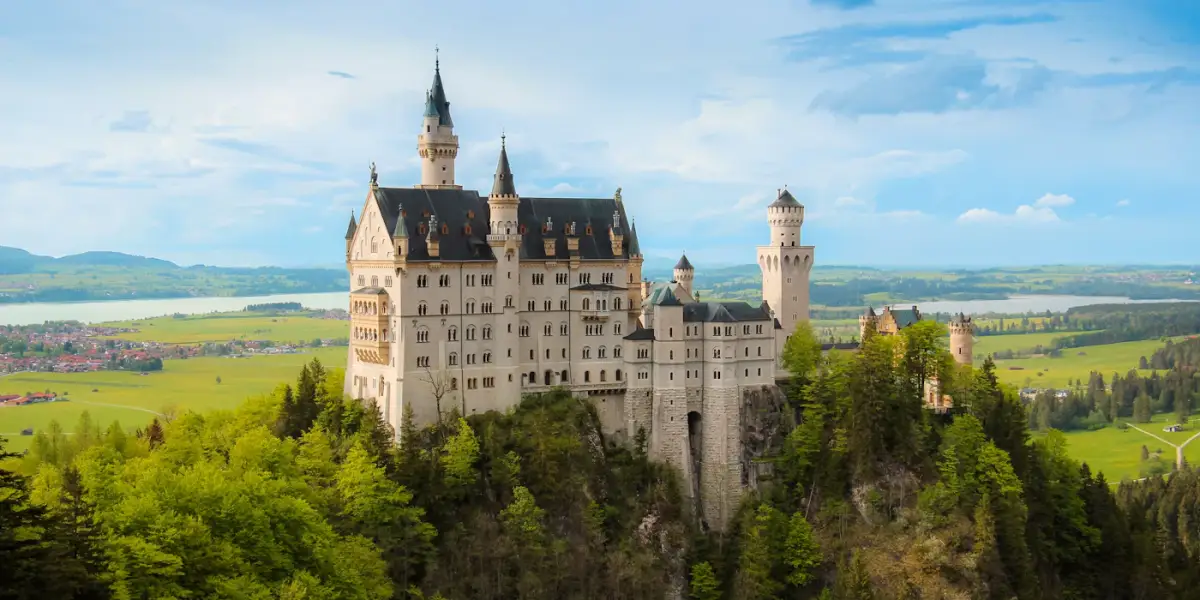
King Ludwig II of Bavaria began Neuschwanstein in 1869 as an idealised medieval castle fitted with the latest technology, never saw it finished, and it opened to visitors weeks after his death in 1886; in 2025 it became a UNESCO World Heritage Site together with his palaces at Linderhof and Herrenchiemsee. It stands above the village of Hohenschwangau, a few kilometres from Füssen, the old town at the southern end of the Romantic Road, which direct trains reach from Munich in about two hours. With about 1.4 million visitors a year, it is one of Europe's most popular castles.
What to do in Neuschwanstein and Füssen
- Inside Neuschwanstein. The king's rooms on the third and fourth floors include the 15 m-high Throne Room in gold and blue and the Singers' Hall, modelled on the Wartburg's but grander; the second floor was never finished.
- Walk up from Hohenschwangau. The road from the village climbs about 1.5 km to the castle, a steep walk of 30 to 40 minutes; horse-drawn carriages and buses cover most of the way (the buses stop in snow or ice), but the last few hundred metres are on foot.
- The view from the Marienbrücke. King Maximilian II had this bridge put up for Queen Marie to make it easier for her to reach the mountains; it spans the deep Pöllat Gorge and gives the classic view of the castle.
- Hohenschwangau Castle. Ludwig's father, Maximilian II, rebuilt a ruin here in neo-Gothic style in the 1830s as a summer home, and Ludwig spent much of his childhood in it.
- Füssen old town and the Lech Falls. Wander the lanes below the High Castle, built as a summer seat for Augsburg's prince-bishops, then walk to the Lech Falls, where the turquoise river drops 12 m over five steps into a gorge.
Füssen's tourist board calls winter the best time for Neuschwanstein, with smaller crowds and snow on the hills; the buses from Füssen station are at their fullest from July to September.
Sources: Bavarian Palace Administration: Neuschwanstein today, Bavarian Palace Administration: Neuschwanstein building history, Bavarian Palace Administration: Tour of the castle, Bavarian Palace Administration: How to get there, Füssen Tourism: Neuschwanstein Castle, Füssen Tourism: Hohenschwangau Castle, Füssen Tourism: High Castle, Füssen Tourism: The Lech, Germany.travel (GNTB): Neuschwanstein Castle, Germany.travel (GNTB): The Romantic Road, Wikivoyage: Füssen, City of Munich (muenchen.de): Munich Airport (checked 14 Oct)
Garmisch-Partenkirchen and the Zugspitze
Hill countryAlpine resort at the foot of the Zugspitze, Germany's highest peak, with gorges, lakes and a 1936 Olympic past.
1–2 nightsabout 2 h 30 min by train from Munich airportBest Jun–Sep
Garmisch-Partenkirchen and the Zugspitze
Hill countryAlpine resort at the foot of the Zugspitze, Germany's highest peak, with gorges, lakes and a 1936 Olympic past.
Garmisch and Partenkirchen were separate market towns until they were merged for the 1936 Winter Olympics, and the joint town lies at the foot of the Zugspitze, at 2,962 m the highest mountain in Germany. Regional trains from Munich run hourly and take 80 to 90 minutes, and the cogwheel railway up the mountain starts next to the main station.
What to do in Garmisch-Partenkirchen and the Zugspitze
- Up the Zugspitze. Ride the cogwheel railway (about 1 hour 20 minutes from town) to the Zugspitzplatt plateau and the glacier cable car on to the summit, or take the cable car straight up, for a view of some 400 peaks.
- Partnach Gorge. A path cut into the rock follows the roaring Partnach for about 700 m through this narrow gorge, which can be walked at any time of year.
- Lake Eibsee. A clear, turquoise lake of about 177 hectares below the Zugspitze, good for a walk along the shore, a swim or a hired boat in summer.
- AlpspiX viewing platform. Two steel walkways cross in an X beside the Alpspitz cable car's top station, about 1,000 m above the valley floor, ending 25 m out at a glass wall.
- Ludwigstrasse and the Olympic ski jump. Walk the historic main street of Partenkirchen, then visit the Olympic ski stadium on the Gudiberg, a venue of the 1936 Winter Games, whose ski jump still hosts international competitions.
The town's tourist board names mid-June to mid-September as the best time to hike up the Zugspitze, when the avalanche risk is lowest; in winter the Zugspitzplatt becomes a glacier ski area.
Sources: GaPa Tourism: Zugspitze, GaPa Tourism: Lake Eibsee, GaPa Tourism: AlpspiX, GaPa Tourism: Great Olympic Ski Jump, GaPa Tourism: Arrival, Germany.travel (GNTB): Garmisch-Partenkirchen, Wikivoyage: Garmisch-Partenkirchen, GaPa Tourism: Skiing, Partnachklamm: official gorge site, City of Munich (muenchen.de): Munich Airport (checked 14 Oct)
Cologne
CityA Gothic cathedral by the Rhine, twelve Romanesque churches, Kölsch beer halls and a famous street carnival.
1–2 nightsabout 1 h by train from Frankfurt airport
Cologne
CityA Gothic cathedral by the Rhine, twelve Romanesque churches, Kölsch beer halls and a famous street carnival.
Cologne was founded by the Romans on the Rhine and is now Germany's fourth-largest city; its 157 m Gothic cathedral, a UNESCO World Heritage Site, stands right beside the main station. Its street carnival takes over the city in the days before Ash Wednesday, and direct high-speed trains from Frankfurt Airport take under an hour, so Cologne also works as a first stop before heading south along the Rhine.
What to do in Cologne
- Cologne Cathedral. Completed only in 1880 after 632 years of building, it holds the Shrine of the Three Kings and over 10,000 square metres of stained glass, including Gerhard Richter's 2007 window of 11,263 coloured squares; cover your shoulders and take off hats.
- Hohenzollern Bridge and the riverside. Cross the Hohenzollern Bridge, its railings heavy with tonnes of love locks, for a view back to the cathedral, then stroll along the Rhine into the Old Town.
- Kölsch in a brewery tavern. The old brewery taverns around the cathedral and the Old Town serve Kölsch in slim 0.2-litre glasses, carried round by waiters called Köbes; some now offer meatless dishes too.
- Romanesque churches. Twelve churches built between 1000 and 1250 form a semicircle around the centre, and some stand on Roman remains that can be seen as well.
- Cable car over the Rhine. Since 1957 small cabins have swung about 50 m above the river between the Zoo and the Rheinpark, a six-minute ride in the warmer months.
Sources: Cologne Tourism: Cologne Cathedral, Cologne Tourism: Sights, Cologne Tourism: Brewery culture in Cologne, Cologne Tourism: 12 Romanesque churches, Cologne Tourism: Cologne cable car, Cologne Tourism: Carnival, Cologne Tourism: Christmas in Cologne, Germany.travel (GNTB): Cologne, Germany.travel (GNTB): Travelling by rail, Wikivoyage: Cologne (checked 14 Oct)
Freiburg and the Black Forest
Hill countryFreiburg's Gothic minster and old town, then forest hills, Lake Titisee, cuckoo clocks and Black Forest cake.
2 nightsabout 2 h by train from Frankfurt airport
Freiburg and the Black Forest
Hill countryFreiburg's Gothic minster and old town, then forest hills, Lake Titisee, cuckoo clocks and Black Forest cake.
The Black Forest is a range of wooded hills in Germany's south-west corner, rising to 1,493 m at the Feldberg and known for cuckoo clocks, hiking and Black Forest gateau. Freiburg, a historic university city on its edge known for its sunshine, is the easiest base: direct trains from Frankfurt Airport take about two hours, and regional trains run from Freiburg up to Lake Titisee.
What to do in Freiburg and the Black Forest
- Freiburg Minster. Begun around 1200, the minster got its 116 m west tower, topped by an openwork stone spire, around 1330; the windows donated by medieval guilds and the more than 400 carved figures of the west porch tell Bible stories in detail.
- The Bächle and the minster market. Narrow water channels, the Bächle, run along the old town's streets, and the market around the minster sells the Lange Rote sausage in a roll as well as a tofu version for vegetarians.
- Lake Titisee. Trains from Freiburg reach this lake of about 1 square kilometre, with a holiday village and hotels by the water and fine views.
- Triberg waterfall and cuckoo clocks. In Triberg, in the heart of the Black Forest, a waterfall drops a total of about 163 m through the woods, and the shops in town are known for Black Forest cuckoo clocks.
- Black Forest Open-Air Museum. The Vogtsbauernhof, a farmhouse more than 300 years old, is the heart of a museum of historic farms, mills and gardens moved here from across the Black Forest.
Sources: Freiburg Tourism (visit.freiburg.de): Freiburg Minster, Freiburg Tourism (visit.freiburg.de): Old town, Freiburg Tourism (visit.freiburg.de): Must-see destinations around Freiburg, Wikivoyage: Black Forest, Wikivoyage: Freiburg, Wikivoyage: Titisee-Neustadt, Wikivoyage: Triberg im Schwarzwald (checked 14 Oct)
Berlin
CityThe capital: Brandenburg Gate, the Reichstag dome, Museum Island and what is left of the Berlin Wall.
3 nightsabout 5 h by train from Munich airport
Berlin
CityThe capital: Brandenburg Gate, the Reichstag dome, Museum Island and what is left of the Berlin Wall.
Berlin is Germany's capital and largest city, home to about 3.7 million people, and its sights run from Prussian palaces and Nazi-era sites to the remains of the Wall and the glass towers built after reunification. It lies well off the southern route, but the fastest trains from Munich take just under four hours. Vegetarians eat well here, and Kreuzberg and Neukölln have plenty of Indian restaurants.
What to do in Berlin
- Brandenburg Gate and the Reichstag. The gate, built in 1791 and now the symbol of reunification, stands a short walk from the Reichstag, whose walk-through glass dome looks down on the parliament and out over the city.
- Museum Island. The museums on this UNESCO-listed island trace more than 6,000 years of human culture and art, with the domed Berlin Cathedral beside them.
- Berlin Wall Memorial and East Side Gallery. On Bernauer Strasse an original stretch of the Wall with a watchtower shows how the border worked; the East Side Gallery, over 1,300 m long, was decorated after the Wall fell by 118 artists from 21 countries.
- TV Tower at Alexanderplatz. Built in the 1960s in what was East Berlin, the 368 m tower is the tallest building in the city, with a 360-degree view from its deck.
- Charlottenburg Palace and the Kurfürstendamm. In the west, the palace built around 1700 for Queen Sophie Charlotte has Rococo state rooms and a riverside park, and the Kurfürstendamm, also in Charlottenburg, is the city's most popular shopping street.
Sources: visitBerlin: Top 10 attractions, Germany.travel (GNTB): Berlin, Wikivoyage: Berlin, City of Munich (muenchen.de): Munich Airport, Wikivoyage: Munich (checked 14 Oct)
A first trip: 8–11 nights
- Frankfurt · 1n
- →Rhine Valley (Bacharach and St. Goar) · 1–2n
- →Heidelberg · 1n
- →Rothenburg ob der Tauber · 1n
- →Munich · 2–3n
- →Neuschwanstein and Füssen · 1n
- →Garmisch-Partenkirchen and the Zugspitze · 1–2n
Fly into Frankfurt and home from Munich: after Frankfurt, follow the Rhine gorge by train or boat, stop in Heidelberg and Rothenburg on the way to Munich, then loop through Füssen and Garmisch-Partenkirchen before flying out; Cologne fits in before the Rhine, the Black Forest after Heidelberg, and Berlin is about four to five hours from Munich by fast train. Rhine boats run mainly from April to October and summer is the time for Alpine walks, while in Advent (late November and December) Christmas markets fill the old squares, Füssen's tourist board recommends winter at Neuschwanstein for its smaller crowds, and Oktoberfest fills Munich from the second half of September into early October.
Getting around
Trains do most of the work: high-speed ICE and Intercity trains link the big cities about once an hour (Frankfurt to Cologne takes about an hour), and regional trains, often with one change, reach smaller places such as Rothenburg, Füssen and the Rhine villages. Long-distance trains are often late, so leave a buffer before flights and tight connections. On the Rhine, river boats are a slower, scenic alternative to the train from spring to autumn, and car ferries cross the river where there are no bridges.
Peak Shoulder Off-season
No official Frankfurt or German tourism page describes tourist seasons, so these ratings are derived from NASA POWER climate normals: highs of 20-27°C from May to September, 16°C in April and October, and 4-9°C with 11-14 rain days a month from November to March. December is cold but the Christmas market makes it busy, and trade fairs can fill hotels in any month.
Flights to Germany from India
Visa for Indian passports
Indian passport holders need a visa for Germany before travel. Allow about 40 days for a first-time application. Schengen visa via VFS. Allow 60+ days for April–August travel.
Before you book, check the Ministry of External Affairs travel advisories for the latest guidance.
Germany: questions
What are the best places to visit in Germany?
Frankfurt: Germany's finance capital: a skyscraper skyline, a rebuilt old town, riverside museums and apple-wine taverns. Rhine Valley (Bacharach and St. Goar): The castle-lined Rhine gorge: river boats, the Loreley rock, vineyard walks and small wine towns. Heidelberg: A castle ruin above the Neckar, Germany's oldest university, an 18th-century bridge and the Philosophers' Walk. Rothenburg ob der Tauber: A walled medieval town on the Romantic Road: towers and gates, a walk along the ramparts and the Plönlein. Munich: Bavaria's capital: Marienplatz, royal palaces, a big food market, beer gardens and Oktoberfest each autumn. Neuschwanstein and Füssen: Ludwig II's fairy-tale castle above the Pöllat Gorge, his childhood home Hohenschwangau and the old town of Füssen. Garmisch-Partenkirchen and the Zugspitze: Alpine resort at the foot of the Zugspitze, Germany's highest peak, with gorges, lakes and a 1936 Olympic past. Cologne: A Gothic cathedral by the Rhine, twelve Romanesque churches, Kölsch beer halls and a famous street carnival. Freiburg and the Black Forest: Freiburg's Gothic minster and old town, then forest hills, Lake Titisee, cuckoo clocks and Black Forest cake. Berlin: The capital: Brandenburg Gate, the Reichstag dome, Museum Island and what is left of the Berlin Wall.
How many days do you need for Germany?
A first trip takes about 8–11 nights: Frankfurt (1 night), Rhine Valley (Bacharach and St. Goar) (1–2 nights), Heidelberg (1 night), Rothenburg ob der Tauber (1 night), Munich (2–3 nights), Neuschwanstein and Füssen (1 night), Garmisch-Partenkirchen and the Zugspitze (1–2 nights). Fly into Frankfurt and home from Munich: after Frankfurt, follow the Rhine gorge by train or boat, stop in Heidelberg and Rothenburg on the way to Munich, then loop through Füssen and Garmisch-Partenkirchen before flying out; Cologne fits in before the Rhine, the Black Forest after Heidelberg, and Berlin is about four to five hours from Munich by fast train. Rhine boats run mainly from April to October and summer is the time for Alpine walks, while in Advent (late November and December) Christmas markets fill the old squares, Füssen's tourist board recommends winter at Neuschwanstein for its smaller crowds, and Oktoberfest fills Munich from the second half of September into early October.
What is the best time to visit Germany?
Peak season is May–Sep. No official Frankfurt or German tourism page describes tourist seasons, so these ratings are derived from NASA POWER climate normals: highs of 20-27°C from May to September, 16°C in April and October, and 4-9°C with 11-14 rain days a month from November to March. December is cold but the Christmas market makes it busy, and trade fairs can fill hotels in any month.
Do Indians need a visa for Germany?
Indian passport holders need a visa for Germany before travel. Allow about 40 days for a first-time application. Schengen visa via VFS. Allow 60+ days for April–August travel.
How much is a flight to Germany from India?
The lowest return fare FlyBun has seen in the last 14 days is ₹40,502, Mumbai to Munich, for April 2027 departures. Fares change daily.
Places and things to do are written by FlyBun from official tourism, heritage and park sources, linked under each place, last checked 14 Oct. We leave out entry fees and opening hours because they change; check them before you go.
Watch a route and FlyBun alerts you free when its fare drops.