

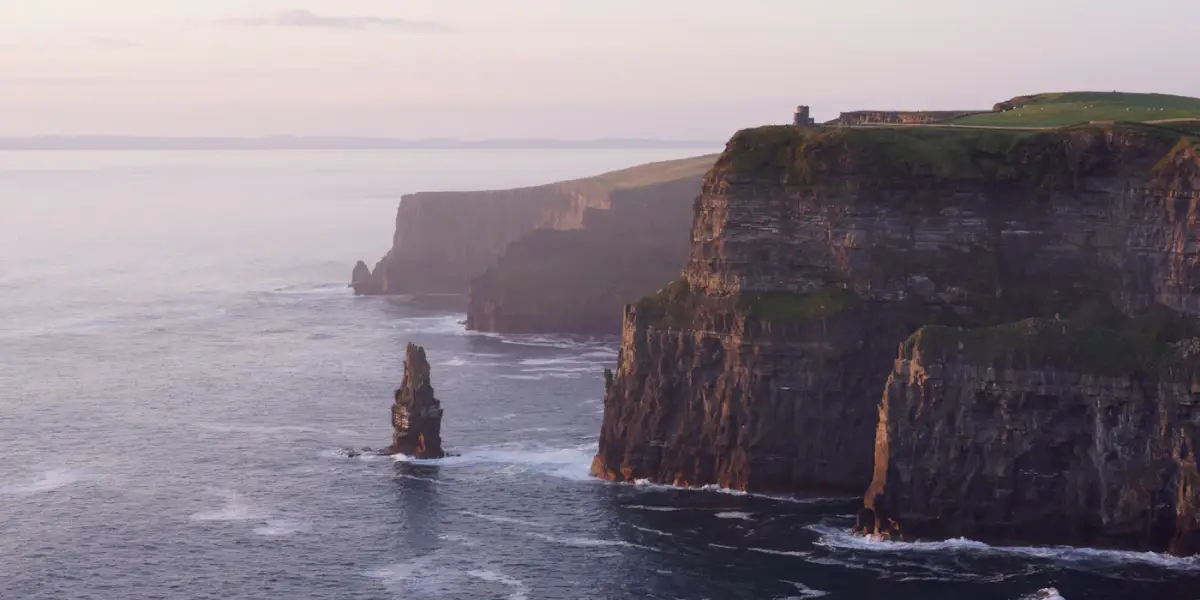
Travel guide from India
Ireland
The Republic of Ireland covers most of an island on the Atlantic edge of north-west Europe, west of Great Britain; Dublin has direct flights from the Gulf hubs Dubai, Abu Dhabi and Doha and from much of Europe, so from India you can connect through a Gulf hub. It packs sea cliffs, lakes and low mountains around medieval castles, monastic ruins and towns whose pubs host traditional music. The climate is mild but changeable and rain can fall in any month, so pack layers and a waterproof; Northern Ireland, six counties in the north of the island, is part of the UK and not covered here.
- Best time
- Jun–Aug
- First trip
- 11–13 nights
- Visa
- Visa needed, 90 days
- Return flights
- from ₹38,112 ●
- Mumbai, checked in the last 48 h
Places to visit in Ireland
9 places in the order you would meet them on a first trip. Tap one for what to do there.
Dublin
CityThe capital: the Book of Kells, two medieval cathedrals, Kilmainham Gaol, Georgian squares and Temple Bar's pubs.
3 nights30 min from Dublin airportBest Jun–Aug
Dublin
CityThe capital: the Book of Kells, two medieval cathedrals, Kilmainham Gaol, Georgian squares and Temple Bar's pubs.
Dublin spreads along the River Liffey where it meets Dublin Bay, with O'Connell Street on the north bank and Trinity College, St Stephen's Green, Grafton Street and the two medieval cathedrals on the south. Once a Viking settlement and for some 700 years the centre of English, later British, rule in Ireland, it is now a city of Georgian streets and squares, museums and pubs, with the Dublin Mountains and the cliff path at Howth close by. The airport is about 10 km north of the centre, roughly half an hour by bus or taxi.
What to do in Dublin
- Book of Kells and the Long Room. At Trinity College, founded in 1592, see the 9th-century illuminated manuscript of the four Gospels, then walk through the Old Library's great Long Room.
- Kilmainham Gaol. This prison, in use from 1796 to 1924, held leaders of the risings of 1798, 1803, 1848, 1867 and 1916, and the tour tells the story of Ireland's road to independence; wrap up, as the inside is very cold in winter.
- Two medieval cathedrals. St Patrick's, the Church of Ireland's national cathedral, where Jonathan Swift was dean and is buried, is about ten minutes' walk from Christ Church, whose medieval crypt is a big draw.
- National Museum and Phoenix Park. The National Museum of Ireland shows ancient gold and the preserved bodies of Iron Age people, and the Phoenix Park, which ranks among Europe's largest enclosed city parks, has its own herd of fallow deer.
- Eat vegetarian, Dublin style. Fáilte Ireland's Dublin food guide points to long-standing vegetarian and vegan restaurants, a South Indian vegetarian restaurant, and a dosa food truck in the Docklands.
Dublin's average highs peak at about 18 to 20°C from June to August, yet rain still falls on 10 to 12 days a month, so carry a waterproof.
Sources: Tourism Ireland (Ireland.com): Dublin, Tourism Ireland (Ireland.com): Dublin's top nine attractions, Tourism Ireland (Ireland.com): Ireland's weather, Tourism Ireland (Ireland.com): Driving in Ireland, Visit Dublin (Fáilte Ireland): The Book of Kells Experience, Visit Dublin (Fáilte Ireland): St Patrick's Cathedral, Visit Dublin (Fáilte Ireland): The best vegetarian and vegan restaurants in Dublin, Visit Dublin (Fáilte Ireland): Getting here, Heritage Ireland (OPW): Kilmainham Gaol, Heritage Ireland (OPW): Dublin Castle, Met Éireann: Sunshine, Met Éireann: Climate of Ireland, Wikivoyage: Dublin, Wikivoyage: Ireland (checked 14 Oct)
Glendalough and the Wicklow Mountains
HeritageDay tripSt Kevin's 6th-century monastic site, with a round tower and stone churches in a glacial valley of two lakes.
about 1 h 30 min from Dublin airport
Glendalough and the Wicklow Mountains
HeritageDay tripSt Kevin's 6th-century monastic site, with a round tower and stone churches in a glacial valley of two lakes.
Glendalough, Irish for 'valley of two lakes', lies about 40 km south of Dublin inside Wicklow Mountains National Park. In the 6th century St Kevin founded a monastery here that became one of Europe's most famous religious centres, and the ruins of its round tower, stone churches and carved crosses are scattered across the wooded glen. It is the park's most visited spot, so sunny weekends bring heavy traffic and parking trouble; it makes an easy day trip from Dublin by car, bus or coach tour.
What to do in Glendalough and the Wicklow Mountains
- Start at the visitor centre. The OPW centre near the Lower Lake explains the monastery's story with an exhibition and audio-visual show before you walk the site.
- The Monastic City. Pass through the old double gateway to the round tower, about 1,000 years old and just over 30 m high, then on to the cathedral of St Peter and St Paul and St Kevin's Church with its small round belfry.
- Walk to the Upper Lake. Signposted trails loop round both lakes, and the Upper Lake, about a kilometre west of the main ruins, has the finer scenery.
- Look for St Kevin's Bed. From the Upper Lake, look up at the small man-made cave in the cliff where St Kevin is said to have lived and prayed, though it may be a much older burial place.
- Drive the Military Road. With a car, return to Dublin over the mountains on the old Military Road through the Sally Gap, with wide views over rolling uplands.
Sources: Heritage Ireland (OPW): Glendalough Monastic Site and Visitor Centre, National Parks of Ireland (NPWS): Wicklow Mountains National Park, Wikivoyage: Glendalough (checked 14 Oct)
Kilkenny
HeritageA compact medieval city on the River Nore, with the Butlers' castle, a climbable round tower and the Medieval Mile.
1–2 nights2 h from Dublin airport
Kilkenny
HeritageA compact medieval city on the River Nore, with the Butlers' castle, a climbable round tower and the Medieval Mile.
Kilkenny, on the River Nore in the south-east, grew up around a 6th-century church of St Canice, became a Norman stronghold and in the 1640s was the capital of Confederate Ireland. It is called the Marble City after the dark local limestone used in many of its buildings, and its Medieval Mile runs through narrow lanes from the castle to the cathedral. Direct coaches from Dublin Airport take around two hours, and trains from Dublin Heuston about 90 minutes.
What to do in Kilkenny
- Kilkenny Castle. Built in the 12th century and home to the Butler family, later dukes of Ormond, for almost 600 years, the castle has rooms decorated in 1830s style and a picture gallery, all set in wide parkland.
- St Canice's Cathedral and round tower. The 13th-century cathedral has a 9th-century round tower in its graveyard that adults can climb by steep ladders.
- Walk the Medieval Mile. Between castle and cathedral, duck into the narrow slips such as the Butter Slip of 1616, once the butter sellers' lane, and Rothe House, a Tudor merchant's home of three houses and courtyards.
- Smithwick's Experience. A tour of the former brewery tells the story of Smithwick's red ale on a site where Franciscan monks were brewing from the 13th century.
- Jerpoint Abbey. South of the city near Thomastown, this 12th-century Cistercian abbey is known for its stone carvings, from two 13th-century knights to the decorated cloister arcades, and a treasure hunt sends children looking for saints and strange beasts.
Sources: Tourism Ireland (Ireland.com): Kilkenny city, Heritage Ireland (OPW): Kilkenny Castle, Heritage Ireland (OPW): Jerpoint Abbey, Wikivoyage: Kilkenny (checked 14 Oct)
Rock of Cashel
HeritageDay tripA cluster of medieval buildings on a limestone rock: round tower, Gothic cathedral and Romanesque Cormac's Chapel.
about 2 h 30 min from Dublin airport
Rock of Cashel
HeritageDay tripA cluster of medieval buildings on a limestone rock: round tower, Gothic cathedral and Romanesque Cormac's Chapel.
The Rock of Cashel rises from the farmland of the Golden Vale in County Tipperary, above the small town of Cashel on the M8 between Dublin and Cork. It was the seat of the kings of Munster, where legend says St Patrick converted King Aenghus and where Brian Boru was crowned king in 978, before the site was granted to the church in 1101. A visit takes an hour or so, easy to fit into the drive south or a day out from Kilkenny.
What to do in Rock of Cashel
- Cormac's Chapel. This 12th-century Romanesque chapel is rich in carved stone and holds the only surviving Romanesque frescoes in Ireland.
- Cathedral, tower and cross. Enter through the 15th-century Hall of the Vicars Choral, then walk through the 13th-century Gothic cathedral to the round tower at one corner and the high crosses in the graveyard.
- Hore Abbey. Close to the rock stand the ruins of Hore Abbey, founded by Benedictines in the late 12th century and handed to Cistercian monks in 1270.
- Cahir Castle. About 16 km away, this 13th-century Butler stronghold on a rocky island in the River Suir ranks among the largest and best-preserved castles in Ireland.
- Dress for the wind. The rock is a very exposed hilltop that can shut at short notice in bad weather, so wear sturdy shoes and check before setting out in a storm.
Sources: Heritage Ireland (OPW): The Rock of Cashel, Heritage Ireland (OPW): Cahir Castle, Tourism Ireland (Ireland.com): Kilkenny city, Wikivoyage: Cashel (checked 14 Oct)
Cork and Kinsale
CityA walkable river city with the English Market and Shandon's bells, plus Cobh's Titanic story and harbour-town Kinsale.
2 nightsabout 3 h 30 min from Dublin airport
Cork and Kinsale
CityA walkable river city with the English Market and Shandon's bells, plus Cobh's Titanic story and harbour-town Kinsale.
Cork stands on an island in the River Lee near the south coast, a compact city of Georgian fronts, narrow lanes and pubs pouring its own brews, Murphy's and Beamish. Its name comes from the Irish word for a salt marsh, and the city grew from a monastery founded by St Fin Barre in the early 7th century. Trains from Dublin take about two and a half hours, and from Cork the harbour town of Cobh is about 25 minutes by train and Kinsale a short bus ride south.
What to do in Cork and Kinsale
- English Market. In this covered market in the city centre, traders sell mainly fresh food, and several stalls make sandwiches and takeaway lunches.
- Ring the Shandon bells. Climb the tower of St Anne's Church in Shandon, built in 1722, play a tune on its 18th-century bells using the sheet music provided, and look out across the rooftops.
- Cobh and the Titanic. Take the train to Cobh, the Titanic's last port of call, where an exhibition follows the passengers who boarded there, and ferries cross to Spike Island, a former prison fortress.
- Kinsale and Charles Fort. This small harbour town 25 km south of Cork is known for its brightly painted houses and its restaurants, and from the ramparts of Charles Fort, a vast late-17th-century star-shaped fort, you look out over the harbour.
- Blarney Castle. Explore this medieval stronghold with its dungeons, gardens and caves, and kiss the Blarney Stone, said to give the gift of eloquence.
Sources: Tourism Ireland (Ireland.com): Cork city, Heritage Ireland (OPW): Charles Fort, Wikivoyage: Cork, Wikivoyage: Kinsale (checked 14 Oct)
Killarney and the Ring of Kerry
Hill countryLakes, oak woods and mountains in Ireland's first national park, and the 179 km coastal loop of the Ring of Kerry.
2–3 nightsabout 4 h from Dublin airportBest May–Jun
Killarney and the Ring of Kerry
Hill countryLakes, oak woods and mountains in Ireland's first national park, and the 179 km coastal loop of the Ring of Kerry.
Killarney, a lively town that has drawn travellers since the 18th century, sits beside Killarney National Park, where lakes, oak and yew woods and waterfalls lie below MacGillycuddy's Reeks, Ireland's highest mountain range. The park grew from the Muckross estate, given to the state in 1932 as the country's first national park, and it shelters Ireland's last native herd of red deer. The Ring of Kerry, a 179 km road loop round the Iveragh Peninsula past beaches, mountain passes and small villages, begins and ends in the town.
What to do in Killarney and the Ring of Kerry
- Muckross House and Torc Waterfall. Tour 19th-century Muckross House, where Queen Victoria stayed on her 1861 visit, stroll its gardens by the lakes, then walk the short path to Torc Waterfall, about 7 km from town.
- Ross Castle and the lakes. This 15th-century castle on an inlet of Lough Leane is the starting point for boat trips across the lakes, and legend says O'Donoghue Mór, the chieftain thought to have built it, still sleeps beneath the water.
- Gap of Dunloe. This narrow pass through MacGillycuddy's Reeks, about 11 km long, can be walked, cycled or crossed by horse-drawn trap; on foot, there and back takes five to six hours.
- Drive the Ring of Kerry. Coach tours from Killarney cover the loop in a day with stops such as the Kerry Bog Village, Coomakista Pass and Ladies View, named for Queen Victoria's ladies-in-waiting; with a car, linger at Derrynane Beach and colourful Sneem.
- A barracks with an Indian legend. In Cahersiveen, the turreted Old Stone Barracks, built as a police station in the 1870s and now a heritage centre, comes with a local story that its plans were meant for a building in India.
May and June are Ireland's sunniest months, averaging 5 to 6.5 hours of bright sunshine a day over most of the country, while December is the dullest.
Sources: National Parks of Ireland (NPWS): Killarney National Park, Tourism Ireland (Ireland.com): Ring of Kerry, Tourism Ireland (Ireland.com): Ring of Kerry road trip, Discover Ireland (Fáilte Ireland): Plan an epic Ring of Kerry road trip, Discover Ireland (Fáilte Ireland): How to explore Killarney and the Ring of Kerry without a car, Heritage Ireland (OPW): Ross Castle, Met Éireann: Sunshine, Wikivoyage: Killarney (checked 14 Oct)
Cliffs of Moher and the Burren
Hill countrySheer Atlantic sea cliffs over 200 m high, seabird colonies, and the bare limestone pavement of the Burren.
1 nightabout 3 h 30 min from Dublin airportBest May–Jun
Cliffs of Moher and the Burren
Hill countrySheer Atlantic sea cliffs over 200 m high, seabird colonies, and the bare limestone pavement of the Burren.
On the west coast of County Clare, the Cliffs of Moher run for about 14 km and reach 214 m just north of O'Brien's Tower, with views on clear days to the Aran Islands and across Galway Bay. Inland lies the Burren, a karst country of bare limestone pavement where rare plants grow in the cracks, and together they make up a UNESCO Global Geopark. The village of Doolin, about 7 km from the cliffs and known for traditional music in its pubs, makes a good base, and the coastal bus between Galway and Ennis stops at both.
What to do in Cliffs of Moher and the Burren
- Walk the cliff-top paths. From the visitor centre, paved paths lead to viewing areas and O'Brien's Tower, built in 1835 by local landlord and MP Cornelius O'Brien as a lookout for visitors; keep to the paths, as the cliffs drop straight down.
- Watch the seabirds. Over 30,000 pairs of seabirds nest here in the breeding season, with fulmars near the top, kittiwakes below and guillemots and razorbills lower still, and puffins nest on Goat Island, seen from the south platform.
- See the cliffs from the sea. Some ferries from Doolin to the Aran Islands, and the seasonal sailing from Galway city, run along the foot of the cliffs for a view from the water.
- Poulnabrone and the Burren. Drive inland to Poulnabrone, a tomb of three upright stones under a huge capstone where burials date to between 3800 and 3200 BC, and look for orchids: 23 of Ireland's 27 species grow in the Burren National Park.
- Music in Doolin. Spend the evening in Doolin, where several pubs hold traditional music sessions most nights.
Puffins come to the cliffs from late March to mid-July, and May and June are the best months to spot them.
Sources: Cliffs of Moher Experience (Clare County Council): FAQ, Cliffs of Moher Experience: At the Cliffs, Cliffs of Moher Experience: O'Brien's Tower, Cliffs of Moher Experience: Home, Discover Ireland (Fáilte Ireland): Cliffs of Moher Experience, Discover Ireland (Fáilte Ireland): The Burren, Discover Ireland (Fáilte Ireland): Your ultimate guide to the Aran Islands, National Parks of Ireland (NPWS): Burren National Park, Wikivoyage: Burren, Wikivoyage: Doolin (checked 14 Oct)
Galway
CityA lively west-coast city of music pubs and festivals, and the gateway to Connemara and the Aran Islands.
2 nightsabout 2 h 30 min from Dublin airport
Galway
CityA lively west-coast city of music pubs and festivals, and the gateway to Connemara and the Aran Islands.
Galway lies where the River Corrib runs into Galway Bay on the west coast, with a compact old centre of colourful, cobbled pedestrian streets in the Latin Quarter. Its nickname, the City of the Tribes, recalls the 14 merchant families who ran the medieval town, and today it is known for traditional music sessions, good food and a crowded festival calendar. Coaches from Dublin Airport and trains from Dublin Heuston each take about two and a half hours.
What to do in Galway
- Latin Quarter to the Spanish Arch. Stroll from Eyre Square down Shop Street and Quay Street to the Spanish Arch, cut through a stretch of the city walls that was built in 1584 to guard the quays.
- Galway City Museum. Beside the Spanish Arch, three floors of galleries cover the city's archaeology, its history and its long ties to the sea.
- Trad music in the pubs. Pubs in the centre and across the river in the West End host traditional music sessions, some of them twice a day.
- Salthill Promenade. Walk along the seafront to Salthill, past the Famine Ship Memorial, and follow local custom by kicking the wall at the far end.
- Day trip to Connemara. Coach tours cross Connemara's bogs and lakes to Kylemore Abbey, a neo-Gothic house of 1868 now run by Benedictine nuns, with a Victorian walled garden, and return past the Twelve Bens and the Irish-speaking district around Spiddal.
Sources: Discover Ireland (Fáilte Ireland): Galway city, Discover Ireland (Fáilte Ireland): 9 things to do in Galway, Discover Ireland (Fáilte Ireland): How to explore Galway city without a car, Discover Ireland (Fáilte Ireland): How to explore Connemara and Kylemore Abbey without a car, National Parks of Ireland (NPWS): Connemara National Park, Wikivoyage: Galway (checked 14 Oct)
Aran Islands
IslandThree Irish-speaking limestone islands, with stone-walled fields and the cliff-edge fort of Dún Aonghasa.
1 nightabout 4 h 30 min by boat from Dublin airport
Aran Islands
IslandThree Irish-speaking limestone islands, with stone-walled fields and the cliff-edge fort of Dún Aonghasa.
The three Aran Islands, Inis Mór (the largest), Inis Meáin and Inis Oírr, lie off the coast of County Galway and are a geological continuation of the Burren: bare limestone cut into small fields by dry-stone walls, and dotted with prehistoric forts and early Christian ruins. They are a Gaeltacht, an Irish-speaking area, though visitors get by in English. Ferries from Rossaveal, about an hour by road west of Galway city, reach Inis Mór in around 40 minutes all year, and in summer boats also sail from Doolin.
What to do in Aran Islands
- Dún Aonghasa. On Inis Mór, a rocky 1 km path climbs to this fort of three massive dry-stone walls, more than 3,000 years old, ringed by upright stone spikes and set on an 87 m sea cliff with no fence at the edge.
- Cycle Inis Mór. Hire a bike by the pier at Kilronan and ride the northern road past stone-walled fields and the white sand of Kilmurvey Beach to the fort, about 7 km away.
- Seals and the Seven Churches. East of Kilmurvey Beach, seals haul out on the rocks when the tide is right, and Na Seacht Teampaill, a medieval pilgrimage site, keeps two of its churches.
- Inis Meáin and Inis Oírr. Quiet Inis Meáin has the hilltop fort of Dún Chonchúir and the cottage where playwright J. M. Synge stayed, while the smallest island, Inis Oírr, has the Plassey shipwreck on its loop walk.
- Buy an Aran sweater. Look near the Inis Mór pier for knitted Aran sweaters, handmade by craftspeople who live on the island.
Sources: Discover Ireland (Fáilte Ireland): Your ultimate guide to the Aran Islands, Discover Ireland (Fáilte Ireland): How to explore Inis Mór and the Aran Islands without a car, Discover Ireland (Fáilte Ireland): 9 things to do in Galway, Heritage Ireland (OPW): Dún Aonghasa, Wikivoyage: Aran Islands, Wikivoyage: Burren (checked 14 Oct)
A first trip: 11–13 nights
- Dublin · 3n
- →Glendalough and the Wicklow Mountains
- →Kilkenny · 1–2n
- →Rock of Cashel
- →Cork and Kinsale · 2n
- →Killarney and the Ring of Kerry · 2–3n
- →Cliffs of Moher and the Burren · 1n
- →Galway · 2n
Start in Dublin with a day out to Glendalough, head south-west through Kilkenny and past the Rock of Cashel to Cork, continue to Killarney for the Ring of Kerry, then go north up the Atlantic coast by the Cliffs of Moher to Galway and cross the country back to Dublin; add a night on the Aran Islands from Galway if you can. May and June are the sunniest months and the best time for puffins at the Cliffs of Moher, July and August the warmest, while winter brings the least sunshine and wind-driven Atlantic rain, so leave slack in the plan for a wet day.
Getting around
Irish Rail's intercity trains fan out from Dublin Heuston to Kilkenny (about 90 minutes), Cork and Galway (about two and a half hours each) and Killarney (usually changing at Mallow), and journeys seldom run past two to three hours. Long-distance coaches fill the gaps, and many leave straight from Dublin Airport, which saves a trip into the city. Buses are sparse around the Ring of Kerry, the Burren and Connemara, so visitors either join a day coach tour or hire a car; Ireland drives on the left, and country lanes can be very narrow, with few places to pass.
Peak Shoulder Off-season
Met Éireann describes February to June as the months of least rainfall, summers as mostly mild with cloud and showers increasing from late June, and October and November as bringing moderate to heavy frontal rain. Highs reach only 16-18°C even in July and August, so pack for showers in any month; March is cold but St Patrick's week is a crowd peak anyway.
Flights to Ireland from India
Visa for Indian passports
Indian passport holders need a visa for Ireland before travel. Allow about 60 days for a first-time application. With a UK visa: a BIVS-endorsed UK visa, or the short-stay visa waiver after entering the UK first (waiver runs to 31 Oct 2026). Irish visa via VFS; the embassy quotes 6–8 weeks.
Before you book, check the Ministry of External Affairs travel advisories for the latest guidance.
Ireland: questions
What are the best places to visit in Ireland?
Dublin: The capital: the Book of Kells, two medieval cathedrals, Kilmainham Gaol, Georgian squares and Temple Bar's pubs. Glendalough and the Wicklow Mountains: St Kevin's 6th-century monastic site, with a round tower and stone churches in a glacial valley of two lakes. Kilkenny: A compact medieval city on the River Nore, with the Butlers' castle, a climbable round tower and the Medieval Mile. Rock of Cashel: A cluster of medieval buildings on a limestone rock: round tower, Gothic cathedral and Romanesque Cormac's Chapel. Cork and Kinsale: A walkable river city with the English Market and Shandon's bells, plus Cobh's Titanic story and harbour-town Kinsale. Killarney and the Ring of Kerry: Lakes, oak woods and mountains in Ireland's first national park, and the 179 km coastal loop of the Ring of Kerry. Cliffs of Moher and the Burren: Sheer Atlantic sea cliffs over 200 m high, seabird colonies, and the bare limestone pavement of the Burren. Galway: A lively west-coast city of music pubs and festivals, and the gateway to Connemara and the Aran Islands. Aran Islands: Three Irish-speaking limestone islands, with stone-walled fields and the cliff-edge fort of Dún Aonghasa.
How many days do you need for Ireland?
A first trip takes about 11–13 nights: Dublin (3 nights), Glendalough and the Wicklow Mountains (1 night), Kilkenny (1–2 nights), Rock of Cashel (1 night), Cork and Kinsale (2 nights), Killarney and the Ring of Kerry (2–3 nights), Cliffs of Moher and the Burren (1 night), Galway (2 nights). Start in Dublin with a day out to Glendalough, head south-west through Kilkenny and past the Rock of Cashel to Cork, continue to Killarney for the Ring of Kerry, then go north up the Atlantic coast by the Cliffs of Moher to Galway and cross the country back to Dublin; add a night on the Aran Islands from Galway if you can. May and June are the sunniest months and the best time for puffins at the Cliffs of Moher, July and August the warmest, while winter brings the least sunshine and wind-driven Atlantic rain, so leave slack in the plan for a wet day.
What is the best time to visit Ireland?
Peak season is Jun–Aug. Met Éireann describes February to June as the months of least rainfall, summers as mostly mild with cloud and showers increasing from late June, and October and November as bringing moderate to heavy frontal rain. Highs reach only 16-18°C even in July and August, so pack for showers in any month; March is cold but St Patrick's week is a crowd peak anyway.
Do Indians need a visa for Ireland?
Indian passport holders need a visa for Ireland before travel. Allow about 60 days for a first-time application. With a UK visa: a BIVS-endorsed UK visa, or the short-stay visa waiver after entering the UK first (waiver runs to 31 Oct 2026). Irish visa via VFS; the embassy quotes 6–8 weeks.
How much is a flight to Ireland from India?
The lowest return fare FlyBun has seen in the last 14 days is ₹32,924, Mumbai to Dublin, for October 2026 departures. Fares change daily.
Places and things to do are written by FlyBun from official tourism, heritage and park sources, linked under each place, last checked 14 Oct. We leave out entry fees and opening hours because they change; check them before you go.
Watch a route and FlyBun alerts you free when its fare drops.