

Travel guide from India
Italy
Italy is a long-haul flight from India, and Rome's Fiumicino airport is the way in. A first trip usually runs north from Rome to Florence and Venice on fast trains, taking in Roman ruins, Renaissance art, Tuscan hill towns and the canals within a few hours of each other, with the cliff villages of the Amalfi Coast or the Cinque Terre as a summer add-on. Vegetarians eat well: Naples' classic margherita is just tomato, mozzarella and basil, and in Rome a pizza marinara leaves out the cheese altogether.
- Best time
- Apr–Jun, Sep–Oct
- First trip
- 9–10 nights
- Visa
- Visa needed, 90 days
- Return flights
- from ₹42,308 ●
- Delhi, checked in the last 48 h
Places to visit in Italy
11 places in the order you would meet them on a first trip. Tap one for what to do there.
Rome
CityThe Colosseum, the Pantheon, Baroque piazzas and the Vatican, 32 minutes by train from the airport.
3–4 nights32 min by train from Rome airportBest Apr–May, Sep–Oct
Rome
CityThe Colosseum, the Pantheon, Baroque piazzas and the Vatican, 32 minutes by train from the airport.
Rome ran the Roman Empire and is Italy's capital today, and the Pope's Vatican sits inside it, so ancient ruins, Renaissance churches and Baroque squares are a walk apart. The Leonardo Express runs non-stop from Fiumicino to Roma Termini, the main station, in 32 minutes. Vegetarians usually manage well: restaurant buffets tend to carry roast peppers and aubergines, and a pizza marinara is simply tomato, garlic and oregano.
What to do in Rome
- Colosseum, Roman Forum and Palatine. The Colosseum, built between 70 and 80 AD for gladiator fights, is the largest Roman amphitheatre; beside it, the Forum's temples and arches were the political centre of the ancient city, and the Palatine Hill begins just past the Arch of Constantine.
- The Pantheon. Hadrian rebuilt this temple between 112 and 125 AD, and its 43 m dome, open to the sky through a round oculus, is still the widest ever built in unreinforced concrete; Raphael is buried inside.
- Trevi Fountain. Oceanus rides his horse-drawn chariot at the centre; by tradition, throw a coin with your back to the fountain and you will come back to Rome. This is the fountain Anita Ekberg waded into in La Dolce Vita.
- Piazza Navona. The square follows the track of the Stadium of Domitian, with Bernini's Fountain of the Four Rivers in the middle facing Borromini's church of Sant'Agnese in Agone, and street painters and performers around them.
- Trastevere after dark. Cross the Tiber to the cobbled lanes around the fountain of Santa Maria in Trastevere, where the streets near Piazza San Callisto fill up with trattorias and bars in the evening.
Spring and autumn bring mild to warm days; summers are long and hot, and for two weeks in August many Romans close their shops and restaurants for the holidays.
Sources: Italia.it (ENIT, official Italian tourism site): Rome, Italia.it: Rome guide, history and facts, Italia.it: Colosseum, Italia.it: Roman Forum, Italia.it: Pantheon, Italia.it: Trevi Fountain, Italia.it: Piazza Navona, Italia.it: Trastevere, Italia.it: How to travel around Italy, Aeroporti di Roma (Fiumicino airport operator): Train from Fiumicino, Trenitalia: Leonardo Express, Trenitalia: Frecciarossa connections, Wikivoyage: Rome (checked 14 Oct)
Vatican City
HeritageDay tripSt Peter's Basilica, the Sistine Chapel and the Vatican Museums, in the world's smallest country.
about 1 h by train from Rome airport
Vatican City
HeritageDay tripSt Peter's Basilica, the Sistine Chapel and the Vatican Museums, in the world's smallest country.
The Vatican, an independent state surrounded by Rome and the world's smallest country by both area and population, is the Pope's seat and the centre of the Catholic Church. St Peter's Basilica, its square and the Vatican Museums with the Sistine Chapel are all here, and Italia.it reckons the museums alone deserve a full day. Dress with knees and shoulders covered: both the basilica and the museums enforce a dress code.
What to do in Vatican City
- St Peter's Basilica. In the first chapel on the right is Michelangelo's Pietà, carved when he was 23 and the only work he ever signed; under the dome, Bernini's bronze canopy rises over the papal altar.
- Climb the dome. A lift takes you to the roof, then 323 steps wind up Michelangelo's dome, about 136 m from the ground to the cross, for the view from the top.
- Vatican Museums and the Sistine Chapel. The route passes Raphael's Rooms, including the School of Athens, before the Sistine Chapel, where Michelangelo painted the ceiling in 1508-1512 and the Last Judgement on the main wall in 1536-1541.
- St Peter's Square. Bernini's colonnades of 284 columns curve around the oval square; stand on one of the two marked stones between the obelisk and the fountains and each row of four columns lines up as one.
- Castel Sant'Angelo. Hadrian's mausoleum, built in the 130s AD, became a papal fortress tied to the Vatican by a covered, fortified corridor, and is now a museum reached over the Ponte Sant'Angelo with its ten angel statues.
Sources: Italia.it: St Peter's Basilica, Italia.it: The Vatican Museums and the Sistine Chapel, Italia.it: Rome, Wikivoyage: Rome/Vatican, Wikivoyage: Rome (church dress codes), Aeroporti di Roma: Train from Fiumicino (checked 14 Oct)
Siena and San Gimignano
HeritageSiena's shell-shaped Campo and black-and-white cathedral, and the medieval towers of San Gimignano.
1 nightabout 4 h by train from Rome airport
Siena and San Gimignano
HeritageSiena's shell-shaped Campo and black-and-white cathedral, and the medieval towers of San Gimignano.
Siena, Florence's great medieval rival, still looks much as it did around 1300, and its historic centre has been on UNESCO's World Heritage list since 1995. Life centres on the shell-shaped Piazza del Campo, which turns into the track for the Palio, a horse race between the city's districts, twice each summer. San Gimignano, a smaller walled hill town of medieval towers, is about an hour away by bus and grows quiet once the day-trippers leave in the evening.
What to do in Siena and San Gimignano
- Palazzo Pubblico and the Torre del Mangia. Siena's town hall for almost 800 years holds Ambrogio Lorenzetti's 1338-1339 frescoes of good and bad government, and its tall Torre del Mangia looks out over the Sienese countryside.
- Siena Cathedral. Inside the black-and-white Duomo, look down at the inlaid marble floors and into the Piccolomini Library frescoed by Pinturicchio; outside, a lone wall marks the far bigger church that was shelved after the Black Death of 1348.
- Sienese sweets and pici. Try panforte, a dense cake of honey, almonds and candied fruit, ricciarelli almond biscuits, and pici, the thick handmade local pasta.
- San Gimignano's towers. Medieval tower houses still stand above the walls; climb Torre Grossa, the tallest, from the town museum in the Palazzo Comunale, and see the Florentine frescoes in the 12th-century cathedral.
- Monteriggioni. This small castle town near Siena, on the old Via Francigena pilgrim route, is ringed by walls and towers that Dante likened to giants in the Inferno.
Sources: Visit Tuscany (official Tuscany tourism site): Siena, Visit Tuscany: San Gimignano, Wikivoyage: Siena, Wikivoyage: San Gimignano, Aeroporti di Roma: Train from Fiumicino (checked 14 Oct)
Florence
HeritageBrunelleschi's dome, Botticelli at the Uffizi, Michelangelo's David and the Ponte Vecchio, in the Renaissance's home.
3 nightsabout 2 h 30 min by train from Rome airportBest Apr–May, Sep–Oct
Florence
HeritageBrunelleschi's dome, Botticelli at the Uffizi, Michelangelo's David and the Ponte Vecchio, in the Renaissance's home.
Florence, the Tuscan capital, was the cradle of the Renaissance, and its historic centre, inside the line of its medieval walls, has been a UNESCO World Heritage Site since 1982. The big sights sit close together, and you can walk across the centre in about half an hour. Fast trains from Rome take about 90 minutes, and the city makes a good base for day trips to Pisa, Lucca, Siena and the Chianti wine hills.
What to do in Florence
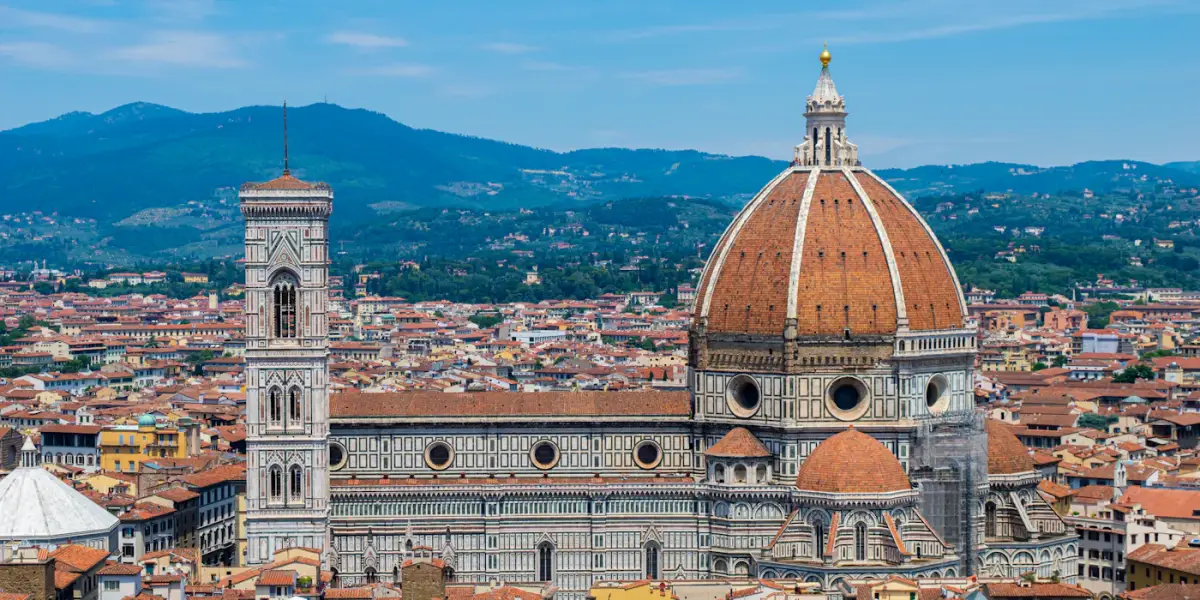
- The Duomo and Brunelleschi's dome. The cathedral, clad in white, green and red marble, is crowned by Brunelleschi's dome, still the largest masonry dome ever built; a narrow 463-step stairway climbs up inside it past the Last Judgement frescoes, and Giotto's bell tower next door is the other climb.
- The Uffizi. Highlights run from Botticelli's Birth of Venus and Primavera to Leonardo's Adoration of the Magi, Titian's Venus of Urbino and Caravaggio's Bacchus, alongside ancient sculpture from the Medici collections.
- Piazza della Signoria and the David. A copy of Michelangelo's David guards the door of Palazzo Vecchio, opposite Cellini's Perseus in the open-air Loggia dei Lanzi; the original statue is in the Accademia Gallery.
- Ponte Vecchio and the Oltrarno. Goldsmiths have worked in the shops on this 1345 bridge since 1593, and it was the only bridge in the city left intact in August 1944; across it, the Oltrarno has craft workshops and the Medici's Boboli Gardens.
- Piazzale Michelangelo at dusk. Walk up the stairs from the riverbank to this hillside square for the classic view over the domes and towers, stay to see the city lights, or climb a little higher to San Miniato al Monte.
Spring and autumn are mild to warm, while summer daytime highs climb from about 30°C in June to 33°C by July and August.
Sources: Italia.it: Florence, Feel Florence (official tourism site of the City of Florence): Cathedral of Santa Maria del Fiore, Feel Florence: Uffizi Gallery, Feel Florence: Ponte Vecchio, Feel Florence: Boboli Gardens, Wikivoyage: Florence, Wikivoyage: Tuscany, Trenitalia: Frecciarossa connections (checked 14 Oct)
Pisa
HeritageDay tripThe Leaning Tower and the cathedral square of Piazza dei Miracoli, an easy day out from Florence.
about 3 h 30 min by train from Rome airport
Pisa
HeritageDay tripThe Leaning Tower and the cathedral square of Piazza dei Miracoli, an easy day out from Florence.
Pisa reached its peak as one of Italy's maritime republics, and its Piazza dei Miracoli, on UNESCO's World Heritage list since 1987, gathers the cathedral, baptistery, monumental cemetery and leaning bell tower in one square. Trains from Florence take an hour to an hour and a half, so most people come for the day. From the main station it is about half an hour's walk through the old centre to the tower.
What to do in Pisa
- The Leaning Tower. Begun in the 12th century as the cathedral's bell tower, it started to lean soon afterwards as the ground beneath it sank; work finished in 2001 stopped the tilt from growing, and it still holds seven bells, one for each note.
- Pisa Cathedral. Founded in 1063, the cathedral of Santa Maria Assunta is the masterpiece of Pisan Romanesque architecture, with the famous tower standing behind it.
- Hear the baptistery echo. Inside the round baptistery a guard calls out a few notes from time to time and the dome turns the echo into chords; visitors are welcome to try it too.
- Camposanto Monumentale. The monumental cemetery along the edge of the square stretches 130 m behind a wall of 43 blind arches.
- Walk the city walls. A walkway 11 m up along the medieval walls gives an unusual view over the rooftops to the tower and the cathedral square.
Sources: Visit Tuscany: Pisa, Opera della Primaziale Pisana (official Piazza dei Miracoli site): The Tower, Wikivoyage: Pisa, Wikivoyage: Tuscany, Wikivoyage: Florence (checked 14 Oct)
Venice
HeritageSt Mark's Square, the Grand Canal and Rialto, and the glass and lace islands, in a city without cars.
2 nightsabout 5 h by train from Rome airportBest Apr–May, Sep–Oct
Venice
HeritageSt Mark's Square, the Grand Canal and Rialto, and the glass and lace islands, in a city without cars.
Venice spreads over 118 islands in a lagoon, stitched together by more than 400 bridges, and the city and its lagoon have been on UNESCO's World Heritage list since 1987. There are no cars: you walk, or ride the vaporetto water buses along the canals. Trains from Rome, via Florence, reach Venezia Santa Lucia, the terminus on the west side of the old city, in about 3 hours 50 minutes.
What to do in Venice
- St Mark's Square and Basilica. The only square in Venice called a piazza is lined by the domed Italian-Byzantine basilica, its walls covered in gold mosaics, and the 98.6 m bell tower; it is also the lowest part of the city and floods easily at high tide.
- Doge's Palace and the Bridge of Sighs. The white and pink palace was the seat of Venice's elected rulers, and the enclosed white-stone bridge built in the early 1600s led prisoners from its courtrooms to the prison next door.
- The Grand Canal and Rialto. Vaporetto line 1 runs the length of the Grand Canal; get off at the Rialto Bridge, a single arch finished in 1591 and the oldest of the four bridges over the canal, with open-air markets beside it.
- Murano and Burano. Venice moved its glassworks to Murano in 1291 to keep furnace fires away from the city, and its Glass Museum tells the story; quieter Burano, north of Venice, is known for its brightly painted houses and lace.
- Cicchetti in Cannaregio. In the northern district of Cannaregio, small canal-side taverns called bacari open towards evening, where Venetians meet over an aperitif and cicchetti, small Venetian bar snacks.
Later spring and the first half of autumn balance mild weather against the crowds; July and August are hot, humid and packed, and acqua alta floods low areas mostly in the colder months.
Sources: Italia.it: Venice, Wikivoyage: Venice, Wikivoyage: Venice/Burano, Trenitalia: Frecciarossa connections (checked 14 Oct)
Cinque Terre
BeachFive cliffside villages on the Ligurian coast, linked by a local train, boats and coastal footpaths.
1–2 nightsabout 4 h 30 min by train from Rome airport
Cinque Terre
BeachFive cliffside villages on the Ligurian coast, linked by a local train, boats and coastal footpaths.
The Cinque Terre are five villages, Monterosso, Vernazza, Corniglia, Manarola and Riomaggiore, spread along about 18 km of steep Ligurian coast below terraced vineyards and olive groves, and a UNESCO World Heritage Site since 1997. Cars are kept out of the villages and parking is scarce, so most people arrive by train from La Spezia or Genoa and move between them by train, boat or footpath. Monterosso is the beach resort of the five; the other four keep their tight lanes of colourful old houses.
What to do in Cinque Terre
- Walk the Sentiero Azzurro. The coastal Blue Trail links the villages and takes most of a day end to end; Vernazza to Monterosso is the steepest stretch, so wear proper walking shoes and check which sections are open before you set out.
- Hop between villages by train. Frequent local trains stop at all five villages and La Spezia, so you can walk one stretch and ride the next.
- Swim off the rocks or the sand. Monterosso has two large sandy beaches, Vernazza a small one by its harbour, and in Manarola people swim from the rocks by the little harbour.
- Corniglia. The only village not at sea level sits on top of a tall cliff, reached from its station by a long zig-zag stairway or a park bus.
- See the villages from the sea. Seasonal boats call along the coast, giving a view of the villages from the water.
Sources: Italia.it: Cinque Terre, Wikivoyage: Cinque Terre, Trenitalia: Travel around the Cinque Terre, Trenitalia: Frecciarossa connections (checked 14 Oct)
Milan
CityThe Gothic Duomo and its rooftop, Leonardo's Last Supper, fashion streets and canal-side bars.
1–2 nightsabout 4 h by train from Rome airportBest Apr–May, Sep–Oct
Milan
CityThe Gothic Duomo and its rooftop, Leonardo's Last Supper, fashion streets and canal-side bars.
Milan, the capital of Lombardy, ranks among the world capitals of fashion and design and is a financial hub, yet it also served as a capital of the late Roman Empire's northern half. High-speed trains link it with Rome in just over three hours. It is also the usual way in to Lake Como, about an hour away by train.
What to do in Milan
- The Duomo and its roof terraces. Begun in 1386 and six centuries in the building, the pinkish-white marble cathedral is the largest Gothic building in Italy; a lift goes up to the terraces among the spires and the golden Madonnina statue.
- Galleria Vittorio Emanuele II. The 19th-century arcade beside the Duomo, a landmark of iron architecture, holds historic shops and cafés; for luck, spin three times on the mosaic bull set in the floor at its centre.
- Leonardo's Last Supper. Leonardo painted it on the wall of the old Dominican dining hall at Santa Maria delle Grazie, an early Renaissance church on the UNESCO list since 1980.
- Castello Sforzesco. The castle, built for defence, now houses the city museums, including Michelangelo's unfinished sculpture the Pietà Rondanini and the Sala delle Asse painted by Leonardo.
- The Navigli at aperitivo time. In the evening the bars, small shops and restaurants along the old canals from the Darsena make this the city's main aperitivo and nightlife district.
Spring and early autumn are mild; summer turns hot and humid and many businesses close in August, and winter is often cold and foggy, though the weeks before Christmas bring lights and markets.
Sources: Italia.it: Milan, Italia.it: How to travel around Italy, Wikivoyage: Milan, Wikivoyage: Lake Como (checked 14 Oct)
Lake Como
Hill countryVillas, gardens and ferry hops between Bellagio, Varenna and Menaggio under the Alpine foothills.
2 nightsabout 5 h 30 min by train from Rome airport
Lake Como
Hill countryVillas, gardens and ferry hops between Bellagio, Varenna and Menaggio under the Alpine foothills.
Lake Como is shaped like an upside-down Y, with Como and Lecco at the tips of its two southern arms and Bellagio on the point where they meet, and it grows more mountainous as it runs north towards the Alps. Villas with gardens line the shores, and boats link the lakeside villages, most often between Menaggio, Bellagio and Varenna in the middle. Direct trains from Milan reach Varenna in about an hour.
What to do in Lake Como
- Bellagio. On the central promontory, Villa Serbelloni dates from the 16th century, and the park of the neoclassical Villa Melzi was a favourite of the composer Franz Liszt.
- Varenna. Arrive by boat and follow the Lovers' Promenade into the village, wander its stepped lanes, then climb to Vezio Castle for a view over the lake.
- Villa del Balbianello and Villa Carlotta. The 18th-century Villa del Balbianello stands on a promontory at Lenno, on the Gulf of Venus, and Villa Carlotta is known for its art and botanical gardens.
- Ferry hopping. Boats cross often between Menaggio, Bellagio and Varenna; the slow ferry from Como to Bellagio takes about two hours, so plan on two or three villages a day.
- Como town. The lake's namesake town has the last Gothic cathedral built in Lombardy and the Volta Temple, dedicated to Alessandro Volta, who was born here.
Sources: Italia.it: Lake Como, Wikivoyage: Lake Como (checked 14 Oct)
Naples and Pompeii
HeritagePizza in its home city, a UNESCO-listed old centre, and Roman Pompeii and Herculaneum under Vesuvius.
2 nightsabout 2 h by train from Rome airport
Naples and Pompeii
HeritagePizza in its home city, a UNESCO-listed old centre, and Roman Pompeii and Herculaneum under Vesuvius.
Naples, about an hour south of Rome by high-speed train, is a big port city whose historic centre has been a UNESCO World Heritage Site since 1995, and the place pizza as we know it comes from. It is also the base for Pompeii and Herculaneum, the Roman towns buried when Vesuvius erupted in AD 79. Circumvesuviana local trains reach Pompeii from Naples in 30 to 40 minutes.
What to do in Naples and Pompeii
- Pompeii. The dig covers 44 hectares of streets, houses, baths, theatres and an amphitheatre; find the frescoes of the Villa of the Mysteries and the vast House of the Faun, and carry water, as summer days reach 32-35°C on uneven stone.
- Herculaneum. It has fewer remains than Pompeii but better preserved ones, among them the House of the Deer, with a terrace that once looked over the sea.
- Pizza margherita. Pizza topped with tomato and mozzarella was already common in Naples by the 1850s, decades before the margherita got its name, and the craft of the Neapolitan pizza maker is on UNESCO's intangible heritage list.
- The old centre. See the Veiled Christ, a marble figure carved in 1753 under a shroud that looks transparent, in the Sansevero Chapel, then walk Via San Gregorio Armeno, lined with workshops selling nativity cribs.
- Up Mount Vesuvius. Buses run from Pompeii up the volcano, and a steep walk on loose stones leads to the crater rim, with views over the Bay of Naples and Capri on clear days; wear closed shoes.
Sources: Italia.it: The historic centre of Naples, Italia.it: Naples, world pizza capital, Italia.it: Pompeii, Herculaneum and Torre Annunziata, Wikivoyage: Pompeii, Wikivoyage: Vesuvius, Wikivoyage: Rome (Naples by high-speed train) (checked 14 Oct)
Amalfi Coast
BeachCliffside Positano, Amalfi's cathedral and Ravello's gardens, joined by ferries and coast buses.
2–3 nightsabout 4 h 30 min by train from Rome airportBest Apr–Oct
Amalfi Coast
BeachCliffside Positano, Amalfi's cathedral and Ravello's gardens, joined by ferries and coast buses.
The Amalfi Coast stretches between Positano and Vietri sul Mare, facing the Gulf of Salerno with the Lattari Mountains behind: steep cliffs, terraces of lemons, vines and olives, and towns stacked above small pebble beaches, all on UNESCO's World Heritage list since 1997. The coast road is narrow and short of parking, so most visitors use the SITA buses or the ferries, coming from Naples, Sorrento or Salerno.
What to do in Amalfi Coast
- Positano. Colourful houses, churches and stairways drop down the hillside to Spiaggia Grande, the main beach and ferry pier; smaller, more secluded Fornillo beach is reached by a path from it.
- Amalfi. The town that led the oldest of Italy's four maritime republics gathers round its cathedral and the cathedral's cloister, the Chiostro del Paradiso.
- Ravello. In Ravello, the gardens of Villa Cimbrone include the Terrace of Infinity, with a sweeping view of the coast; Villa Rufolo is in the same town.
- Path of the Gods. This hiking trail runs between Agerola and Positano, with plenty of steps and views down to the sea, the cliffs and the villages below.
- Amalfi lemons. The coast's long, tapered Sfusato lemons carry a protected geographical indication, and limoncello, the lemon liqueur, is made mainly around the Gulf of Naples and along this coast.
Ferries linking Amalfi with Positano, Capri, Naples, Sorrento and Salerno run from Easter weekend until mid to late October; outside that season you rely on the buses.
Sources: Italia.it: The Amalfi Coast, Wikivoyage: Amalfi Coast, Wikivoyage: Amalfi, Wikivoyage: Positano (checked 14 Oct)
A first trip: 9–10 nights
Fly into Fiumicino and base in Rome with a day at the Vatican, head north by train via Chiusi to Siena for a night and San Gimignano, go on to Florence with a day trip to Pisa, and finish in Venice, where fast trains run back to Rome for the Leonardo Express to the airport. Spring and autumn suit these cities best because July and August are hot; in summer a few nights on the Amalfi Coast, whose ferries run from Easter to October, can replace a city stop, and Milan (just over three hours north of Rome by fast train) with Lake Como beyond it can replace Siena.
Getting around
Trenitalia's Frecciarossa and Italo high-speed trains link the big cities: Rome to Florence takes about 90 minutes, Florence to Venice about two hours, Rome to Naples about an hour and Rome to Milan just over three hours. Slower regional trains reach Pisa, Siena and the five Cinque Terre villages, buses climb to hill towns such as San Gimignano and wind along the Amalfi Coast, and boats hop between the villages on Lake Como and the Amalfi Coast.
When to go
Rome month by month: weather and fares →Peak Shoulder Off-season
Rome's tourist board calls spring and autumn the periods with mild temperatures and long days, says the heat builds in July and August, and puts the rain mostly in November and February. The climate table agrees: 32°C highs in July and August and over 110 mm of rain in November, with December cool but busy for Christmas and the Vatican.
Flights to Italy from India
Visa for Indian passports
Indian passport holders need a visa for Italy before travel. Allow about 45 days for a first-time application. Schengen visa via VFS; summer processing can take 4–8 weeks.
Before you book, check the Ministry of External Affairs travel advisories for the latest guidance.
Italy: questions
What are the best places to visit in Italy?
Rome: The Colosseum, the Pantheon, Baroque piazzas and the Vatican, 32 minutes by train from the airport. Vatican City: St Peter's Basilica, the Sistine Chapel and the Vatican Museums, in the world's smallest country. Siena and San Gimignano: Siena's shell-shaped Campo and black-and-white cathedral, and the medieval towers of San Gimignano. Florence: Brunelleschi's dome, Botticelli at the Uffizi, Michelangelo's David and the Ponte Vecchio, in the Renaissance's home. Pisa: The Leaning Tower and the cathedral square of Piazza dei Miracoli, an easy day out from Florence. Venice: St Mark's Square, the Grand Canal and Rialto, and the glass and lace islands, in a city without cars. Cinque Terre: Five cliffside villages on the Ligurian coast, linked by a local train, boats and coastal footpaths. Milan: The Gothic Duomo and its rooftop, Leonardo's Last Supper, fashion streets and canal-side bars. Lake Como: Villas, gardens and ferry hops between Bellagio, Varenna and Menaggio under the Alpine foothills. Naples and Pompeii: Pizza in its home city, a UNESCO-listed old centre, and Roman Pompeii and Herculaneum under Vesuvius. Amalfi Coast: Cliffside Positano, Amalfi's cathedral and Ravello's gardens, joined by ferries and coast buses.
How many days do you need for Italy?
A first trip takes about 9–10 nights: Rome (3–4 nights), Vatican City (1 night), Siena and San Gimignano (1 night), Florence (3 nights), Pisa (1 night), Venice (2 nights). Fly into Fiumicino and base in Rome with a day at the Vatican, head north by train via Chiusi to Siena for a night and San Gimignano, go on to Florence with a day trip to Pisa, and finish in Venice, where fast trains run back to Rome for the Leonardo Express to the airport. Spring and autumn suit these cities best because July and August are hot; in summer a few nights on the Amalfi Coast, whose ferries run from Easter to October, can replace a city stop, and Milan (just over three hours north of Rome by fast train) with Lake Como beyond it can replace Siena.
What is the best time to visit Italy?
Peak season is Apr–Jun, Sep–Oct. Rome's tourist board calls spring and autumn the periods with mild temperatures and long days, says the heat builds in July and August, and puts the rain mostly in November and February. The climate table agrees: 32°C highs in July and August and over 110 mm of rain in November, with December cool but busy for Christmas and the Vatican.
Do Indians need a visa for Italy?
Indian passport holders need a visa for Italy before travel. Allow about 45 days for a first-time application. Schengen visa via VFS; summer processing can take 4–8 weeks.
How much is a flight to Italy from India?
The lowest return fare FlyBun has seen in the last 14 days is ₹42,299, Delhi to Rome, for February 2027 departures. Fares change daily.
Places and things to do are written by FlyBun from official tourism, heritage and park sources, linked under each place, last checked 14 Oct. We leave out entry fees and opening hours because they change; check them before you go.
Watch a route and FlyBun alerts you free when its fare drops.