

Travel guide from India
Japan
Japan is a long-haul flight from India, and a first trip usually runs west from Tokyo to Osaka along the bullet-train line. In that stretch you get neon megacities, temples more than a thousand years old, hot-spring towns and close-up views of Mount Fuji, all linked by fast, punctual trains. Vegetarians should plan ahead: fish stock (dashi) hides in many dishes, though Buddhist temple cooking and a growing number of vegan restaurants make it workable.
- Best time
- Apr–May, Oct–Nov
- First trip
- 11–12 nights
- Visa
- e-Visa, 90 days
- Return flights
- from ₹50,206 ●
- Delhi, checked in the last 48 h
Places to visit in Japan
10 places in the order you would meet them on a first trip. Tap one for what to do there.
Tokyo
CityThe landing city: old temple quarters, neon nightlife districts, huge food halls and a day trip to Nikko.
3–4 nights1 h 35 min by train from Tokyo airportBest Mar–Apr, Oct–Nov
Tokyo
CityThe landing city: old temple quarters, neon nightlife districts, huge food halls and a day trip to Nikko.
Tokyo is Japan's capital and one of the world's biggest cities, less a single centre than a ring of districts along the JR Yamanote loop line. Asakusa keeps the old downtown feel around Senso-ji temple, Shinjuku and Shibuya are the neon, late-night hubs, and Harajuku pairs street fashion with the quiet woods of Meiji Shrine. Narita airport is well east of the city, so most people ride the Skyliner or the Narita Express in.
What to do in Tokyo
- Senso-ji and Nakamise, Asakusa. Walk in under the giant red lantern of the Kaminarimon gate and up the stall-lined Nakamise street to the temple, then on to the red Azuma-bashi bridge for a view of Tokyo Skytree.
- Shibuya Crossing. Join the crowds on the scramble crossing outside Shibuya Station, then watch it from above, from the station buildings or the SHIBUYA SKY deck about 230 m up.
- Meiji Shrine and Harajuku. A short walk from Harajuku Station, the shrine's wooded grounds are a quiet break from the street-fashion shops of Takeshita Street next door.
- Tsukiji outer market and Hongan-ji. The old fish market's outer streets still sell seafood, kitchen knives and snacks, and nearby Tsukiji Hongan-ji is a 1934 Buddhist temple with an Indian-inspired design.
- Shinjuku after dark. Kabukicho's neon lanes, tiny stacked bars and the cluster of ramen shops north of the station are at their busiest at night; by day, Shinjuku Gyoen garden is the calm escape.
Cherry blossoms fill parks such as Ueno in March and April; the rainy season runs from late May through June and July-August is very hot and humid, so spring and autumn are the comfortable windows.
Sources: JNTO (Japan National Tourism Organization): Tokyo, GO TOKYO (official Tokyo travel guide): Asakusa, GO TOKYO: Shibuya, GO TOKYO: Shinjuku, GO TOKYO: Harajuku, GO TOKYO: Tsukiji, GO TOKYO: Ueno, Keisei Electric Railway: Skyliner, Wikivoyage: Narita International Airport, Wikivoyage: Tokyo (checked 14 Oct)
Nikko
HeritageDay tripGilded 17th-century shogun shrines in forest about two hours from Tokyo, with a lake and waterfalls above.
about 3 h 30 min by train from Tokyo airportBest Oct–Nov
Nikko
HeritageDay tripGilded 17th-century shogun shrines in forest about two hours from Tokyo, with a lake and waterfalls above.
Nikko's shrines and temples, a UNESCO World Heritage site, stand in old forest below sacred mountains that have drawn Shinto and Buddhist worshippers since at least the 8th century. The showpiece is Toshogu, the richly carved and gilded mausoleum of Tokugawa Ieyasu, founder of the shogunate that ruled Japan from 1603 to 1867. Higher up, the hairpin Irohazaka road climbs into Nikko National Park, to Lake Chuzenji and Kegon Falls.
What to do in Nikko
- Toshogu Shrine. Among its 55 buildings, look for the carved and gilded Yomeimon gate, the sleeping cat and the three monkeys in their 'see no evil, hear no evil, speak no evil' poses.
- Shinkyo Bridge. The vermilion bridge over the Daiya River marks the way into the shrine area; legend says two snakes turned into a bridge so the monk Shodo could cross.
- Rinnoji and Taiyuin. Rinnoji's hall holds three Buddha images for Nikko's three sacred mountains, and Taiyuin, a short walk away, is the ornate mausoleum of Ieyasu's grandson, the shogun Iemitsu.
- Lake Chuzenji and Kegon Falls. Buses take about an hour from the stations up the 48 bends of the Irohazaka road to the lake and to Kegon Falls, one of Japan's best-known waterfalls.
- Try yuba. Nikko's speciality is the skin lifted off simmering soy milk, a staple of Buddhist temple cooking, served fresh, fried or in sweet buns.
Autumn colour along the Irohazaka road up to Lake Chuzenji is at its best from mid-October to early November, when traffic queues build on the road.
Sources: JNTO: Nikko area, Nikko City Tourism Association: Central Nikko, Nikko City Tourism Association: Nikko Toshogu Shrine, Nikko City Tourism Association: Shinkyo Bridge, Nikko City Tourism Association: Irohazaka Slope, Nikko City Tourism Association: Yuba, Nikko City Tourism Association: Nature, Nikko City Tourism Association: Getting to and around Nikko, Wikivoyage: Nikko (checked 14 Oct)
Mount Fuji and the Fuji Five Lakes
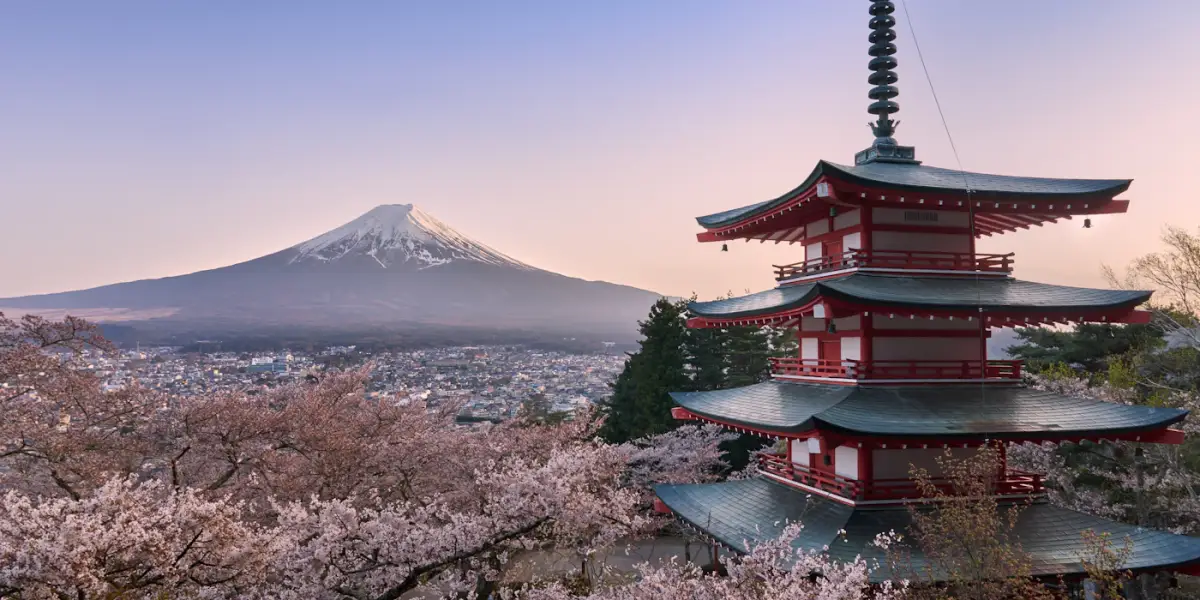
Hill countryClose-up views of Mount Fuji from Lake Kawaguchi and the Chureito pagoda, plus lava caves and lakeside walks.
1 nightabout 3 h 30 min from Tokyo airport
Mount Fuji and the Fuji Five Lakes
Hill countryClose-up views of Mount Fuji from Lake Kawaguchi and the Chureito pagoda, plus lava caves and lakeside walks.
Five small lakes lie along the northern foot of Mount Fuji, at 3,776 m Japan's highest mountain, and Lake Kawaguchi, the easiest to reach, is about two hours from Shinjuku by express bus or train. Most visitors come for the view, and Fuji is most often clear early in the morning or late in the afternoon, so a night by the lake beats a rushed day trip from Tokyo. In summer the area is also the starting point for climbing the mountain.
What to do in Mount Fuji and the Fuji Five Lakes
- Chureito Pagoda. The five-storey pagoda in Arakurayama Sengen Park, on a hillside above Fujiyoshida, lines up with Fuji and about 650 cherry trees in spring and red leaves in autumn; expect crowds.
- Lake Kawaguchi's north shore. Go round to the lake's north shore early in the morning for Fuji reflected in the water, framed by cherry blossoms in spring.
- Oshino Hakkai. Eight spring-fed ponds among old thatched houses and waterwheels north of the mountain, with Fuji as the backdrop.
- Lava caves by Lake Saiko. The Fugaku Wind Cave and Narusawa Ice Cave, on the edge of Aokigahara forest, have walkways inside, and ice pillars form in the ice cave from early winter to mid-spring.
- Climb Mount Fuji in season. The trails are open only from July to early September; climbers bus from Kawaguchiko to the Yoshida Trail's 5th Station, and JNTO asks them to check the official climbing site for current rules first.
Sources: JNTO: Fuji Five Lakes itinerary, JNTO: Views of Fuji, JNTO: The best ways to enjoy Fuji, JNTO: Mt. Fuji and around, JNTO: Fuji guide, Fujiyoshida official tourist guide: Mount Fuji viewing spots, Fujiyoshida official tourist guide: Access, GO TOKYO: Shinjuku (Narita to Shinjuku time), Wikivoyage: Fuji Five Lakes (checked 14 Oct)
Hakone
Hill countryHot-spring inns in volcanic hills, a lake cruise with Fuji views and a mountain railway, on the way from Tokyo to Kyoto.
1 nightabout 3 h by train from Tokyo airportBest Dec–Feb
Hakone
Hill countryHot-spring inns in volcanic hills, a lake cruise with Fuji views and a mountain railway, on the way from Tokyo to Kyoto.
Hakone is a hot-spring resort area in the hills of Fuji-Hakone-Izu National Park, about 90 minutes from Shinjuku on the Odakyu line, made up of seven hot-spring villages plus Lake Ashi, which formed in the Hakone volcano's last eruption about 3,000 years ago. Most visitors ride a loop of mountain train, cable car, ropeway and lake boat, then spend the night in a ryokan with its own hot-spring baths. It sits near the shinkansen at Odawara, so it breaks the trip from Tokyo to Kyoto neatly.
What to do in Hakone
- Ride the Hakone loop. The Hakone Tozan train, cable car, ropeway and sightseeing boat link up into a circuit; the ropeway sometimes stops for inspections or wind, with buses running instead.
- Owakudani. The ropeway crosses this steaming volcanic valley of sulphur vents, where eggs boiled black in the hot springs are the local snack.
- Cruise Lake Ashi. Pirate-ship-styled boats cross the lake, and the classic view of Fuji is from the south-east shore, though only on a clear day.
- Hakone Open-Air Museum. More than 100 sculptures by Japanese and international artists fill a hillside park a few minutes on foot from Chokoku-no-Mori station on the mountain railway.
- Soak in a hot spring. If a traditional bath without swimwear is not for you, Hakone Yunessun, a hot-spring park, has swimsuit areas alongside its regular baths.
Views of Fuji across Lake Ashi are sharpest in the clear winter months; cloud often hides the mountain in the June–July rains.
Sources: JNTO: Hakone and around, JNTO: Views of Fuji, Hakone Navi (Odakyu Hakone Group, official), Hakone Japan (Hakone travel guide), Wikivoyage: Hakone (checked 14 Oct)
Kyoto
HeritageJapan's capital for a thousand years: temples, shrines, Zen gardens, geisha districts and Buddhist temple cooking.
3 nights1 h 30 min by train from Osaka airportBest Mar–Apr, Oct–Nov
Kyoto
HeritageJapan's capital for a thousand years: temples, shrines, Zen gardens, geisha districts and Buddhist temple cooking.
Kyoto was Japan's imperial capital from 794 until 1868, and its temples, shrines, gardens and wooden machiya townhouses make it the heart of traditional Japanese culture. The big sights are spread around the edges of the city (Fushimi Inari to the south, Kinkaku-ji to the north, Arashiyama to the west, Higashiyama and the Gion geisha district to the east), so plan one area at a time and go early, before the crowds. In Gion, do not stop geiko or maiko for photos or wander into private lanes; the city asks visitors to respect residents.
What to do in Kyoto
- Fushimi Inari Taisha. More than 5,000 orange torii gates climb the wooded hill behind this 8th-century shrine to the god of rice and sake; the walk up through the upper shrines is a pleasant hike, and the paths feel eerily calm in the late afternoon.
- Kiyomizu-dera. The temple's wooden veranda, raised on 13 m pillars, juts out from the hillside with views west over the city; it sits in Higashiyama, the eastern district that also holds the Gion geisha quarter.
- Kinkaku-ji, the Golden Pavilion. The gold-leaf pavilion reflected in its mirror pond is Kyoto's best-known image; today's building dates from 1955, after a monk burned the original in 1950.
- Arashiyama. Tenryu-ji's 14th-century Zen garden borrows the hills behind it as scenery, and the famous bamboo grove starts just behind the temple.
- Temple food and yudofu. Kyoto is the home of shojin ryori, the plant-based cooking of Buddhist temples, and of yudofu, tofu simmered in kelp broth; ask ahead, as some dishes use fish-based dashi, egg or honey.
Spring and autumn are Kyoto's best and busiest seasons, with cherry blossoms in April and maple colours in November; early June to mid-July is the rainy season and the heat lasts well into September.
Sources: JNTO: Kyoto, Kyoto City Tourism Association: Seasonal info, Kyoto City Tourism Association: Getting to Kyoto, Kyoto City Tourism Association: Fushimi Inari Taisha Shrine, Kyoto City Tourism Association: Kiyomizu-dera Temple, Kyoto City Tourism Association: Kinkaku-ji Temple, Kyoto City Tourism Association: Tenryu-ji Temple, Kyoto City Tourism Association: Kyoto vegan food guide, JNTO: Vegetarian and vegan guide, Wikivoyage: Kyoto, Wikivoyage: Kyoto/Arashiyama, Wikivoyage: Kansai International Airport (checked 14 Oct)
Nara
HeritageDay tripJapan's first permanent capital: the giant bronze Buddha of Todai-ji and tame deer roaming Nara Park.
1 h 30 min by train from Osaka airport
Nara
HeritageDay tripJapan's first permanent capital: the giant bronze Buddha of Todai-ji and tame deer roaming Nara Park.
Nara was Japan's first permanent capital in the 8th century, and many of its temples and shrines are among Japan's oldest. Almost everything a first-time visitor comes for sits in Nara Park, 660 hectares of lawns and woods where about 1,200 protected deer wander freely. It is just over half an hour by train from Kyoto or Osaka, so most people come for the day, though the city's tourism board says a longer stay rewards a slower pace.
What to do in Nara
- Todai-ji's Great Buddha. The 15 m bronze Buddha, dedicated in 752, sits in a vast wooden hall; the dark stones down the middle of the path in are said to come from India, flanked by stones from China, Korea and Japan to trace Buddhism's route east.
- The deer of Nara Park. The deer are used to people and crackers for them are sold around the park, but keep maps and food out of sight, as they nudge hard when they think you have something.
- Kasuga Taisha. Walk to this vermilion shrine through woods lined with stone lanterns; its hanging brass lanterns are famous, and its wisteria blooms in May.
- Kofuku-ji's National Treasure Hall. The temple's treasure hall holds Buddhist carvings by masters such as Unkei, some of them strikingly lifelike.
- Naramachi. South of the park, narrow lanes of old merchant houses around Gango-ji, a temple whose roots go back to Japan's oldest Buddhist temple, now hold craft shops, cafés and a sake brewery.
Sources: JNTO: Nara, JNTO: Nara Park and around, Visit Nara (official Nara travel guide): Nara Park, Visit Nara: Naramachi, Visit Nara: For first-time visitors, Visit Nara: Travel to Nara, Todai-ji (official site): Great Buddha Hall, Todai-ji (official site): History, Wikivoyage: Nara (checked 14 Oct)
Hiroshima and Miyajima
HeritageThe Peace Memorial Park and A-Bomb Dome, then a boat to Miyajima's shrine and its torii standing in the sea.
1 nightabout 3 h by train from Osaka airportBest Apr–May, Oct–Nov
Hiroshima and Miyajima
HeritageThe Peace Memorial Park and A-Bomb Dome, then a boat to Miyajima's shrine and its torii standing in the sea.
Hiroshima was destroyed by the first atomic bomb on 6 August 1945; the Peace Memorial Park and the ruined Atomic Bomb Dome, a World Heritage site, now sit at the heart of a rebuilt city of over a million people, easily covered by tram. Miyajima, an island in the Seto Inland Sea south-west of the city, holds Itsukushima Shrine, whose halls and great vermilion torii stand over the water at high tide. Hiroshima is about 90 minutes from Osaka by shinkansen, and one night lets you see both without rushing.
What to do in Hiroshima and Miyajima
- Peace Memorial Park and the A-Bomb Dome. The dome, a 1915 exhibition hall wrecked in the bombing, stands across the river from a park of memorials that includes the cenotaph for the victims.
- Peace Memorial Museum. The museum in the park shows the city before and after the bombing and the damage it caused, and ends with its appeal for the abolition of nuclear weapons.
- Boat or ferry to Miyajima. A direct boat from the Motoyasu Bridge pier in the Peace Park takes about 45 minutes, or take the JR train to Miyajimaguchi and the 10-minute ferry across.
- Itsukushima Shrine and the torii. At high tide the shrine and its giant torii seem to float, and at low tide you can walk out to the gate, so check the tide table and stay long enough to see both if you can.
- Hike Mount Misen. The climb from the town takes about an hour, or ride the ropeway most of the way, for views over the island and the Inland Sea; watch for the island's deer and monkeys.
October-November and April-May bring the best weather, with cherry blossoms in early April; July and August are rainy then very humid, and typhoons can hit in late September.
Sources: JNTO: Hiroshima, JNTO: Hiroshima City, Dive! Hiroshima (official Hiroshima guide): Hiroshima and Miyajima day course, JR West: Hiroshima, JR West: Itsukushima Shrine, Wikivoyage: Hiroshima, Wikivoyage: Miyajima, Wikivoyage: Kansai International Airport (checked 14 Oct)
Osaka
CityStreet food and neon in Dotonbori, a castle and Universal Studios, and an easy base for Kyoto, Nara and the airport.
2 nightsabout 1 h by train from Osaka airportBest Apr, Oct–Nov
Osaka
CityStreet food and neon in Dotonbori, a castle and Universal Studios, and an easy base for Kyoto, Nara and the airport.
Osaka is Japan's big, informal second city, known for eating out, nightlife and straight-talking locals, and it splits into Kita around Umeda and Minami around Namba and Dotonbori. Kyoto, Nara and Kobe are each about an hour away by train, which makes it a practical base for the region, and Kansai Airport is about 40 minutes from Namba on the Nankai rapi:t.
What to do in Osaka
- Eat your way through Dotonbori. The canal-side strip in Minami is the place for takoyaki and okonomiyaki; the usual okonomiyaki batter contains dashi, so vegetarians need a place that makes a vegetarian version.
- Osaka Castle. The 1931 rebuild of Toyotomi Hideyoshi's castle keep holds a museum with an observation deck on its top floor, and the castle park is one of the city's main cherry-blossom spots.
- Shinsekai and Tsutenkaku. Ride up the retro Tsutenkaku tower to its golden deck, where visitors rub the soles of the Billiken statue's feet for luck.
- Universal Studios Japan. The theme park's Super Nintendo World and Wizarding World of Harry Potter make it a full day out for families.
- Osaka Aquarium Kaiyukan. Its tanks recreate regions around the Pacific Rim, and the huge central Pacific Ocean tank holds a whale shark.
April, when the castle grounds are in blossom, often brings the city's best weather, and autumn turns cooler and less humid after a stifling summer.
Sources: JNTO: Osaka, OSAKA-INFO (Osaka Convention & Tourism Bureau): Minami model course, OSAKA-INFO: Osaka Castle Main Tower, OSAKA-INFO: Tsutenkaku, OSAKA-INFO: Universal Studios Japan, OSAKA-INFO: Osaka Aquarium Kaiyukan, OSAKA-INFO: Useful access information, JNTO: Vegetarian and vegan guide, Wikivoyage: Kansai International Airport (checked 14 Oct)
Kanazawa
HeritageA castle town spared by wartime bombing: Kenrokuen garden, geisha and samurai districts, and Sea of Japan seafood.
1–2 nightsabout 3 h 30 min by train from Osaka airportBest Oct–Nov
Kanazawa
HeritageA castle town spared by wartime bombing: Kenrokuen garden, geisha and samurai districts, and Sea of Japan seafood.
Kanazawa, near the Sea of Japan coast, was the seat of the wealthy Maeda lords of Kaga and grew into a centre of crafts and the arts in the Edo period; it still makes almost all of Japan's gold leaf. The city escaped the wartime firebombing that hit Tokyo and Osaka, so its samurai and teahouse districts keep their old lanes. The Hokuriku shinkansen puts it about 2.5 hours from Tokyo, and the Thunderbird plus shinkansen about two hours from Osaka or Kyoto, so it can sit between the two.
What to do in Kanazawa
- Kenrokuen Garden. Counted among Japan's three finest gardens, it was built up by the Maeda lords beside Kanazawa Castle, and in winter its pines are roped into cones of yukitsuri supports against the snow.
- Higashi Chaya District. The largest of the city's old geisha districts, with latticed two-storey teahouses, one of them nearly 200 years old and open inside, and shops selling gold-leaf crafts.
- Nagamachi Samurai District. Narrow lanes of earthen walls where middle- and high-ranking samurai lived; the restored Nomura Samurai House has a small garden.
- Omicho Market. More than 170 stalls have fed the city for 300 years, mostly Sea of Japan seafood plus local fruit and vegetables; snow crab season opens in early November.
- 21st Century Museum of Contemporary Art. A round glass building of hands-on modern art, best known for Leandro Erlich's The Swimming Pool, where you seem to stand at the bottom of a pool.
October and November bring settled, crisp weather; from November the yukitsuri ropes go up in Kenrokuen and crab season opens, and the city is rainy all year, so pack an umbrella.
Sources: JNTO: Kanazawa and around, Visit Kanazawa (Kanazawa City Tourism Association): Getting to Kanazawa, Visit Kanazawa: Kenrokuen Garden, Visit Kanazawa: Higashi Chaya District, Visit Kanazawa: Nagamachi Samurai District, Visit Kanazawa: Omicho Market, Visit Kanazawa: 21st Century Museum of Contemporary Art, Visit Kanazawa: Autumn in Kanazawa, Wikivoyage: Kansai International Airport (checked 14 Oct)
Takayama
HeritageOld merchant streets, sake breweries and morning markets in the Japan Alps, with Shirakawa-go a bus ride away.
1–2 nightsabout 5 h by train from Osaka airport
Takayama
HeritageOld merchant streets, sake breweries and morning markets in the Japan Alps, with Shirakawa-go a bus ride away.
Takayama is an old merchant town in the mountains of Gifu, where the Sanmachi quarter keeps rows of dark wooden townhouses, water channels under the eaves and sake breweries marked by balls of cedar leaves. The Hida limited express reaches it from Nagoya or Toyama, and highway buses run to Shirakawa-go and on to Kanazawa, so the two towns pair well. Its spring and autumn festivals, when ornate floats are paraded through town, are when the town fills with visitors.
What to do in Takayama
- Walk Sanmachi. The preserved merchant streets are lined with craft shops, stalls selling local snacks and sake breweries where you can taste.
- Morning markets. Stalls set up every morning along the Miyagawa River and in front of Takayama Jinya, selling local produce and crafts.
- Takayama Jinya. The only surviving Edo-period local government office in Japan, out of more than 60 that once existed, with its offices and storehouses for rice paid as tax.
- Hida Folk Village. More than 30 old buildings from around the Hida area, some with steep thatched roofs, rebuilt as a village about 10 minutes by bus from the station.
- Day trip to Shirakawa-go. The UNESCO-listed village of steep-roofed gassho-zukuri farmhouses is about 50 minutes away by bus, and a few of the houses take overnight guests.
Sources: JNTO: Takayama and around, Hida Takayama (official tourism site): Sanmachi preservation area, Hida Takayama: Takayama Jinya, Hida Takayama: Hida Folk Village, Hida Takayama: Autumn Takayama Festival, Hida Takayama: Access, Visit Kanazawa: Getting to Kanazawa (Takayama buses), Wikivoyage: Takayama (checked 14 Oct)
A first trip: 11–12 nights
- Tokyo · 3–4n
- →Nikko
- →Mount Fuji and the Fuji Five Lakes · 1n
- →Hakone · 1n
- →Kyoto · 3n
- →Nara
- →Hiroshima and Miyajima · 1n
- →Osaka · 2n
Fly into Narita and home from Kansai: base in Tokyo for a day trip to Nikko, spend a night by the Fuji lakes and one in Hakone's hot springs, then take the shinkansen to Kyoto (with a day in Nara), on to Hiroshima and Miyajima, and finish in Osaka near the airport. Late March to early April and November are the most rewarding and most crowded months; from early June to mid-July cloud often hides Fuji, and Kanazawa can replace Hakone as the stop between Tokyo and Kyoto.
Getting around
Trains do almost all the work: the Tokaido-Sanyo shinkansen links Tokyo, Kyoto, Osaka and Hiroshima, the Hokuriku shinkansen runs from Tokyo to Kanazawa, and rechargeable IC cards such as Suica and ICOCA cover city trains, subways and many buses. Private railways such as Tobu (to Nikko), Odakyu (to Hakone) and Kintetsu (to Nara) run alongside JR, and travellers moving between cities with large suitcases often send them ahead with a luggage delivery service.
Peak Shoulder Off-season
Go Tokyo, the city's tourism site, describes a wet, humid rainy season from June to mid-July, summer highs above 35°C, a typhoon season from August into September, crisp autumn weather with leaves turning from late October, and real cold only from January. Late March to early April is the cherry-blossom crush, so March is rated shoulder on weather but books up early.
Flights to Japan from India
Visa for Indian passports
Indian passport holders need an e-visa for Japan, applied for online before travel (allow about 10 days). eVISA through an accredited agency, or a sticker visa via VFS. Show the eVISA on your phone; printouts are not accepted.
Before you book, check the Ministry of External Affairs travel advisories for the latest guidance.
Japan: questions
What are the best places to visit in Japan?
Tokyo: The landing city: old temple quarters, neon nightlife districts, huge food halls and a day trip to Nikko. Nikko: Gilded 17th-century shogun shrines in forest about two hours from Tokyo, with a lake and waterfalls above. Mount Fuji and the Fuji Five Lakes: Close-up views of Mount Fuji from Lake Kawaguchi and the Chureito pagoda, plus lava caves and lakeside walks. Hakone: Hot-spring inns in volcanic hills, a lake cruise with Fuji views and a mountain railway, on the way from Tokyo to Kyoto. Kyoto: Japan's capital for a thousand years: temples, shrines, Zen gardens, geisha districts and Buddhist temple cooking. Nara: Japan's first permanent capital: the giant bronze Buddha of Todai-ji and tame deer roaming Nara Park. Hiroshima and Miyajima: The Peace Memorial Park and A-Bomb Dome, then a boat to Miyajima's shrine and its torii standing in the sea. Osaka: Street food and neon in Dotonbori, a castle and Universal Studios, and an easy base for Kyoto, Nara and the airport. Kanazawa: A castle town spared by wartime bombing: Kenrokuen garden, geisha and samurai districts, and Sea of Japan seafood. Takayama: Old merchant streets, sake breweries and morning markets in the Japan Alps, with Shirakawa-go a bus ride away.
How many days do you need for Japan?
A first trip takes about 11–12 nights: Tokyo (3–4 nights), Nikko (1 night), Mount Fuji and the Fuji Five Lakes (1 night), Hakone (1 night), Kyoto (3 nights), Nara (1 night), Hiroshima and Miyajima (1 night), Osaka (2 nights). Fly into Narita and home from Kansai: base in Tokyo for a day trip to Nikko, spend a night by the Fuji lakes and one in Hakone's hot springs, then take the shinkansen to Kyoto (with a day in Nara), on to Hiroshima and Miyajima, and finish in Osaka near the airport. Late March to early April and November are the most rewarding and most crowded months; from early June to mid-July cloud often hides Fuji, and Kanazawa can replace Hakone as the stop between Tokyo and Kyoto.
What is the best time to visit Japan?
Peak season is Apr–May, Oct–Nov. Go Tokyo, the city's tourism site, describes a wet, humid rainy season from June to mid-July, summer highs above 35°C, a typhoon season from August into September, crisp autumn weather with leaves turning from late October, and real cold only from January. Late March to early April is the cherry-blossom crush, so March is rated shoulder on weather but books up early.
Do Indians need a visa for Japan?
Indian passport holders need an e-visa for Japan, applied for online before travel (allow about 10 days). eVISA through an accredited agency, or a sticker visa via VFS. Show the eVISA on your phone; printouts are not accepted.
How much is a flight to Japan from India?
The lowest return fare FlyBun has seen in the last 14 days is ₹46,107, Kolkata to Tokyo, for October 2026 departures. Fares change daily.
Places and things to do are written by FlyBun from official tourism, heritage and park sources, linked under each place, last checked 14 Oct. We leave out entry fees and opening hours because they change; check them before you go.
Watch a route and FlyBun alerts you free when its fare drops.