

Travel guide from India
Kenya
Kenya faces India across the Indian Ocean, and Nairobi is a long-haul flight from Mumbai. The country sits on the equator, with savannah parks for elephants, big cats and the wildebeest migration inland, and a warm coast of coral reefs, beaches and old Swahili towns. Indian visitors will also find a long-settled Indian community, whose forebears arrived with the colonial railway, and Hindu temples in Mombasa.
- Best time
- Jan–Feb, Jun–Sep
- First trip
- 9–12 nights
- Visa
- e-Visa, 90 days
- Return flights
- from ₹45,423 ●
- Mumbai, checked in the last 48 h
Places to visit in Kenya
10 places in the order you would meet them on a first trip. Tap one for what to do there.
Nairobi
CityThe capital and safari starting point, with a national park on its edge, elephant orphans and giraffes.
1–2 nightsabout 30 min from Nairobi airport
Nairobi
CityThe capital and safari starting point, with a national park on its edge, elephant orphans and giraffes.
Nairobi began in 1899 as a camp on the Uganda Railway and is now Kenya's capital and the usual first stop of a safari. At about 1,795 m it is cool in the mornings and evenings, especially in June and July. Its Indian community, descended from railway labourers and colonial-era traders, is one reason the city has so many Indian restaurants.
What to do in Nairobi
- Game drive in Nairobi National Park. Gazetted in 1946 as Kenya's first national park and only about 10 km from the city centre, it has lions, buffalo and black rhinos (but no elephants) grazing with office towers on the skyline.
- Sheldrick elephant nursery. The Sheldrick Wildlife Trust raises orphaned elephants and rhinos at its nursery inside Nairobi National Park, and the young elephants can be watched during a short public visit; check the Trust's visiting page before you go.
- Feed giraffes at the Giraffe Centre. This conservation centre in Lang'ata, south-west of the city, breeds the endangered Rothschild giraffe; you feed them pellets from a raised platform and can then walk a 1.5 km nature trail down to the Gogo River.
- Nairobi National Museum. Galleries on human origins, Kenya's history, mammals and birds sit alongside an Asian African Heritage gallery, about 20 minutes from the city centre.
- Karen Blixen Museum. The farmhouse of the Danish writer behind Out of Africa, about 10 km from the centre at the foot of the Ngong Hills, with guided tours, old farm machinery and a nature trail.
Sources: Kenya Wildlife Service: Nairobi National Park, Sheldrick Wildlife Trust: FAQs (visiting the Nairobi Nursery), Sheldrick Wildlife Trust: Orphans' Project, Giraffe Centre (A.F.E.W. Kenya): About us, Giraffe Centre (A.F.E.W. Kenya): Our sanctuary, National Museums of Kenya: Nairobi National Museum, National Museums of Kenya: Karen Blixen Museum, Wikivoyage: Nairobi, Wikivoyage: Nairobi National Park, Wikivoyage: Kenya (checked 14 Oct)
Maasai Mara National Reserve
WildlifeOpen grass plains with lions, cheetahs and leopards, and the wildebeest migration in the dry season.
2–3 nightsabout 5 h 30 min from Nairobi airportBest Jul–Oct
Maasai Mara National Reserve
WildlifeOpen grass plains with lions, cheetahs and leopards, and the wildebeest migration in the dry season.
The Mara is a 1,510 sq km reserve in south-western Kenya, run by the local county governments and unfenced along its border with Tanzania. It is known for its predators, and in the dry season more than a million wildebeest, with zebras and gazelles, move in from the Serengeti and cross the Mara River. By road from Nairobi it takes about five hours in the dry season and up to seven in the rains; small planes from Wilson Airport take around half an hour.
What to do in Maasai Mara National Reserve
- Morning and afternoon game drives. Lions are common here and used to vehicles, which makes them easier to spot; you must stay inside the vehicle except at camps and designated spots.
- Watch a Mara River crossing. During the migration the herds bunch up on the banks before plunging across; crossings are hard to predict, and drivers are asked to keep back and never block the animals' path.
- Balloon flight over the plains. Seeing the migration from a hot-air balloon is the classic way to take in the size of the herds.
- Visit a Maasai village. Guides can arrange a visit to a lived-in Maasai village (manyatta) near the reserve, where buying beadwork directly supports the community; ask before photographing anyone.
- Drive the Mara Triangle. The north-western third of the reserve, bounded by the Mara River and the Oloololo escarpment, has only a couple of lodges inside it and strict limits on how many vehicles gather at a sighting.
July to October, the dry season, is the best time to visit, and the migrating herds usually arrive between July and early August; the April-May and November rains can leave parts of the reserve too muddy to reach.
Sources: Wikivoyage: Maasai Mara National Reserve, Mara Conservancy (Mara Triangle): Wildebeest migration, Mara Conservancy (Mara Triangle): Experience Mara Triangle, Mara Conservancy (Mara Triangle): Driving to the Mara Triangle, County Government of Narok: About the county, Wikivoyage: Kenya (checked 14 Oct)
Lake Naivasha and Hell's Gate
WildlifeA Rift Valley lake for hippo boat rides, with cycling past zebras and giraffes in Hell's Gate next door.
1 nightabout 2 h 30 min from Nairobi airport
Lake Naivasha and Hell's Gate
WildlifeA Rift Valley lake for hippo boat rides, with cycling past zebras and giraffes in Hell's Gate next door.
Lake Naivasha is a freshwater lake in the Rift Valley, about 90 km north-west of Nairobi, and a favourite weekend break for people from the capital, with places to stay spread along its shore. Hell's Gate National Park, a valley of cliffs, rock towers and geothermal features, lies just south of the lake, and the Mount Longonot volcano is close by.
What to do in Lake Naivasha and Hell's Gate
- Boat ride for hippos and birds. Boats go out on the lake to see hippos and water birds, with mornings said to be best for the hippos, and a trip can include a stop at Crescent Island.
- Cycle through Hell's Gate. Bikes are rented near Elsa Gate for the 7 km dirt road down the valley towards the gorge, with zebras, giraffes and warthogs grazing beside the track.
- Walk the gorge with a guide. The narrow gorge at the end of the valley was cut by water and can flood suddenly; check locally whether it is open, and go with a guide who knows the exits.
- Fischer's Tower. A 25 m volcanic column at the head of the valley and a well-known rock climb; climbing needs equipment and a guide.
- Hike the rim of Mount Longonot. A young volcano that last erupted in 1863, with a demanding rim walk and views down into a forested crater.
Sources: Wikivoyage: Naivasha, Wikivoyage: Hell's Gate National Park, Kenya Wildlife Service: Hell's Gate National Park, Kenya Wildlife Service: Mt. Longonot National Park (checked 14 Oct)
Amboseli National Park
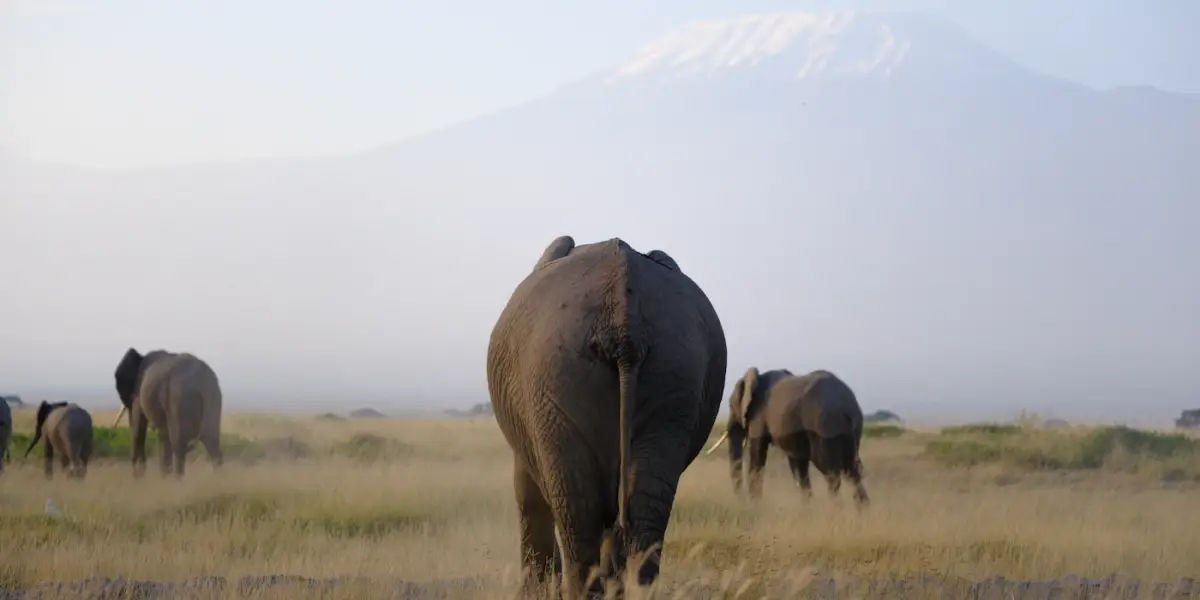
WildlifeBig elephant herds on open plains, with Kilimanjaro, Africa's highest mountain, rising behind.
2 nightsabout 4 h from Nairobi airportBest Jan–Feb, Jul–Oct
Amboseli National Park
WildlifeBig elephant herds on open plains, with Kilimanjaro, Africa's highest mountain, rising behind.
Amboseli is a 767 sq km park south of Nairobi, known for close views of large elephant herds with Kilimanjaro as the backdrop. Swamps fed by underground water from the mountain hold wildlife here all year in otherwise dry country, and the mountain often shows itself at sunrise.
What to do in Amboseli National Park
- Elephants at the swamps. Herds come to the Enkongo Narok and Ol Tukai swamps to drink and cool off, often crossing the dusty plains in single file; drive early or late, when the animals are most active.
- Observation Hill. The only place inside the park where you can get out and walk, with a view over the swamps and plains and, on clear days, to Kilimanjaro.
- Photograph Kilimanjaro at dawn. Clear views of the peak are likeliest at first light, and the marshes and dry salt pans make good foregrounds.
- Birdwatching. Over 400 bird species are on record here, from pelicans and crowned cranes to flamingos on the lake basin, and migrants arrive from November to April.
- Maasai cultural visit. Maasai villages and cultural centres around the park show visitors their homesteads, dances and beadwork.
Game drives are best in Kenya's dry seasons: mid-June through October, and again late December into mid-March.
Sources: Kenya Wildlife Service: Amboseli National Park, Wikivoyage: Amboseli National Park, Wikivoyage: Kenya (checked 14 Oct)
Mombasa
CityThe old port city: a 16th-century Portuguese fort, Swahili Old Town lanes and Hindu temples.
1 nightabout 30 min from Mombasa airport
Mombasa
CityThe old port city: a 16th-century Portuguese fort, Swahili Old Town lanes and Hindu temples.
Mombasa is Kenya's second-largest city and main port, an old Swahili trading town on an island that was later ruled by the Portuguese, Arabs and British. Fort Jesus and the Old Town are on the island, the airport is about 6 km away on the mainland, and the Madaraka Express from Nairobi ends at a new terminus west of the city. North of the island lie the beaches of Nyali, Bamburi and Shanzu.
What to do in Mombasa
- Fort Jesus. Built by the Portuguese between 1593 and 1596 to guard the harbour, the fort changed hands many times, was a prison under the British and is now a UNESCO-listed museum of finds from coastal digs.
- Walk the Old Town. North of the fort along Tudor Creek, the lanes of the original Swahili town have craft shops selling silver jewellery and guides waiting outside the fort.
- Hindu temples. The city's Indian community has built several mandirs, among them the Shri Kutch Satsang Swaminarayan temple of 1957 and the New Dwarikadham Krishna temple in Nyali; temple guides take visitors inside.
- The tusks on Moi Avenue. Steel tusks put up in 1956 for a visit by Princess Margaret stand at the entrance to the city and together form an M for Mombasa.
- Snorkel in the marine park. Boats from the north-coast beaches take snorkellers and divers out to the protected coral gardens of Mombasa Marine National Park.
Sources: National Museums of Kenya: Fort Jesus National Monument, National Museums of Kenya: Fort Jesus Museum, Kenya Wildlife Service: Mombasa Marine National Park & Reserve, Kenya Railways: Madaraka Express, Wikivoyage: Mombasa, Wikivoyage: Kenya (checked 14 Oct)
Diani Beach
BeachKenya's best-known resort beach, south of Mombasa, with reef snorkelling trips and coastal forest close by.
2–3 nightsabout 1 h 30 min from Mombasa airportBest Dec–Feb
Diani Beach
BeachKenya's best-known resort beach, south of Mombasa, with reef snorkelling trips and coastal forest close by.
Diani, about 30 km south of Mombasa, is the best-known resort area on Kenya's south coast, with hotels spread along a long, broad beach. From Mombasa airport the trip takes about 1 to 1½ hours by taxi and includes the Likoni ferry crossing. Offshore, the Diani-Chale marine reserve protects coral reefs, seagrass and turtle nesting grounds.
What to do in Diani Beach
- Snorkelling in Kisite-Mpunguti. Boat trips leave Shimoni, near the Tanzanian border, for the coral gardens around three small islands, among the best snorkelling on the coast, though currents run strong and the sea is rough in May and June.
- Shimba Hills National Reserve. About 31 km inland from Diani, this forested reserve shelters Kenya's last breeding herd of sable antelope, as well as forest elephants and the Sheldrick Falls.
- Colobus Conservation. A rescue and rehabilitation centre for the Angolan colobus monkey that runs informative walks to spot the area's primates.
- Kaya Kinondo sacred forest. A sacred forest near Diani that can only be entered with a guide; visitors wear a black kanga out of respect for the spirits thought to dwell there.
- Africa Pool at Tiwi. On the reef at the end of Tiwi Beach, just north of Diani, a rock pool shaped like the African continent shows at low tide and can be snorkelled.
Late November to mid-March is the best time; April to June is the main rainy season, and October and November can also be wet.
Sources: Wikivoyage: Diani Beach, Wikivoyage: Coastal Kenya, Kenya Wildlife Service: Diani Chale National Reserve, Kenya Wildlife Service: Kisite Mpunguti Marine National Park, Kenya Wildlife Service: Shimba Hills National Reserve (checked 14 Oct)
Lake Nakuru National Park
WildlifeA fenced Rift Valley park around a soda lake, with rhinos, Rothschild giraffes, flamingos and lake viewpoints.
1 nightabout 3 h 30 min from Nairobi airport
Lake Nakuru National Park
WildlifeA fenced Rift Valley park around a soda lake, with rhinos, Rothschild giraffes, flamingos and lake viewpoints.
Lake Nakuru National Park surrounds a shallow alkaline lake in the Rift Valley, about 156 km north-west of Nairobi beside Nakuru city. It became Kenya's first government-run rhino sanctuary in 1987, and because it is fenced it holds black and white rhinos and Rothschild giraffes but no elephants. Flamingos move between Nakuru and the nearby lakes Bogoria and Elementaita, so how many you see here changes from season to season.
What to do in Lake Nakuru National Park
- Rhinos on a game drive. White rhinos are seen on most drives, buffalo and zebras are common, and black rhinos and lions take more luck to find.
- Baboon Cliff and Lion Hill. Two of the park's viewpoints where you may step out of the vehicle and look down over the lake, the woodland and the buffalo herds.
- Makalia Falls. A waterfall where you can leave the vehicle and walk a short way to the falls.
- Birdwatching on the shore. About 450 bird species have been recorded, with pelicans, marabou storks and fish eagles around the water as well as flamingos when they are in.
- Rothschild giraffes. Giraffes of this endangered subspecies were brought here from western Kenya in 1977 to protect them and now breed in the park.
Sources: Kenya Wildlife Service: Lake Nakuru National Park, Wikivoyage: Lake Nakuru National Park, National Museums of Kenya: Kenya Lake System in the Great Rift Valley, Giraffe Centre (A.F.E.W. Kenya): About us (checked 14 Oct)
Tsavo East and West
WildlifeKenya's two largest national parks, within reach of the coast: red-dusted elephants, lava fields and springs.
1–2 nightsabout 3 h from Mombasa airportBest Aug–Sep
Tsavo East and West
WildlifeKenya's two largest national parks, within reach of the coast: red-dusted elephants, lava fields and springs.
Tsavo East and Tsavo West are Kenya's largest and second-largest national parks, separated by the Nairobi-Mombasa highway and railway. Tsavo East is flatter and drier, which makes animals easier to spot, and its Voi Gate is about 156 km from Mombasa, so it is a common short safari from the coast; Tsavo West is hillier, with volcanic cones, lava flows and springs.
What to do in Tsavo East and West
- Red elephants of Tsavo East. The elephants here are often coated in the park's red dust, a familiar sight on drives across the plains along the Galana River.
- Mzima Springs. In Tsavo West, clear water wells up from under the lava rocks into pools that draw wildlife and birds.
- The man-eaters and the railway. In 1898 two lions killed many workers building the Kenya-Uganda Railway here, the same railway whose construction brought many Indian labourers to Kenya.
- Lugard's Falls and Mudanda Rock. A run of rapids on the Galana River and a 1.6 km rock outcrop with a waterhole at its foot are two regular stops in Tsavo East.
- Roaring Rocks and Poacher's Lookout. Two viewpoints in Tsavo West that look out over the park's plains and hills.
August and September, when the grass is low, are the best months for seeing wildlife; the long rains from March to May are a poor time for a safari.
Sources: Kenya Wildlife Service: Tsavo East National Park, Kenya Wildlife Service: Tsavo West National Park, Wikivoyage: Tsavo East National Park, Wikivoyage: Tsavo West National Park, Wikivoyage: Kenya (checked 14 Oct)
Watamu and Malindi
BeachReef-sheltered beaches north of Mombasa, a marine park for snorkelling and the ruined Swahili town of Gede.
2–3 nightsabout 2 h 30 min from Mombasa airportBest Oct–Mar
Watamu and Malindi
BeachReef-sheltered beaches north of Mombasa, a marine park for snorkelling and the ruined Swahili town of Gede.
Watamu is a fishing village about 120 km north of Mombasa, known for its coves and white-sand beaches such as Turtle Bay and Garoda, which front a marine park. Malindi, 28 km further north, is the larger town, where Vasco da Gama anchored in April 1498 on his voyage to India. The marine parks off both towns were set up in 1968, among the first in Kenya.
What to do in Watamu and Malindi
- Snorkel Watamu Marine National Park. Boats take snorkellers and divers out to coral gardens in the reef-protected lagoons, home to sea turtles and plenty of reef fish.
- Gede ruins. In the forest between Watamu and Malindi, the mosques, palace and houses of a Swahili town that peaked in the 15th century and was abandoned in the 17th were listed by UNESCO in 2024.
- Vasco da Gama Pillar. The pillar near Malindi marks where the Portuguese navigator came ashore, and the Malindi marine park stretches south from it.
- Malindi Museum. Housed in the House of Columns, a two-storey building already standing in 1891, with exhibits that include a coelacanth.
- Whales and whale sharks. Humpback whales pass this coast from July to October, and whale sharks visit from November to February.
The sea is at its calmest between October and March, whale sharks pass from November to February, and April and May bring the most rain.
Sources: Kenya Wildlife Service: Watamu Marine National Park & Reserve, Kenya Wildlife Service: Malindi Marine National Park & Reserve, National Museums of Kenya: Gede Museum, National Museums of Kenya: The Historic Town and Archaeological Site of Gedi, National Museums of Kenya: Malindi Museum, Wikivoyage: Malindi, Wikivoyage: Coastal Kenya (checked 14 Oct)
Lamu
HeritageA UNESCO-listed Swahili island town of stone houses, narrow lanes, dhows and donkeys, with few cars.
2–3 nightsabout 2 h by flight from Nairobi airport
Lamu
HeritageA UNESCO-listed Swahili island town of stone houses, narrow lanes, dhows and donkeys, with few cars.
Lamu Old Town, on an island near the northern end of Kenya's coast, has been lived in for more than 700 years and was listed by UNESCO in 2001; its stone houses and narrow lanes mix Swahili, Arab, Persian, Indian and European building styles. There are few motor vehicles, so boats and donkeys do much of the carrying, and Shela village, with a 12 km beach, is about 3 km along the shore. Flights land on Manda Island, a five-minute boat ride across the channel; Wikivoyage advises flying rather than going overland from Malindi.
What to do in Lamu
- Wander the Old Town. Winding lanes run between houses built of coral stone, lime and mangrove poles, many with ornate timber doors and, inside, painted ceilings and wall niches.
- Lamu Museum and Lamu Fort. The museum holds one of the coast's largest Swahili ethnographic collections, including a gallery of old Lamu doors, and the fort built between 1813 and 1821 served as a prison until 1984.
- Sail in a dhow. Traditional sailing dhows take visitors across to Manda Island or out for a sunset sail.
- Shela Beach. Walk about 45 minutes, or take a motorbike taxi, to Shela village, where a 12 km sand beach runs along the island's southern shore.
- Takwa ruins on Manda Island. About 30 minutes by boat from Lamu, the remains of a 15th-16th century Swahili trading town include a Friday mosque with a pillar rising above its qibla wall.
Sources: National Museums of Kenya: Lamu Old Town, National Museums of Kenya: Lamu Museum, National Museums of Kenya: Takwa, Wikivoyage: Lamu, Wikivoyage: Malindi, Wikivoyage: Kenya (checked 14 Oct)
A first trip: 9–12 nights
- Nairobi · 1–2n
- →Maasai Mara National Reserve · 2–3n
- →Lake Naivasha and Hell's Gate · 1n
- →Amboseli National Park · 2n
- →Mombasa · 1n
- →Diani Beach · 2–3n
Land in Nairobi, drive west to the Maasai Mara, return through the Rift Valley with a night at Lake Naivasha, then head south to Amboseli; from there go back to Nairobi for the train or a short flight to Mombasa (or drive to the coast through Tsavo West) and end on the beach at Diani, flying home from Mombasa. The loop works best in Kenya's dry seasons: July to October is the Mara's dry season and migration time, and late December to February suits both the parks and the coast, while the long rains from March to May are the time to avoid.
Getting around
The parks are usually covered on an organised road safari from Nairobi, in a minivan or 4x4 with a driver-guide, and small planes from Nairobi's Wilson Airport also serve airstrips in the Maasai Mara, Amboseli and Samburu. Between Nairobi and Mombasa the Madaraka Express train takes about five hours and crosses the Tsavo plains, while domestic flights link Nairobi with Mombasa, Malindi, Ukunda (for Diani) and Lamu. Plan road legs for daylight, and fly rather than drive to Lamu.
Peak Shoulder Off-season
The Kenya Meteorological Department describes March to May as the main 'long rains', with the highlands around Nairobi among the wettest areas, and October to December as the 'short rains'. June to September is cool and dry, which is also safari high season; January and February are warm and dry.
Flights to Kenya from India
Visa for Indian passports
Indian passport holders need an e-visa for Kenya, applied for online before travel (allow about 7 days). Online eTA (about US$30) at etakenya.go.ke, at least 3 days before travel.
Before you book, check the Ministry of External Affairs travel advisories and the High Commission of India, Nairobi for the latest guidance.
Kenya: questions
What are the best places to visit in Kenya?
Nairobi: The capital and safari starting point, with a national park on its edge, elephant orphans and giraffes. Maasai Mara National Reserve: Open grass plains with lions, cheetahs and leopards, and the wildebeest migration in the dry season. Lake Naivasha and Hell's Gate: A Rift Valley lake for hippo boat rides, with cycling past zebras and giraffes in Hell's Gate next door. Amboseli National Park: Big elephant herds on open plains, with Kilimanjaro, Africa's highest mountain, rising behind. Mombasa: The old port city: a 16th-century Portuguese fort, Swahili Old Town lanes and Hindu temples. Diani Beach: Kenya's best-known resort beach, south of Mombasa, with reef snorkelling trips and coastal forest close by. Lake Nakuru National Park: A fenced Rift Valley park around a soda lake, with rhinos, Rothschild giraffes, flamingos and lake viewpoints. Tsavo East and West: Kenya's two largest national parks, within reach of the coast: red-dusted elephants, lava fields and springs. Watamu and Malindi: Reef-sheltered beaches north of Mombasa, a marine park for snorkelling and the ruined Swahili town of Gede. Lamu: A UNESCO-listed Swahili island town of stone houses, narrow lanes, dhows and donkeys, with few cars.
How many days do you need for Kenya?
A first trip takes about 9–12 nights: Nairobi (1–2 nights), Maasai Mara National Reserve (2–3 nights), Lake Naivasha and Hell's Gate (1 night), Amboseli National Park (2 nights), Mombasa (1 night), Diani Beach (2–3 nights). Land in Nairobi, drive west to the Maasai Mara, return through the Rift Valley with a night at Lake Naivasha, then head south to Amboseli; from there go back to Nairobi for the train or a short flight to Mombasa (or drive to the coast through Tsavo West) and end on the beach at Diani, flying home from Mombasa. The loop works best in Kenya's dry seasons: July to October is the Mara's dry season and migration time, and late December to February suits both the parks and the coast, while the long rains from March to May are the time to avoid.
What is the best time to visit Kenya?
Peak season is Jan–Feb, Jun–Sep. The Kenya Meteorological Department describes March to May as the main 'long rains', with the highlands around Nairobi among the wettest areas, and October to December as the 'short rains'. June to September is cool and dry, which is also safari high season; January and February are warm and dry.
Do Indians need a visa for Kenya?
Indian passport holders need an e-visa for Kenya, applied for online before travel (allow about 7 days). Online eTA (about US$30) at etakenya.go.ke, at least 3 days before travel.
How much is a flight to Kenya from India?
The lowest return fare FlyBun has seen in the last 14 days is ₹38,787, Mumbai to Nairobi, for November 2026 departures. Fares change daily.
Places and things to do are written by FlyBun from official tourism, heritage and park sources, linked under each place, last checked 14 Oct. We leave out entry fees and opening hours because they change; check them before you go.
Watch a route and FlyBun alerts you free when its fare drops.