

Travel guide from India
Kuwait
Kuwait is a small, flat desert country at the head of the Gulf between Iraq and Saudi Arabia, a short flight from India, and nearly everything a visitor comes for is in and around Kuwait City. Indians are its largest expatriate community, about a fifth of the population, so Hindi, Tamil and Malayalam are widely spoken, and the ties are old: dhows once sailed to India with dates, Arabian horses and pearls, and the Indian rupee was legal tender here until 1961. A short trip takes in the Kuwait Towers and the seafront, the souqs and the Grand Mosque, and a new crop of museums.
- Best time
- Nov–Mar
- First trip
- 3–4 nights
- Visa
- Visa needed
- Return flights
- from ₹19,010 ●
- Mumbai, checked in the last 48 h
Places to visit in Kuwait
5 places in the order you would meet them on a first trip. Tap one for what to do there.
Kuwait City centre and Souq Al-Mubarakiya
HeritageThe traditional souq, the Grand Mosque, Seif Palace, a 1930s house of Bedouin weaving and the dhow harbour.
2 nightsabout 30 min from Kuwait City airportBest Nov–Apr
Kuwait City centre and Souq Al-Mubarakiya
HeritageThe traditional souq, the Grand Mosque, Seif Palace, a 1930s house of Bedouin weaving and the dhow harbour.
Downtown Kuwait City sits on a peninsula on the southern side of Kuwait Bay, and its business district holds the big international hotels, which makes it the natural base for a short stay. Souq Al-Mubarakiya, the city's famous traditional market, is right in the middle, while the Grand Mosque faces Seif Palace about 400 m from the National Museum and Sadu House on Gulf Street. Along the water by the Souq Sharq mall, the fish market and the old ships' harbour keep the city's seafaring past in view.
What to do in Kuwait City centre and Souq Al-Mubarakiya
- Souq Al-Mubarakiya. Shops in the heart of downtown sell Middle Eastern and Asian goods, and the souq has a gold and jewellery market of its own.
- Grand Mosque. Across from Seif Palace; Wikivoyage reports guided tours for visitors, so dress modestly and check locally how tours are run.
- Seif Palace from outside. The palace, built in 1896 and the place where the Amir runs the country's day-to-day affairs, cannot be entered, but you can walk past and look at its large gardens.
- Sadu House. Built in 1936 for a wealthy family around four open courtyards, with doors brought from Karachi and other Indian decorative touches, it now tells the story of Bedouin weaving, from the woven 'House of Hair' to men's cloaks.
- Fish market and dhow harbour. The market beside Souq Sharq has 274 fish counters and a restaurant in the same building that will cook what you buy, and next door about fifty wooden dhows crowd the old ships' port, prettiest at sunset.
The heat usually breaks around mid-October; December to February are cool with cold nights, March and most of April are the most pleasant, and July and August can pass 50°C for weeks.
Sources: Wikivoyage: Kuwait City, Wikivoyage: Kuwait, Al Sadu Society (Sadu House): Sadu House History, Al Sadu Society (Sadu House): Museum, Al Sadu Society (Sadu House): Contact Us, Amiri Diwan: Entities affiliated to Al Diwan Al Amiri, Embassy of India, Kuwait: Indian Community, Embassy of India, Kuwait: India-Kuwait bilateral relations (checked 14 Oct)
Kuwait Towers and the Sea Front
CityDay tripThe country's best-known symbol and its revolving viewing sphere, on 9 km of seafront parks, beaches and cafés.
about 30 min from Kuwait City airport
Kuwait Towers and the Sea Front
CityDay tripThe country's best-known symbol and its revolving viewing sphere, on 9 km of seafront parks, beaches and cafés.
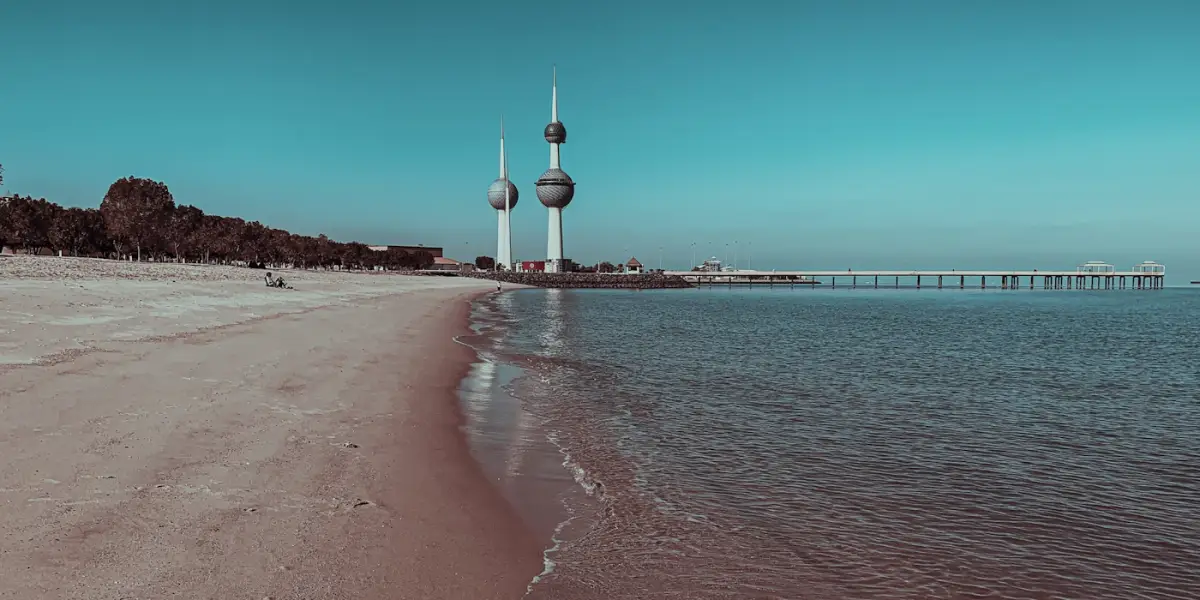
The three Kuwait Towers rise beside the sea on the Arabian Gulf Road, a symbol so familiar it turns up on almost everything except the flag; the state-owned Touristic Enterprises Company (TEC) runs them. They stand on the Sea Front, nine kilometres of coast from Shaab to Bneid Al Gar with public beaches, beach clubs, parks, play areas and cafés, which also takes in Green Island (check whether it is open). Sunset is the best time to come, and also the busiest.
What to do in Kuwait Towers and the Sea Front
- Viewing Sphere. The upper sphere sits more than 120 m above the sea and its platform turns a full circle every half hour, with a small café serving snacks and drinks.
- Look closely at the spheres. Opened in 1979 to a Swedish design and put up by Yugoslav builders, the towers wear spheres clad in a dotted pattern of coloured round plates, and photographs by the stairs inside the viewing sphere show the damage done in the Iraqi invasion.
- Green Island. A man-made island and marine park, opened in 1988, whose shoreline looks back across the water to the city skyline.
- Dasman Beach. A quieter beach with the towers and the skyline in view; Wikivoyage has long cautioned against swimming off the mainland because of sewage reaching some beaches.
- Sunset on the seafront. Footpaths line much of the coast; at dusk, find a bench facing the water across from Souq Sharq and watch the sun go down.
Sources: Touristic Enterprises Company: Kuwait Towers, Touristic Enterprises Company: The Sea Front, Touristic Enterprises Company: About Us, Wikivoyage: Kuwait City, Wikivoyage: Kuwait (checked 14 Oct)
Jaber Al-Ahmad Cultural Centre and Al Salam Palace
HeritageDay tripA glittering performing-arts complex, a wrecked state guest palace rebuilt as a museum, and Kuwait's largest urban park.
about 30 min from Kuwait City airport
Jaber Al-Ahmad Cultural Centre and Al Salam Palace
HeritageDay tripA glittering performing-arts complex, a wrecked state guest palace rebuilt as a museum, and Kuwait's largest urban park.
The Amiri Diwan, the Amir's court, runs several of the capital's cultural venues. Opened in 2016, the Sheikh Jaber Al-Ahmad Cultural Centre sets four titanium-and-glass buildings for theatre, music and film in a public park, and together with the Sheikh Abdullah Al Salem Cultural Centre it makes up Kuwait's new national cultural district. In Shuwaikh, Al Salam Palace, built in the 1950s and used as the state guest palace until it was wrecked and looted in the 1990 invasion, reopened in 2019 as a museum of more than 300 years of Kuwaiti history.
What to do in Jaber Al-Ahmad Cultural Centre and Al Salam Palace
- Sheikh Jaber Al-Ahmad Cultural Centre. Geometric forms inspired by Islamic architecture wrap its theatres, concert hall, cinema and amphitheatre, and more than 8,000 sq m of calligraphy is worked into the cladding inside.
- Catch a performance. The centre's programme runs from concerts and plays to films, workshops and spoken word, so check its What's On listings for your dates.
- Al Salam Palace Museum. Three museums inside tell the palace's own story, the civilisations that lived on Kuwait's land and the country's history through its rulers, with guides in English or Arabic.
- Before you go to the palace. Check the palace's minimum age before bringing children; the dress code rules out shorts, sleeveless tops, sportswear, jeans and hats.
- Al Shaheed Park. Kuwait's largest urban park mixes a museum, a botanical garden, monuments, fountains and jogging paths, with shady corners and small pop-up markets at weekends.
Sources: Sheikh Jaber Al-Ahmad Cultural Centre: The Cultural Centre, Sheikh Jaber Al-Ahmad Cultural Centre: The Architecture, Sheikh Jaber Al-Ahmad Cultural Centre: The Opening, Sheikh Jaber Al-Ahmad Cultural Centre: The Venues, Al Salam Palace Museum: Our Story, Al Salam Palace Museum: Standard Tour, Al Salam Palace Museum: Contact Us, Amiri Diwan: Entities affiliated to Al Diwan Al Amiri, Wikivoyage: Kuwait City (checked 14 Oct)
Salmiya and the Scientific Center
CityA seaside district of malls and snack streets, with Kuwait's largest marine tank at the Scientific Center.
1–2 nightsabout 30 min from Kuwait City airport
Salmiya and the Scientific Center
CityA seaside district of malls and snack streets, with Kuwait's largest marine tank at the Scientific Center.
Salmiya, about 10 minutes down the coast from Kuwait City, is a busy commercial and residential district of malls, restaurants and beach with a good spread of hotels, so it works as a seaside alternative to staying downtown. On the waterfront by Gulf Street, the Scientific Center combines an aquarium, a hands-on play and science area and an IMAX cinema, with traditional dhows on show outside. Marina Mall, one of the city's big shopping centres, is on the same coastal road.
What to do in Salmiya and the Scientific Center
- Mijbil Almutawa Aquarium. Walk from desert caves through a coastal zone with African penguins and river otters to Kuwait's largest marine tank, home to sharks big and small, sea turtles and coral.
- Power of Play. More than 20 hands-on activities in five themes let children climb, build and invent at the Scientific Center.
- IMAX films. The Scientific Center's giant-screen theatre shows nature and science documentaries, a cool break from the heat.
- Restaurants Road. Ask a local for the 'Restaurants Road', a Salmiya street lined end to end with eateries selling local sandwiches, juices and snacks.
- Indian food. South Indian takeaways are a cheap everyday meal, and Indian restaurants across the city range from downtown dining rooms to mall outlets known for North Indian dishes.
Sources: The Scientific Center Kuwait (official site), The Scientific Center Kuwait: Mijbil Almutawa Aquarium, The Scientific Center Kuwait: Power of Play, Wikivoyage: Kuwait, Wikivoyage: Kuwait City, Wikivoyage: Hawalli (Salmiya hotels) (checked 14 Oct)
Ahmadi and the Oil & Gas Exhibition
HeritageDay tripThe Kuwait Oil Company's interactive museum of oil, from how it forms to the oil-well fires of 1991.
about 30 min from Kuwait City airport
Ahmadi and the Oil & Gas Exhibition
HeritageDay tripThe Kuwait Oil Company's interactive museum of oil, from how it forms to the oil-well fires of 1991.
Ahmadi, about 30 minutes by car from Kuwait City, sits among the Kuwait Oil Company's fields and installations, and KOC runs the Ahmad Al-Jaber Oil & Gas Exhibition here as Kuwait's national oil and gas museum. Guides lead visitors, in English or Arabic, through nine galleries of interactive displays, a visit of one and a half to two hours on foot and all indoors. It is wheelchair friendly and Wikivoyage rates it good fun for children too.
What to do in Ahmadi and the Oil & Gas Exhibition
- From a drop of oil to export. Galleries follow oil and gas from how they form and get trapped under Kuwait to exploration, extraction, refining and export, with high-tech interactive displays.
- The early days of oil. A graphic panel and a timeline cover the industry's beginnings under Sheikh Ahmad Al-Jaber, Amir from 1921 to 1950 and the exhibition's namesake; oil was first struck at the Burgan field in 1938.
- Heroes of Fire. A documentary honours the firefighters, the Kuwaiti team above all, who put out the burning oil wells of 1991.
- Viewing Gallery. Real and virtual views look out over KOC's oil fields and installations around Ahmadi.
- Keep cameras away from the fields. Oil fields are heavily guarded, so stay well back from the fences and do not photograph them, or airports and government buildings, as you could be detained.
Sources: Kuwait Oil Company: Ahmad Al-Jaber Oil & Gas Exhibition, Kuwait Oil Company: Ahmad Al-Jaber Oil & Gas Exhibition, Plan Your Visit, Wikivoyage: Kuwait (checked 14 Oct)
A first trip: 3–4 nights
- Kuwait City centre and Souq Al-Mubarakiya · 2n
- →Kuwait Towers and the Sea Front
- →Jaber Al-Ahmad Cultural Centre and Al Salam Palace
- →Salmiya and the Scientific Center · 1–2n
- →Ahmadi and the Oil & Gas Exhibition
Base yourself downtown for the souq, the Grand Mosque, Sadu House and the fish market, catch sunset at the Kuwait Towers and give the cultural centre and Al Salam Palace an outing of their own, then move down the coast to Salmiya for the Scientific Center, with a half day at the oil exhibition in Ahmadi; Salmiya is only about 10 minutes from the city, so either area can be your only base. Come between November and April if you can: from June to August daytime heat passes 50°C, so keep the middle of the day for indoor sights.
Getting around
Kuwait International Airport is about 16 km south of Kuwait City, with taxis into town; check your airline for the latest on flights and terminals. Around town, taxis are the practical choice: street taxis seldom use their meters, so settle the fare before you get in, or call one through the Careem app. KPTC and CityBus buses run south from the centre parallel to the coast as far as Fahaheel, and a hired car is the simplest way to reach places outside the city, though local driving is fast and aggressive.
Peak Shoulder Off-season
No tourism-board page describes Kuwait's seasons, so these ratings are derived from the NASA POWER climate normals: highs pass 40°C from June to September with no rain at all, April and October are warm transition months, and November to March is mild, with the little rain the year brings.
Flights to Kuwait from India
Visa for Indian passports
Indian passport holders need a visa for Kuwait before travel. Allow about 14 days for a first-time application. GCC residence holders can get an e-visa or visa on arrival. No e-visa for Indians living in India; apply via the Kuwaiti embassy or an approved agent.
Before you book, check the Ministry of External Affairs travel advisories and the Embassy of India, Kuwait for the latest guidance.
Kuwait: questions
What are the best places to visit in Kuwait?
Kuwait City centre and Souq Al-Mubarakiya: The traditional souq, the Grand Mosque, Seif Palace, a 1930s house of Bedouin weaving and the dhow harbour. Kuwait Towers and the Sea Front: The country's best-known symbol and its revolving viewing sphere, on 9 km of seafront parks, beaches and cafés. Jaber Al-Ahmad Cultural Centre and Al Salam Palace: A glittering performing-arts complex, a wrecked state guest palace rebuilt as a museum, and Kuwait's largest urban park. Salmiya and the Scientific Center: A seaside district of malls and snack streets, with Kuwait's largest marine tank at the Scientific Center. Ahmadi and the Oil & Gas Exhibition: The Kuwait Oil Company's interactive museum of oil, from how it forms to the oil-well fires of 1991.
How many days do you need for Kuwait?
A first trip takes about 3–4 nights: Kuwait City centre and Souq Al-Mubarakiya (2 nights), Kuwait Towers and the Sea Front (1 night), Jaber Al-Ahmad Cultural Centre and Al Salam Palace (1 night), Salmiya and the Scientific Center (1–2 nights), Ahmadi and the Oil & Gas Exhibition (1 night). Base yourself downtown for the souq, the Grand Mosque, Sadu House and the fish market, catch sunset at the Kuwait Towers and give the cultural centre and Al Salam Palace an outing of their own, then move down the coast to Salmiya for the Scientific Center, with a half day at the oil exhibition in Ahmadi; Salmiya is only about 10 minutes from the city, so either area can be your only base. Come between November and April if you can: from June to August daytime heat passes 50°C, so keep the middle of the day for indoor sights.
What is the best time to visit Kuwait?
Peak season is Nov–Mar. No tourism-board page describes Kuwait's seasons, so these ratings are derived from the NASA POWER climate normals: highs pass 40°C from June to September with no rain at all, April and October are warm transition months, and November to March is mild, with the little rain the year brings.
Do Indians need a visa for Kuwait?
Indian passport holders need a visa for Kuwait before travel. Allow about 14 days for a first-time application. GCC residence holders can get an e-visa or visa on arrival. No e-visa for Indians living in India; apply via the Kuwaiti embassy or an approved agent.
How much is a flight to Kuwait from India?
The lowest return fare FlyBun has seen in the last 14 days is ₹19,010, Mumbai to Kuwait City, for February 2027 departures. Fares change daily.
Places and things to do are written by FlyBun from official tourism, heritage and park sources, linked under each place, last checked 14 Oct. We leave out entry fees and opening hours because they change; check them before you go.
Watch a route and FlyBun alerts you free when its fare drops.