

Travel guide from India
Malaysia
Kuala Lumpur is a few hours' direct flight from most large Indian cities, and Malaysia fits a modern capital, colonial port towns, cool tea hills and island beaches into one easy trip. About one in eleven Malaysians is of Indian descent, so Little India districts, banana-leaf rice and Hindu temples such as Batu Caves are part of the trip rather than a detour.
- Best time
- Feb, Jun–Jul
- First trip
- 9–13 nights
- Visa
- Visa-free, 30 days
- Return flights
- from ₹20,977 ●
- Chennai, checked in the last 48 h
Places to visit in Malaysia
9 places in the order you would meet them on a first trip. Tap one for what to do there.
Melaka
HeritagePortuguese, Dutch and British relics in a UNESCO-listed old town, with Jonker Street's night food stalls.
1–2 nightsabout 2 h from Kuala Lumpur airport
Melaka
HeritagePortuguese, Dutch and British relics in a UNESCO-listed old town, with Jonker Street's night food stalls.
Melaka was the hub of a trading empire on the Straits of Malacca until the Portuguese took it in 1511, followed by the Dutch and the British, and its old core was listed by UNESCO in 2008 together with George Town. The compact centre on both banks of the Melaka River packs red Dutch buildings, a ruined Portuguese church, Peranakan shophouses and the temples of Harmony Street, and the town is home to the Chitty, a Tamil-Malay community that still celebrates Pongal. Weekends bring crowds and traffic from KL and Singapore, so weekdays are calmer.
What to do in Melaka
- Stadthuys and Red Square. Built in the mid-1600s for the Dutch governors, the salmon-red Stadthuys ranks among Asia's oldest Dutch buildings and now holds the History and Ethnography Museum.
- St Paul's Hill and A Famosa. The Portuguese built their A Famosa fortress and a chapel here, St Francis Xavier was buried on the hill in 1553 before his remains were taken to Goa, and the fort's gateway still stands.
- Harmony Street. A Chinese temple (Cheng Hoon Teng), a Hindu temple (Sri Poyatha Vinayagar Moorthi) and a mosque (Kampung Kling) stand within a few steps of each other on Jalan Tokong.
- Jonker Street at night. The old shophouse street becomes a night market on weekend evenings, with antique shops and stalls selling Malay, Nyonya, Chinese, Portuguese and Chetti food.
- Melaka River Cruise. Boats from the Muara Jetty run through the city past old warehouses, churches, village houses and mangroves, with commentary on the river's trading past.
Sources: Tourism Malaysia: Melaka map guide (PDF), Wikivoyage: Malacca (checked 14 Oct)
Putrajaya
CityDay tripThe planned federal capital: a rose-pink mosque, sculpted bridges and a lake cruise, close to the airport.
about 30 min from Kuala Lumpur airport
Putrajaya
CityDay tripThe planned federal capital: a rose-pink mosque, sculpted bridges and a lake cruise, close to the airport.
Putrajaya is Malaysia's federal administrative centre, built from 1993 on former plantation land about 30 km south of Kuala Lumpur, with the government moving in from 1999. Its showpiece mosques, bridges and gardens are spread around a 650-hectare man-made lake, and the city is quiet and built for cars, so most visitors come by taxi or on a tour rather than on foot. It lies between the airport and KL, which makes it an easy stop on the drive up from Melaka or on arrival.
What to do in Putrajaya
- Putra Mosque. The pink-domed mosque on the lake has a 116 m minaret; a dress code applies, robes are lent to visitors who need to cover up, and non-Muslims cannot enter during prayers.
- Lake cruise. Cruise Tasik Putrajaya boats, either an air-conditioned launch or a small four- to six-seat perahu, pass about 20 landmarks including the mosque, the Palace of Justice and Putra Bridge.
- Seri Wawasan Bridge after dark. The 240 m cable-stayed bridge, with a forward-leaning pylon shaped like a sail, is lit in changing colours at night.
- Putrajaya Botanical Garden. Ninety-two hectares holding more than 750 plant species in themed gardens, including a Moroccan pavilion, and popular for walks, cycling and picnics.
- The Iron Mosque. Masjid Tuanku Mizan Zainal Abidin is known for a 13 m glass wall inscribed with verses from the Quran.
Sources: Perbadanan Putrajaya tourism: Masjid Putra, Perbadanan Putrajaya tourism: Cruise Tasik Putrajaya, Perbadanan Putrajaya tourism: Jambatan Seri Wawasan, Perbadanan Putrajaya tourism: Taman Botani Putrajaya, Perbadanan Putrajaya tourism: Masjid Tuanku Mizan Zainal Abidin, Perbadanan Putrajaya tourism: Tasik Putrajaya, KLIA Ekspres: About us, Wikivoyage: Putrajaya (checked 14 Oct)
Kuala Lumpur
CityThe capital: the Petronas Towers, a Little India in Brickfields, colonial squares and night food streets.
2–3 nights28 min by train from Kuala Lumpur airportBest Feb, Jun–Jul
Kuala Lumpur
CityThe capital: the Petronas Towers, a Little India in Brickfields, colonial squares and night food streets.
Kuala Lumpur grew in about 150 years from a tin-mining settlement into the capital, and its Malay, Chinese and Indian communities show in its temples, markets and food. The 452 m Petronas Twin Towers rise over the Golden Triangle shopping district, while the colonial centre around Merdeka Square and Chinatown is a short train ride away. The KLIA Ekspres runs non-stop from the airport to KL Sentral, the city's main station, in 28 minutes.
What to do in Kuala Lumpur
- Petronas Twin Towers. Go up to the Skybridge between the towers and the observation deck on the 86th floor, then walk through Suria KLCC mall at their base.
- Brickfields, KL's Little India. Next to KL Sentral, Jalan Tun Sambanthan is lined with Indian shops, banana-leaf rice and vegetarian restaurants, and the Sri Kandaswamy Kovil, a Tamil temple opened in 1890, stands on Jalan Scott.
- Merdeka Square. The old Selangor Club green, where the Union Flag came down at midnight on 31 August 1957, is lined by the Sultan Abdul Samad Building, with Masjid Jamek at the river confluence nearby.
- Night food at Jalan Alor and Chinatown. Coffee shops and hawker stalls crowd Jalan Alor in Bukit Bintang and Jalan Petaling in Chinatown, and most of them only open in the evening.
- Thean Hou Temple. A six-tiered Chinese temple near Brickfields, one of the largest and most ornate in the region, with a wide view over the city.
In MetMalaysia's rainfall pattern for most of the Peninsula away from the north-west and south-west coasts, June and July are the driest months and February the next driest, while October-November is the wettest.
Sources: KLIA Ekspres: About us, Petronas Twin Towers (official site), MetMalaysia: Climate of Malaysia, Wikivoyage: Kuala Lumpur, Wikivoyage: Kuala Lumpur/Brickfields and Bangsar (checked 14 Oct)
Batu Caves
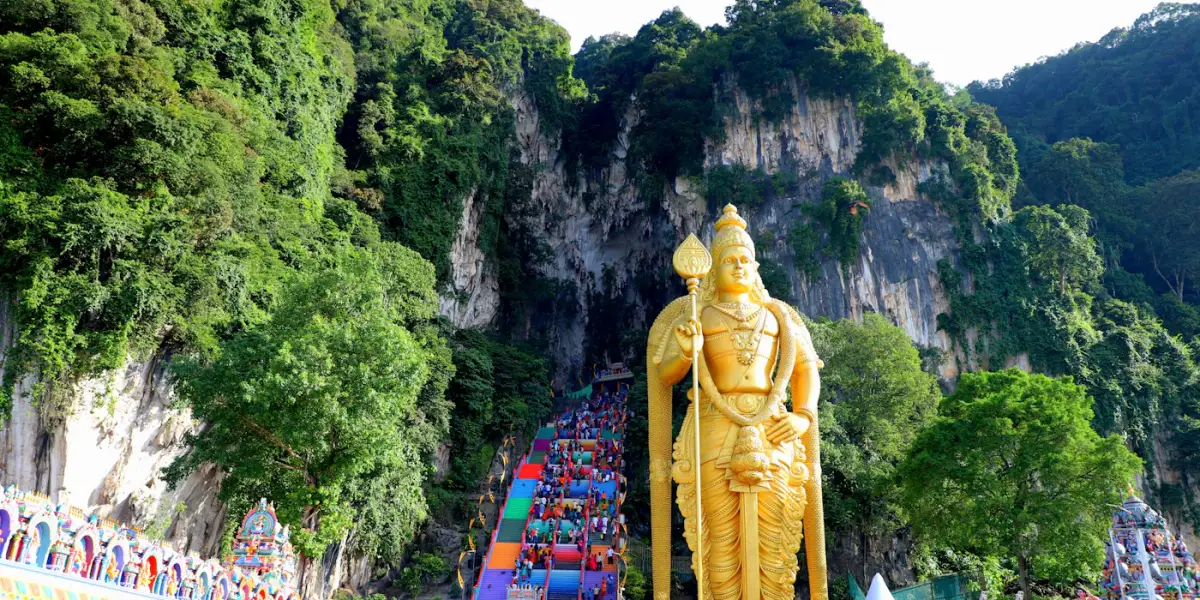
HeritageDay tripLimestone cave temples to Lord Murugan, up 272 painted steps beside a giant golden statue.
about 1 h from Kuala Lumpur airport
Batu Caves
HeritageDay tripLimestone cave temples to Lord Murugan, up 272 painted steps beside a giant golden statue.
Batu Caves is a limestone hill on the northern edge of Kuala Lumpur, about 13 km from the city centre, whose caves have held Hindu shrines since the late 19th century. A towering golden statue of Lord Murugan stands at the foot of the 272 steps that climb to the Sri Subramaniar Swamy Temple in the main Temple Cave. It is the focus of Thaipusam, the country's largest Hindu procession, which falls in January or February and draws enormous crowds, and an easy trip from the city on the KTM Komuter train to Batu Caves station.
What to do in Batu Caves
- Climb to the Temple Cave. The 272 steps, now painted in rainbow colours, lead past the golden Murugan statue to the Sri Subramaniar Swamy Temple inside the largest cave; Tourism Selangor advises arriving early, especially on public holidays.
- Ramayana Cave. Another cave in the complex, filled with paintings and scenes of Hindu gods.
- Mind the monkeys. Long-tailed macaques live around the steps and are known to snatch food and bags, so keep both out of sight.
- Dark Cave. Next to the Temple Cave, this conservation cave shows the animals that live in total darkness on guided educational tours; check that tours are running before you go.
Sources: Tourism Selangor: Batu Caves, Wikivoyage: Kuala Lumpur/North, Wikivoyage: Malaysia (checked 14 Oct)
Genting Highlands
Hill countryDay tripCool hilltop resort with theme parks, a cable car over the rainforest and a cave temple; an easy day from KL.
about 1 h 30 min from Kuala Lumpur airport
Genting Highlands
Hill countryDay tripCool hilltop resort with theme parks, a cable car over the rainforest and a cave temple; an easy day from KL.
Genting Highlands is a resort city built from 1965 on the hills along the Pahang-Selangor border, about an hour's drive from Kuala Lumpur. At the top, hotels, malls, Malaysia's only legal casinos and indoor and outdoor theme parks are all joined by covered walkways, and the air is around 10°C cooler than in KL. Tourism Pahang notes it is popular with day-trippers, and buses from KL connect with the cable car up.
What to do in Genting Highlands
- Ride the Awana SkyWay. The cable car climbs over the rainforest from Sky Sentral at mid-hill to the summit in about 10 minutes, and glass-floor gondolas are also offered.
- Chin Swee Caves Temple. The SkyWay stops at Chin Swee Station on the way up; this temple on a rocky slope near the top has a nine-storey pagoda, a 15 m Buddha statue and a vegetarian restaurant.
- Theme parks. Genting SkyWorlds is the outdoor park with themed rides for adults and children, and Skytropolis is the indoor one inside First World Plaza.
- Genting Highlands Premium Outlets. Brand outlet shopping next to the Sky Sentral cable car station at mid-hill.
- Pack a jacket. Temperatures usually stay between 15°C and 25°C, cloud closes in when it rains in KL, and hotel rooms are unheated.
Sources: Tourism Pahang: Genting Highlands, Resorts World Genting: Awana SkyWay, Wikivoyage: Genting Highlands (checked 14 Oct)
Cameron Highlands
Hill countryA cool-climate hill station: tea estates, strawberry farms, a mossy forest and nights cool enough for a jacket.
2 nightsabout 4 h from Kuala Lumpur airportBest Mar–Sep
Cameron Highlands
Hill countryA cool-climate hill station: tea estates, strawberry farms, a mossy forest and nights cool enough for a jacket.
The Cameron Highlands is a 1,500 m plateau in Pahang that the British developed from the 1920s as a cool retreat and for growing tea, leaving mock-Tudor bungalows among the farms. The mean temperature is about 18°C and nights can drop to around 12°C, and most of Malaysia's temperate vegetables and cut flowers are grown here. Tanah Rata is the main town for hotels and trailheads, with Brinchang higher up and Ringlet at the southern entrance.
What to do in Cameron Highlands
- Visit a tea estate. BOH's Sungai Palas estate and Bharat Tea have the best-developed visitor facilities, and the Sungai Palas tea house looks down over the terraced tea bushes.
- Mossy Forest on Gunung Brinchang. A boardwalk at the top of the highest peak in Malaysia reachable by road runs through old, moss-covered forest, with a lookout tower nearby; much of the ground moss has gone, though the lookout tower is still worth the trip.
- Strawberry and flower farms. Pick strawberries and buy vegetables, flowers and honey at the farms and markets, or visit the butterfly farm.
- Forest trails. Numbered trails, most of them starting from Tanah Rata, lead to viewpoints and waterfalls; Tourism Pahang suggests going with an experienced guide.
- Cream tea. Scones with cream and locally made strawberry jam are the classic Cameron afternoon tea.
Tourism Pahang names March to September as the state's dry season and a good time for the highlands; from October to February the hills turn misty and wetter.
Sources: Tourism Pahang: Cameron Highlands, Tourism Pahang: Weather, Wikivoyage: Cameron Highlands (checked 14 Oct)
Penang (George Town)
HeritageMalaysia's food capital: a walkable UNESCO-listed old town, Little India, street art and Penang Hill.
2–3 nightsabout 2 h by flight from Kuala Lumpur airportBest Dec–Feb
Penang (George Town)
HeritageMalaysia's food capital: a walkable UNESCO-listed old town, Little India, street art and Penang Hill.
George Town, on the north-east tip of Penang Island, was founded in 1786 as the first British settlement in South-East Asia, and its 2.5 sq km UNESCO-listed core of shophouses, clan houses and temples is small enough to explore on foot or by trishaw. Penang Global Tourism bills the state as Malaysia's food capital, with Malay, Chinese, Indian, Thai and Peranakan cooking. Penang's airport is about 16 km south of the city, and from KL you can also take the ETS train to Butterworth and cross on the ferry.
What to do in Penang (George Town)
- Street of Harmony. St George's Church, the Goddess of Mercy Temple, Sri Maha Mariamman Temple and Kapitan Keling Mosque stand a short walk apart along Pitt Street; dress modestly and remove your shoes at temples and mosques.
- Little India. The streets around Chulia, Queen and Market Streets are full of spice shops and Indian eateries, and are at their brightest at Deepavali; Sri Mariamman, from 1833, is Penang's oldest Hindu temple.
- Hawker food. Try char koay teow, assam laksa, nasi kandar and cendol around Gurney Drive, New Lane and Chulia Street, and Jawi Peranakan dishes such as curry kapitan that carry Indian-Muslim influences.
- Street art trail. Ernest Zacharevic's 2012 murals, such as the children on a bicycle on Lebuh Armenian, and 52 steel-rod caricatures are spread through the heritage zone.
- Penang Hill by funicular. The funicular railway climbs to a cooler hilltop of old rainforest and colonial bungalows looking over George Town; the hill is a UNESCO biosphere reserve.
December to February is the driest time in George Town and September to November the wettest, with frequent thunderstorms.
Sources: Penang Global Tourism: George Town UNESCO World Heritage Site, Penang Global Tourism: Food, Penang Global Tourism: Street art, Penang Global Tourism: Parks and forests, Penang Hill Corporation (official site), Wikivoyage: George Town (Malaysia), Wikivoyage: Penang (checked 14 Oct)
Langkawi
IslandDuty-free island geopark: Pantai Cenang's beach, a cable car to a sky bridge and mangrove boat trips.
2–3 nightsabout 30 min from Langkawi airportBest Jan–Feb
Langkawi
IslandDuty-free island geopark: Pantai Cenang's beach, a cable car to a sky bridge and mangrove boat trips.
Langkawi is an archipelago of 99 islands in the Andaman Sea, about 30 km off the Kedah coast, which UNESCO declared a Global Geopark in 2007 for rocks that record more than half a billion years of the earth's history. Most visitors stay on the main island around Pantai Cenang, the main beach strip, while Kuah is the main town and ferry port. The islands have been duty-free since 1987, and flights link them with KL and Penang.
What to do in Langkawi
- SkyCab and SkyBridge. The cable car rises from the foot of the Machinchang range via a middle station at 650 m to the top station at 708 m, where the 125 m curved SkyBridge hangs over the forest; on clear days you can see southern Thailand.
- Kilim Geoforest Park by boat. Boats run through mangrove channels and limestone cliffs in the north-east, stopping at a boardwalk and a bat cave, with eagles overhead.
- Pantai Cenang and Pantai Tengah. Cenang is the busy main beach with most of the places to eat and stay, while Pantai Tengah just to the south is quieter and popular with families.
- Island hopping. Boat tours run to the southern islands, including Pulau Dayang Bunting, the 'Pregnant Maiden', named for the shape of its hills.
- Telaga Tujuh waterfalls. Seven natural pools fed by a chain of falls on the western headland, close to the cable car.
Langkawi sits in the north-west, where MetMalaysia records the driest months as January and February and the wettest as October and November.
Sources: Naturally Langkawi (LADA): About Langkawi, Naturally Langkawi (LADA): Getting here, Naturally Langkawi (LADA): Kilim Geoforest Park, Naturally Langkawi (LADA): Telaga Tujuh Waterfall, Panorama Langkawi: SkyCab, Panorama Langkawi: SkyBridge, MetMalaysia: Climate of Malaysia, Wikivoyage: Langkawi (checked 14 Oct)
Redang Island
IslandEast-coast marine-park island for clear water and reef snorkelling; its season runs from about March to October.
2–3 nightsabout 3 h by flight from Kuala Lumpur airportBest Mar–Oct
Redang Island
IslandEast-coast marine-park island for clear water and reef snorkelling; its season runs from about March to October.
Redang lies about 45 km off the Terengganu coast, and Redang Marine Park covers all nine islands in its group. Almost all accommodation is resort-based, and the reefs, home to turtles and reef sharks, start within a short swim of the main beach at Pasir Panjang. It is the opposite-season choice to Langkawi: resorts and ferries run from about March to October and mostly close in the north-east monsoon.
What to do in Redang Island
- Snorkel off Pasir Panjang. Reefs lie close to the main beach, and the water in the bay is calm enough that fins are not needed.
- Snorkelling boat trips. Many resort packages include boat trips to snorkel around the smaller islands of the marine park.
- Learn to dive. Almost every resort has its own dive shop and Redang is a popular place for a first course, though sites further out can have strong currents.
- Kayak in the marine park. Sea kayaks are available for paddling along the shore inside the marine park.
- Jungle trails between beaches. Forest paths link Pasir Panjang with the beaches to the north and south, a crossing of about 30 to 40 minutes.
Resorts, ferries and dive shops run from about March to October; from November to February the north-east monsoon closes most of them.
Sources: Wikivoyage: Redang, Wikivoyage: Malaysia, MetMalaysia: Climate of Malaysia (checked 14 Oct)
A first trip: 9–13 nights
- Melaka · 1–2n
- →Putrajaya
- →Kuala Lumpur · 2–3n
- →Batu Caves
- →Genting Highlands
- →Cameron Highlands · 2n
- →Penang (George Town) · 2–3n
- →Langkawi · 2–3n
Land at KLIA and go south to Melaka first, stop at Putrajaya on the way up to Kuala Lumpur (Batu Caves and Genting are day trips from the city), then head north by road through the Cameron Highlands to Penang and take the short flight to Langkawi; the north-west is driest in January and February. From about March to October, when the east-coast islands are open and Langkawi is past its driest months, swap Langkawi for Redang, flying from KL to Kuala Terengganu.
Getting around
Domestic flights are the quick way between Kuala Lumpur, Penang, Langkawi and the east coast, and since direct Penang-Langkawi ferries no longer run, most people fly that hop. KTM's ETS electric trains run up the west coast from KL Sentral to Butterworth, where a ferry crosses to George Town, and express buses from KL reach Melaka, Genting and Tanah Rata; the Cameron Highlands can only be reached by road.
When to go
Kuala Lumpur month by month: weather and fares →Langkawi month by month: weather and fares →Peak Shoulder Off-season
The Malaysian Meteorological Department describes two rainy peaks for the inland peninsula, the main one in October and November and a secondary one in April and May, with February the driest month. Kuala Lumpur is hot and humid all year, so these ratings follow rainfall rather than temperature.
Flights to Malaysia from India
Visa for Indian passports
Indian passport holders can visit Malaysia without a visa for up to 30 days. Visa-free until 31 Dec 2026. Fill the free MDAC arrival card within 3 days before arrival.
Before you book, check the Ministry of External Affairs travel advisories for the latest guidance.
Malaysia: questions
What are the best places to visit in Malaysia?
Melaka: Portuguese, Dutch and British relics in a UNESCO-listed old town, with Jonker Street's night food stalls. Putrajaya: The planned federal capital: a rose-pink mosque, sculpted bridges and a lake cruise, close to the airport. Kuala Lumpur: The capital: the Petronas Towers, a Little India in Brickfields, colonial squares and night food streets. Batu Caves: Limestone cave temples to Lord Murugan, up 272 painted steps beside a giant golden statue. Genting Highlands: Cool hilltop resort with theme parks, a cable car over the rainforest and a cave temple; an easy day from KL. Cameron Highlands: A cool-climate hill station: tea estates, strawberry farms, a mossy forest and nights cool enough for a jacket. Penang (George Town): Malaysia's food capital: a walkable UNESCO-listed old town, Little India, street art and Penang Hill. Langkawi: Duty-free island geopark: Pantai Cenang's beach, a cable car to a sky bridge and mangrove boat trips. Redang Island: East-coast marine-park island for clear water and reef snorkelling; its season runs from about March to October.
How many days do you need for Malaysia?
A first trip takes about 9–13 nights: Melaka (1–2 nights), Putrajaya (1 night), Kuala Lumpur (2–3 nights), Batu Caves (1 night), Genting Highlands (1 night), Cameron Highlands (2 nights), Penang (George Town) (2–3 nights), Langkawi (2–3 nights). Land at KLIA and go south to Melaka first, stop at Putrajaya on the way up to Kuala Lumpur (Batu Caves and Genting are day trips from the city), then head north by road through the Cameron Highlands to Penang and take the short flight to Langkawi; the north-west is driest in January and February. From about March to October, when the east-coast islands are open and Langkawi is past its driest months, swap Langkawi for Redang, flying from KL to Kuala Terengganu.
What is the best time to visit Malaysia?
Peak season is Feb, Jun–Jul. The Malaysian Meteorological Department describes two rainy peaks for the inland peninsula, the main one in October and November and a secondary one in April and May, with February the driest month. Kuala Lumpur is hot and humid all year, so these ratings follow rainfall rather than temperature.
Do Indians need a visa for Malaysia?
Indian passport holders can visit Malaysia without a visa for up to 30 days. Visa-free until 31 Dec 2026. Fill the free MDAC arrival card within 3 days before arrival.
How much is a flight to Malaysia from India?
The lowest return fare FlyBun has seen in the last 14 days is ₹20,977, Chennai to Langkawi, for April 2027 departures. Fares change daily.
Places and things to do are written by FlyBun from official tourism, heritage and park sources, linked under each place, last checked 14 Oct. We leave out entry fees and opening hours because they change; check them before you go.
Watch a route and FlyBun alerts you free when its fare drops.