

Travel guide from India
Maldives
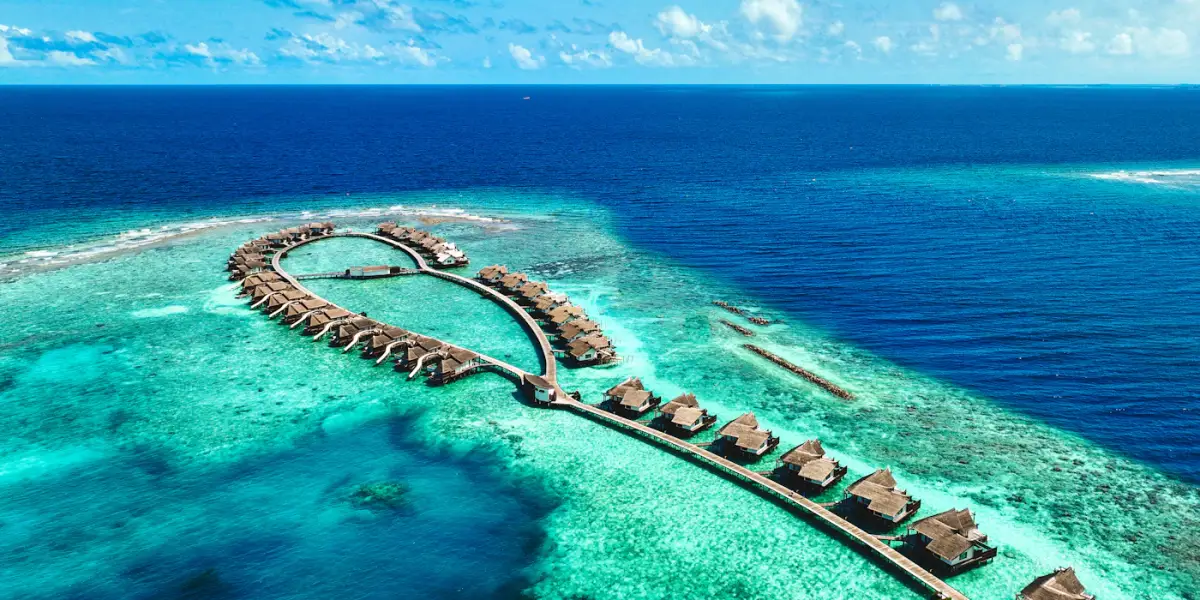
The Maldives is a chain of 1,192 low coral islands grouped into 26 atolls in the Indian Ocean, south-west of India's southern tip, and Indian cities are among the busiest routes into Malé's Velana airport. The big decision is where to sleep: a resort that has an island to itself, where alcohol and swimwear are allowed, or a guesthouse on a local island where Maldivians live, which costs far less but is dry and expects modest dress. Most people come for the water, from sandbank picnics and reef snorkelling to whale sharks in South Ari and manta rays in Baa.
- Best time
- Jan–Mar
- First trip
- 6–8 nights
- Visa
- Visa-free, 30 days
- Return flights
- from ₹25,905 ●
- Kochi, checked in the last 48 h
Places to visit in Maldives
9 places in the order you would meet them on a first trip. Tap one for what to do there.
Hulhumalé
CityThe new town next to the airport: the usual first or last night, with beachfront guesthouses and cheap food.
1 nightabout 30 min from Male airport
Hulhumalé
CityThe new town next to the airport: the usual first or last night, with beachfront guesthouses and cheap food.
Hulhumalé is a fast-growing town built on land reclaimed from the lagoon beside the airport island, about 15 minutes away by road. Hotels and guesthouses line its beach, which makes it the usual place to sleep when you land after dark, have an early seaplane or want an inexpensive last night before flying home. It is a local Maldivian town rather than a resort, so dress and swim modestly.
What to do in Hulhumalé
- Walk the beachfront. Guesthouses, cafés and watersports centres sit a few steps from the sand; this is a residential island, so keep swimwear modest rather than wearing a bikini.
- Maldivian breakfast. Try mas huni, tuna mixed with grated coconut, onion and chilli and scooped up with roshi flatbread; Maldivian cooking draws heavily on Kerala's.
- Short eats with black tea. Cafés sell hedhikaa such as bajiya and gulha, deep-fried snacks that are almost always filled with fish, so vegetarians should ask before ordering; there are Indian restaurants in town too.
- Bus or ferry into Malé. Public buses run between the airport, Hulhumalé and Malé, and a ferry also links Hulhumalé with Malé's ferry terminal.
- Break a late arrival. If you land after dark and your resort is a seaplane ride away, book a night here, because the seaplane transfer will usually wait until morning.
Sources: Visit Maldives (archived copy): Taste the world in the Maldives, a culinary journey in Hulhumalé, Visit Maldives (archived copy): Maldives for the first-timers, Velana International Airport (MACL): Transport and directions, Wikivoyage: Malé, Wikivoyage: Maldives (checked 14 Oct)
Malé
CityDay tripThe crowded capital across the bridge: a 17th-century coral-stone mosque, fish market and the National Museum.
about 30 min from Male airport
Malé
CityDay tripThe crowded capital across the bridge: a 17th-century coral-stone mosque, fish market and the National Museum.
Malé, the capital, covers an entire small island next to the airport and is by some measures the most densely populated city in the world. Many travellers treat it only as a transit point, but half a day on foot is the easiest look at everyday Maldivian life, and almost all the sights are within a short walk of the airport ferry jetty on the north shore. Cover knees and shoulders, and remember the weekend is Friday and Saturday, when banks, offices and many shops close.
What to do in Malé
- Hukuru Miskiy (Old Friday Mosque). Finished in 1658 from interlocking coral blocks carved with fine patterns, it has lacquered woodwork inside, and its graveyard of carved royal tombstones is on UNESCO's tentative World Heritage list; politely dressed visitors are often let in.
- Grand Friday Mosque. The gold-domed Islamic Centre, opened in 1984, is the country's largest mosque and dominates the skyline; visitors are welcome outside prayer times.
- Sultan Park and National Museum. The last surviving building of the old Sultan's palace holds royal regalia, old photographs and carved woodwork with Arabic and Thaana inscriptions.
- Fish market and local market. On the northern waterfront the day's tuna is landed and cut up, and a block away stalls sell produce from the atolls, breadfruit chips and smoked and dried fish.
- Ferry to Villimalé. A short ferry from the south-west harbour reaches this quieter ward of the city, which has Malé's only natural beaches; currents on its far side are strong.
Sources: Visit Maldives (archived copy): Hukuru Miskiy and Munnaaru, Visit Maldives (archived copy): Mosques in Maldives, Velana International Airport (MACL): Transport and directions, Wikivoyage: Malé, Wikivoyage: Maldives (checked 14 Oct)
Maafushi
IslandA popular guesthouse island near the airport: inexpensive stays, sandbank and snorkel trips, dive shops, a bikini beach.
2–3 nights40 min by boat from Male airportBest Jan–Apr
Maafushi
IslandA popular guesthouse island near the airport: inexpensive stays, sandbank and snorkel trips, dive shops, a bikini beach.
Maafushi is an inhabited island in Kaafu Atoll, 27 km from Malé, that became one of the most popular places to stay once tourism was allowed on local islands. Guesthouses and small hotels, dive centres and excursion desks fill a few walkable streets, and restaurants serve Maldivian, Indian, Thai and Western food. Like every local island it is dry, and away from the designated bikini beach you are expected to dress modestly.
What to do in Maafushi
- Sandbank and snorkel trips. Excursion operators run boats to nearby sandbanks, reefs and resort islands for the day, and the surrounding reefs have turtles and plenty of reef fish.
- Bikini beach. Swimwear is fine on the small designated beach at the north end of the island; cover up everywhere else.
- Learn to dive. Several dive centres teach beginners and take certified divers out to the reefs around the island.
- Watersports. Jet skis, parasailing, banana rides and wakeboarding are all offered from the beach.
- Sunset by dhoni and Bodu Beru. Watch the sunset from a traditional dhoni boat, and look out for evenings of Bodu Beru drumming put on for visitors.
January to April brings calm seas, sunshine and the clearest water; rain, wind and waves pick up in the south-west monsoon, especially from June to November.
Sources: Maafushi Council: Visitor guide, Visit Maldives (archived copy): The guest house culture in Maldives, Visit Maldives (archived copy): Maldives for the first-timers, Wikivoyage: Maafushi, Wikivoyage: Maldives (checked 14 Oct)
North Malé Atoll resorts
IslandPrivate-island resorts a short speedboat ride from the airport, near the country's best-known surf breaks and dives.
3–4 nightsabout 30 min by boat from Male airportBest Jan–Apr
North Malé Atoll resorts
IslandPrivate-island resorts a short speedboat ride from the airport, near the country's best-known surf breaks and dives.
North Malé Atoll, around the capital and the airport, was the first part of the Maldives developed for tourism, and nearly all its uninhabited islands became resorts, each the only hotel on its island. Transfers are by speedboat rather than seaplane, which makes these resorts the easiest choice for a short trip or a holiday with children, and alcohol and swimwear are allowed on resort islands. The atoll's eastern rim has the most popular surf breaks, and its dive sites range from a manta feeding spot to a sunken cargo ship.
What to do in North Malé Atoll resorts
- Surf the eastern rim. Cokes off Thulusdhoo, Lhohis, Jailbreaks, Honky's and Sultans are among the breaks; the season runs from mid-February to November, best from March to May and September to November.
- Mantas at Manta Point. In the south-east of the atoll, manta rays gather to feed during the south-west monsoon, roughly May to October.
- Maldives Victory wreck. An 83 m cargo ship that sank off the airport island's reef in 1981 now lies at about 35 m under a cover of coral, a deep dive.
- Reef dives. HP Reef with its caves and crevices, fish-rich Banana Reef and Nassimo Thila are the atoll's best-known dive sites.
- Huraa mangrove. The protected mangrove on the inhabited island of Huraa is the Malé area's only mangrove of this kind and is good for birdwatching; the island's Dhonbandaara Miskiy recalls the first sultan of the Huraa dynasty.
January to April has the calmest sea and the best visibility for snorkelling and diving.
Sources: Visit Maldives (archived copy): Diving in North Malé Atoll, Visit Maldives (archived copy): Surfing in the Maldives, Visit Maldives (archived copy): Culture-rich Kaafu, Visit Maldives (archived copy): All things Maldives for your first trip, Ministry of Environment protected areas: Maldives Victory wreck, Ministry of Environment protected areas: Huraa mangrove area, Velana International Airport (MACL): Arriving at VIA, Wikivoyage: Kaafu, Wikivoyage: Maldives (checked 14 Oct)
South Malé Atoll resorts
IslandSpeedboat-transfer resorts south of the airport, near shark-filled channel dives and sandbank picnics.
3–4 nightsabout 1 h by boat from Male airportBest Jan–Apr
South Malé Atoll resorts
IslandSpeedboat-transfer resorts south of the airport, near shark-filled channel dives and sandbank picnics.
South Malé Atoll is the southern half of Kaafu, the atoll around the capital, and like the north it is ringed with one-island resorts reached by speedboat rather than seaplane, no more than about an hour by boat from the airport. Its reef channels have been protected dive sites since 1995, and grey reef sharks, eagle rays and napoleon wrasse gather in the current there. Most resorts run day trips to Malé for shopping and sightseeing.
What to do in South Malé Atoll resorts
- Dive Guraidhoo Kandu. Two channels split by the Medhu Faru reef, where eagle rays, napoleon wrasse and grey reef sharks meet the current at Guraidhoo Corner; dive boats often spend two or three dives here.
- Sharks at Emboodhoo channel. Grey reef sharks gather at the front of the submerged Embudhoo Thila when the current flows in, especially in the north-east monsoon season.
- Sandbank picnic. Resorts and guesthouses across Kaafu run boat trips to sandbanks for a swim and a picnic lunch in the middle of the lagoon.
- Adopt a coral. Some Kaafu resorts let guests adopt, name and plant corals in their reef nurseries with help from marine biologists.
- Day trip to Malé. Most resorts offer half-day trips to the capital for shopping and a look around, the easiest way to see it if you are not passing through.
January to March is the dry north-east monsoon with 10 to 11 hours of sunshine a day; April is a hot transition month before the south-west monsoon arrives in mid-May.
Sources: Ministry of Environment protected areas: Guraidhoo Kanduolhi, Ministry of Environment protected areas: Emboodhoo Kanduolhi, Visit Maldives (archived copy): Culture-rich Kaafu, Visit Maldives (archived copy): Connectivity, Maldives Meteorological Service: Climate of Maldives, Wikivoyage: Kaafu (checked 14 Oct)
South Ari Atoll
WildlifeWhale sharks all year in a marine protected area, from a seaplane resort or a budget guesthouse on Dhigurah.
3–4 nightsabout 30 min by seaplane from Male airportBest Jan–Apr
South Ari Atoll
WildlifeWhale sharks all year in a marine protected area, from a seaplane resort or a budget guesthouse on Dhigurah.
Ari, west of Malé, is the second most visited atoll group, and its southern half holds the South Ari Marine Protected Area, the only year-round whale shark gathering site of its kind in the world, where most of the sharks are young males. Resorts are a 20 to 30 minute seaplane flight from the airport, while guesthouses on Dhigurah, Dhidhdhoo, Maamigili and Dhangethi put you close to the sharks, about two hours away by speedboat or reached by a domestic flight to Maamigili. Dhigurah is known for its long, powder-soft sandspit beach.
What to do in South Ari Atoll
- Snorkel with whale sharks. Whale sharks are seen in the protected area all year; follow the code of conduct and choose a guide from the Environmental Regulatory Authority's register of approved SAMPA tour guides.
- Reef life in the marine park. Besides whale sharks, the protected reef has rich coral, turtles, manta rays and several kinds of shark.
- Dhigurah's sandspit. Walk out along the island's long white sandbar at sunset with a cup of tea and some Maldivian snacks.
- Stay local for less. Guesthouses on Dhigurah, Dhidhdhoo, Maamigili and Dhangethi are the budget way to see the whale sharks, with the island's culture and food on the side.
- Watersports. Resorts in Ari offer kayaking, paddleboarding, wakeboarding and water-jetpack rides, and some run coral-planting projects guests can join.
Whale sharks are seen in every month, so pick January to April for the calmest seas and clearest water.
Sources: Ministry of Environment protected areas: South Ari Marine Protected Area (SAMPA), Environmental Regulatory Authority: home page (registered SAMPA tour guide list), Visit Maldives (archived copy): Whale sharks, South Ari Atoll, Visit Maldives (archived copy): Adventure in Ari, Visit Maldives (archived copy): Swim with whale sharks during your local island stay, Wikivoyage: Ari, Wikivoyage: Maamigili, Wikivoyage: Maldives (checked 14 Oct)
Baa Atoll
WildlifeA UNESCO biosphere reserve where Hanifaru Bay draws large feeding gatherings of manta rays in season.
3–4 nightsabout 30 min by seaplane from Male airportBest May–Nov
Baa Atoll
WildlifeA UNESCO biosphere reserve where Hanifaru Bay draws large feeding gatherings of manta rays in season.
Baa, in the central west of the country, has been a UNESCO biosphere reserve since 2011 for its coral reefs, home to about 250 coral species and 1,200 kinds of reef fish as well as turtles, mantas and whale sharks. Its draw is Hanifaru Bay, a small protected bay where south-west monsoon currents trap plankton and manta rays, sometimes with whale sharks, arrive to feed between about May and November. Resorts are a 30 to 35 minute seaplane flight away, or you can fly to Dharavandhoo in about 20 minutes and stay in a guesthouse on a nearby local island.
What to do in Baa Atoll
- Snorkel Hanifaru Bay. Dozens of mantas, sometimes well over a hundred, can feed together in the bay; scuba diving is banned in the core area, and every visit needs an access permit and a certified guide.
- Whale sharks in season. Whale sharks follow the same plankton into the area from about May or June to October or November.
- Stay on a local island. Dharavandhoo, Dhonfanu, Maalhos and Eydhafushi are guesthouse islands close to Hanifaru Bay.
- Lacquer work on Thulhaadhoo. The only island in the Maldives that does traditional lacquer work, once made for noble families and now sold to visitors.
- Kashikeyo foah in Eydhafushi. In Baa's capital, screwpine fruit is cooked with sugar, jasmine water and coconut and rolled into these small sweets.
Hanifaru's manta and whale shark season follows the south-west monsoon, roughly May to November, and boat traffic is heaviest from July to September.
Sources: UNESCO Man and the Biosphere Programme: Baa Atoll, Ministry of Environment protected areas: Hanifaru region, Ministry of Tourism and Environment: Hanifaru MPA Conservation Action Plan 2025-2030 (PDF), Visit Maldives (archived copy): Baa Atoll Biosphere Reserve, Visit Maldives (archived copy): Whale sharks, Baa Atoll, Visit Maldives (archived copy): Swim with whale sharks during your local island stay, Visit Maldives (archived copy): Eat like a local, Wikivoyage: Baa (checked 14 Oct)
Rasdhoo, Ukulhas and Thoddoo (North Ari)
IslandQuieter guesthouse islands west of Malé: hammerhead dives off Rasdhoo, eco-minded Ukulhas and Thoddoo's fruit farms.
2–3 nightsabout 1 h by boat from Male airportBest Dec–Apr
Rasdhoo, Ukulhas and Thoddoo (North Ari)
IslandQuieter guesthouse islands west of Malé: hammerhead dives off Rasdhoo, eco-minded Ukulhas and Thoddoo's fruit farms.
These three inhabited islands in North Ari (Alif Alif) Atoll are linked to each other by public ferry and to Malé by speedboats taking about an hour, and they are a quieter alternative to Maafushi for a local-island stay. Rasdhoo, the atoll capital, sits in its own small atoll and is a diving base; Ukulhas, open to tourists only since 2012, is a tiny green island known as an environmental model; and Thoddoo, larger and more isolated, is a farming island known for its papaya and passion fruit. All three are dry and allow swimwear only on a designated tourist beach.
What to do in Rasdhoo, Ukulhas and Thoddoo (North Ari)
- Hammerheads at Rasdhoo Madivaru. This protected area outside Rasdhoo records more hammerhead sharks through the year than any other dive spot in the Maldives, along with rays, napoleon wrasse and turtles.
- Dive Maaya Thila. A protected submerged reef in the middle of North Ari, its top at 7 to 12 m, known for grey and whitetip reef sharks.
- Snorkel off Thoddoo's beach. The reef starts a few metres from the sand and the outer reef is about 100 m out, but watch for strong currents.
- Picnic island day. Guesthouses arrange boats to uninhabited Fushi off Ukulhas or Madivaru off Rasdhoo for swimming, snorkelling and a barbecue.
- Thoddoo's farms. Passion fruit and papaya are the island's main crops, and its grocery shops sell a wide range of fresh fruit and vegetables.
December to April is the dry, high season; temperatures barely change through the year, but the other months bring more rain.
Sources: Ministry of Environment protected areas: Rasdhoo Madivaru area, Ministry of Environment protected areas: Maaya Thila, Wikivoyage: Rasdhoo, Wikivoyage: Ukulhas, Wikivoyage: Thoddoo, Wikivoyage: Ari (checked 14 Oct)
Vaavu Atoll (Fulidhoo)
IslandThe least-populated atoll near Malé: shark channel dives, a half-sunken wreck, fishing trips and guesthouse Fulidhoo.
2–3 nightsabout 1 h by boat from Male airportBest Dec–Apr
Vaavu Atoll (Fulidhoo)
IslandThe least-populated atoll near Malé: shark channel dives, a half-sunken wreck, fishing trips and guesthouse Fulidhoo.
Vaavu, a short way south of the Malé atolls, is the smallest administrative atoll by population and has many uninhabited islands. Fulidhoo, its northernmost island, has guesthouses and a remote, village feel about an hour from Malé by speedboat, while Felidhoo, the capital, is known for its love of boduberu drumming and dance. Visit Maldives rates Vaavu among the best atolls for fishing, and its reef channels are protected dive sites.
What to do in Vaavu Atoll (Fulidhoo)
- Snorkel the Keyodhoo wreck. A half-submerged ship in the lagoon off Keyodhoo is now home to reef fish and makes an easy snorkel.
- Line fishing at sunrise or sunset. Sunset fishing cruises and sunrise line-fishing trips go out from the islands, and the catch can be grilled back on shore.
- Dive Miyaru Kandu. This narrow protected channel, also called Devana Kandu, has soft corals and eagle rays, grey reef and whitetip sharks in the north-east monsoon, and the occasional hammerhead.
- Dolphin cruise. Boat trips go out from the islands to look for dolphins.
- Boduberu on Felidhoo. The capital island is known for traditional drumming and dance; ask your guesthouse whether a performance is on.
Grey reef and whitetip sharks gather in Miyaru Kandu during the north-east monsoon; December to April avoids the tail of the south-west monsoon that the Met Service puts in November.
Sources: Visit Maldives (archived copy): Wow it's Vaavu, Visit Maldives (archived copy): A dozen ways to live like a local, Visit Maldives (archived copy): Travel information, Ministry of Environment protected areas: Miyaru Kandu, Wikivoyage: Vaavu (checked 14 Oct)
A first trip: 6–8 nights
Take a speedboat from the airport to Maafushi for a few guesthouse nights of snorkelling and sandbank trips, move to a North Malé resort for the island-to-yourself stay, then finish with an afternoon in Malé and a night in Hulhumalé before your flight. For whale sharks, which South Ari has all year, or Baa's manta season of about May to November, swap the resort for one of those atolls; January to April brings the calmest sea, though the Baa manta version needs May to November.
Getting around
Beyond the airport, Malé and Hulhumalé, every transfer is by sea or air: resorts near the airport send a speedboat, those farther away use a seaplane or a domestic flight followed by a boat, and the resort usually arranges this when you book. Seaplanes do not normally fly after dark, so a late landing can mean a first night in Hulhumalé or Malé. Guesthouse islands are reached by shared speedboats or slower public ferries from Malé, while buses and taxis link the airport, Malé and Hulhumalé by road.
When to go
Male month by month: weather and fares →Peak Shoulder Off-season
The Maldives Meteorological Service describes a drier north-east monsoon from January to March, a wetter south-west monsoon from mid-May to November, and December and April as transitional months. Rain usually falls as short showers between sunny spells, so the wet months are a gamble rather than a washout.
Flights to Maldives from India
Visa for Indian passports
Indian passport holders can visit Maldives without a visa for up to 30 days. Free entry stamp on arrival. Submit the free IMUGA form within 96 hours of travel.
Before you book, check the Ministry of External Affairs travel advisories for the latest guidance.
Maldives: questions
What are the best places to visit in Maldives?
Hulhumalé: The new town next to the airport: the usual first or last night, with beachfront guesthouses and cheap food. Malé: The crowded capital across the bridge: a 17th-century coral-stone mosque, fish market and the National Museum. Maafushi: A popular guesthouse island near the airport: inexpensive stays, sandbank and snorkel trips, dive shops, a bikini beach. North Malé Atoll resorts: Private-island resorts a short speedboat ride from the airport, near the country's best-known surf breaks and dives. South Malé Atoll resorts: Speedboat-transfer resorts south of the airport, near shark-filled channel dives and sandbank picnics. South Ari Atoll: Whale sharks all year in a marine protected area, from a seaplane resort or a budget guesthouse on Dhigurah. Baa Atoll: A UNESCO biosphere reserve where Hanifaru Bay draws large feeding gatherings of manta rays in season. Rasdhoo, Ukulhas and Thoddoo (North Ari): Quieter guesthouse islands west of Malé: hammerhead dives off Rasdhoo, eco-minded Ukulhas and Thoddoo's fruit farms. Vaavu Atoll (Fulidhoo): The least-populated atoll near Malé: shark channel dives, a half-sunken wreck, fishing trips and guesthouse Fulidhoo.
How many days do you need for Maldives?
A first trip takes about 6–8 nights: Maafushi (2–3 nights), North Malé Atoll resorts (3–4 nights), Malé (1 night), Hulhumalé (1 night). Take a speedboat from the airport to Maafushi for a few guesthouse nights of snorkelling and sandbank trips, move to a North Malé resort for the island-to-yourself stay, then finish with an afternoon in Malé and a night in Hulhumalé before your flight. For whale sharks, which South Ari has all year, or Baa's manta season of about May to November, swap the resort for one of those atolls; January to April brings the calmest sea, though the Baa manta version needs May to November.
What is the best time to visit Maldives?
Peak season is Jan–Mar. The Maldives Meteorological Service describes a drier north-east monsoon from January to March, a wetter south-west monsoon from mid-May to November, and December and April as transitional months. Rain usually falls as short showers between sunny spells, so the wet months are a gamble rather than a washout.
Do Indians need a visa for Maldives?
Indian passport holders can visit Maldives without a visa for up to 30 days. Free entry stamp on arrival. Submit the free IMUGA form within 96 hours of travel.
How much is a flight to Maldives from India?
The lowest return fare FlyBun has seen in the last 14 days is ₹25,894, Kochi to Male, for October 2026 departures. Fares change daily.
Places and things to do are written by FlyBun from official tourism, heritage and park sources, linked under each place, last checked 14 Oct. We leave out entry fees and opening hours because they change; check them before you go.
Watch a route and FlyBun alerts you free when its fare drops.