

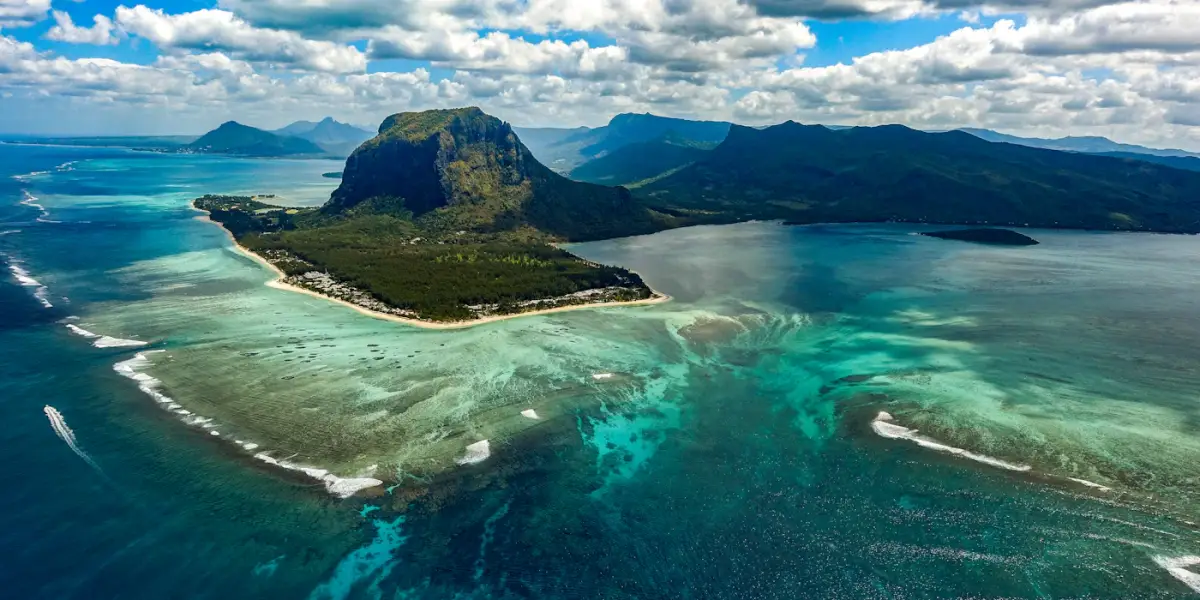
Travel guide from India
Mauritius
Mauritius is a volcanic island in the Indian Ocean, about 800 km east of Madagascar; direct flights from Mumbai take around six hours, and its clocks run an hour and a half behind IST. About 70 per cent of Mauritians descend from indentured labourers, most of them from India: Hinduism is the largest religion, and Diwali and Maha Shivaratri are public holidays, in a society that also has African, Chinese and European roots. Most people come for the reef-sheltered lagoons and beaches, but the mountains, forests and history repay the drives inland.
- Best time
- May, Oct–Dec
- First trip
- 7 nights
- Visa
- Visa-free, 60 days
- Return flights
- from ₹39,356 ●
- Mumbai, checked in the last 48 h
Places to visit in Mauritius
9 places in the order you would meet them on a first trip. Tap one for what to do there.
Grand Baie and the north
BeachThe liveliest part of the island: Grand Baie's bars and restaurants, calm beaches and boats to the northern islets.
3 nightsabout 1 h 30 min from Mauritius airportBest Sep–Nov
Grand Baie and the north
BeachThe liveliest part of the island: Grand Baie's bars and restaurants, calm beaches and boats to the northern islets.
Grand Baie sits on a sheltered, horseshoe-shaped bay on the north-west coast, and its cafés, restaurants, beach clubs and shops run along the coast road towards Pereybère. It was the first part of Mauritius to boom with tourism and is still where Mauritians go for a night out. Around it are calm swimming beaches shaded by casuarinas, such as Trou aux Biches and Mont Choisy, and boats leave from here for the islets off the island's northern tip.
What to do in Grand Baie and the north
- Catamaran to Îlot Gabriel. Boats from Grand Baie and Pereybère run out to the white sandbar of Îlot Gabriel, about 20 km off the coast, and snorkelling trips visit the waters around Coin de Mire, a nature reserve full of seabirds where landing is not allowed.
- Cap Malheureux church. The red-roofed chapel of Notre-Dame Auxiliatrice, with the headland of Coin de Mire behind it, is one of the most photographed sights in Mauritius, and its holy-water basin is a giant clam shell.
- Maheswarnath Mandir, Triolet. The largest Hindu temple in Mauritius is a Shiva temple with a linga, Parvati and Nandi in the main shrine and several smaller temples within the complex.
- Swim at Trou aux Biches or Mont Choisy. Both beaches have long stretches of sand under casuarina trees and calm, clear water for snorkelling, and Trou aux Biches is a good place to watch the sunset.
- Evening in Grand Baie. Beach clubs, bars and nightclubs make this the island's main nightlife area, and live bands and sega performances play through the week.
The island's driest months are September to November, and rain is likeliest from January to March.
Sources: Mauritius Now (MTPA): Grand Baie, Mauritius Now (MTPA): North Mauritius, Mauritius Now (MTPA): Mauritius northern islands, Mauritius Now (MTPA): Offshore islands, Mauritius Now (MTPA): Cap Malheureux Church, Mauritius Now (MTPA): Maheswarnath Mandir, Mauritius Now (MTPA): Trou aux Biches beach, Mauritius Now (MTPA): Mont Choisy Beach, Mauritius Now (MTPA): Mauritius weather, Wikivoyage: Grand Bay, Wikivoyage: Mauritius (checked 14 Oct)
Port Louis
CityDay tripThe capital: Aapravasi Ghat, where indentured Indians landed, plus the old market, Chinatown and the waterfront.
50 min from Mauritius airport
Port Louis
CityDay tripThe capital: Aapravasi Ghat, where indentured Indians landed, plus the old market, Chinatown and the waterfront.
Port Louis, the capital, lies on a harbour in the north-west with mountains behind it, and grew from the naval base and shipyard set up by the French governor Mahé de La Bourdonnais in the 18th century. For Indian visitors its key sight is Aapravasi Ghat, the immigration depot that stands for the almost half a million indentured labourers, most of them from India, who entered Mauritius in the 19th and early 20th centuries. The market, Chinatown, the waterfront and the depot are all within walking distance of each other, and most holidaymakers visit for the day from a beach hotel.
What to do in Port Louis
- Aapravasi Ghat. Start at the interpretation centre on the story of indenture, then see the remains of the 1849 depot's immigrant sheds, kitchens and hospital block and the flight of steps every new arrival had to climb; the visit takes about an hour.
- Central Market. Opened in 1844, the island's oldest market first drew traders from Madras, Pondicherry and Tranquebar; today its stalls sell dholl puri plus samosas, glasses of alouda and, upstairs, local crafts.
- Chinatown. Next to the market, one of the oldest Chinatowns in Africa has family-run shops, dim sum and many of the city's murals, and it goes quiet at night.
- Caudan Waterfront. The harbourside walkway under coloured umbrellas has shops, a food court and the Blue Penny Museum, which tells the island's history alongside its famous rare stamps.
- A city of many faiths. The city's places of worship include the Jummah Mosque of 1853, St Louis Cathedral, the Kwan Tee Pagoda, built by the Chinese community in 1842, and the Tamil temple of Sockalingum Meenatchee Ammen Kovil.
Sources: Aapravasi Ghat Trust Fund: Outstanding Universal Value, Aapravasi Ghat Trust Fund: Aapravasi Ghat World Heritage Property, Aapravasi Ghat Trust Fund: Plan your visit, Aapravasi Ghat Trust Fund: Heritage trails, Mauritius Now (MTPA): Aapravasi Ghat, Mauritius Now (MTPA): Port Louis in Mauritius, Mauritius Now (MTPA): Port Louis market, Mauritius Now (MTPA): Chinatown in Port Louis, Mauritius Now (MTPA): Le Caudan Waterfront, Mauritius Now (MTPA): Kwan Tee Pagoda, Mauritius Now (MTPA): History of Mauritius, Mauritius Now (MTPA): Festivals in Mauritius, Mauritius Now (MTPA): Mauritius Island, Mauritius Now (MTPA): Flights to Mauritius, Mauritius Now (MTPA): Useful tips, Mauritius Now (MTPA): Getting around Mauritius, Wikivoyage: Port Louis, Wikivoyage: Mauritius (checked 14 Oct)
Pamplemousses Botanic Garden
HeritageDay tripThe oldest botanic garden in the Southern Hemisphere: giant water lilies, lotus ponds, palms and SSR's samadhi.
about 1 h from Mauritius airport
Pamplemousses Botanic Garden
HeritageDay tripThe oldest botanic garden in the Southern Hemisphere: giant water lilies, lotus ponds, palms and SSR's samadhi.
The Sir Seewoosagur Ramgoolam Botanic Garden in Pamplemousses, about 10 km north-east of Port Louis, began as a vegetable garden on the Mon Plaisir estate of the French governor Mahé de La Bourdonnais in the 1730s, and Pierre Poivre made it a garden of spice trees and plants from around the world after 1770. Its trust calls it the oldest botanic garden in the Southern Hemisphere; today it covers 33 hectares with more than 800 plant species. It was renamed in 1988 after the first prime minister of independent Mauritius, who was cremated here.
What to do in Pamplemousses Botanic Garden
- Giant water lilies. A rectangular pond holds the Amazon water lily, Victoria amazonica, whose huge floating leaves have raised rims; each flower opens creamy white in the late afternoon and turns pink the next day.
- Lotus ponds. White, yellow and pink lotuses fill the ponds, among them Nelumbo nucifera, the lotus held sacred by Hindus.
- The prime ministers' samadhis. The garden holds the samadhis of the first two prime ministers: Sir Seewoosagur Ramgoolam, remembered as the Father of the Nation, and Sir Anerood Jugnauth, at whose memorial's inauguration a Rudraksha tree was planted.
- Talipot palm and spice corner. Among some 80 kinds of palm is the talipot, a native of India and Sri Lanka that flowers once with the largest flower head in the plant kingdom and then dies, and there are corners of spice and medicinal plants.
- L'Aventure du Sucre. Nearby, a museum in an old sugar mill tells how sugar cane, brought by the Dutch in 1639, shaped the island, and ends with tastings of unrefined sugars and rum.
Sources: SSR Botanic Garden: About the Garden, SSR Botanic Garden: History of the Garden, SSR Botanic Garden: Ponds and the Grand Bassin, SSR Botanic Garden: Monuments and Samadhi, SSR Botanic Garden: Palms, Mauritius Now (MTPA): L'Aventure du Sucre, Wikivoyage: Pamplemousses (checked 14 Oct)
Le Morne
HeritageThe UNESCO-listed mountain where runaway slaves hid, with a steep summit hike, a kitesurfing lagoon and resort beaches.
2 nightsabout 1 h 30 min from Mauritius airportBest May–Oct
Le Morne
HeritageThe UNESCO-listed mountain where runaway slaves hid, with a steep summit hike, a kitesurfing lagoon and resort beaches.
Le Morne Brabant is the 556 m basalt mountain on the island's south-western tip, rising sheer above a small peninsula of white beaches and a wide lagoon inside the reef. In the 17th and 18th centuries enslaved people who escaped their masters hid in its caves and on its cliff-guarded summit, and in 2008 UNESCO inscribed the Le Morne Cultural Landscape as a symbol of resistance to slavery. Today resort hotels share the beach, the lagoon is the island's most popular kitesurfing spot, and offshore lies the 'underwater waterfall'.
What to do in Le Morne
- Climb Le Morne Brabant. The summit trail takes three to four hours with steep, rocky stretches near the top; start early, take a guide if you are unsure of yourself, and do not attempt it in the rain.
- Slave Route Monument and Trou Chenille. At the foot of the mountain stand the International Slave Route Monument and a replica of Trou Chenille, the first village at Le Morne after slavery was abolished in 1835, whose thatched huts show how its people cooked, fished, healed and danced the sega.
- Kitesurf at Le Morne. Strong, steady trade winds, especially from April to November, suit beginners' lessons in the lagoon, while One Eye at Pointe du Morne draws experts from around the world.
- Boat to Île aux Bénitiers. Local fishing boats from La Gaulette and Case Noyale cross to this small uninhabited island in the lagoon for a beach picnic and a snorkel out to the clam-shaped Crystal Rock, and dolphins are sometimes seen on the way.
- See the underwater waterfall. The illusion of water pouring off the reef is really sand and silt swept over the edge of the undersea shelf; only a helicopter or seaplane flight shows its full shape, though the summit of Le Morne gives a rough view.
May to October is cooler for hiking and falls within the kitesurfing season, April to November, with the strongest winds in July and August.
Sources: Le Morne Heritage Trust Fund: Le Morne, Le Morne Heritage Trust Fund: Your visit (Trou Chenille Open Air Museum), Mauritius Now (MTPA): History of Mauritius, Mauritius Now (MTPA): Best hikes in Mauritius, Mauritius Now (MTPA): Le Morne Beach, Mauritius Now (MTPA): Kitesurfing in Mauritius, Mauritius Now (MTPA): Île aux Bénitiers, Mauritius Now (MTPA): Underwater waterfall in Mauritius, Mauritius Now (MTPA): Mauritius weather, Wikivoyage: Le Morne Brabant, Wikivoyage: Mauritius (checked 14 Oct)
Black River Gorges and Chamarel
Hill countryDay tripForest trails, waterfalls and rare birds in the largest national park, then Chamarel's coloured earths and waterfall.
about 1 h from Mauritius airportBest May–Oct
Black River Gorges and Chamarel
Hill countryDay tripForest trails, waterfalls and rare birds in the largest national park, then Chamarel's coloured earths and waterfall.
Black River Gorges is the largest national park in Mauritius, covering about 2 per cent of the island with forested hills, deep valleys, rivers and waterfalls that hold the island's remaining rainforest and many native and endangered species. Black River Peak, inside the park, is the highest point in Mauritius at 828 m. On the park's south-western edge, around the village of Chamarel, are the Seven Coloured Earth dunes and the tallest single-drop waterfall on the island.
What to do in Black River Gorges and Chamarel
- Alexandra Falls viewpoint. A signposted lookout gives views of the waterfall and across the park, and the one-to-two-hour walk to Cascade 500 Pieds starts from here.
- Walk the trails. More than 50 km of trails run from easy forest walks to the climb of Black River Peak, and a birdwatching walk with a biologist is a good way to look for the nine bird species found only in Mauritius.
- Seven Coloured Earth. Bare dunes in an 8.5-hectare geopark show bands of sand in red, violet, brown, yellow, green, blue and purple, and are now fenced off, so you see them from the edge.
- Chamarel Waterfall. On the road up to the coloured earths, a viewpoint looks across to falls about 100 m high plunging over a basalt cliff into a pool, at their fullest from December to April.
- Ebony Forest. Near Chamarel, a conservation reserve has a 300 m raised walkway through native forest and aviaries where rare birds like the echo parakeet and pink pigeon are released.
Temperatures are lower from May to October, which makes hiking much more pleasant than in the hot summer months.
Sources: Mauritius Now (MTPA): Black River Gorges National Park, Mauritius Now (MTPA): National Parks in Mauritius, Mauritius Now (MTPA): Best hikes in Mauritius, Mauritius Now (MTPA): 7 Coloured Earth, Mauritius Now (MTPA): Chamarel Waterfall, Mauritius Now (MTPA): Waterfalls in Mauritius, Mauritius Now (MTPA): Ebony Forest, Mauritius Now (MTPA): West Mauritius, Mauritius Now (MTPA): Mauritius weather, Wikivoyage: Chamarel (checked 14 Oct)
Grand Bassin (Ganga Talao)
HeritageDay tripThe sacred crater lake of Mauritian Hindus, with a 33 m Shiva at its gate and the Maha Shivaratri pilgrimage.
about 30 min from Mauritius airportBest Feb–Mar
Grand Bassin (Ganga Talao)
HeritageDay tripThe sacred crater lake of Mauritian Hindus, with a 33 m Shiva at its gate and the Maha Shivaratri pilgrimage.
Ganga Talao, or Grand Bassin, is a lake in the crater of an extinct volcano high in the hills of Savanne in the south, and an important Hindu pilgrimage site. A 33-metre statue of Shiva stands at the gateway, and colourful shrines line the shore, where devotees light incense, pray and leave offerings. At Maha Shivaratri, Hindus from all over Mauritius walk to the lake to worship.
What to do in Grand Bassin (Ganga Talao)
- Walk round the shore. A path follows the water past the shrines, and the monkeys that play around the lake are part of the scene.
- Watch the eels. Very large eels live in the lake, and pilgrims feed them from the edge.
- Climb the hill by the lake. From the top of the hill beside the lake there are wide views over the area called Plaine Champagne.
- Maha Shivaratri. On this Hindu festival, a public holiday in Mauritius, pilgrims walk from every part of the island to make offerings at the lake's shrines.
- Bois Chéri tea route. Nearby, the Bois Chéri plantation is on the island's tea route, where you can learn the history of tea on the island and taste vanilla tea, which remains a Mauritian favourite.
Maha Shivaratri, which usually falls in February or March, is when pilgrims travel on foot from all over the island to the lake.
Sources: Mauritius Now (MTPA): Ganga Talao, Mauritius Now (MTPA): Festivals in Mauritius, Mauritius Now (MTPA): South Mauritius, Mauritius Now (MTPA): Meet the locals (tea), Wikivoyage: Mauritius (Ganga Talao) (checked 14 Oct)
Belle Mare and Île aux Cerfs
BeachLong, quiet east-coast beaches and a wide lagoon, with boats from Trou d'Eau Douce to the sands of Île aux Cerfs.
2 nightsabout 1 h from Mauritius airportBest Sep–Nov
Belle Mare and Île aux Cerfs
BeachLong, quiet east-coast beaches and a wide lagoon, with boats from Trou d'Eau Douce to the sands of Île aux Cerfs.
The east coast is the relaxed side of Mauritius, with some of the island's longest beaches, a broad, clear lagoon inside the reef and a breeze that keeps it cool most of the year. Belle Mare's beach, one of the longest on the island, is shaded by casuarinas and popular with visitors and locals alike. Just to the south, the fishing village of Trou d'Eau Douce is where boats leave for Île aux Cerfs, a private island of white beaches and a golf course.
What to do in Belle Mare and Île aux Cerfs
- A day on Île aux Cerfs. The beaches and rustic beach bars are at the island's northern tip, and the reef-sheltered lagoon suits a swim as well as parasailing, waterskiing and banana-boat rides.
- Grand River South East waterfall. Some of the catamarans and other boats heading to Île aux Cerfs make a detour to see the waterfall on the Grand River South East.
- Sunrise at Trou d'Eau Douce. Come early to watch the sun rise over the lagoon as fishermen head out, then look for the murals painted around this fishing village.
- Bras d'Eau National Park. On the north-east coast, this quieter park, created in 2011, has native ebony trees, old ruins, a gentle loop walk and a chance of the rare Mascarene Paradise Flycatcher.
- Centre de Flacq market. This inland town, the meeting point for people from all over the east, has one of the biggest open-air markets on the island.
September to November are the driest months; July and August are the windiest, with the breeze strongest on the east and south coasts.
Sources: Mauritius Now (MTPA): East Mauritius, Mauritius Now (MTPA): Belle Mare Beach, Mauritius Now (MTPA): Best beaches in Mauritius, Mauritius Now (MTPA): Ile aux Cerfs, Mauritius Now (MTPA): National Parks in Mauritius, Mauritius Now (MTPA): Meet the locals (street art, Trou d'Eau Douce), Mauritius Now (MTPA): Mauritius weather, Wikivoyage: Mauritius, Wikivoyage: Trou d'Eau Douce (checked 14 Oct)
Flic en Flac and the west coast
BeachAn 8 km sunset beach with dive sites offshore, dolphins off Tamarin and Casela's safari park close by.
2–3 nightsabout 1 h from Mauritius airportBest May–Oct
Flic en Flac and the west coast
BeachAn 8 km sunset beach with dive sites offshore, dolphins off Tamarin and Casela's safari park close by.
Flic en Flac has grown from a fishing village into a popular resort area on the west coast, with a beach about 8 km long that runs south towards Tamarin under casuarina trees and places to stay and eat for every budget. The west is the hottest and driest side of the island, known for its sunsets, and in winter its beaches are more sheltered from the wind. Tamarin Bay, to the south, has its own pod of dolphins.
What to do in Flic en Flac and the west coast
- Dive or snorkel the reef. The well-known Cathedral and Snake Reef dive sites are a short boat ride out, and the lagoon is good for snorkelling, but wear water shoes, as sea urchins are common in the shallows.
- Dolphins, by the rules. Bottlenose and spinner dolphins rest off the west coast; go only with a licensed operator, and by law boats approach from the side and nobody may touch or feed them.
- Casela Nature Parks. This park of more than 350 hectares near Flic en Flac has a safari-style zone with giraffes and camels, a petting farm, zip lines and a canyon swing.
- Tamarin salt pans. At the entrance to Tamarin, the island's last working salt pans still use methods unchanged for some 200 years; go early to watch the salt workers.
- Martello Tower, La Preneuse. The British put up round stone towers along the coast in the early 19th century as a defence against the French, and the one at La Preneuse has been restored as a museum.
From May to October the west coast's beaches are quieter and more sheltered from the wind, though the busiest diving months are November to April.
Sources: Mauritius Now (MTPA): Flic en Flac beach, Mauritius Now (MTPA): West Mauritius, Mauritius Now (MTPA): Dolphins in Mauritius, Mauritius Now (MTPA): Casela Nature Parks, Mauritius Now (MTPA): Tamarin Salt Pans, Mauritius Now (MTPA): History of Mauritius (Martello Towers), Mauritius Now (MTPA): Mauritius weather, Wikivoyage: Flic en Flac, Wikivoyage: Tamarin (Mauritius), Wikivoyage: Mauritius (checked 14 Oct)
Blue Bay and Mahébourg
BeachBeside the airport: a protected coral lagoon, an island reserve for rare birds and the old town of Mahébourg.
1–2 nightsabout 30 min from Mauritius airport
Blue Bay and Mahébourg
BeachBeside the airport: a protected coral lagoon, an island reserve for rare birds and the old town of Mahébourg.
The south-east corner around the airport is where Mauritius's colonial story began: the Dutch first landed in the bay of Grand Port in 1598, and Mahébourg, a fishing town on the same bay founded by the French in 1804, still has a relaxed, local feel. A few kilometres south of the town, Blue Bay has a white beach under casuarinas and a protected marine park whose shallow, clear water makes it one of the best snorkelling spots on the island. Offshore, the Île aux Aigrettes reserve shelters some of the rarest birds in the world.
What to do in Blue Bay and Mahébourg
- Blue Bay Marine Park. Wade out from the beach to see clownfish, angelfish and coral, or take a glass-bottom boat over the brain-coral garden; weekdays are quieter than weekends, when local families come to picnic.
- Île aux Aigrettes. A guided walk on this coral islet, a nature reserve since 1965, leads through ebony forest to look for pink pigeons, Mauritius fodies, olive white-eyes and giant tortoises.
- Mahébourg Museum. A colonial mansion from the late 18th century holds a nearly complete dodo skeleton, old maps and objects recovered from shipwrecks and naval battles.
- Vieux Grand Port. North of Mahébourg, the Frederik Hendrik Museum and its ruins mark the first Dutch settlement of 1638, and a memorial on the coast road near Ferney, below Lion Mountain, marks their landing.
- Mahébourg waterfront and market. Stroll the seafront past the slave memorial and old wash house, and browse the weekly market, one of the biggest on the island, for fruit, spices and crafts.
Sources: Mauritius Now (MTPA): South Mauritius, Mauritius Now (MTPA): Blue Bay Beach, Mauritius Now (MTPA): Blue Bay Marine Park, Mauritius Now (MTPA): Ile aux Aigrettes, Mauritius Now (MTPA): Mahebourg Museum, Mauritius Now (MTPA): Vieux Grand Port, Mauritius Now (MTPA): History of Mauritius, Wikivoyage: Blue Bay, Wikivoyage: Mahebourg, Wikivoyage: Mauritius (checked 14 Oct)
A first trip: 7 nights
- Grand Baie and the north · 3n
- →Port Louis
- →Pamplemousses Botanic Garden
- →Le Morne · 2n
- →Black River Gorges and Chamarel
- →Grand Bassin (Ganga Talao)
- →Belle Mare and Île aux Cerfs · 2n
Start in the north around Grand Baie, with day trips to Port Louis and the Pamplemousses garden, then move to Le Morne for the climb and the lagoon, and cross to the east by way of Chamarel, Black River Gorges and Grand Bassin to finish at Belle Mare with a boat day to Île aux Cerfs. Flic en Flac is the alternative base for the west and Blue Bay, beside the airport, suits a last night; cyclones are possible from November to April and likeliest from late December to March, so keep a spare day in those months.
Getting around
The island is small: driving from the east coast to the west takes about an hour and a quarter, and from north to south about an hour and twenty minutes, so most sights are a day trip from a coastal base. There is no Uber, so visitors hire a licensed driver-guide, rent a car (traffic drives on the left) or join group excursions, and taxis have no meters, so agree the fare before you get in. Buses reach most of the island, and the Metro Express light rail connects Port Louis and the central town of Curepipe.
Peak Shoulder Off-season
The Mauritius Meteorological Services define summer as November to April, warm and humid with the wettest months in February and March, and winter as June to September, cooler and dry; May and October are transition months and October is the driest. December's dry warmth and the May to November dry stretch are the comfortable windows, with winter evenings cool enough for a jumper.
Flights to Mauritius from India
Visa for Indian passports
Indian passport holders can visit Mauritius without a visa for up to 60 days. Free entry on arrival with a return ticket, hotel booking and enough funds; the officer sets the stay (often up to 90 days). Fill the free All-in-One Travel Form at safemauritius.govmu.org before you fly.
Before you book, check the Ministry of External Affairs travel advisories for the latest guidance.
Mauritius: questions
What are the best places to visit in Mauritius?
Grand Baie and the north: The liveliest part of the island: Grand Baie's bars and restaurants, calm beaches and boats to the northern islets. Port Louis: The capital: Aapravasi Ghat, where indentured Indians landed, plus the old market, Chinatown and the waterfront. Pamplemousses Botanic Garden: The oldest botanic garden in the Southern Hemisphere: giant water lilies, lotus ponds, palms and SSR's samadhi. Le Morne: The UNESCO-listed mountain where runaway slaves hid, with a steep summit hike, a kitesurfing lagoon and resort beaches. Black River Gorges and Chamarel: Forest trails, waterfalls and rare birds in the largest national park, then Chamarel's coloured earths and waterfall. Grand Bassin (Ganga Talao): The sacred crater lake of Mauritian Hindus, with a 33 m Shiva at its gate and the Maha Shivaratri pilgrimage. Belle Mare and Île aux Cerfs: Long, quiet east-coast beaches and a wide lagoon, with boats from Trou d'Eau Douce to the sands of Île aux Cerfs. Flic en Flac and the west coast: An 8 km sunset beach with dive sites offshore, dolphins off Tamarin and Casela's safari park close by. Blue Bay and Mahébourg: Beside the airport: a protected coral lagoon, an island reserve for rare birds and the old town of Mahébourg.
How many days do you need for Mauritius?
A first trip takes about 7 nights: Grand Baie and the north (3 nights), Port Louis (1 night), Pamplemousses Botanic Garden (1 night), Le Morne (2 nights), Black River Gorges and Chamarel (1 night), Grand Bassin (Ganga Talao) (1 night), Belle Mare and Île aux Cerfs (2 nights). Start in the north around Grand Baie, with day trips to Port Louis and the Pamplemousses garden, then move to Le Morne for the climb and the lagoon, and cross to the east by way of Chamarel, Black River Gorges and Grand Bassin to finish at Belle Mare with a boat day to Île aux Cerfs. Flic en Flac is the alternative base for the west and Blue Bay, beside the airport, suits a last night; cyclones are possible from November to April and likeliest from late December to March, so keep a spare day in those months.
What is the best time to visit Mauritius?
Peak season is May, Oct–Dec. The Mauritius Meteorological Services define summer as November to April, warm and humid with the wettest months in February and March, and winter as June to September, cooler and dry; May and October are transition months and October is the driest. December's dry warmth and the May to November dry stretch are the comfortable windows, with winter evenings cool enough for a jumper.
Do Indians need a visa for Mauritius?
Indian passport holders can visit Mauritius without a visa for up to 60 days. Free entry on arrival with a return ticket, hotel booking and enough funds; the officer sets the stay (often up to 90 days). Fill the free All-in-One Travel Form at safemauritius.govmu.org before you fly.
How much is a flight to Mauritius from India?
The lowest return fare FlyBun has seen in the last 14 days is ₹39,356, Mumbai to Mauritius, for December 2026 departures. Fares change daily.
Places and things to do are written by FlyBun from official tourism, heritage and park sources, linked under each place, last checked 14 Oct. We leave out entry fees and opening hours because they change; check them before you go.
Watch a route and FlyBun alerts you free when its fare drops.