

Travel guide from India
Morocco
Morocco sits at the far north-western corner of Africa, a long flight west of India. A first trip runs from the souks, palaces and riads of the old walled cities of Marrakech and Fes to Berber villages in the High Atlas, earthen kasbahs and a night among the Sahara's dunes. Vegetarians can look for vegetable tagines and bean and lentil stews, though bissara, a split-pea soup, is rarely on tourist menus, and even a vegetable tagine may be cooked in meat stock.
- Best time
- Mar–May, Oct
- First trip
- 9–10 nights
- Visa
- e-Visa, 30 days
- Return flights
- from ₹70,154 ●
- Bangalore, checked in the last 48 h
Places to visit in Morocco
9 places in the order you would meet them on a first trip. Tap one for what to do there.
Marrakech
CityJemaa el-Fna after dark, souks, riads, Almohad and Saadian monuments and the Majorelle Garden.
3 nightsabout 30 min from Marrakech airportBest Mar–Jun, Sep–Nov
Marrakech
CityJemaa el-Fna after dark, souks, riads, Almohad and Saadian monuments and the Majorelle Garden.
Marrakech has two halves: the medina, the old city inside sandstone ramparts that earn it the name Red City, and Gueliz, the European-style new town, with modern restaurants and big-brand stores. The medina, put on UNESCO's World Heritage List in 1985 along with the Agdal and Menara gardens, is a maze of souks and alleys around the great square of Jemaa el-Fna, and staying there usually means a riad, a traditional house built around an inner courtyard. The airport is a short ride away, and the snowy peaks of the Atlas stand close by.
What to do in Marrakech
- Jemaa el-Fna after dark. As evening falls the square fills with steaming food stalls, storytellers, Gnaoua dancers and musicians, a living tradition UNESCO lists as intangible heritage; performers expect a tip if you watch or take photos.
- Haggle in the souks. The covered markets beside the square sell spices, shoes, kaftans, teapots and tagines; foreigners get higher first prices, so bargain anyway.
- Koutoubia Mosque. Its 12th-century Almohad minaret is the city's landmark and inspired Seville's Giralda and Rabat's Hassan Tower; non-Muslims cannot go inside, but the excavated remains of the earlier mosque lie open beside it.
- Ben Youssef Madrasa and Bahia Palace. The madrasa, a religious school completed in the 1560s under the Saadians, keeps an 11th-century Andalusi marble basin, while the Bahia Palace, built for two grand viziers between the 1860s and 1900, has about 150 rooms set around courtyards and gardens.
- Jardin Majorelle. The painter Jacques Majorelle began planting this walled garden with species from around the world in 1922, Yves Saint Laurent and Pierre Bergé bought it in 1980, and Majorelle's old studio now houses a museum of more than 600 Berber objects.
The tourism council recommends March to June and September to November; summers are very hot, with July the warmest month.
Sources: Visit Marrakech (Marrakech-Safi Regional Tourism Council): Marrakech, Visit Marrakech: Weather in Marrakech, Visit Marrakech: How and when to come, Visit Marrakech: Transport, UNESCO Intangible Cultural Heritage: Cultural space of Jemaa el-Fna Square, Jardin Majorelle (official site): The Jardin Majorelle, Jardin Majorelle (official site): The Pierre Bergé Museum of Berber Arts, Wikivoyage: Marrakech, Wikivoyage: Morocco (checked 14 Oct)
Aït-Benhaddou and Ouarzazate
HeritageA hillside ksar of earthen houses and towers, a UNESCO site and film set on the road to the Sahara.
1 nightabout 4 h from Marrakech airport
Aït-Benhaddou and Ouarzazate
HeritageA hillside ksar of earthen houses and towers, a UNESCO site and film set on the road to the Sahara.
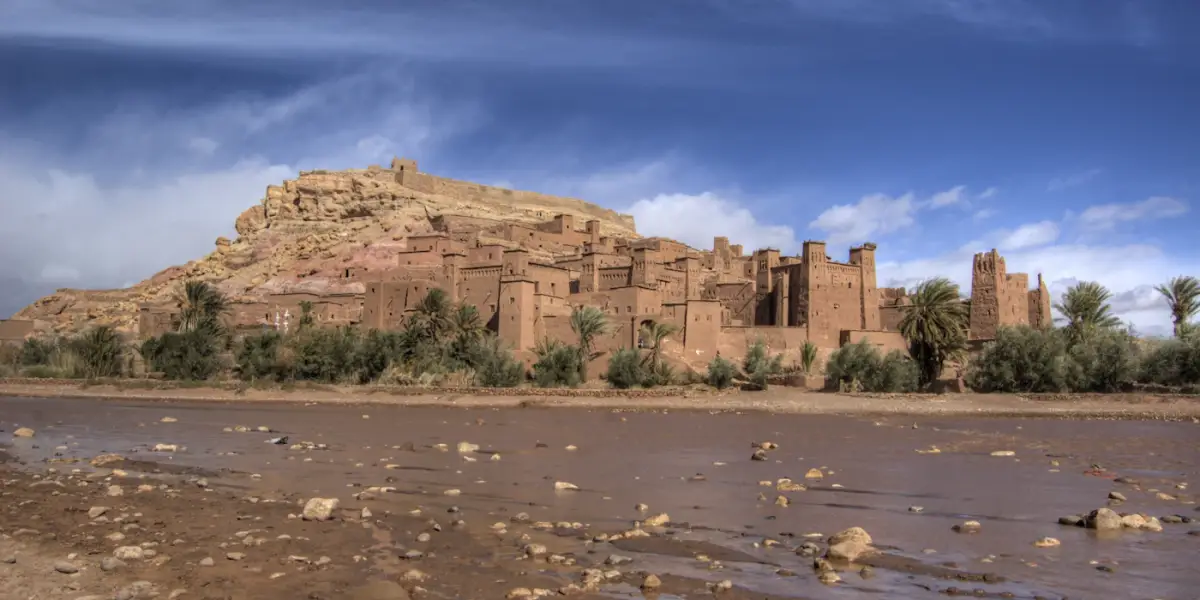
Aït-Benhaddou is a ksar, a fortified village of earthen houses and towers, stacked up a hill beside the Ounila River, on the southern side of the High Atlas. For centuries it was a stop for caravans between the Sahara and Marrakech, it has been on UNESCO's list since 1987, and it has appeared in more than ten films, among them Lawrence of Arabia and Gladiator, often standing in for Jerusalem. A handful of families still live within the walls; most of the village's people now live in newer houses on the far bank. Ouarzazate, the quiet regional town nearby, has film studios and kasbahs of its own.
What to do in Aït-Benhaddou and Ouarzazate
- Climb to the granary. Cross the river by the new bridge or the stepping stones (keep your feet dry, as Wikivoyage reports schistosomiasis picked up from the water), then climb the lanes up to the granary and the hilltop for views over the ksar.
- Stay for first and last light. Spending the night means you see the earthen walls at sunrise and sunset, when the ksar looks quite different from the way it does at midday.
- Over the Tizi n'Tichka. The N9 from Marrakech crosses the High Atlas by this pass, the main road over the range, on a winding drive of about four hours full of hairpins, so build in time for photo stops.
- Telouet kasbah. A road of about 40 km up the Ounila Valley, through the earthen villages of Tamdaght and Anemiter, leads to the Glaoui family's kasbah at Telouet, partly in ruins and famous for ceilings of painted cedar and zellij tilework.
- Ouarzazate's kasbah and studios. Wander the rooms and passages of Kasbah Taourirt in town, then tour Atlas Studios, where scenes for Lawrence of Arabia, Gladiator and Kingdom of Heaven were filmed.
Sources: Wikivoyage: Aït-Benhaddou, Wikivoyage: Ouarzazate, Wikivoyage: High Atlas, Wikivoyage: Saharan Morocco, Wikivoyage: Morocco (checked 14 Oct)
Dadès and Todra gorges
Hill countryRiver canyons, palm oases and old kasbahs on the road of kasbahs between Ouarzazate and the Sahara.
1 nightabout 7 h from Marrakech airport
Dadès and Todra gorges
Hill countryRiver canyons, palm oases and old kasbahs on the road of kasbahs between Ouarzazate and the Sahara.
East of Ouarzazate, the road towards the Sahara, known as the road of kasbahs, passes palm oases and earthen kasbahs, some lived in and some abandoned. Two rivers have cut gorges into the mountains here: the Dadès, whose valley is best seen on a day by 4WD, and the Todra (Todgha), near Tinghir, an oasis town at about 1,300 m whose people are mostly Amazigh. A night in the valleys breaks the long drive from Marrakech to Merzouga.
What to do in Dadès and Todra gorges
- Walk the Todra Gorge. Take a shared taxi up from Tinghir, walk on past the last hotels and the narrow part of the gorge, and follow the marked donkey trail past a Berber encampment, two to three hours on foot.
- Drive the Dadès Gorges. A day by 4WD up the valley of the Dadès River passes kasbahs, inhabited and abandoned, with a good chance of meeting shepherds out with their flocks.
- Tinghir's oasis and old quarter. Walk through the palm grove and the old Jewish quarter, then cross the river to the old Ikalalne mosque, reached by a signed path through an old kasbah.
- Skoura on the way. About 40 km east of Ouarzazate, this oasis of palm groves is dotted with rammed-earth kasbahs and fortified villages, some crumbling and others restored, Kasbah Amridil among them.
- Valley of Roses. The M'Goun valley, the southernmost of the Dadès gorges, is known for growing roses on a large scale, and the M'Goun geopark is known for its dinosaur tracks.
Sources: Wikivoyage: Tinerhir, Wikivoyage: Saharan Morocco, Wikivoyage: Ouarzazate, Wikivoyage: Skoura, Wikivoyage: Tinejdad, Wikivoyage: Merzouga, Wikivoyage: Morocco (checked 14 Oct)
Merzouga and the Erg Chebbi dunes
WildlifeCamel rides into the orange sand of Erg Chebbi, a night in a desert camp and a sky full of stars.
2 nightsabout 12 h from Marrakech airportBest Oct–Apr
Merzouga and the Erg Chebbi dunes
WildlifeCamel rides into the orange sand of Erg Chebbi, a night in a desert camp and a sky full of stars.
Merzouga is a small village where Erg Chebbi begins, a field of orange sand dunes rising up to about 150 m above the stony desert around them. Small hotels and auberges line the edge of the dunes, and most can arrange camel rides and nights in a tented camp; other villages, Khamlia among them, lie around the erg. It is a long way from Marrakech, two days' drive with a night near Ouarzazate, though a daily Supratours coach from Marrakech also ends in the village.
What to do in Merzouga and the Erg Chebbi dunes
- Camel ride and desert camp. Ride out towards sunset to a camp of Berber-style tents among the dunes for dinner, music and a night under the stars, and head back early the next morning before the heat; agree exactly what is included before you set off.
- Climb the Grand Dune. Hike up the highest, steepest dune near the village to watch the sun go down, or slide down its slopes on skis, which some hotels rent out.
- Gnawa music at Khamlia. This village on the south-western edge of Erg Chebbi is known for Gnawa music and dance.
- Stargazing. Erg Chebbi has very dark skies (Bortle class 1 to 2), good for picking out the Milky Way and meteor showers, best between October and April.
- Rissani. The oasis town on the road in holds the mausoleum of Moulay Ali Chérif, who founded the Alaouite dynasty (non-Muslims may enter only the garden), and the ruins of Sijilmasa, once the northern end of a trans-Saharan trade route.
Wikivoyage puts the best stargazing in the Sahara between October and April, with crisp air and no summer sandstorms, and suggests February for desert trekking; winter nights can drop to freezing.
Sources: Wikivoyage: Merzouga, Wikivoyage: Erg Chebbi, Wikivoyage: Saharan Morocco, Wikivoyage: Rissani, Wikivoyage: Ouarzazate, Wikivoyage: Morocco (checked 14 Oct)
Fes
HeritageThe medieval maze of Fes el-Bali: souks, tanneries, carved madrasas and lanes where donkeys still carry the loads.
2–3 nightsabout 7 h 30 min by train from Marrakech airportBest Apr–May, Sep–Oct
Fes
HeritageThe medieval maze of Fes el-Bali: souks, tanneries, carved madrasas and lanes where donkeys still carry the loads.
Fes was the capital of the Idrisid dynasty, its Qarawiyyin grew into a famous centre of learning, and its old walled city, Fes el-Bali, is on UNESCO's World Heritage List. Cars can reach the medina at only a few points, so donkeys, carts and motorbikes move the goods through its lanes, which run downhill from Bab Boujeloud, the main gate. It is a more traditional city than Casablanca or Marrakech, and touts and false guides work hard here.
What to do in Fes
- Into Fes el-Bali. From Bab Boujeloud follow the Talaa Kbira, the main street, down towards the Qarawiyyin; colour-coded signed trails help, and if you lose your way, heading downhill eventually brings you out at Place R'cif.
- Chouara tannery. Watch hides being worked in vats of dye from the balcony of one of the leather shops around it, expecting a sales pitch in return; go early in the morning, before the sun heats the pits and the smell builds.
- Bou Inania and Al-Attarine madrasas. Two 14th-century religious colleges that non-Muslims can enter: Bou Inania has walls of carved wood with geometric patterns and Arabic calligraphy, and the smaller Al-Attarine is just as richly decorated.
- Al-Qarawiyyin. A mosque and seat of learning that has grown since the 9th century; non-Muslims cannot go in, but can glimpse the courtyard and prayer hall from the doorways, which are more often open on Fridays.
- Volubilis. For a day out, Morocco's biggest Roman ruins lie 30 km north of Meknes beside the holy town of Moulay Idriss, and are known for their mosaics.
Marrakech's tourism council names spring (April-May) and autumn (September-October) as the best seasons for Morocco as a whole, which has mild winters and hot summers.
Sources: Wikivoyage: Fez, Wikivoyage: Morocco, Wikivoyage: Marrakech, Visit Marrakech: Weather in Marrakech (checked 14 Oct)
Chefchaouen
Hill countryA blue-and-white mountain town in the Rif for slow days in the medina and walks to the Akchour waterfalls.
2 nightsabout 5 h by flight from Marrakech airportBest Apr–May, Sep–Oct
Chefchaouen
Hill countryA blue-and-white mountain town in the Rif for slow days in the medina and walks to the Akchour waterfalls.
Chefchaouen is a small town in the Rif mountains of northern Morocco whose medina is a tangle of whitewashed houses with powder-blue walls and doors. It is compact and easy to walk, a calmer change from Fes or Marrakech, and a base for hiking in the mountains around it; Spanish and French are the foreign languages you hear most. Cannabis is farmed in the hills and touts offer hashish in the streets, but Morocco's drug laws are harsh, so say no.
What to do in Chefchaouen
- Outa el-Hammam and the Kasbah. The old town's main square, laid out like the public squares of Andalusia, faces the Kasbah, one of the town's first buildings, with its towers, garden, green courtyard and old prison.
- Ras El Ma. At this spring on the edge of the medina, local people come to cool off, chat and wash their laundry.
- Sunset at the Spanish Mosque. A walk up the hill behind Ras El Ma reaches this little-used mosque, built by the Spanish in the 1920s, which looks over the whole town.
- Akchour waterfalls. Half an hour away by shared taxi, paths lead to the small cascades (about 40 minutes' walk), the big waterfall (6 km each way) and the rock arch called God's Bridge; after rain or snowmelt the river can be impassable.
- Leather and goat cheese. The town is known for its leather workshops, which will make a bag to your own design in a couple of days, and for local goat cheese and olive oil.
Spring (April-May) and autumn (September-October) are the best seasons for Morocco as a whole; the short rainy season runs from November to January, and the Rif gets more rain than the rest of the country.
Sources: Wikivoyage: Chefchaouen, Wikivoyage: Morocco, Wikivoyage: Marrakech, Visit Marrakech: Weather in Marrakech (checked 14 Oct)
Essaouira
BeachA walled Atlantic port with cannon-lined ramparts, a fishing harbour, a long windy beach and an easy-going medina.
2 nightsabout 3 h 30 min from Marrakech airportBest Jul
Essaouira
BeachA walled Atlantic port with cannon-lined ramparts, a fishing harbour, a long windy beach and an easy-going medina.
Essaouira is a fortified port on the Atlantic whose sea walls and medina were laid out in the 18th century to a French architect's design; the medina is on UNESCO's list, and the ramparts still carry their old cannons. Fishing boats work the harbour, craftsmen turn out inlaid woodwork, and the long beach draws kitesurfers and windsurfers. Its nickname, the Windy City, is fair warning: the wind and strong currents make it a better place for watersports than for lying on the sand.
What to do in Essaouira
- Walk the ramparts. Climb onto the Skala, the wall tower north-east of Place Moulay Hassan, and stay to watch the sunset from the seawall.
- Grilled fish by the port. Buy fish straight from the dock and take it to the grill stalls in the lanes by the central market, where they cook it for you along with vegetables or a Moroccan salad.
- Kitesurf or windsurf. With wind on most days of the year the bay is a watersports spot, with gear for hire on the beach, though the shore break and fickle wind make it a poor place to learn kitesurfing.
- Woodwork and galleries. Shops across the medina sell inlaid boxes and chessboards made by the town's woodworkers, and its art galleries show work of every kind.
- Beach walk to Diabat. Walk to the south end of the beach past the ruined fort to Diabat, the village tied to Jimi Hendrix legends, or cross the shallow river to the ruins of the 18th-century Dar Sultan palace.
Wikivoyage's Morocco guide suggests July for Essaouira's beaches, in the middle of the country's peak tourist season of July and August.
Sources: Visit Marrakech (Marrakech-Safi Regional Tourism Council): Essaouira, Wikivoyage: Essaouira, Wikivoyage: Morocco (checked 14 Oct)
Imlil and the High Atlas
Hill countryDay tripA Berber mountain village below Toubkal, North Africa's highest peak, for valley walks or the climb to the summit.
about 1 h 30 min from Marrakech airportBest Apr–Nov
Imlil and the High Atlas
Hill countryDay tripA Berber mountain village below Toubkal, North Africa's highest peak, for valley walks or the climb to the summit.
Imlil is a village of Amazigh (Berber) farmers, mountain guides and muleteers in the High Atlas, about 60 km south of Marrakech, where terraced fields and walnut trees fill the valley. It is the usual starting point for climbing Jebel Toubkal, the highest mountain in North Africa, and for shorter walks between the villages around it. It makes a day out from Marrakech by way of Asni, and its guesthouses suit anyone staying on to trek.
What to do in Imlil and the High Atlas
- Village walks. Short paths link Imlil with the neighbouring villages of Aroumd (Armed) and Aït Souka, while longer routes cross the passes towards Tacheddirt.
- Sidi Chamharouch. Up the Aït Mizane valley on the Toubkal trail, this shrine is held sacred by Muslims and Jews alike, and climbers often stop there for a meal.
- Climb Toubkal. Guided ascents usually take two or three days: about six hours' walk to the stone refuges at 3,207 m, then a pre-dawn start for the summit and a long descent; guides and mules can be arranged in Imlil, and in winter snow and ice call for proper gear.
- Asni on the way. The road from Marrakech passes this small town in a fertile valley of orchards, whose big weekly market brings in farmers and traders from far around.
- Or the Ourika Valley. Another day out from Marrakech leads up this valley past Berber villages, women's argan-oil cooperatives and rope bridges over the river to the waterfalls at Setti Fatma.
Winter is very cold in the Atlas, so the tourism council recommends road trips into the mountains from spring to autumn, April to November.
Sources: Visit Marrakech (Marrakech-Safi Regional Tourism Council): Imlil, Visit Marrakech: Hiking in Asni and Imlil, Visit Marrakech: Toubkal hike, Visit Marrakech: Prepare your hikes, Wikivoyage: Imlil, Wikivoyage: Toubkal National Park, Wikivoyage: Asni, Wikivoyage: Ourika Valley, Wikivoyage: High Atlas (checked 14 Oct)
Casablanca
CityMorocco's biggest city, worth a stop for the Hassan II Mosque on the Atlantic shore and its colonial-era centre.
1 nightabout 3 h 30 min by train from Marrakech airport
Casablanca
CityMorocco's biggest city, worth a stop for the Hassan II Mosque on the Atlantic shore and its colonial-era centre.
Casablanca is Morocco's largest city and its business capital, a big modern port whose new town the French began building after they occupied it in 1907, and whose wartime intrigues the 1942 film made famous. Its old medina is small, but the city is worth at least a day for the Hassan II Mosque and the art deco and Hispano-Moorish buildings of the centre. Trains from Marrakech take about three hours.
What to do in Casablanca
- Hassan II Mosque. Opened in 1993 on the edge of the Atlantic, it has a prayer hall for about 25,000 worshippers under a roof that opens in five minutes, and a minaret that shines a laser beam towards Mecca.
- Go inside on a guided visit. Guided tours take non-Muslims inside the mosque and its outbuildings; wear clothes that cover your shoulders and knees, and carry your shoes with you once you take them off.
- Downtown facades. Walk the colonial centre for its art deco and Hispano-Moorish buildings, such as the Central Post Office of 1918 with its mosaics.
- The Corniche. Follow the ocean road west of the mosque and stop at one of the cafés looking over the sea.
- Sidi Abderrahman. Well past the Corniche, a shrine sits on a rock offshore that can be reached only at low tide; the shrine is for Muslims, but anyone can wander the tiny quarter around it.
Sources: Hassan II Mosque Foundation: History, Hassan II Mosque Foundation: Prayer hall, Hassan II Mosque Foundation: Minaret, Hassan II Mosque Foundation: Hammams and swimming pools, Hassan II Mosque Foundation: Guided visits, Wikivoyage: Casablanca, Wikivoyage: Morocco (checked 14 Oct)
A first trip: 9–10 nights
- Marrakech · 3n
- →Aït-Benhaddou and Ouarzazate · 1n
- →Dadès and Todra gorges · 1n
- →Merzouga and the Erg Chebbi dunes · 2n
- →Fes · 2–3n
Start in Marrakech, cross the High Atlas by the Tizi n'Tichka pass to Aït-Benhaddou, follow the road of kasbahs past the Dadès and Todra gorges to the dunes at Merzouga, then drive north to Fes and take the train back to Marrakech, about seven hours. Spring and autumn suit the loop best, as summer days in Marrakech and the desert are very hot and winter is very cold in the Atlas, with freezing nights; in July add Essaouira's breezy coast, and in spring or autumn add Chefchaouen, about four hours by bus from Fes.
Getting around
Trains are the easiest way between the big cities: one line joins Marrakech with Casablanca, Rabat, Meknes and Fes, and the Al Boraq high-speed train covers Casablanca to Tangier in about 2 hours 20 minutes, but no railway runs south of Marrakech. The High Atlas, the desert and the coast at Essaouira are reached by long-distance coach (CTM, or Supratours, the railway's own bus company), by shared grand taxi between towns, or with a driver on a tour, and Marrakech is a common base for multi-day Sahara trips. Domestic flights exist but few travellers use them.
Peak Shoulder Off-season
The Marrakech-Safi Regional Tourism Council recommends March to June and September to November, with July the hottest month at an average 37°C and February to April the rainiest. Spring and October are the comfortable, busy windows; July and August are too hot for daytime sightseeing, and winter is mild by day but cold at night.
Flights to Morocco from India
Visa for Indian passports
Indian passport holders need an e-visa for Morocco, applied for online before travel (allow about 7 days). e-Visa (about US$80, single entry) only at acces-maroc.ma, about 3 working days (express 1 day). A US, UK or Schengen visa does not exempt Indians.
Before you book, check the Ministry of External Affairs travel advisories for the latest guidance.
Morocco: questions
What are the best places to visit in Morocco?
Marrakech: Jemaa el-Fna after dark, souks, riads, Almohad and Saadian monuments and the Majorelle Garden. Aït-Benhaddou and Ouarzazate: A hillside ksar of earthen houses and towers, a UNESCO site and film set on the road to the Sahara. Dadès and Todra gorges: River canyons, palm oases and old kasbahs on the road of kasbahs between Ouarzazate and the Sahara. Merzouga and the Erg Chebbi dunes: Camel rides into the orange sand of Erg Chebbi, a night in a desert camp and a sky full of stars. Fes: The medieval maze of Fes el-Bali: souks, tanneries, carved madrasas and lanes where donkeys still carry the loads. Chefchaouen: A blue-and-white mountain town in the Rif for slow days in the medina and walks to the Akchour waterfalls. Essaouira: A walled Atlantic port with cannon-lined ramparts, a fishing harbour, a long windy beach and an easy-going medina. Imlil and the High Atlas: A Berber mountain village below Toubkal, North Africa's highest peak, for valley walks or the climb to the summit. Casablanca: Morocco's biggest city, worth a stop for the Hassan II Mosque on the Atlantic shore and its colonial-era centre.
How many days do you need for Morocco?
A first trip takes about 9–10 nights: Marrakech (3 nights), Aït-Benhaddou and Ouarzazate (1 night), Dadès and Todra gorges (1 night), Merzouga and the Erg Chebbi dunes (2 nights), Fes (2–3 nights). Start in Marrakech, cross the High Atlas by the Tizi n'Tichka pass to Aït-Benhaddou, follow the road of kasbahs past the Dadès and Todra gorges to the dunes at Merzouga, then drive north to Fes and take the train back to Marrakech, about seven hours. Spring and autumn suit the loop best, as summer days in Marrakech and the desert are very hot and winter is very cold in the Atlas, with freezing nights; in July add Essaouira's breezy coast, and in spring or autumn add Chefchaouen, about four hours by bus from Fes.
What is the best time to visit Morocco?
Peak season is Mar–May, Oct. The Marrakech-Safi Regional Tourism Council recommends March to June and September to November, with July the hottest month at an average 37°C and February to April the rainiest. Spring and October are the comfortable, busy windows; July and August are too hot for daytime sightseeing, and winter is mild by day but cold at night.
Do Indians need a visa for Morocco?
Indian passport holders need an e-visa for Morocco, applied for online before travel (allow about 7 days). e-Visa (about US$80, single entry) only at acces-maroc.ma, about 3 working days (express 1 day). A US, UK or Schengen visa does not exempt Indians.
How much is a flight to Morocco from India?
The lowest return fare FlyBun has seen in the last 14 days is ₹70,154, Bangalore to Marrakech, for January 2027 departures. Fares change daily.
Places and things to do are written by FlyBun from official tourism, heritage and park sources, linked under each place, last checked 14 Oct. We leave out entry fees and opening hours because they change; check them before you go.
Watch a route and FlyBun alerts you free when its fare drops.