

Travel guide from India
Netherlands
The Netherlands is a small, flat country in north-western Europe, much of it reclaimed from the sea, and Indian travellers reach it on a long-haul flight into Amsterdam's Schiphol, one of the world's busiest airports. The main cities lie within about an hour of Amsterdam, so one trip can take in the canal ring and the Dutch masters, windmills and old fishing villages, and the bulb fields that flower each spring. Amsterdam also has many Surinamese takeaways serving roti, a dish with South Asian roots.
- Best time
- Apr–Aug
- First trip
- 6–9 nights
- Visa
- Visa needed, 90 days
- Return flights
- from ₹40,382 ●
- Mumbai, checked in the last 48 h
Places to visit in Netherlands
9 places in the order you would meet them on a first trip. Tap one for what to do there.
Amsterdam
CityThe 17th-century canal ring, Rembrandt and Van Gogh, the Anne Frank House and easy day trips.
3–4 nights17 min by train from Amsterdam airportBest May–Sep
Amsterdam
CityThe 17th-century canal ring, Rembrandt and Van Gogh, the Anne Frank House and easy day trips.
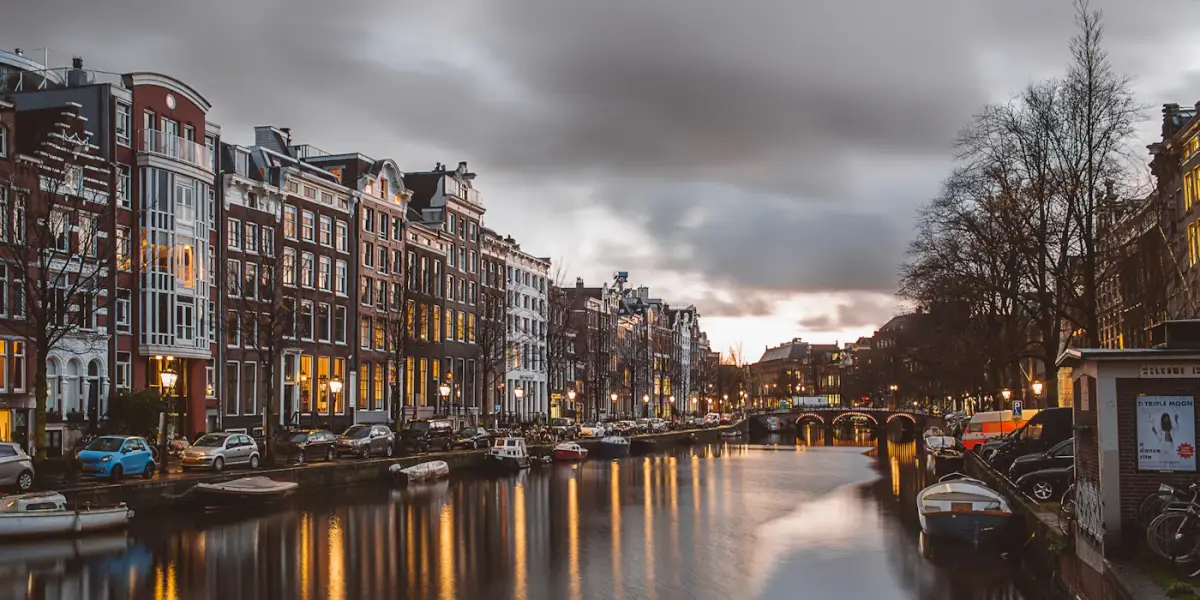
Amsterdam's old centre is a half-circle of canals fanning out from Centraal Station, lined with tall merchants' houses and crossed by about 400 bridges; the 17th-century canal ring has been on the UNESCO World Heritage List since 2010. The big museums, the markets and the canal-side neighbourhoods all sit in or just outside this compact core, and trains from Schiphol reach Centraal in about 17 minutes.
What to do in Amsterdam
- Canal ring by boat. A guided cruise along the canals, dug in the 17th century, explains the leaning 'dancing houses', and after dark the bridges are strung with lights.
- Rijksmuseum and Van Gogh Museum. Both face Museumplein: the national museum holds Rembrandt's Night Watch and Vermeer's Milkmaid, and its neighbour holds more of Van Gogh's paintings and drawings than any other museum in the world.
- Anne Frank House. The canal house on the Prinsengracht where the young diarist's family spent two years in hiding during the war; the back annexe is kept as it was to show how they lived.
- Jordaan and the Nine Streets. A former working-class district of narrow lanes, galleries and courtyard gardens, next to the Nine Streets of small independent shops crossing the main canals.
- Albert Cuyp Market and Surinamese roti. The city's best-known street market fills Albert Cuypstraat in De Pijp, a neighbourhood where you can try Surinamese roti, a chickpea-flour flatbread with South Asian roots, served with curry, potato and long beans and with plenty of vegetarian fillings.
May to September is the most pleasant time, with April and October often mild too; rain is possible in every month, so pack a raincoat.
Sources: Holland.com: Amsterdam, Holland.com: Canals of Amsterdam, Holland.com: Travelling to the Netherlands, Holland.com: Getting around in the Netherlands, Holland.com: The Netherlands by train, Holland.com: Dutch food and cuisine, I amsterdam: How to get from Schiphol Airport to Amsterdam, I amsterdam: Top 20 things to do in Amsterdam, I amsterdam: Love letter to the roti shops of Amsterdam, Wikivoyage: Amsterdam, Wikivoyage: Netherlands (checked 14 Oct)
Zaanse Schans
HeritageDay tripWorking windmills, green wooden houses and craft workshops on the Zaan river, just north of Amsterdam.
about 1 h by train from Amsterdam airport
Zaanse Schans
HeritageDay tripWorking windmills, green wooden houses and craft workshops on the Zaan river, just north of Amsterdam.
The Zaanse Schans is a heritage village on the bank of the Zaan, north of Zaandam, put together from 1961 onwards out of wooden houses, warehouses and windmills moved here from around the region. It recalls the 18th and 19th centuries, when around 600 windmills in the Zaan district sawed timber and ground oil, paint and spices. Most of the houses are still lived in, so stay out of the gardens.
What to do in Zaanse Schans
- De Kat paint mill. Built in 1664, this mill still grinds pigments into paint that goes to artists and restorers, and narrow stairs lead up to the deck for a view over the meadows.
- Spice mill De Huisman. An 18th-century snuff mill now sits on top of an old spice warehouse, where millstones still grind spices and the air smells of them.
- Clog workshop. Watch clogs being carved from a block of wood in a 1750 warehouse that also shows painted, carved and iron-shod clogs.
- Cheese and cocoa. Cheesemakers in traditional dress show how Dutch cheese is made in a replica farmhouse, and a cocoa shop explains why the whole Zaan area smells of cocoa.
- Zaans Museum. Covers daily life and industry along the Zaan over the centuries, with a presentation of the works Claude Monet painted here on his 1871 visit.
Sources: De Zaanse Schans: History, De Zaanse Schans: Windmills, De Zaanse Schans: Handicrafts, De Zaanse Schans: FAQ, De Zaanse Schans: Accessibility and crowds in spring, I amsterdam: Things to do in Old Holland, Wikivoyage: Zaanse Schans (checked 14 Oct)
Volendam and Marken
HeritageDay tripTwo old Zuiderzee fishing villages: the busy harbour of Volendam and quieter Marken, joined by a ferry.
about 1 h from Amsterdam airport
Volendam and Marken
HeritageDay tripTwo old Zuiderzee fishing villages: the busy harbour of Volendam and quieter Marken, joined by a ferry.
Volendam, about 20 km north of Amsterdam, is a fishing village on the old Zuiderzee coast whose harbour dike is lined with restaurants and souvenir shops, and its traditional dress is among the most famous folk costumes in the country. Marken, across the water, was an island until a dike joined it to the mainland in 1957; its green wooden houses stand on raised mounds built against floods. A ferry crosses between the two in about half an hour.
What to do in Volendam and Marken
- Walk the harbour dike. Volendam's harbour front is the place to try smoked eel or a herring from the fish shops and snack bars along the dike.
- Dress up in Volendam costume. Photo studios on the harbour dress you in the village's traditional costume for a souvenir portrait.
- Volendams Museum. Paintings, costumes and life-size scenes of old village life, plus large mosaics made from more than 11 million cigar bands.
- Ferry to Marken. The crossing to Marken takes about 30 minutes, and bikes can come on board for a ride through the Waterland countryside afterwards.
- Marken lighthouse and museum. Walk out to the lighthouse, then visit the Marker Museum for the history of the island's fishing community.
Sources: I amsterdam: 24 hours in Old Holland, I amsterdam: Things to do in Old Holland, I amsterdam: Fairytale villages near Amsterdam, I amsterdam: Day trips from Amsterdam, Wikivoyage: Volendam, Wikivoyage: Marken (checked 14 Oct)
Keukenhof and the bulb fields
HeritageDay tripA spring-only garden of about 7 million bulbs, with striped tulip fields all around it.
about 30 min from Amsterdam airportBest Mar–May
Keukenhof and the bulb fields
HeritageDay tripA spring-only garden of about 7 million bulbs, with striped tulip fields all around it.
Keukenhof is a 32-hectare spring garden at Lisse, between Haarlem and Leiden, first laid out in 1949 by the town's mayor and local bulb growers and replanted every year with about 7 million bulbs, including more than 800 tulip varieties. It opens for only about two months each spring, and the bulb fields of the Bollenstreek around it flower from late March to the end of May.
What to do in Keukenhof and the bulb fields
- Time it for the tulips. Keukenhof's bloom calendar starts with crocuses, daffodils and hyacinths, brings the big tulips to their peak in the second half of April, and ends with late tulips and alliums.
- Flower shows in the pavilions. Indoor pavilions hold their own displays, with orchids and anthuriums in one and tulips and amaryllis in another.
- Climb the old windmill. The park's windmill dates from 1892, and its deck, reached by stairs, looks over the garden and the bulb fields beyond.
- The Historical Garden. A walled garden of centuries-old tulip varieties, one stop on some 15 km of paths through the park.
- Cycle the bulb fields. Signposted routes, such as a 37 km route from Leiden station, run through the fields; admire them from the path, because growers ask visitors not to trample the flowers.
The park opens only from mid-March to early May, and its bloom calendar puts the larger tulips at their peak in the second half of April.
Sources: Keukenhof (official site), Keukenhof: The park, Keukenhof: Flower report, Keukenhof: Mill, Holland.com: Flowers, I amsterdam: Day trips from Amsterdam, I amsterdam: Top 20 things to do in Amsterdam, Wikivoyage: Lisse, Wikivoyage: Bollenstreek (checked 14 Oct)
The Hague and Delft
CityThe seat of government, Girl with a Pearl Earring, a North Sea beach, and canal-side Delft next door.
1–2 nightsabout 30 min by train from Amsterdam airportBest May–Sep
The Hague and Delft
CityThe seat of government, Girl with a Pearl Earring, a North Sea beach, and canal-side Delft next door.
The Hague, the country's third-largest city, houses the Dutch parliament and government as well as the International Court of Justice, with the beach at Scheveningen a few tram stops from the centre. Delft, about 15 minutes away by train, is an old canal city, the birthplace of the painter Johannes Vermeer and of Delft Blue pottery, and an easy day trip.
What to do in The Hague and Delft
- Mauritshuis. A small museum in a 17th-century palace on the Hofvijver pond, with Vermeer's Girl with a Pearl Earring and View of Delft and Rembrandt's Anatomy Lesson.
- Peace Palace. Built in 1913 for international arbitration, the palace is also home to the UN's International Court of Justice, which rules on disputes between states.
- Scheveningen beach. The country's most popular seaside resort, with a pier and beach cafés; Madurodam, a miniature Netherlands that children enjoy, is on the tram line out.
- Delft's Markt and Nieuwe Kerk. The main square is overlooked by the Nieuwe Kerk, the royal burial church, where William of Orange was buried after his assassination in 1584.
- Oude Kerk and Delft Blue. Delft's oldest church leans out over its canal and holds Vermeer's grave, and a working Delftware factory in town can be visited.
Late spring to early autumn is the time to explore the parks, dunes and beach on foot or by bike, though Scheveningen gets very crowded on hot days.
Sources: Holland.com: The Hague, Holland.com: Delft, Wikivoyage: The Hague, Wikivoyage: Delft (checked 14 Oct)
Rotterdam
CityPost-war skyline, the Erasmus Bridge and Cube Houses, Europe's largest port, and the base for Kinderdijk.
1–2 nightsabout 30 min by train from Amsterdam airport
Rotterdam
CityPost-war skyline, the Erasmus Bridge and Cube Houses, Europe's largest port, and the base for Kinderdijk.
Rotterdam, on the river Meuse, was almost completely destroyed by German bombing in 1940 and rebuilt as one of the most modern cities in the Netherlands, with a skyline of towers and experiments such as the tilted Cube Houses. It is home to Europe's largest port and a busy nightlife scene, and Intercity Direct trains reach it from Schiphol in under half an hour.
What to do in Rotterdam
- Cube Houses and Markthal. At Blaak, homes shaped like cubes tipped over by 45 degrees stand beside the Markthal, and one cube house is kept as a museum.
- Erasmus Bridge. Walk across the bridge over the Nieuwe Maas, then sit on a riverside terrace with the bridge and the skyline in view.
- Harbour boat trip. Boat tours run through part of the port, and the Maritime Museum covers the city's seafaring history.
- Euromast. The observation tower at the edge of the centre gives views across the city, the river and the surrounding area.
- Historic Delfshaven. This old harbour quarter is one of the few parts of Rotterdam to survive the 1940 bombing, with 17th-century canal houses, moored barges and small cafés.
Sources: Holland.com: Rotterdam, NS: Intercity direct, Wikivoyage: Rotterdam (checked 14 Oct)
Kinderdijk
HeritageDay trip19 windmills from about 1740 in a polder near Rotterdam, a UNESCO site on Dutch water management.
1 h 30 min from Amsterdam airport
Kinderdijk
HeritageDay trip19 windmills from about 1740 in a polder near Rotterdam, a UNESCO site on Dutch water management.
Kinderdijk, in the Alblasserwaard polder near Rotterdam, has 19 windmills built around 1740 to keep the low-lying land dry, set out facing each other along the waterways. They were added to the UNESCO World Heritage List in 1997, and some still turn when the weather allows, although diesel pumping stations now do the main work. It is an easy trip from Rotterdam by waterbus, bus or bike.
What to do in Kinderdijk
- Walk or cycle the mill network. Walking or cycling between the mills is the best way to see them, and the ride out from Rotterdam is just over 15 km.
- Inside a museum mill. Museum mills show the gears turned by the sails and the curved blades that lift the water, and the cramped rooms where a miller's family lived.
- The film and the name. A multiscreen film in the De Fabriek pumping station tells the mills' story and the legend of a baby who survived the 1421 flood floating in her cradle, one tale behind the name 'child's dike'.
- See the mills from the water. Boats sail along the canals past the mills, which is a different angle from the footpaths.
- Waterbus from Rotterdam. In season a waterbus runs from beside the Erasmus Bridge in about half an hour, and the river ride is part of the outing.
Sources: Holland.com: The windmills of Kinderdijk, Holland.com: UNESCO World Heritage Sites, Wikivoyage: Kinderdijk, Wikivoyage: Rotterdam (checked 14 Oct)
Utrecht
CityCanal-level wharves, the country's tallest church tower and the Miffy Museum, half an hour from Schiphol.
1 nightabout 30 min by train from Amsterdam airport
Utrecht
CityCanal-level wharves, the country's tallest church tower and the Miffy Museum, half an hour from Schiphol.
Utrecht, the fourth-largest city in the Netherlands, grew up around a Roman fort on the Rhine and later a Gothic cathedral, whose 112 m Dom Tower is the tallest church tower in the country. Its Oudegracht canal is unusual: steps lead down from the street to old wharves at water level, where cafés set out their terraces. Many visitors see it as a smaller, cosier alternative to Amsterdam.
What to do in Utrecht
- Climb the Dom Tower. 465 steps lead up the 112 m tower, and on a clear day the view reaches as far as Amsterdam and Rotterdam.
- Oudegracht wharves. Sit at a terrace at water level on the old canal, or paddle it by canoe past the vaulted cellars, ducking under the low bridges.
- Miffy Museum. A playful museum for small children built around Miffy, the Utrecht rabbit from Dick Bruna's picture books.
- Railway Museum. The national railway museum is filled with old stations, steam locomotives and other railway history.
- Centraal Museum and Rietveld. The city museum's collection includes the designs of Gerrit Rietveld, and his Rietveld Schröder House is about 20 minutes' walk from the museum.
Sources: Holland.com: Utrecht, Holland.com: The Netherlands by train, Wikivoyage: Utrecht (checked 14 Oct)
Giethoorn
HeritageDay tripA village of thatched farms where canals take the place of streets, best seen from a small boat.
about 2 h by train from Amsterdam airport
Giethoorn
HeritageDay tripA village of thatched farms where canals take the place of streets, best seen from a small boat.
Giethoorn is a village in Overijssel, in the Weerribben-Wieden national park, whose old centre has canals instead of roads; its thatched farmhouses stand on small islands reached by some 176 bridges. The canals were first dug around the 16th century to carry peat, and the digging left the lakes that now surround the village. It is a long day trip from Amsterdam.
What to do in Giethoorn
- Steer a punter. Hire a boat and find your own way along the canals; the traditional flat-bottomed punters are easy for beginners to handle.
- The Dorpsgracht. The Dorpsgracht, the central canal, links the village's three small settlements, Noordeinde, Middenbuurt and Zuideinde.
- Spot the humpback farms. Look for the local farm type where the barn behind the house is bigger than the house itself, giving the roof a hump.
- Village life museum. A small museum in an old farmhouse shows what life in Giethoorn was like around 1900.
- Cycle into the national park. Cycle routes of 35 km or more run past thatched cottages, lakes and wetlands in the Weerribben and Wieden.
Sources: Holland.com: Holland, land of water, Holland.com: Christmastime in the Netherlands, I amsterdam: Fairytale villages near Amsterdam, Wikivoyage: Giethoorn (checked 14 Oct)
A first trip: 6–9 nights
- Amsterdam · 3–4n
- →Zaanse Schans
- →Volendam and Marken
- →Keukenhof and the bulb fields
- →The Hague and Delft · 1–2n
- →Rotterdam · 1–2n
- →Kinderdijk
- →Utrecht · 1n
Stay in Amsterdam for the canals, museums and day trips to Zaanse Schans and Volendam, then take the train to The Hague and Delft, on to Rotterdam for a trip out to Kinderdijk, and finish in Utrecht, about half an hour from Schiphol. Keukenhof opens only from mid-March to early May, so fit it in from Amsterdam or The Hague in spring and skip it at other times; Giethoorn, a long day out to the east, needs an extra day in Amsterdam.
Getting around
Trains do most of the work: Schiphol's station sits under the terminal, with direct trains to Amsterdam, The Hague, Rotterdam and Utrecht and up to 12 trains an hour on the busiest lines in the west, but check whether an Amsterdam train is going to Centraal or to Zuid. Keukenhof and villages such as Volendam, Marken and Giethoorn need a bus for the last stretch, and a waterbus runs from central Rotterdam to Kinderdijk. The land is flat and has more than 32,000 km of signposted cycle routes, so a hired bike suits the countryside.
Peak Shoulder Off-season
The Netherlands tourism board describes a temperate climate with rain in every month, spring highs rising from 9°C in March to 17°C in May, summer in the low to mid 20s and autumn as the less busy season. April to August is the busy stretch, helped by tulip season and King's Day; November to March is cold, wet and short on daylight.
Flights to Netherlands from India
Visa for Indian passports
Indian passport holders need a visa for Netherlands before travel. Allow about 40 days for a first-time application. Schengen visa via VFS; Dutch slots are usually among the quickest.
Before you book, check the Ministry of External Affairs travel advisories for the latest guidance.
Netherlands: questions
What are the best places to visit in Netherlands?
Amsterdam: The 17th-century canal ring, Rembrandt and Van Gogh, the Anne Frank House and easy day trips. Zaanse Schans: Working windmills, green wooden houses and craft workshops on the Zaan river, just north of Amsterdam. Volendam and Marken: Two old Zuiderzee fishing villages: the busy harbour of Volendam and quieter Marken, joined by a ferry. Keukenhof and the bulb fields: A spring-only garden of about 7 million bulbs, with striped tulip fields all around it. The Hague and Delft: The seat of government, Girl with a Pearl Earring, a North Sea beach, and canal-side Delft next door. Rotterdam: Post-war skyline, the Erasmus Bridge and Cube Houses, Europe's largest port, and the base for Kinderdijk. Kinderdijk: 19 windmills from about 1740 in a polder near Rotterdam, a UNESCO site on Dutch water management. Utrecht: Canal-level wharves, the country's tallest church tower and the Miffy Museum, half an hour from Schiphol. Giethoorn: A village of thatched farms where canals take the place of streets, best seen from a small boat.
How many days do you need for Netherlands?
A first trip takes about 6–9 nights: Amsterdam (3–4 nights), Zaanse Schans (1 night), Volendam and Marken (1 night), Keukenhof and the bulb fields (1 night), The Hague and Delft (1–2 nights), Rotterdam (1–2 nights), Kinderdijk (1 night), Utrecht (1 night). Stay in Amsterdam for the canals, museums and day trips to Zaanse Schans and Volendam, then take the train to The Hague and Delft, on to Rotterdam for a trip out to Kinderdijk, and finish in Utrecht, about half an hour from Schiphol. Keukenhof opens only from mid-March to early May, so fit it in from Amsterdam or The Hague in spring and skip it at other times; Giethoorn, a long day out to the east, needs an extra day in Amsterdam.
What is the best time to visit Netherlands?
Peak season is Apr–Aug. The Netherlands tourism board describes a temperate climate with rain in every month, spring highs rising from 9°C in March to 17°C in May, summer in the low to mid 20s and autumn as the less busy season. April to August is the busy stretch, helped by tulip season and King's Day; November to March is cold, wet and short on daylight.
Do Indians need a visa for Netherlands?
Indian passport holders need a visa for Netherlands before travel. Allow about 40 days for a first-time application. Schengen visa via VFS; Dutch slots are usually among the quickest.
How much is a flight to Netherlands from India?
The lowest return fare FlyBun has seen in the last 14 days is ₹40,382, Mumbai to Amsterdam, for November 2026 departures. Fares change daily.
Places and things to do are written by FlyBun from official tourism, heritage and park sources, linked under each place, last checked 14 Oct. We leave out entry fees and opening hours because they change; check them before you go.
Watch a route and FlyBun alerts you free when its fare drops.