

Travel guide from India
Qatar
Qatar is a small desert peninsula jutting into the Gulf, a short flight from India, and its capital Doha holds more people than the rest of the country put together. A first visit pairs two landmark museums and the rebuilt Souq Waqif with dunes that run into the sea at Khor Al Adaid and the UNESCO-listed pearling town of Al Zubarah. Doha has a large Indian community, so Indian food is easy to find, and the city works well as a stopover of a night or a few on long-haul Qatar Airways journeys.
- Best time
- Nov–Feb
- First trip
- 3–5 nights
- Visa
- Visa-free, 30 days
- Return flights
- from ₹25,326 ●
- Mumbai, checked in the last 48 h
Places to visit in Qatar
8 places in the order you would meet them on a first trip. Tap one for what to do there.
Souq Waqif and Msheireb
HeritageDoha's rebuilt old market and the new downtown next door: falcons, spices, museum houses and late cafés.
3–5 nightsabout 30 min from Doha airportBest Nov–Feb
Souq Waqif and Msheireb
HeritageDoha's rebuilt old market and the new downtown next door: falcons, spices, museum houses and late cafés.
Souq Waqif stands on the site of Doha's old trading market beside the Wadi Musheireb, rebuilt in the traditional style with mud-plastered walls and winding alleys, and it is busiest after dark and at weekends, when locals come out in numbers. Next door, Msheireb Downtown has rebuilt the old commercial district as a walkable quarter of courtyards, hotels and four restored heritage houses, and its metro station is where all three lines meet. Visit Qatar picks these two as the places to stay for history and culture; cover shoulders and knees in the souq, where modest dress is widely expected.
What to do in Souq Waqif and Msheireb
- Falcon Souq. Qatar's national bird is sold here with hoods, gloves and lures, the souq even has its own falcon hospital, and shopkeepers will put a falcon on your arm for a photo.
- Spices, gold and pearls. Spice stalls are piled with saffron, sumac and dried black lemons, while the souq and the Gold Souq close by sell gold and natural, cultured and freshwater pearls; bargaining is normal.
- Horses, camels and evening snacks. Arabian horses from the Emiri Stables carry the souq's heritage police on their rounds, camels are penned near the falcon section, and local women sell home-cooked samosas, stuffed vine leaves and, in the evenings, Arab-style pancakes.
- Msheireb Museums. Four restored courtyard houses tell Qatar's modern story: Bin Jelmood House looks hard at slavery and its legacy, Company House, once the office of Qatar's first oil company, at the men who built the industry, and Radwani House at changing family life.
- Indian meals in the centre. With Doha's big Indian community, small Indian restaurants crowd the city centre, and Wikivoyage lists places for South Indian dishes and vegetarian thalis.
Visit Qatar names November to February, with temperatures of about 15–20°C, as the season for exploring Souq Waqif and the city on foot.
Sources: Visit Qatar: 12 things to do in Souq Waqif, Visit Qatar: Falcon Souq, Visit Qatar: Pearls of Qatar, Visit Qatar: Msheireb Downtown Doha, Visit Qatar: Msheireb Museums, Visit Qatar: Iconic places, Visit Qatar: Accommodation in Qatar (popular areas to stay), Visit Qatar: Travel tips (dress code), Visit Qatar: Qatar's climate, Visit Qatar: Doha, Visit Qatar: Getting to Qatar, Visit Qatar: Qatar Stopover, Visit Qatar: Getting around in Qatar, Visit Qatar: Doha Metro, Doha Metro and Lusail Tram (Qatar Rail): Explore stations, Hamad International Airport: Taxi, Wikivoyage: Doha, Wikivoyage: Qatar (checked 14 Oct)
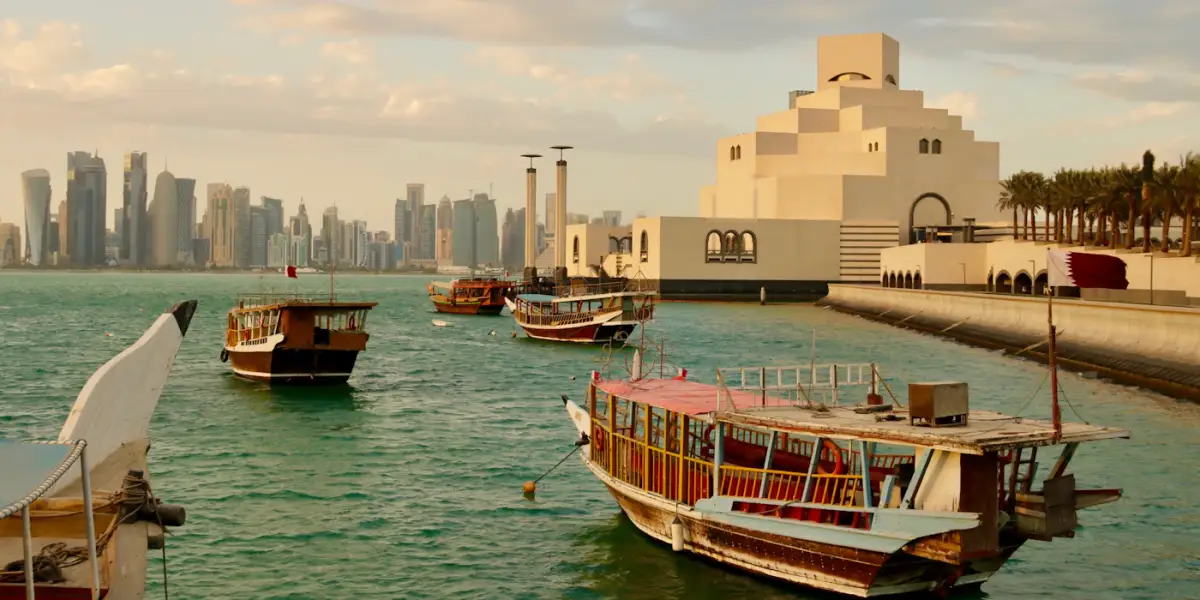
The Corniche and Museum of Islamic Art
CityDay tripI.M. Pei's museum on its own island, a 7 km bayside promenade, moored dhows and the West Bay skyline.
15 min from Doha airportBest Oct–May
The Corniche and Museum of Islamic Art
CityDay tripI.M. Pei's museum on its own island, a 7 km bayside promenade, moored dhows and the West Bay skyline.
The Corniche is a 7 km promenade curving around Doha Bay, with the Museum of Islamic Art on its own man-made island at one end and views across the water to the towers of West Bay. Locals stroll and jog along it in the afternoons, and the wooden dhows moored by the shore are lit up in the evenings. Near the museum, the old Doha port has been rebuilt as the Mina District, a small neighbourhood of pastel-painted buildings, cafés and a fish market, and Souq Waqif is a few minutes' walk away.
What to do in The Corniche and Museum of Islamic Art
- Museum of Islamic Art. I.M. Pei, architect of the Louvre's glass pyramid, based the building on an ablution fountain at Cairo's 9th-century Ibn Tulun Mosque, and its 18 galleries span Islamic art made between the 7th and 20th centuries; allow at least two hours and cover shoulders and knees.
- Mughal treasures. The South Asia gallery holds Mughal jewellery, a Mughal carpet from Lahore and a chest inlaid with mother-of-pearl, and the collection includes a large 16th-century emerald once owned by the Mughal emperors, carved with a prayer on one face and flowers on the other.
- MIA Park. The lawns around the museum look across the bay to the skyline, Richard Serra's monumental sculpture '7' stands at the end of the park's promenade, and pop-up markets and outdoor film screenings are held here through the year.
- Walk the bay or take a dhow. Follow the promenade past the giant oyster-and-pearl sculpture to the dhow harbour, or ride out on one of the wooden boats, a design some historians credit to Indian builders and others to Arab ones; many evening cruises include a meal.
- Mina District and Box Park. The former Old Doha Port has cobbled lanes of pastel buildings and a fish market under a glass roof, and Box Park nearby turns painted shipping containers into cafés and shops with views over MIA Park and the skyline.
Visit Qatar's season for outdoor sightseeing runs from October to May; from June to September it suggests museums and other indoor sights instead.
Sources: Visit Qatar: Museum of Islamic Art, Museum of Islamic Art (official site): About us, Museum of Islamic Art (official site): About the galleries, Museum of Islamic Art (official site): Visitor guidelines, Museum of Islamic Art (official site): MIA Park, Museum of Islamic Art (official site): Home, Visit Qatar: The Doha Corniche, Visit Qatar: Get onboard a traditional dhow, Visit Qatar: Mina District, Visit Qatar: Box Park, Visit Qatar: Qatar's climate, Wikivoyage: Doha (checked 14 Oct)
National Museum of Qatar
HeritageDay tripJean Nouvel's desert-rose building around a royal palace, telling Qatar's story from fossils to gas.
15 min from Doha airport
National Museum of Qatar
HeritageDay tripJean Nouvel's desert-rose building around a royal palace, telling Qatar's story from fossils to gas.
The National Museum, completed in 2019, is French architect Jean Nouvel's building modelled on the desert rose, the crystal clusters that form in Qatar's desert. It wraps around Sheikh Abdullah bin Jassim Al Thani's restored palace, once his family home and for 25 years the seat of government, and its 11 galleries follow the country from its geological origins through desert and pearling life to the oil and gas era. It stands just off the Corniche near National Museum station on the Gold Line; shoulders and knees should be covered, and a few abayas are lent at the museum.
What to do in National Museum of Qatar
- The Old Palace. The early 20th-century palace at the heart of the building has been restored and is the largest single object on display.
- The Baroda pearl carpet. The pearl gallery is built around an Indian-made carpet intended for the Prophet Muhammad's tomb and sewn with thousands of Gulf seed pearls, shown beside pearl jewellery made in India and Europe.
- Al Zubarah and Mira Nair's film. The coastal galleries set a large model of Al Zubarah against a film of the town trading with Europe and India, then Mira Nair's 'Nafas' shows what pearl divers endured during months at sea.
- Hands-on family exhibits. Children can row a dhow, make Arabic coffee, track desert animals and hunt for pearls in the family areas, and a life-size whale shark hangs in the natural-environments gallery.
- The museum park. Outside there are playgrounds, artworks and a garden of Qatar's native plants, and one of the museum's cafés is an outdoor vegan café, useful for vegetarians.
Sources: Visit Qatar: National Museum of Qatar (NMoQ), National Museum of Qatar (official site): Architecture, National Museum of Qatar (official site): About the galleries, National Museum of Qatar (official site): Plan your visit, National Museum of Qatar (official site): Visitor guidelines, Qatar Museums: Heritage sites (The Old Palace), Visit Qatar: Doha Metro, Visit Qatar: Qatar's climate, Wikivoyage: Doha (checked 14 Oct)
Katara Cultural Village
CityDay tripDoha's arts quarter by the sea: tiled mosques, a Greek-style amphitheatre, a planetarium and a public beach.
about 30 min from Doha airport
Katara Cultural Village
CityDay tripDoha's arts quarter by the sea: tiled mosques, a Greek-style amphitheatre, a planetarium and a public beach.
Katara is a cultural district on the coast between West Bay and The Pearl, built to look like a traditional Qatari village, with lanes of galleries, theatres and restaurants around a large open-air amphitheatre. Festivals and exhibitions run here through the year, its restaurants range from Lebanese, Syrian and Egyptian to Turkish and Indian, and landscaped hills on either side look over the village and the sea. The Red Line's Al Qassar station serves it.
What to do in Katara Cultural Village
- Katara Mosque and the Gold Mosque. The main mosque, by Turkish architect Zeynep Fadilloglu, is covered in blue and gold Persian and Turkish tilework, with pigeon towers beside it, and a smaller mosque facing the amphitheatre is clad in gold tiles.
- The amphitheatre. A classical Greek-style theatre with arched, Islamic-style entrances seats up to 5,000 people and looks out to the sea.
- Katara Beach. A wide public beach with boat rides, kayaks, stand-up paddleboards and water skiing; Wikivoyage advises modest swimwear on public beaches, such as long water shorts and a T-shirt for women.
- Al Thuraya Planetarium. Qatar's first planetarium has a 200-seat dome with shows in English and Arabic, plus a space museum where you can pose with real NASA spacesuits.
- Katara Hills at sunset. Paths and water features climb the hills north and south of the village, and the tops look over the rooftops and the sea as the sun goes down.
Sources: Visit Qatar: Katara Cultural Village, Visit Qatar: Katara Beach, Visit Qatar: Al Thuraya Planetarium, Visit Qatar: Iconic places, Wikivoyage: Doha (checked 14 Oct)
The Pearl-Qatar
IslandDay tripA man-made island of yacht marinas and Venice-style canals, with waterside cafés in pastel Qanat Quartier.
35 min from Doha airport
The Pearl-Qatar
IslandDay tripA man-made island of yacht marinas and Venice-style canals, with waterside cafés in pastel Qanat Quartier.
The Pearl is an artificial island on about four million square metres of reclaimed land off West Bay, with yacht marinas, residential towers, villas, hotels and designer shops. Visit Qatar divides it into three main areas: Porto Arabia around the big marina, Qanat Quartier with its Venice-inspired canals, bridges and colourful buildings, and Medina Centrale's plazas and play areas. It is mostly a place to stroll and eat by the water; by public transport, take the Red Line to Legtaifiya and change to the M110 Metrolink bus.
What to do in The Pearl-Qatar
- Qanat Quartier. Wander the pastel streets along the canals, cross a copy of Venice's Rialto Bridge and sit in Plaza Andalucia, a Spanish-style square of arches, balconies and tiled fountains.
- Piano stairs. Thirty musical steps play notes as you climb them between the QQ7 boardwalk and the mezzanine level.
- Canal water taxi. Small water taxis carrying up to 10 people set off from Gate B of the Qanat Quartier canals for an unhurried look at the waterways and bridges.
- Porto Arabia marina. Walk the yacht-lined marina for ice cream, street food and restaurants serving food from around the world.
- Medina Centrale. The island's central district has plazas, gardens and play areas for children, with plenty of cafés and shops around them.
Sources: Visit Qatar: The Pearl-Qatar, Visit Qatar: Qanat Quartier, Visit Qatar: Iconic places, Visit Qatar: Accommodation in Qatar (popular areas to stay) (checked 14 Oct)
Lusail
CityDay tripQatar's new planned city north of Doha: the World Cup final stadium, a marina promenade and a canal-side mall.
about 30 min from Doha airport
Lusail
CityDay tripQatar's new planned city north of Doha: the World Cup final stadium, a marina promenade and a canal-side mall.
Lusail is a planned city on the coast north of Doha, often billed as Qatar's smart city of the future, built with district cooling and a high-speed fibre network. It hosted the 2022 FIFA World Cup final, and its waterfront mixes landmark towers, parks and a marina with malls and food trucks. The Red Line metro runs up from Doha, and the Lusail Tram connects with it at Legtaifiya and Lusail stations.
What to do in Lusail
- Lusail Marina Promenade. A palm-lined waterfront path several kilometres long, with fountains children can play in, a shaded playground and views of the Katara Towers, at its best when the paths and fountains light up after sunset.
- Place Vendôme. A huge mall built in French style around a canal, with a dancing-fountain and 3D laser show in the evenings; the Lusail Tram's Lusail Central stop is right outside.
- Lusail Stadium. Foster + Partners drew its shape from the traditional fanar lantern, and it staged ten World Cup matches, including the 2022 final in which Argentina beat France; Lusail QNB metro station is about 15 minutes' walk away.
- Katara Towers and the food trucks. The crescent-shaped towers echo the crossed scimitars on Qatar's national seal, and the Lusail Marina Food Arena's trucks and stalls sell everything from coffee to kebabs with the towers in view.
- Crescent Park. A park designed around the look of the Qatari desert, with themed playgrounds, sports areas and lawns watered with recycled water.
Sources: Visit Qatar: Ten things to do in Lusail, Visit Qatar: Lusail Marina Promenade, Visit Qatar: Place Vendôme, Visit Qatar: Lusail Stadium, Visit Qatar: Lusail Museum (Lusail as Qatar's smart city), Visit Qatar: Getting around in Qatar (Lusail Tram), Visit Qatar: Doha Metro, Visit Qatar: Accommodation in Qatar (popular areas to stay) (checked 14 Oct)
Khor Al Adaid (the Inland Sea)
WildlifeDay tripDunes up to 40 m high run down to a calm tidal lagoon on the Saudi border: dune drives, a swim and desert camps.
about 1 h 30 min from Doha airportBest Nov–Apr
Khor Al Adaid (the Inland Sea)
WildlifeDay tripDunes up to 40 m high run down to a calm tidal lagoon on the Saudi border: dune drives, a swim and desert camps.
Khor Al Adaid is a tidal inlet of the Gulf in Qatar's far south-east, on the border with Saudi Arabia, where tall sand dunes slope straight into calm, warm water; English speakers call it the Inland Sea. It became a nature reserve in 2007 and sits on UNESCO's tentative list for World Heritage status. There is no road: the last stretch from the Mesaieed and Sealine area is a drive over the dunes in a 4x4 with an experienced off-road driver, so it is easiest on a half- or full-day desert tour, or with a night in a camp.
What to do in Khor Al Adaid (the Inland Sea)
- Drive the dunes. Drivers let air out of the tyres before leaving Mesaieed, then climb and descend dunes up to 40 m high; quad bikes, buggies and sandboards are other ways over the sand.
- Swim in the Inland Sea. The lagoon is calm and warm; the water creeps up the sand in the morning and draws back by evening, and at low tide you may spot fossil shells and corals.
- Look for wildlife. Arabian oryx, the native rheem gazelle, desert foxes, flamingos, green turtles and dugongs all live in or around the reserve; dawn is when desert animals are most active.
- Sleep in a desert camp. Overnight safaris end at Bedouin-style camps under the stars, echoing Al Enna, the winter season when locals still move out to elaborate desert camps.
- Sealine and the Singing Sand Dunes. Near Mesaieed, Sealine's beach is a popular spot for swimming, camping and dune bashing, and the crescent-shaped Singing Sand Dunes give off a hum when the wind moves the sand.
Visit Qatar names November to April as the best time to visit, when the weather is neither too hot nor too cool.
Sources: Visit Qatar: Khor Al Adaid, the Inland Sea of Qatar, Visit Qatar: Khor Al Adaid Beach, Visit Qatar: Inland Sea, Visit Qatar: Desert safari in Qatar, Visit Qatar: Towns and cities (Mesaieed), Wikivoyage: Mesaieed, Wikivoyage: Doha (Go next) (checked 14 Oct)
Al Zubarah and the north
HeritageDay tripQatar's largest heritage site, a UNESCO-listed pearling town and 1938 fort, plus mangroves near Al Khor.
about 1 h 30 min from Doha airportBest Nov–Feb
Al Zubarah and the north
HeritageDay tripQatar's largest heritage site, a UNESCO-listed pearling town and 1938 fort, plus mangroves near Al Khor.
Al Zubarah, about 100 km north-west of Doha on the coast, was founded in the mid-18th century and grew into Qatar's largest and most important town, living on pearling and trade until it was burned in 1811; by the early 20th century it lay abandoned under the sand. Qatar Museums calls it the best-preserved 18th–19th century pearling and trading town in the Gulf, and UNESCO inscribed it on the World Heritage List in 2013. Pair it with the mangroves and Purple Island near Al Khor for a long day; Qatar Museums warns that its remote heritage sites can be rugged with limited facilities, so wear comfortable shoes.
What to do in Al Zubarah and the north
- Al Zubarah Fort. Built in 1938 on the ruins of an earlier fort, with walls about a metre thick that kept out attackers and kept the rooms cool, it is now a museum of finds from the pearl-diving era.
- Walk the old town. A boardwalk leads through the 60-hectare excavated town, which runs 2.5 km from the fort to the shore, past house walls, mosques, date presses and the market, and a shuttle links the fort and the town.
- Qal'at Murair. This older fortified enclosure beside the town has four corner towers and the traces of a canal that let boats come in to trade and collect water.
- Kayak the Al Thakhira mangroves. Guided kayak and paddleboard trips near Al Khor, about 40 minutes from Doha, wind through grey mangroves where herons and flamingos feed; stay on the water, since walking in the forest damages it.
- Purple Island. Bin Ghannam Island near Al Khor is named for a purple-dye industry run there in the second millennium BC; a wooden bridge leads across to mangroves and a beach with no shade or facilities.
Visit Qatar calls November to February, with temperatures around 15–20°C, the best season for outdoor trips.
Sources: Qatar Museums: Al Zubarah Archaeological Site, Qatar Museums: Heritage sites, Visit Qatar: Al Zubarah Archaeological Site, Visit Qatar: Al Thakira Mangroves, Visit Qatar: Purple Island (Bin Ghannam Island), Visit Qatar: Desert safari in Qatar (the north), Visit Qatar: Qatar's climate, National Museum of Qatar (official site): Home, Wikivoyage: Al Shamal (checked 14 Oct)
A first trip: 3–5 nights
- Souq Waqif and Msheireb · 3–5n
- →The Corniche and Museum of Islamic Art
- →National Museum of Qatar
- →Katara Cultural Village
- →The Pearl-Qatar
- →Lusail
- →Khor Al Adaid (the Inland Sea)
- →Al Zubarah and the north
Stay in the old centre around Souq Waqif and Msheireb and work outwards: the souq and the museum houses first, then MIA and the Corniche, the National Museum, and Katara, The Pearl and Lusail along the coast to the north, before a day in the dunes at the Inland Sea and a long drive north to Al Zubarah. November to February are the mild months for the desert and the souq lanes; from June to September, lean on the museums and malls.
Getting around
The driverless Doha Metro has three lines that meet at Msheireb: the Red Line runs from Terminal 1 of Hamad International Airport through the city and north to Lusail, where the Lusail Tram takes over, and the Gold Line stops at Souq Waqif and the National Museum. Visit Qatar points to Karwa taxis and ride-hailing apps such as Uber, and the airport is about 20 minutes from central Doha by road. Al Zubarah is a long drive by car, taxi or tour, and the Inland Sea has no road at all, only a 4x4 drive over the dunes with an experienced driver, so a guided desert trip is the simple option.
When to go
Doha month by month: weather and fares →Peak Shoulder Off-season
Visit Qatar describes mild winters from November to February at 15 to 20°C, a hot and humid summer from June to September, and pleasant outdoor weather from October to May. The climate table already shows 32°C highs in May and October, so those months are treated as shoulder rather than peak.
Flights to Qatar from India
Visa for Indian passports
Indian passport holders can visit Qatar without a visa for up to 30 days. Or a Hayya A1 e-visa if you are not booking your hotel through Discover Qatar. Free 30-day entry on arrival with a hotel booked via Discover Qatar and a return ticket.
Before you book, check the Ministry of External Affairs travel advisories and the Embassy of India, Doha for the latest guidance.
Qatar: questions
What are the best places to visit in Qatar?
Souq Waqif and Msheireb: Doha's rebuilt old market and the new downtown next door: falcons, spices, museum houses and late cafés. The Corniche and Museum of Islamic Art: I.M. Pei's museum on its own island, a 7 km bayside promenade, moored dhows and the West Bay skyline. National Museum of Qatar: Jean Nouvel's desert-rose building around a royal palace, telling Qatar's story from fossils to gas. Katara Cultural Village: Doha's arts quarter by the sea: tiled mosques, a Greek-style amphitheatre, a planetarium and a public beach. The Pearl-Qatar: A man-made island of yacht marinas and Venice-style canals, with waterside cafés in pastel Qanat Quartier. Lusail: Qatar's new planned city north of Doha: the World Cup final stadium, a marina promenade and a canal-side mall. Khor Al Adaid (the Inland Sea): Dunes up to 40 m high run down to a calm tidal lagoon on the Saudi border: dune drives, a swim and desert camps. Al Zubarah and the north: Qatar's largest heritage site, a UNESCO-listed pearling town and 1938 fort, plus mangroves near Al Khor.
How many days do you need for Qatar?
A first trip takes about 3–5 nights: Souq Waqif and Msheireb (3–5 nights), The Corniche and Museum of Islamic Art (1 night), National Museum of Qatar (1 night), Katara Cultural Village (1 night), The Pearl-Qatar (1 night), Lusail (1 night), Khor Al Adaid (the Inland Sea) (1 night), Al Zubarah and the north (1 night). Stay in the old centre around Souq Waqif and Msheireb and work outwards: the souq and the museum houses first, then MIA and the Corniche, the National Museum, and Katara, The Pearl and Lusail along the coast to the north, before a day in the dunes at the Inland Sea and a long drive north to Al Zubarah. November to February are the mild months for the desert and the souq lanes; from June to September, lean on the museums and malls.
What is the best time to visit Qatar?
Peak season is Nov–Feb. Visit Qatar describes mild winters from November to February at 15 to 20°C, a hot and humid summer from June to September, and pleasant outdoor weather from October to May. The climate table already shows 32°C highs in May and October, so those months are treated as shoulder rather than peak.
Do Indians need a visa for Qatar?
Indian passport holders can visit Qatar without a visa for up to 30 days. Or a Hayya A1 e-visa if you are not booking your hotel through Discover Qatar. Free 30-day entry on arrival with a hotel booked via Discover Qatar and a return ticket.
How much is a flight to Qatar from India?
The lowest return fare FlyBun has seen in the last 14 days is ₹24,272, Bangalore to Doha, for October 2026 departures. Fares change daily.
Places and things to do are written by FlyBun from official tourism, heritage and park sources, linked under each place, last checked 14 Oct. We leave out entry fees and opening hours because they change; check them before you go.
Watch a route and FlyBun alerts you free when its fare drops.