

Travel guide from India
Singapore
Singapore is an island city-state at the southern tip of the Malay peninsula, a nonstop flight of a few hours from most large Indian cities and small enough to cross in about an hour. English is spoken everywhere and Tamil is one of the languages you will hear, and Little India's Hindu temples and South Indian vegetarian food are a short ride from the skyscrapers. A first visit mixes Marina Bay's gardens and skyline, the old Chinese, Indian and Malay quarters, the Mandai wildlife parks and Sentosa's theme parks, with plenty for children.
- Best time
- Feb–Mar
- First trip
- 4–6 nights
- Visa
- e-Visa, 30 days
- Return flights
- from ₹26,554 ●
- Mumbai, checked in the last 48 h
Places to visit in Singapore
10 places in the order you would meet them on a first trip. Tap one for what to do there.
Civic District and Clarke Quay
CityColonial-era museums, riverside quays for dinner and drinks, and the most central place to stay.
3–4 nightsabout 30 min from Singapore airport
Civic District and Clarke Quay
CityColonial-era museums, riverside quays for dinner and drinks, and the most central place to stay.
The north bank of the Singapore River is where the British colony began, and the Civic District around it keeps the old City Hall, Supreme Court and other colonial landmarks, several of them now museums. Along the water, Boat Quay, Clarke Quay and Robertson Quay hold most of the city's riverside restaurants and nightlife, and mid-range hotels cluster at the western end of the river. Wikivoyage rates this riverside area the best all-round base, with Marina Bay and Chinatown within walking distance and City Hall, Raffles Place and Clarke Quay MRT stations close by.
What to do in Civic District and Clarke Quay
- National Gallery Singapore. The former City Hall and Supreme Court now hold more than 8,000 works of Southeast Asian art from the 19th century to today, the largest such collection in the world.
- Asian Civilisations Museum. On the riverbank at Empress Place, with cargo recovered from a Tang-dynasty shipwreck and Hindu, Buddhist and Christian art from across Asia.
- Bumboat on the Singapore River. River cruises stop at jetties along both banks and pass the old quays and the skyscrapers of the financial district while telling the river's history.
- Fort Canning Park. The hill above the river was the seat of ancient Malay rulers and later a British military base; walk its lawns, the heritage gallery and the spiral 'tree tunnel' staircase.
- Evenings on the quays. Clarke Quay is the centre of the club and bar scene while Robertson Quay is calmer for a family dinner by the water; skip any restaurant that has to use touts.
Sources: Visit Singapore: Civic District, Visit Singapore: National Gallery Singapore, Visit Singapore: Asian Civilisations Museum, Visit Singapore: Singapore River, Changi Airport: Leaving the airport, Wikivoyage: Singapore/Riverside, Wikivoyage: Singapore (checked 14 Oct)
Marina Bay and Gardens by the Bay
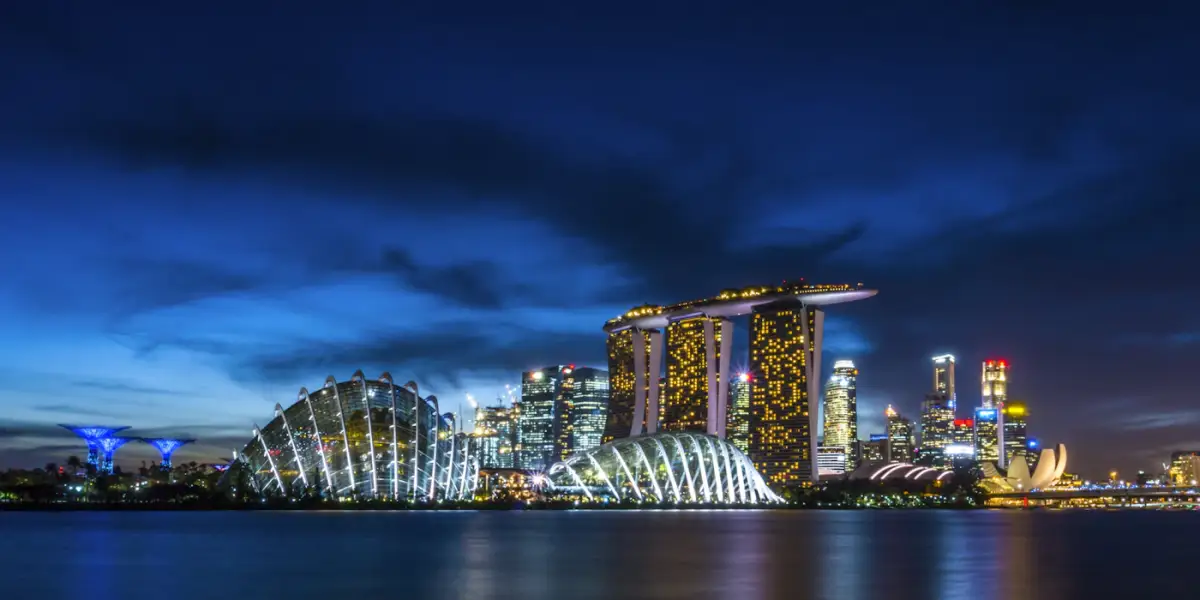
CityDay tripThe skyline you know from photos: Marina Bay Sands, the Supertrees and cooled domes of the Gardens, and the Merlion.
about 30 min from Singapore airport
Marina Bay and Gardens by the Bay
CityDay tripThe skyline you know from photos: Marina Bay Sands, the Supertrees and cooled domes of the Gardens, and the Merlion.
Marina Bay is the newer downtown built on land reclaimed where the Singapore River meets the sea, dominated by the three towers of Marina Bay Sands with the SkyPark laid across their tops. Behind it, Gardens by the Bay mixes open-air gardens and the Supertree Grove with two air-conditioned glass conservatories, and a waterfront promenade loops the bay past the Merlion, the Esplanade theatres and the Singapore Flyer. Evenings are cooler, and both the Supertrees and Marina Bay Sands put on light shows after dark; the bay's hotels are mostly at the top end.
What to do in Marina Bay and Gardens by the Bay
- Cloud Forest and Flower Dome. Two cooled conservatories: Cloud Forest wraps walkways around a misty indoor mountain and waterfall, and the Flower Dome, the world's largest glass greenhouse, grows plants from cool, dry climates with changing flower displays.
- Supertrees after dark. The vertical-garden Supertrees light up for the Garden Rhapsody light and sound show every evening; by day the OCBC Skyway, a walkway 22 m up, runs between them.
- Children's Garden. The Far East Organization Children's Garden inside Gardens by the Bay has water play for small children, so pack a change of clothes.
- SkyPark view. The observation deck on top of Marina Bay Sands, 55 storeys up, looks across the bay and the Gardens.
- Walk the bay to the Merlion. Cross the Helix Bridge and follow the promenade to the 8.6 m Merlion, then catch Spectra, a light and water show outside Marina Bay Sands in the evening.
Sources: Visit Singapore: Marina Bay, Visit Singapore: Gardens by the Bay, Visit Singapore: Marina Bay Sands, Visit Singapore: Merlion Park, Visit Singapore: Nature and wildlife for families, Gardens by the Bay (official site): Attractions, Jewel Changi Airport (official site): Getting to Jewel, Wikivoyage: Singapore/Marina Bay, Wikivoyage: Singapore (checked 14 Oct)
Chinatown
HeritageDay tripShophouse lanes, Singapore's oldest Hindu and Chinese temples, the Buddha Tooth Relic Temple and big hawker centres.
about 30 min from Singapore airportBest Jan–Feb
Chinatown
HeritageDay tripShophouse lanes, Singapore's oldest Hindu and Chinese temples, the Buddha Tooth Relic Temple and big hawker centres.
Chinatown grew from an enclave of early Chinese migrants south of the river, and its restored shophouse lanes around Pagoda Street and Smith Street now sell souvenirs, herbal medicine, tea and dried meat. It is also one of the city's most mixed quarters: Singapore's oldest Hindu temple, its oldest Chinese temple and one of its oldest mosques stand a few streets apart. Chinatown and Maxwell MRT stations put you in the middle of it.
What to do in Chinatown
- Sri Mariamman Temple. Singapore's oldest Hindu temple, whose carved gopuram gave Pagoda Street its name; cover-ups are lent at the entrance, shoes come off, and the Theemithi fire-walk is held here about a week before Deepavali.
- Buddha Tooth Relic Temple. A Tang-style Buddhist temple keeping a relic said to be a tooth of the Buddha, with two museums inside; bare shoulders, shorts and short skirts are not allowed, and no non-vegetarian food may be carried in.
- Maxwell and Chinatown Complex. Maxwell is the hawker centre known for chicken rice and Chinatown Complex is the country's largest food centre, with Michelin Bib Gourmand stalls; vegetarians should ask about egg, oyster sauce or lard in dishes that look meat-free.
- Thian Hock Keng temple. Singapore's oldest Chinese temple, built in southern Chinese style with carved dragons and phoenixes and broken porcelain on the roof ridges, around the corner from the Al-Abrar Mosque.
- Chinatown Heritage Centre. Rooms recreated inside an old shophouse show how cramped and hard life was for the migrants who once lived in them.
Chinatown is lit up and at its busiest in the weeks before Chinese New Year, in late January or February; almost everything shuts for the first two days of the New Year.
Sources: Visit Singapore: Chinatown, Visit Singapore: Sri Mariamman Temple, Visit Singapore: Buddha Tooth Relic Temple, Visit Singapore: Thian Hock Keng Temple, Visit Singapore: Chinese New Year, Visit Singapore: 4 days in Singapore, Wikivoyage: Singapore/Chinatown, Wikivoyage: Singapore (dietary restrictions) (checked 14 Oct)
Little India
HeritageDay tripHindu temples, South Indian vegetarian food, Tekka Centre and Mustafa Centre: the heart of Singapore's Indian community.
about 30 min from Singapore airportBest Oct–Nov
Little India
HeritageDay tripHindu temples, South Indian vegetarian food, Tekka Centre and Mustafa Centre: the heart of Singapore's Indian community.
Little India grew up along Serangoon Road, one of Singapore's earliest roads, and is the centre of the country's Indian community: shophouses sell saris, gold, spices and flower garlands, and shop signs switch to Tamil and other Indian scripts. Each January or February the Thaipusam kavadi procession sets out from the Sri Srinivasa Perumal Temple here. The district is compact enough to cover on foot from Little India MRT station, and Kampong Glam is a short walk away.
What to do in Little India
- Sri Veeramakaliamman Temple. Raised by Indian settlers in the 1800s and dedicated to Kali, it is Little India's busiest temple, especially on Tuesdays, Fridays and Sundays; cover-ups are lent at the entrance and shoes come off.
- Eat at Tekka Centre. Singapore's largest indoor wet market, full of spices and fresh produce, with a food centre where South Indian stalls are well represented.
- South Indian vegetarian meals. Pure-vegetarian restaurants serving dosa, rasam and South Indian set meals are dotted around the district, including branches of chains from Chennai and Delhi.
- Mustafa Centre. A huge department store selling everything from gold and electronics to groceries, with money changers out front known for competitive rates.
- Indian Heritage Centre. Galleries trace South Asian migration to Southeast Asia and the Indian community's part in Singapore's story, with more than 400 artefacts and a Singapore Visitor Centre inside.
Deepavali, in October or November, lights up Serangoon Road and fills Little India with open-air markets and stalls in the run-up to the festival.
Sources: Visit Singapore: Little India, Visit Singapore: Sri Veeramakaliamman Temple, Visit Singapore: Indian Heritage Centre, Visit Singapore: Deepavali, Visit Singapore: Thaipusam, Visit Singapore: Vegetarian and vegan food, Wikivoyage: Singapore/Little India, Wikivoyage: Singapore (checked 14 Oct)
Kampong Glam and Bugis
HeritageDay tripThe golden-domed Sultan Mosque, Haji Lane's murals and indie shops, old textile stores and Indian-Muslim murtabak.
about 30 min from Singapore airport
Kampong Glam and Bugis
HeritageDay tripThe golden-domed Sultan Mosque, Haji Lane's murals and indie shops, old textile stores and Indian-Muslim murtabak.
Kampong Glam, spelled Kampong Gelam by Visit Singapore, is where Arab traders settled when the colony was founded and where the town plan placed the Malay community, and the golden domes of the Sultan Mosque still anchor its lanes. The old shophouses now hold textile and perfume shops, cafés, bars and street art, while neighbouring Bugis adds busy malls and a cheap street market. Bugis MRT station is the usual way in, and Little India is within easy walking distance.
What to do in Kampong Glam and Bugis
- Sultan Mosque. Singapore's largest mosque, which dates from 1824 and Singapore's first sultan, Sultan Hussein Shah, welcomes visitors to walk the compound or join a guided tour; cover-ups are provided and shoes come off.
- Haji Lane. A narrow lane of indie boutiques and small bars whose walls are covered in murals and graffiti by local and international artists.
- Old shops on Arab Street. Batik, textile and perfume shops, a couple of them trading since the 1930s and 1940s, sit among newer boutiques in the streets around the mosque.
- Murtabak and biryani. The area's Indian-Muslim restaurants, one of them running since 1908, are known for murtabak, a stuffed pancake eaten with curry, and for biryani.
- Two temples on Waterloo Street. In Bugis, a Hindu temple to Krishna stands next door to the Kwan Im Thong Hood Cho Buddhist temple, and many Chinese worshippers make offerings at both.
Sources: Visit Singapore: Kampong Gelam, Visit Singapore: Sultan Mosque, Visit Singapore: 4 days in Singapore, Wikivoyage: Singapore/Bugis, Wikivoyage: Singapore/Little India (checked 14 Oct)
Mandai Wildlife Reserve
WildlifeDay tripSingapore Zoo, the Night Safari, Asia's largest bird park and River Wonders, side by side in the green north.
about 30 min from Singapore airport
Mandai Wildlife Reserve
WildlifeDay tripSingapore Zoo, the Night Safari, Asia's largest bird park and River Wonders, side by side in the green north.
The Mandai Wildlife Reserve, beside the Upper Seletar Reservoir in the north of the island, groups Singapore Zoo, the Night Safari, River Wonders, a large bird park and the Rainforest Wild ASIA adventure park. Each park is big and the heat is tiring, so Wikivoyage suggests one park per day, starting early, and the Night Safari as a separate evening trip. A taxi is simplest; on public transport, the Mandai Khatib shuttle bus runs from Khatib MRT station.
What to do in Mandai Wildlife Reserve
- Singapore Zoo. A rainforest zoo with open, cageless enclosures where orangutans range through the trees; families can book a breakfast with orangutans and other animals.
- Night Safari. The world's first nocturnal wildlife park shows more than 900 animals from a tram and along four walking trails.
- The bird park. Asia's largest bird park keeps more than 3,500 birds of over 400 species in walk-through aviaries modelled on habitats around the world, plus a penguin cove.
- River Wonders. A river-themed park with Indian gharials, giant pandas, manatees and a boat ride through its Amazon section, almost all under cover.
- Mandai Boardwalk. An easy 3.3 km trail along the Upper Seletar Reservoir for a quieter look at native wildlife.
Sources: Visit Singapore: Mandai, Visit Singapore: Nature and wildlife for families, Mandai Wildlife Reserve (official site): Singapore Zoo, Mandai Wildlife Reserve (official site): Night Safari, Mandai Wildlife Reserve (official site): Bird Paradise, Mandai Wildlife Reserve (official site): River Wonders, Wikivoyage: Singapore/North and West (checked 14 Oct)
Sentosa
IslandUniversal Studios, the Oceanarium, three beaches and a nightly show over the sea on a resort island off the south coast.
1–2 nightsabout 30 min from Singapore airportBest Feb–Mar
Sentosa
IslandUniversal Studios, the Oceanarium, three beaches and a nightly show over the sea on a resort island off the south coast.
Sentosa is a resort island just off the south coast, reached by the Sentosa Express monorail from VivoCity mall at HarbourFront MRT, by cable car or on foot; once part of Britain's 'Fortress Singapore', it is now given over almost entirely to leisure. Resorts World Sentosa holds Universal Studios Singapore, the Singapore Oceanarium and a water park, and the Siloso, Palawan and Tanjong beaches run from lively to quiet. Visit Singapore suggests it as a family base close to the beaches and attractions; expect long queues at weekends and in school holidays.
What to do in Sentosa
- Universal Studios Singapore. Seven movie-themed zones, including the new Minion Land and the duelling roller coasters of Sci-Fi City; queues are long at weekends and in school holidays, so arrive early.
- Singapore Oceanarium. The former S.E.A. Aquarium, rebuilt as a journey through ocean zones from a moon-jelly tank to a walk-through tunnel of reef sharks.
- Pick a beach. Siloso has the beach bars, Palawan suits families and has a rope bridge to an islet billed as continental Asia's southernmost point, and Tanjong is the quietest; all three beaches are man-made and the sea is murky from passing ships.
- Skyline Luge. Ride the chairlift up and race luge carts down one of four tracks, best after dark when the island is lit.
- Wings of Time. A water, laser and fireworks show staged over the sea at Siloso Beach every night.
February is usually Singapore's driest month and late January to early March is relatively dry; November to January bring the most rain, and afternoon thunderstorms are common all year.
Sources: Visit Singapore: Sentosa Island, Visit Singapore: Resorts World Sentosa, Visit Singapore: Family trips (where to stay), Visit Singapore: Adventures for families, Sentosa (official site): Getting to Sentosa, Sentosa (official site): Universal Studios Singapore, Sentosa (official site): Singapore Oceanarium, Sentosa (official site): Siloso Beach, Sentosa (official site): Palawan Beach, Sentosa (official site): Tanjong Beach, Sentosa (official site): Wings of Time, Meteorological Service Singapore: Climate of Singapore, Wikivoyage: Singapore/Sentosa and Harbourfront (checked 14 Oct)
Jewel Changi Airport
CityDay tripThe airport's garden mall around the world's tallest indoor waterfall, for spare hours on arrival or before a flight.
10 min from Singapore airport
Jewel Changi Airport
CityDay tripThe airport's garden mall around the world's tallest indoor waterfall, for spare hours on arrival or before a flight.
Jewel is a glass-domed complex at the heart of Changi Airport, joined to Terminal 1's arrival hall and a five- to ten-minute walk over link bridges from Terminals 2 and 3. Around its 40 m Rain Vortex it stacks an indoor forest, a rooftop play area and floors of shops and restaurants, which makes it the natural place to spend the last hours before a flight home.
What to do in Jewel Changi Airport
- Rain Vortex. The world's tallest indoor waterfall drops 40 m through seven storeys and turns into a light and music show after dark.
- Forest Valley trails. Trails climb through an indoor garden of more than 900 trees and palms towards the top floor; allow half an hour per trail and leave wheeled bags at the baggage storage.
- Canopy Park. The top level has hedge and mirror mazes, bouncing and walking nets strung through the treetops, and the Discovery Slides.
- Changi Experience Studio. An interactive exhibition with games and shows about how Changi Airport works.
- Catch it in transit. Transit passengers who stay airside can still see the Rain Vortex from the Skytrain between Terminals 2 and 3.
Sources: Jewel Changi Airport (official site): Getting to Jewel, Jewel Changi Airport (official site): Rain Vortex, Jewel Changi Airport (official site): Forest Valley, Jewel Changi Airport (official site): Canopy Park, Visit Singapore: Adventures for families, Wikivoyage: Singapore Changi Airport (checked 14 Oct)
Orchard Road
CityA long boulevard of malls and big hotels near the Botanic Gardens: the base for shoppers and many families.
3–4 nightsabout 30 min from Singapore airportBest Nov–Dec
Orchard Road
CityA long boulevard of malls and big hotels near the Botanic Gardens: the base for shoppers and many families.
Orchard Road is a long boulevard of interconnected malls and hotels, from the Tanglin end in the west to Dhoby Ghaut in the east, with underground walkways linking many of the malls out of the heat and rain. Wikivoyage names it the main alternative to the riverside as a base, and Visit Singapore suggests it for families who want easy shopping and transport links; Orchard, Somerset and Dhoby Ghaut MRT stations run along it. The Singapore Botanic Gardens are a short ride west, at Napier station on the Thomson-East Coast line.
What to do in Orchard Road
- Singapore Botanic Gardens. Singapore's first UNESCO World Heritage Site, with the National Orchid Garden and the Jacob Ballas Children's Garden for children up to 14; Napier MRT serves the Tanglin entrance.
- Mall-hop underground. Between ION Orchard, Wisma Atria, Ngee Ann City and their neighbours you can walk long stretches through air-conditioned underpasses.
- Emerald Hill. A gentle slope of ornate Chinese Baroque shophouses just off the main road, with a few bars along it.
- Rainy-day play. Indoor playgrounds, rope courses and climbing walls in malls along the road keep children busy when the weather turns.
- Singapore Visitor Centre. The centre on Orchard Road has information and itinerary advice.
Orchard Road's Christmas light-up, held every year since 1984, runs from November to New Year.
Sources: Visit Singapore: Orchard Road, Visit Singapore: Orchard family itinerary, Visit Singapore: Emerald Hill, Visit Singapore: Christmas on A Great Street, Visit Singapore: Family trips (where to stay), Visit Singapore: Essential travel information, Singapore Botanic Gardens (NParks): Visitor information, Singapore Botanic Gardens (NParks): Attractions, Wikivoyage: Singapore/Orchard, Wikivoyage: Singapore (checked 14 Oct)
Pulau Ubin
IslandDay tripTen minutes by bumboat from Changi Village: rented bikes, old granite quarries, mangroves and the Chek Jawa wetlands.
about 30 min by boat from Singapore airportBest Feb–Mar
Pulau Ubin
IslandDay tripTen minutes by bumboat from Changi Village: rented bikes, old granite quarries, mangroves and the Chek Jawa wetlands.
Pulau Ubin is a boomerang-shaped island off Singapore's north-east corner, once worked for granite and plantation crops and now mostly regrown forest and grassland, with a small village by the jetty. Bumboats cross from Changi Point Ferry Terminal, next to Changi Village, in about 10 minutes, leaving once 12 passengers have gathered. It makes a half-day or day trip for anyone who wants to see the rural Singapore of the past.
What to do in Pulau Ubin
- Cycle the island. Bike shops in the village rent bicycles and helmets; stay on the designated trails and push your bike where signs ask you to on the steep stretches.
- Chek Jawa Wetlands. At the island's eastern end, boardwalks run through mangroves and along the shore, and the Jejawi Tower gives a view over the island and a chance to spot birds.
- Ketam Mountain Bike Park. Ten kilometres of graded trails, with tracks for beginners up to experts.
- Kayak the mangroves. Guided, beginner-friendly kayak tours paddle along the island's shores and mangroves.
- Lunch in the village. A few seafood and Malay eateries sit near the jetty, and village shops sell drinks, ice kacang and seasonal fruit such as durian and rambutan.
February is usually the driest month and late January to early March relatively dry; afternoon thunderstorms are common much of the year.
Sources: NParks Pulau Ubin: Visit Ubin, NParks Pulau Ubin: Cycling, NParks Pulau Ubin: Hiking, NParks Pulau Ubin: Notices, Visit Singapore: Outdoor adventure activities, Meteorological Service Singapore: Climate of Singapore, Wikivoyage: Singapore/East Coast, Wikivoyage: Singapore (checked 14 Oct)
A first trip: 4–6 nights
- Civic District and Clarke Quay · 3–4n
- →Marina Bay and Gardens by the Bay
- →Chinatown
- →Little India
- →Kampong Glam and Bugis
- →Mandai Wildlife Reserve
- →Sentosa · 1–2n
- →Jewel Changi Airport
Base yourself by the river and work outwards on foot and by MRT: Marina Bay and the Gardens, then Chinatown, Little India and Kampong Glam, with a full day at Mandai, before moving to Sentosa for the theme parks and beaches and stopping at Jewel on the way to your flight. Shoppers and families can base on Orchard Road instead of the river; it rains all year, but February is usually the driest month and November to January the wettest.
Getting around
The MRT metro and public buses reach almost everywhere a visitor goes: tap in with a contactless Visa or Mastercard or a phone wallet, or buy a stored-value EZ-Link card, and remember that eating and drinking, even water, is banned on trains and in stations. Taxis and ride-hailing apps such as Grab and Gojek are easy to find, and from Changi a taxi to the city takes about 30 minutes, while the MRT needs a change at Tanah Merah or Expo. Every MRT station has at least one lift for strollers.
Peak Shoulder Off-season
Singapore has no real off-season: it is warm all year. The Meteorological Service Singapore describes a wetter phase of the northeast monsoon from December to January and a drier phase in February to March, so the ratings here follow rainfall only.
Flights to Singapore from India
Visa for Indian passports
Indian passport holders need an e-visa for Singapore, applied for online before travel (allow about 7 days). 96-hour visa-free transit if you hold a valid US, UK, Australia, Canada, Germany, Japan, NZ or Swiss visa. Apply through an authorised agent (e.g. VFS); about 3–5 working days.
Before you book, check the Ministry of External Affairs travel advisories for the latest guidance.
Singapore: questions
What are the best places to visit in Singapore?
Civic District and Clarke Quay: Colonial-era museums, riverside quays for dinner and drinks, and the most central place to stay. Marina Bay and Gardens by the Bay: The skyline you know from photos: Marina Bay Sands, the Supertrees and cooled domes of the Gardens, and the Merlion. Chinatown: Shophouse lanes, Singapore's oldest Hindu and Chinese temples, the Buddha Tooth Relic Temple and big hawker centres. Little India: Hindu temples, South Indian vegetarian food, Tekka Centre and Mustafa Centre: the heart of Singapore's Indian community. Kampong Glam and Bugis: The golden-domed Sultan Mosque, Haji Lane's murals and indie shops, old textile stores and Indian-Muslim murtabak. Mandai Wildlife Reserve: Singapore Zoo, the Night Safari, Asia's largest bird park and River Wonders, side by side in the green north. Sentosa: Universal Studios, the Oceanarium, three beaches and a nightly show over the sea on a resort island off the south coast. Jewel Changi Airport: The airport's garden mall around the world's tallest indoor waterfall, for spare hours on arrival or before a flight. Orchard Road: A long boulevard of malls and big hotels near the Botanic Gardens: the base for shoppers and many families. Pulau Ubin: Ten minutes by bumboat from Changi Village: rented bikes, old granite quarries, mangroves and the Chek Jawa wetlands.
How many days do you need for Singapore?
A first trip takes about 4–6 nights: Civic District and Clarke Quay (3–4 nights), Marina Bay and Gardens by the Bay (1 night), Chinatown (1 night), Little India (1 night), Kampong Glam and Bugis (1 night), Mandai Wildlife Reserve (1 night), Sentosa (1–2 nights), Jewel Changi Airport (1 night). Base yourself by the river and work outwards on foot and by MRT: Marina Bay and the Gardens, then Chinatown, Little India and Kampong Glam, with a full day at Mandai, before moving to Sentosa for the theme parks and beaches and stopping at Jewel on the way to your flight. Shoppers and families can base on Orchard Road instead of the river; it rains all year, but February is usually the driest month and November to January the wettest.
What is the best time to visit Singapore?
Peak season is Feb–Mar. Singapore has no real off-season: it is warm all year. The Meteorological Service Singapore describes a wetter phase of the northeast monsoon from December to January and a drier phase in February to March, so the ratings here follow rainfall only.
Do Indians need a visa for Singapore?
Indian passport holders need an e-visa for Singapore, applied for online before travel (allow about 7 days). 96-hour visa-free transit if you hold a valid US, UK, Australia, Canada, Germany, Japan, NZ or Swiss visa. Apply through an authorised agent (e.g. VFS); about 3–5 working days.
How much is a flight to Singapore from India?
The lowest return fare FlyBun has seen in the last 14 days is ₹24,061, Mumbai to Singapore, for January 2027 departures. Fares change daily.
Places and things to do are written by FlyBun from official tourism, heritage and park sources, linked under each place, last checked 14 Oct. We leave out entry fees and opening hours because they change; check them before you go.
Watch a route and FlyBun alerts you free when its fare drops.