

Travel guide from India
South Africa
South Africa lies at the southern tip of Africa, across the Indian Ocean from India, and most long-haul flights land at Johannesburg's O.R. Tambo, its main international hub, or at Cape Town. Its seasons run opposite to India's, with summer from November to February, and people come for Cape Town's mountain and coast, the Garden Route and safaris in Kruger. Gandhi lived here from 1893 to 1914, and Durban has one of the largest communities of Indian origin outside India.
- Best time
- Dec–Feb
- First trip
- 12–17 nights
- Visa
- e-Visa, 90 days
- Return flights
- from ₹46,217 ●
- Mumbai, checked in the last 48 h
Places to visit in South Africa
10 places in the order you would meet them on a first trip. Tap one for what to do there.
Cape Town
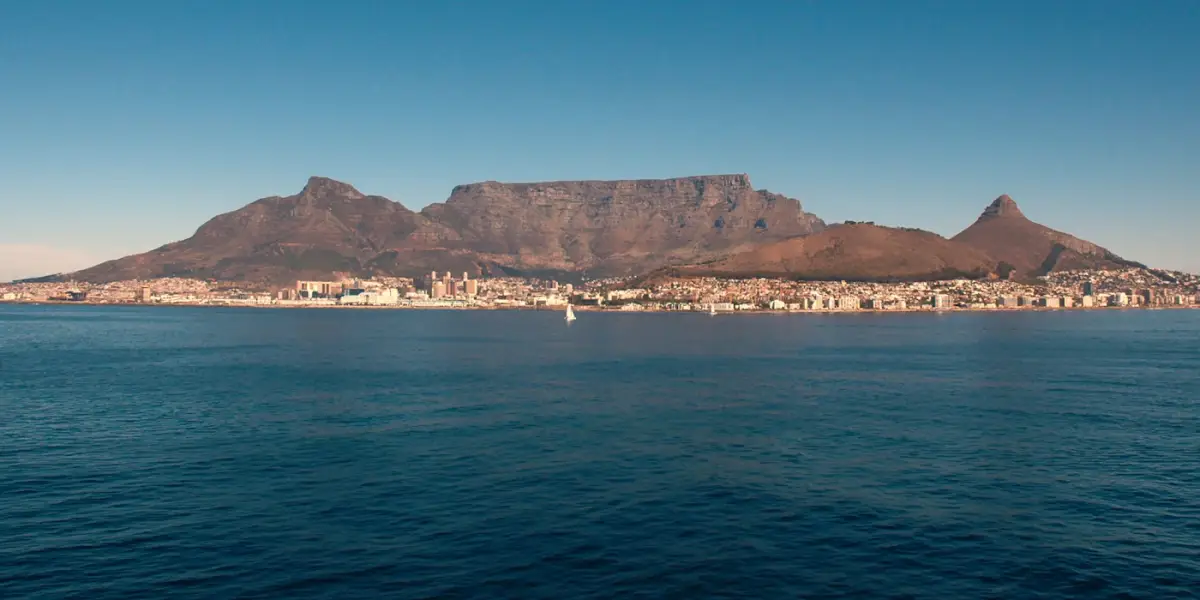
CityTable Mountain over the city, the V&A Waterfront, Bo-Kaap's painted houses, Kirstenbosch and Atlantic beaches.
3–4 nightsabout 30 min from Cape Town airportBest Apr–May, Sep–Oct
Cape Town
CityTable Mountain over the city, the V&A Waterfront, Bo-Kaap's painted houses, Kirstenbosch and Atlantic beaches.
Cape Town grew from the settlement the Dutch East India Company founded in 1652 and is now South Africa's legislative capital, spread between the flat top of Table Mountain and Table Bay. The V&A Waterfront and the Bo-Kaap sit on the edge of the centre, Kirstenbosch's gardens are 13 km away, and the airport is about 20 km east. Vegetarians eat well here: most restaurants have vegetarian dishes, and many offer vegan ones too.
What to do in Cape Town
- Up Table Mountain. Ride the cableway, which has carried visitors since 1929, or climb the steep Platteklip Gorge path in about two hours; the cars stop in strong wind and it can be several degrees colder on top, so carry a jacket.
- V&A Waterfront. Cape Town's working harbour mixes shops, a food market, the Two Oceans Aquarium and the Zeitz MOCAA art museum in a converted grain silo, and the Robben Island ferries leave from here.
- Bo-Kaap. Walk the cobbled streets of brightly painted houses and mosques below Signal Hill, home of the Cape Malay Muslim community, visit the Bo-Kaap Museum in a house from the 1760s, and try Cape Malay dishes such as bobotie.
- Kirstenbosch National Botanical Garden. On Table Mountain's eastern slopes, 13 km from the centre, this garden grows more than 7,000 plant species, with a treetop canopy walkway and proteas at their best from mid-August to mid-October.
- Clifton and Camps Bay. Two of the city's most famous beaches, they are busiest in summer, but the Atlantic here stays cold, around 8 to 14°C, so for a swim head to the warmer water of False Bay.
Spring (September and October) and autumn (April and May) are the best times, with wildflowers in spring and the Winelands changing colour in autumn; winter brings wet, windy spells.
Sources: Wikivoyage: Cape Town, Wikivoyage: South Africa, Wikivoyage: Cape Peninsula, South African Tourism: A trip to the top of Table Mountain by cableway, South African Tourism: A hike up Platteklip Gorge, South African Tourism: Whatever you want to discover in Cape Town, start at the V&A Waterfront, South African Tourism: Cape Town's Bo-Kaap and its museum, South African Tourism: Kirstenbosch Gardens, South African Tourism: Kirstenbosch National Botanical Garden, Cape Town, South African Tourism: The best time to visit Cape Town, South African Tourism: Best times to visit South Africa, Robben Island Museum: Home (checked 14 Oct)
Robben Island
HeritageDay tripThe island prison where Nelson Mandela spent 18 of his 27 years behind bars, now a World Heritage museum.
about 1 h 30 min by boat from Cape Town airportBest Sep–Mar
Robben Island
HeritageDay tripThe island prison where Nelson Mandela spent 18 of his 27 years behind bars, now a World Heritage museum.
Robben Island lies in Table Bay about 12 km from Cape Town's harbour and has served over the centuries as a prison, a leper colony and a military base; from the 1960s it held opponents of apartheid, Nelson Mandela among them. It has been run as a museum since 1997 and was inscribed as a UNESCO World Heritage Site in 1999. Visits are guided tours that begin with a ferry from the V&A Waterfront's Nelson Mandela Gateway and take about three and a half to four hours.
What to do in Robben Island
- Cross Table Bay. The ferry takes from half an hour to an hour each way depending on the boat; the sea can be rough in winter, so take a seasickness tablet beforehand if you need one.
- Maximum Security Prison. The tour ends in the prison block where thousands of freedom fighters were held, at the small cell where Mandela was held for 18 years.
- Island bus tour. A guided coach loop takes in the lime quarry, Robert Sobukwe's house, the graveyard of people who died of leprosy, and gun batteries from the Second World War.
- Moturu Kramat. Near the harbour, this shrine honours a Muslim prince from Madura who resisted Dutch rule in the East Indies, was banished to the island, where he died.
Spring and summer, from September to March, are the best time to go; in the windy, rainy winter the crossing can be rough.
Sources: Robben Island Museum: Home, Robben Island Museum: Tour types, Robben Island Museum: Frequently asked questions, Robben Island Museum: About us, South African Tourism: Robben Island: be humbled by heroes, Wikivoyage: Robben Island (checked 14 Oct)
Cape Peninsula and Cape Point
BeachDay tripAfrican penguins at Boulders Beach, the sea cliffs of Cape Point and the Chapman's Peak drive, in one day's loop.
about 1 h 30 min from Cape Town airportBest May–Nov
Cape Peninsula and Cape Point
BeachDay tripAfrican penguins at Boulders Beach, the sea cliffs of Cape Point and the Chapman's Peak drive, in one day's loop.
South of the city, the peninsula runs out to Cape Point and the Cape of Good Hope, inside Table Mountain National Park and part of the Cape Floral Region World Heritage Site. A day's loop goes down the False Bay side, where the sea is warmer, through Muizenberg, Kalk Bay and Simon's Town, and comes back up the Atlantic coast over Chapman's Peak; Cape Point is about 70 km from the city centre, around an hour and 20 minutes by car. Trains go only as far as Simon's Town, so drive yourself or join a tour.
What to do in Cape Peninsula and Cape Point
- Boulders Beach penguins. Boardwalks lead past a colony of endangered African penguins at Simon's Town, and the beach beside them is sheltered by granite boulders, which keeps the water calm for children; never try to touch the birds.
- Cape Point and the Cape of Good Hope. Walk or ride the funicular up to the old lighthouse on cliffs more than 200 m above the sea, then take the path to the Cape of Good Hope, Africa's south-western tip; the continent's southernmost point is Cape Agulhas.
- Chapman's Peak Drive. This 9 km road is carved into the cliffs between Hout Bay and Noordhoek, with places to pull over for the view; it closes when wind or rain is severe.
- Kalk Bay and Simon's Town. Stop for lunch at the little fishing harbour of Kalk Bay, or in Simon's Town, base of the South African Navy, where several museums line the main road.
- Watch out for baboons. The reserve's baboons are used to people and will grab food, so keep snacks out of sight, never feed them and walk calmly away if one comes close.
From May to November the Cape Point cliffs are a lookout for whales, while dolphins can be seen all year.
Sources: South African Tourism: Cape Point Nature Reserve, South African Tourism: Visit the Boulders Beach penguins, South African Tourism: Boulders Beach penguins, South African Tourism: Chapman's Peak, Wikivoyage: Table Mountain National Park, Wikivoyage: Cape Peninsula, Wikivoyage: Boulders Beach, Wikivoyage: Simon's Town, Wikivoyage: Kalk Bay, Wikivoyage: South Africa (checked 14 Oct)
Cape Winelands (Stellenbosch and Franschhoek)
HeritageOak-shaded Stellenbosch, Franschhoek's French Huguenot roots and wine estates set against the mountains.
1–2 nightsabout 30 min from Cape Town airportBest Mar–May
Cape Winelands (Stellenbosch and Franschhoek)
HeritageOak-shaded Stellenbosch, Franschhoek's French Huguenot roots and wine estates set against the mountains.
Inland from Cape Town, the Winelands are mountain-ringed valleys of vineyards with two historic towns to stay in: Stellenbosch, founded in 1679 and a lively university town about 35 minutes' drive from the airport, and Franschhoek, the 'French corner', whose Huguenot heritage goes back to 1688, about an hour away. Estates offer tastings, cellar tours and long lunches, some pair their wines with chocolate or cheese, and you need a car or a tour to get between them.
What to do in Cape Winelands (Stellenbosch and Franschhoek)
- Old Stellenbosch. Walk the oak-lined streets of the old town, especially Dorp Street, laid out in the early 18th century and lined with buildings in styles from Cape Dutch to Victorian.
- Huguenot Memorial Museum. In Franschhoek, learn how French Huguenot refugees settled the valley, see the arched Huguenot Monument beside the museum, then stroll the main street of shops and restaurants.
- Wine estates. Taste wines and tour cellars at the estates; several pair tastings with chocolate, cheese or olives, a good option if you drink little.
- Cycle or hike. Hire a bike to ride between estates or into Jonkershoek Nature Reserve outside Stellenbosch, or hike in Mont Rochelle Nature Reserve above Franschhoek.
Autumn, as temperatures ease from late March, is the best season for the Winelands and its walking and mountain-bike trails; winter brings the rain.
Sources: South African Tourism: Wonderful winelands: Stellenbosch and Franschhoek, South African Tourism: 24 hours in Stellenbosch, South African Tourism: A French affair in Franschhoek, South African Tourism: Huguenot Memorial Museum, Franschhoek, South African Tourism: 20 amazing things to do in the Cape Winelands, South African Tourism: The best time to visit Cape Town, Wikivoyage: Stellenbosch, Wikivoyage: Cape Winelands (checked 14 Oct)
Hermanus
BeachSouthern right whales close to shore from June to November, watched from a clifftop path above Walker Bay.
1–2 nightsabout 1 h 30 min from Cape Town airportBest Jun–Nov
Hermanus
BeachSouthern right whales close to shore from June to November, watched from a clifftop path above Walker Bay.
Hermanus is a seaside town on Walker Bay, about 90 minutes' drive east of Cape Town, known above all for watching whales from land: southern right whales come into the sheltered bay to mate and calve from June, and some stay until December. Away from the water there are beaches, fynbos walks in Fernkloof Nature Reserve and the wine farms of the Hemel-en-Aarde valley behind the town.
What to do in Hermanus
- Walk the cliff path. A path follows the seafront from one end of town to the other, with lookouts such as Gearing's Point and the Old Harbour terraces, where whales can surface just metres from the rocks.
- Whale-watching boat trip. Permit-holding boats from the harbour may approach whales far more closely than other craft, which must keep 300 m away; August to October is when whales are easiest to see.
- Fernkloof Nature Reserve. Hike the trails through fynbos, the shrubland found only in this corner of the Cape, in the hills behind town.
- Grotto and Voëlklip beaches. Walk the long white sand of Grotto Beach, or watch surfers at Voëlklip; in season, the rocks above both are good whale lookouts too.
- Hemel-en-Aarde valley. Drive the R320 inland through this valley of wine farms, which also makes a scenic back road towards Caledon.
The first southern right whales arrive in June and July, they are easiest to see from August to October, and by December almost all have gone.
Sources: South African Tourism: Hermanus, Western Cape, South African Tourism: The 9 best spots in Hermanus to watch whales, South African Tourism: Southern right whale conservation, South African Tourism: The Cape Whale Route, South African Tourism: Best times to visit South Africa, Wikivoyage: Hermanus (checked 14 Oct)
Garden Route (Knysna, Plettenberg Bay and Tsitsikamma)
BeachA coastal road trip past lagoons, forests and long beaches, from Knysna to the Storms River suspension bridge.
3 nightsabout 6 h from Cape Town airportBest Nov–May
Garden Route (Knysna, Plettenberg Bay and Tsitsikamma)
BeachA coastal road trip past lagoons, forests and long beaches, from Knysna to the Storms River suspension bridge.
The Garden Route is the roughly 170 km of the N2 coast road from Mossel Bay to Storms River, squeezed between the Indian Ocean and the Outeniqua and Tsitsikamma mountains, with forests, lakes, lagoons and long beaches along the way. Knysna, about 500 km from Cape Town, and Plettenberg Bay have plenty of places to stay; Tsitsikamma, at the eastern end, is around six hours' drive from Cape Town, and George airport has regular flights from Cape Town and Johannesburg.
What to do in Garden Route (Knysna, Plettenberg Bay and Tsitsikamma)
- Knysna lagoon and the Heads. Cruise the 18 km² lagoon, home to the Knysna seahorse, towards the Heads, two sandstone cliffs guarding its mouth, and visit the lookout on the eastern Head.
- Robberg Nature Reserve. On a rocky headland 8 km south of Plettenberg Bay, three circular trails of 45 minutes to about four hours pass a colony of Cape fur seals.
- Storms River Mouth. In Tsitsikamma, part of the Garden Route National Park, a walk of about 1 km through the forest leads to a suspension bridge across the river mouth, 77 m long.
- Oudtshoorn detour. Cross the mountains to Oudtshoorn in the Little Karoo, about 50 km north of George, for its ostrich farms and the limestone Cango Caves.
- Whales and dolphins. Southern right and humpback whales pass along this coast from July to December, and bottlenose and common dolphins are often seen, especially around Plettenberg Bay.
Swimming off Plettenberg Bay's beaches is best from November to May; the town is quiet most of the year but busy at Easter and Christmas.
Sources: Wikivoyage: Garden Route, South African Tourism: Discover the Garden Route, South African Tourism: Knysna, South African Tourism: The Garden Route's top 3 holiday destinations, South African Tourism: Robberg 5 Beach, Plettenberg Bay, South African Tourism: Tsitsikamma, South African Tourism: Tsitsikamma Forest's Big Tree, Wikivoyage: Knysna, Wikivoyage: Tsitsikamma National Park, Wikivoyage: Oudtshoorn, South African Tourism: Getting around South Africa by car, Wikivoyage: South Africa (checked 14 Oct)
Johannesburg
CityThe Apartheid Museum, Constitution Hill and Gandhi's Johannesburg, and the gateway to Soweto and Kruger.
1–2 nightsabout 30 min by train from Johannesburg airport
Johannesburg
CityThe Apartheid Museum, Constitution Hill and Gandhi's Johannesburg, and the gateway to Soweto and Kruger.
Johannesburg, the City of Gold, or Jozi to locals, sits on the Witwatersrand, where gold was discovered in 1886, and it is where most international flights arrive. The leafy northern suburbs such as Sandton and Rosebank have many of the hotels and big malls, and the Gautrain reaches Sandton from O.R. Tambo airport in about 15 minutes. A day or two here covers the apartheid-era sights before Soweto and the drive or flight to Kruger.
What to do in Johannesburg
- Apartheid Museum. Opened in 2001, it traces apartheid from 1948 to the 1994 elections, sends visitors in through doors marked 'White' or 'Non-white' and has a large exhibition on Nelson Mandela; allow half a day, and Gold Reef City's theme park and gold-mine tour are next door.
- Constitution Hill. The Old Fort prison here held both Nelson Mandela and Mahatma Gandhi; tour the cells, then the Constitutional Court, opened in 2004 and partly built with bricks from the demolished prison blocks.
- Gandhi in Fordsburg. Outside the Hamidia Mosque, a cauldron sculpture recalls 16 August 1908, when Gandhi led protesters in burning their registration cards; the suburb has many Indian and Pakistani restaurants, mostly halal, and the Oriental Plaza for fabrics.
- Cradle of Humankind. About 50 km north-west of Johannesburg, the limestone caves of this World Heritage Site, Sterkfontein among them, have yielded hundreds of early human fossils, including the skull called Mrs Ples, more than two million years old; Maropeng is the visitor centre.
Sources: South African Tourism: Endless entertainment and leisure in the City of Gold, Johannesburg, South African Tourism: The Apartheid Museum, South African Tourism: The Apartheid Museum, Johannesburg, Apartheid Museum: Home, South African Tourism: Constitution Hill, Johannesburg, South African Tourism: The Gandhi Memorial, Fordsburg, Johannesburg, South African Tourism: The Cradle of Humankind, South African Tourism: Getting around South Africa by air, Wikivoyage: Johannesburg, Wikivoyage: South Africa (checked 14 Oct)
Soweto
HeritageDay tripMandela's former home on Vilakazi Street, the Hector Pieterson Museum and the story of the 1976 uprising.
about 1 h from Johannesburg airport
Soweto
HeritageDay tripMandela's former home on Vilakazi Street, the Hector Pieterson Museum and the story of the 1976 uprising.
Soweto, short for South Western Townships, grew south-west of Johannesburg as black families were moved out of the city, and it was at the centre of the struggle against apartheid. Most visitors come on a guided township tour, by car, bicycle or tuk-tuk, for a few hours or a whole day around Orlando West, where Vilakazi Street and the Hector Pieterson Museum are a short walk apart.
What to do in Soweto
- Vilakazi Street. Visit Mandela House, the family home now kept as a museum, pass the former house of Archbishop Desmond Tutu, and try a township dish such as umngqusho, samp cooked with beans.
- Hector Pieterson Memorial and Museum. Photographs and films tell the story of 16 June 1976, when police fired on students marching against Afrikaans in schools; the picture of 13-year-old Hector Pieterson being carried became a symbol of resistance, and the day is now Youth Day.
- Regina Mundi Church. This Catholic church in Moroka was a refuge and gathering place for Sowetans during the resistance to apartheid.
- Kliptown. Walter Sisulu Square is where the Freedom Charter, which later shaped the democratic constitution, was signed in 1955, and the charter can be seen there.
Sources: South African Tourism: Township life in Soweto, South African Tourism: Soweto struggle sites, South African Tourism: The Hector Pieterson Museum, Soweto, Wikivoyage: Soweto (checked 14 Oct)
Kruger National Park
WildlifeThe Big Five on self-drive or guided game drives, bush walks with armed rangers and fenced camps by the rivers.
3–4 nightsabout 5 h from Johannesburg airportBest Jun–Oct
Kruger National Park
WildlifeThe Big Five on self-drive or guided game drives, bush walks with armed rangers and fenced camps by the rivers.
Kruger runs some 352 km from north to south along the Mozambique border and covers nearly 2 million hectares, with about 2,500 km of tar and dirt roads you can drive yourself between fenced rest camps. The south, along the Sabie and Crocodile rivers, is rich in game and the closest part to Johannesburg, about five hours by road, or fly to Kruger Mpumalanga International Airport near Mbombela and drive from there. Malaria is present all year, so see a doctor about prevention before you go.
What to do in Kruger National Park
- Self-drive safari. Set out at first light, when you may catch lions or wild dogs on the hunt, and look for lion, leopard, elephant, rhino and buffalo; visitors may not drive inside the park after dark.
- Guided drives and bush walks. Rangers lead sunset drives that continue into the night with spotlights, and walks through the bush with an armed ranger, from short outings to three-night wilderness trails.
- Camp by a river. Stay in one of the fenced rest camps on a river, where you can watch animals come down to drink; the main camps have a shop, restaurant and pool, which suits families.
- Panorama Route. On the drive from Johannesburg, detour along the escarpment for the Blyde River Canyon, the Three Rondavels, Bourke's Luck Potholes and God's Window, some 700 m above the Lowveld.
- Plan for malaria. Ask a doctor about tablets, use repellent and cover up; with children aged six or under, or during pregnancy, consider reserves outside the malaria area, such as Pilanesberg or Madikwe.
June to August, the driest months, is the classic safari season, as thin bush and animals gathering at waterholes make game easier to see; September and October bring newborn animals.
Sources: South African Tourism: The Kruger National Park, South African Tourism: Tips for first-time visitors to the Kruger National Park, South African Tourism: Kruger quick guide for first-timers, South African Tourism: 10 ways to get the lion's share of Kruger, South African Tourism: The Panorama Route, South African Tourism: Staying healthy in South Africa, South African Tourism: The best time to visit South Africa, South African Tourism: Best times to visit South Africa, South African Tourism: Getting around South Africa by air, Wikivoyage: Kruger National Park, Wikivoyage: Blyde River Canyon (checked 14 Oct)
Durban
CityWarm Indian Ocean beaches, bunny chow, Hindu temples, Gandhi's Phoenix Settlement and a large Indian community.
2–3 nightsabout 1 h 30 min by flight from Johannesburg airportBest Jun–Aug
Durban
CityWarm Indian Ocean beaches, bunny chow, Hindu temples, Gandhi's Phoenix Settlement and a large Indian community.
Durban, on the KwaZulu-Natal coast, is the heart of South Africa's Indian community: indentured labourers from South India were shipped here from 1860 to work the sugar-cane fields, and the city now has one of the largest populations of Indian origin outside India. Zulu, Indian and British colonial influences show in its temples, mosques and markets and in bunny chow, curry served in a hollowed-out loaf of bread, and the sea is warm enough for a beach holiday even in winter. It is about 45 minutes by air from Johannesburg, and King Shaka airport lies some 35 km north of the city.
What to do in Durban
- Golden Mile. Walk, jog or cycle the paved beachfront promenade past patrolled city beaches, which run from near the harbour north towards Umhlanga.
- uShaka Marine World. Next to Addington Beach near the harbour, this aquarium and water park has sharks, turtles, penguins and a snorkel lagoon, an easy day out with children.
- The old Indian quarter. Around Dr Yusuf Dadoo (formerly Grey) Street, see the Juma Masjid, browse spices and fabrics at the Victoria Street Market, and learn about indentured labour at the cultural and documentation centre on Derby Street.
- Temples. In Chatsworth, the lotus-shaped Sri Sri Radha Radhanath Temple of the Hare Krishna movement serves vegetarian meals, and a temple on Umgeni Road has a statue of Shiva 26 feet tall.
- Gandhi's Phoenix Settlement. At Inanda, see the community Gandhi founded in 1904, with his house Sarvodaya and the rebuilt press that printed Indian Opinion; it was on a train journey inland in 1893 that he was denied a first-class seat and ended up passing the night in Pietermaritzburg's railway station.
With T-shirt weather and a warm sea all year, Durban is the place for a beach break in the South African winter (June to August).
Sources: South African Tourism: A glimpse into Durban's Indian culture, South African Tourism: All you need to know about Durban Indian cuisine, South African Tourism: Sacred journeys and temples in KwaZulu-Natal, South African Tourism: Gandhi's Phoenix Settlement at Inanda, South African Tourism: The Gandhi Memorial, Fordsburg, Johannesburg, South African Tourism: Meet Durban, South Africa's playground, South African Tourism: Durban's Golden Mile beaches, South African Tourism: uShaka Marine World, Durban Tourism: Getting to and around Durban, Durban Tourism: Culture and heritage, Durban Tourism: Culinary experiences, South African Tourism: Getting around South Africa by air, South African Tourism: The best time to visit South Africa, Wikivoyage: Durban, Wikivoyage: South Africa (checked 14 Oct)
A first trip: 12–17 nights
- Cape Town · 3–4n
- →Robben Island
- →Cape Peninsula and Cape Point
- →Cape Winelands (Stellenbosch and Franschhoek) · 1–2n
- →Hermanus · 1–2n
- →Garden Route (Knysna, Plettenberg Bay and Tsitsikamma) · 3n
- →Johannesburg · 1–2n
- →Soweto
- →Kruger National Park · 3–4n
Start in Cape Town with a morning on Robben Island and a day around the Cape Peninsula, then drive east through the Winelands and Hermanus to the Garden Route; fly to Johannesburg from George (or from Cape Town), spend a day in Soweto and finish with a safari in Kruger. September and October work well for most of the loop, with spring in Cape Town, whales off Hermanus and newborn animals in Kruger; in the June to August winter Kruger is at its driest and best for game but the Cape is wet and windy, so trade some Cape days for Durban's warm beaches.
Getting around
Distances are long, so many visitors fly between regions: there are several flights a day between the main airports, Durban is about 45 minutes from Johannesburg by air, and scheduled flights from Johannesburg serve Kruger Mpumalanga International Airport near Mbombela. On the Cape side, the Winelands, Hermanus and the Garden Route make a self-drive trip from Cape Town (South Africans drive on the left), and Kruger is about five hours by road from Johannesburg. National parks are rarely reachable by public transport, so plan on a hire car or a tour; in Johannesburg the Gautrain runs from O.R. Tambo to Sandton and Pretoria.
When to go
Cape Town month by month: weather and fares →Johannesburg month by month: weather and fares →Peak Shoulder Off-season
Cape Town Tourism's seasons page could not be opened, so these ratings follow the NASA POWER climate normals: a dry, warm summer from December to February, a wet winter from May to September in which June to August each bring over 120 mm of rain on 11 to 14 days, and mild, drier shoulder months either side.
Flights to South Africa from India
Visa for Indian passports
Indian passport holders need an e-visa for South Africa, applied for online before travel (allow about 7 days). Online ETA (ZAR 500, about US$30) at eta.dha.gov.za, usually approved within 24 hours. Only valid if you land at Johannesburg or Cape Town (also Lanseria, Durban); other entry points need a VFS visa.
Before you book, check the Ministry of External Affairs travel advisories for the latest guidance.
South Africa: questions
What are the best places to visit in South Africa?
Cape Town: Table Mountain over the city, the V&A Waterfront, Bo-Kaap's painted houses, Kirstenbosch and Atlantic beaches. Robben Island: The island prison where Nelson Mandela spent 18 of his 27 years behind bars, now a World Heritage museum. Cape Peninsula and Cape Point: African penguins at Boulders Beach, the sea cliffs of Cape Point and the Chapman's Peak drive, in one day's loop. Cape Winelands (Stellenbosch and Franschhoek): Oak-shaded Stellenbosch, Franschhoek's French Huguenot roots and wine estates set against the mountains. Hermanus: Southern right whales close to shore from June to November, watched from a clifftop path above Walker Bay. Garden Route (Knysna, Plettenberg Bay and Tsitsikamma): A coastal road trip past lagoons, forests and long beaches, from Knysna to the Storms River suspension bridge. Johannesburg: The Apartheid Museum, Constitution Hill and Gandhi's Johannesburg, and the gateway to Soweto and Kruger. Soweto: Mandela's former home on Vilakazi Street, the Hector Pieterson Museum and the story of the 1976 uprising. Kruger National Park: The Big Five on self-drive or guided game drives, bush walks with armed rangers and fenced camps by the rivers. Durban: Warm Indian Ocean beaches, bunny chow, Hindu temples, Gandhi's Phoenix Settlement and a large Indian community.
How many days do you need for South Africa?
A first trip takes about 12–17 nights: Cape Town (3–4 nights), Robben Island (1 night), Cape Peninsula and Cape Point (1 night), Cape Winelands (Stellenbosch and Franschhoek) (1–2 nights), Hermanus (1–2 nights), Garden Route (Knysna, Plettenberg Bay and Tsitsikamma) (3 nights), Johannesburg (1–2 nights), Soweto (1 night), Kruger National Park (3–4 nights). Start in Cape Town with a morning on Robben Island and a day around the Cape Peninsula, then drive east through the Winelands and Hermanus to the Garden Route; fly to Johannesburg from George (or from Cape Town), spend a day in Soweto and finish with a safari in Kruger. September and October work well for most of the loop, with spring in Cape Town, whales off Hermanus and newborn animals in Kruger; in the June to August winter Kruger is at its driest and best for game but the Cape is wet and windy, so trade some Cape days for Durban's warm beaches.
What is the best time to visit South Africa?
Peak season is Dec–Feb. Cape Town Tourism's seasons page could not be opened, so these ratings follow the NASA POWER climate normals: a dry, warm summer from December to February, a wet winter from May to September in which June to August each bring over 120 mm of rain on 11 to 14 days, and mild, drier shoulder months either side.
Do Indians need a visa for South Africa?
Indian passport holders need an e-visa for South Africa, applied for online before travel (allow about 7 days). Online ETA (ZAR 500, about US$30) at eta.dha.gov.za, usually approved within 24 hours. Only valid if you land at Johannesburg or Cape Town (also Lanseria, Durban); other entry points need a VFS visa.
How much is a flight to South Africa from India?
The lowest return fare FlyBun has seen in the last 14 days is ₹46,217, Mumbai to Johannesburg, for October 2026 departures. Fares change daily.
Places and things to do are written by FlyBun from official tourism, heritage and park sources, linked under each place, last checked 14 Oct. We leave out entry fees and opening hours because they change; check them before you go.
Watch a route and FlyBun alerts you free when its fare drops.