

Travel guide from India
South Korea
South Korea is a long flight east from India, and most trips begin at Incheon airport outside Seoul. The country is compact and fast trains tie it together, so one trip can take in Joseon-era palaces and hanok lanes, Gyeongju's Silla tombs, the port city of Busan and volcanic Jeju, with cherry blossom in early April and autumn colour from mid-October. Vegetarians should plan ahead: fish stock and salted shrimp go into most stews and kimchi, but bibimbap without egg or beef and Buddhist temple food are safe choices.
- Best time
- Apr–May, Oct–Nov
- First trip
- 7–10 nights
- Visa
- Visa needed, 90 days
- Return flights
- from ₹35,428 ●
- Mumbai, checked in the last 48 h
Places to visit in South Korea
9 places in the order you would meet them on a first trip. Tap one for what to do there.
Seoul
CityJoseon palaces, lived-in hanok lanes, K-beauty shopping, street food, late nights and easy day trips.
4–5 nightsabout 1 h by train from Seoul airportBest Mar–May, Sep–Nov
Seoul
CityJoseon palaces, lived-in hanok lanes, K-beauty shopping, street food, late nights and easy day trips.
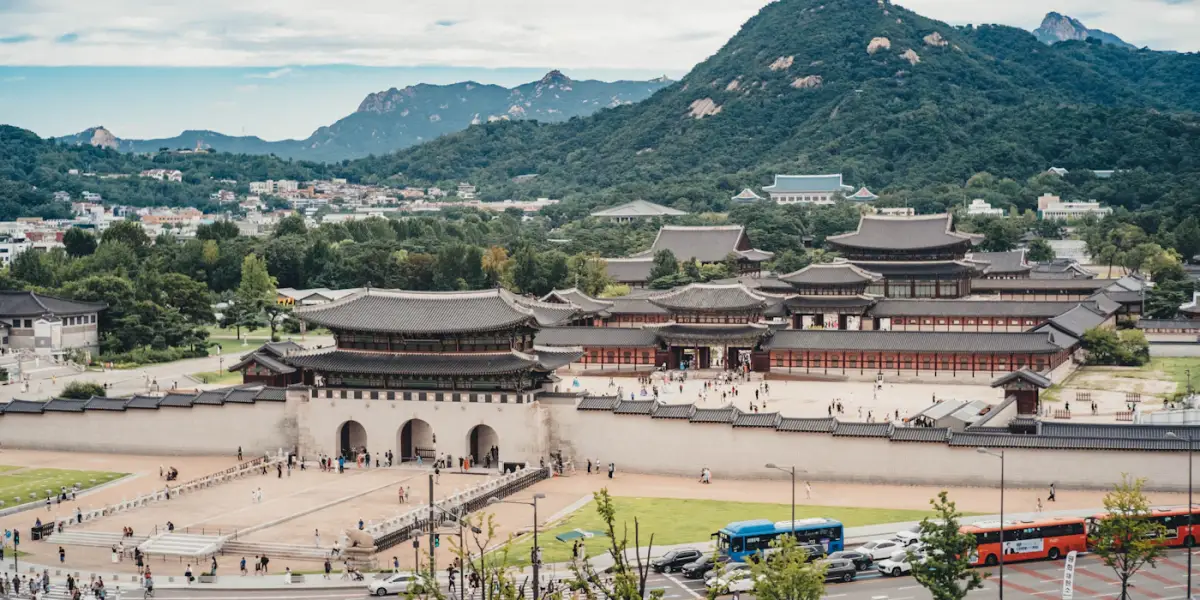
Seoul, home to more than 9 million people, has been Korea's capital since the Joseon dynasty, and its royal palaces now sit among skyscrapers, with mountains all around and the Han River running through the middle. The palaces and the Bukchon hanok lanes are close together in the old Jongno district, Myeongdong is the shopping hub and Hongdae, by Hongik University, is the busking and nightlife quarter; Visit Seoul lists Indian and Nepali restaurants in both. AREX express trains reach Seoul Station from Incheon's Terminal 1 in 43 minutes.
What to do in Seoul
- Gyeongbokgung Palace. Built in 1395 as the main palace of the new Joseon dynasty and the largest of Seoul's five, it was burned in the Imjin War and rebuilt under King Gojong; hanbok rental shops cluster around the palaces if you want to dress the part.
- Changdeokgung and its rear garden. King Taejong's palace of 1405, UNESCO-listed and the Joseon royals' favourite home, has a rear garden, Huwon, that takes up about sixty percent of the grounds, with the Buyongji pond and its pavilion at its heart.
- Bukchon Hanok Village. Hundreds of Joseon-era hanok houses fill the lanes between the two palaces, and people still live in them, so keep your voice down and never photograph through open doors.
- Myeongdong and N Seoul Tower. Browse Myeongdong's Korean cosmetics shops and the food stalls along its main street, then head up Namsan to N Seoul Tower, a 236.7 m tower on the 262 m summit, for a 360-degree view of the city.
- Hongdae after dark. On the pedestrian R2 street near Hongik University Station, registered buskers perform pop, dance, magic and mime, and the area around it is one of Seoul's busiest nightlife districts.
VisitKorea recommends spring (March to May) and autumn (September to November) for getting around on foot; summer brings the rainy season from late June to late July, and in winter the temperature often drops below freezing.
Sources: VisitKorea (Korea Tourism Organization): Gyeongbokgung Palace, VisitKorea: Bukchon Hanok Village, VisitKorea: Climate and seasons, Visit Seoul (official Seoul travel guide): Bukchon Hanok Village, Visit Seoul: Changdeokgung Palace, Visit Seoul: Myeongdong, Visit Seoul: Where to go in Myeongdong, Visit Seoul: Namsan Seoul Tower, Visit Seoul: Hongdae R2 Busking Street, Wikivoyage: Seoul, Wikivoyage: Incheon International Airport, Wikivoyage: South Korea (checked 14 Oct)
The DMZ
HeritageDay tripThe fortified border with North Korea: an infiltration tunnel, lookouts over the North and Imjingak's war memorials.
about 2 h from Seoul airport
The DMZ
HeritageDay tripThe fortified border with North Korea: an infiltration tunnel, lookouts over the North and Imjingak's war memorials.
The Demilitarized Zone is a 4 km-wide buffer strip running 248 km across the peninsula along the line fixed by the Korean War armistice of 27 July 1953. Imjingak, about 7 km short of it, can be reached from Seoul by public transport, but the sites closer to the border lie behind a civilian control line and are visited on organised tours. VisitKorea warns that tours can be cancelled at short notice when tension rises between North and South.
What to do in The DMZ
- Imjingak and the Freedom Bridge. The park keeps the Freedom Bridge and the Imjingang rail bridge from the Korean War, alongside a memorial hall, monuments and the open lawns of Pyeonghwa Nuri Park.
- The 3rd Tunnel. Dug by North Korea and found in 1978, this 1.6 km invasion tunnel is the closest to Seoul of the four found so far, about 52 km away, and tall visitors will find its low passage hard going.
- Dora Observatory. The DMZ lookout nearest to Panmunjeom faces North Korean hills and farmland and the city of Gaeseong, once the capital of the Goryeo kingdom.
- Carry your passport. You need it to enter sites beyond the civilian control line, and there are rules on photos and dress, so follow your guide's instructions.
Sources: VisitKorea: DMZ 101, a tourist's guide to the DMZ, VisitKorea: Imjingak Resort (Pyeonghwa Nuri Park), VisitKorea: The 3rd Tunnel, VisitKorea: Dora Observatory, Wikivoyage: DMZ (Korea) (checked 14 Oct)
Nami Island
IslandDay tripA tree-lined river island near Gapyeong, known from the drama Winter Sonata and at its best in autumn colour.
about 2 h 30 min by train from Seoul airportBest Oct–Nov
Nami Island
IslandDay tripA tree-lined river island near Gapyeong, known from the drama Winter Sonata and at its best in autumn colour.
Nami Island lies in the Bukhan River near Gapyeong, about an hour from Seoul on the ITX-Cheongchun train, and only became a true island when the Cheongpyeong Dam raised the river in 1944. It takes its name from General Nami of the early Joseon period, whose memorial tomb stands on the island, and its fame abroad comes from the 2002 drama Winter Sonata, filmed along its tree-lined paths. From Gapyeong Station it is a five-minute taxi ride or a half-hour walk to the dock, then a short ferry or a zip wire across.
What to do in Nami Island
- Metasequoia Lane. Walk the avenue of tall metasequoias made famous by Winter Sonata, then wander under the ginkgo trees, which turn gold in autumn.
- Gardens and art. Some 27 themed gardens, sculptures and a picture-book lounge are spread across the island, with rabbits, peacocks and curious ostriches wandering about.
- Cycle the island. Rent a single, tandem or electric bike to ride round the island, or pedal the Sky Bike along rails above the ground.
- Garden of Morning Calm and Petite France. Pair the island with the Garden of Morning Calm, a Korean-style arboretum, or Petite France, a French-village-themed drama location, both in Gapyeong county.
VisitKorea names Nami Island among the autumn-foliage spots near Seoul, with colour across the country peaking from mid-October to early November.
Sources: VisitKorea: Take in the vibes of Nami Island with a fall picnic, VisitKorea: Travel to areas near Seoul on public transportation, VisitKorea: 2026 fall foliage forecast, Wikivoyage: Nami Island, Wikivoyage: Incheon International Airport (checked 14 Oct)
Gyeongju
HeritageThe old Silla capital: royal tomb mounds, Bulguksa temple, the Seokguram Buddha and sites lit up at night.
1–2 nightsabout 3 h 30 min by train from Seoul airportBest Mar–Apr
Gyeongju
HeritageThe old Silla capital: royal tomb mounds, Bulguksa temple, the Seokguram Buddha and sites lit up at night.
Gyeongju was the capital of the Silla kingdom, which by the 7th century ruled most of the peninsula, and its royal burial mounds still rise between the low-rise streets of the town. VisitKorea calls it a museum without walls: Bulguksa, Seokguram, the Gyeongju Historic Area and Yangdong Village are all UNESCO World Heritage sites. KTX trains from Seoul take about two hours to Singyeongju station outside town, and buses run into the centre in around 15 minutes.
What to do in Gyeongju
- Bulguksa Temple. Rebuilt in 751 on the slopes of Tohamsan, the temple holds seven national treasures, among them stone stairway-bridges up to the main hall and two contrasting pagodas, the ornate Dabotap and the plain Seokgatap.
- Seokguram Grotto. About 20 minutes by bus above Bulguksa, a 3.4 m granite Buddha sits in a man-made cave roofed with a stone dome, now seen behind glass; photos are not allowed inside.
- Daereungwon and Cheonmachong. Stroll among the Silla royal tombs; one, Cheonmachong, is named after the painting of a heavenly horse on a saddle flap found when it was excavated.
- Cheomseongdae Observatory. Two minutes' walk from the tomb park's main gate, this observatory from the reign of Queen Seondeok is lit up after sunset, and paths lead on to Gyerim Forest.
- Donggung Palace and Wolji Pond. Come after dark, when the pavilions of the Silla crown prince's palace are lit and reflected in the artificial pond.
Gyeongju's cherry blossoms usually open in late March or early April, earlier than Seoul's, with full bloom about a week after opening.
Sources: VisitKorea: Gyeongju Bulguksa Temple [UNESCO World Heritage], VisitKorea (LuxuryKorea): Bulguksa Temple and Seokguram Grotto, VisitKorea: Discover Korea's culture and heritage through Gyeongju, VisitKorea: The ultimate 2-day Gyeongju itinerary, VisitKorea: Donggung Palace and Wolji Pond, VisitKorea: 2026 cherry blossom forecast, Wikivoyage: Gyeongju, Wikivoyage: Incheon International Airport (checked 14 Oct)
Busan
CityKorea's big port city: beaches, a temple on the sea rocks, hillside villages, a seafood market and an India link.
2–3 nightsabout 3 h 30 min by train from Seoul airportBest Jun–Aug
Busan
CityKorea's big port city: beaches, a temple on the sea rocks, hillside villages, a seafood market and an India link.
Busan, South Korea's second-largest city with about 3.6 million people, sits at the southern tip of the peninsula some 450 km south-east of Seoul, two to two and a half hours away by KTX. People from across the country took refuge here during the Korean War, and its hillside villages and markets still carry that history. The beach districts of Haeundae and Gwangalli lie east of the centre, and Haeundae is the easiest base for a first visit.
What to do in Busan
- Haeundae Beach and Dongbaekseom. Walk the broad sandy beach, then follow the coastal trail round Dongbaekseom island for views back over Haeundae's towers and across to the Gwangan Bridge.
- Gamcheon Culture Village. Pastel houses climb a hillside in tiers where refugees settled during the war, and its maze of alleys now holds murals and the much-photographed Little Prince sculpture.
- Jagalchi Market. VisitKorea calls it Korea's largest seafood market: pick live fish and shellfish on the ground floor and have them sliced raw or grilled upstairs.
- Haedong Yonggungsa Temple. This temple on the rocky Gijang coast is reached past statues of the 12 zodiac animals and a stairway of 108 steps through pines; enter the halls by the side doors, as the front doors are for monks.
- Gimhae and Queen Heo. Half an hour by light rail from Sasang Station, Gimhae has the tombs of King Suro and his queen Heo Hwang-ok, who VisitKorea says was a princess from the Indian kingdom of Ayuta; the stones of the pagoda by her tomb are said to come from India.
VisitKorea suggests summer for beach trips, but the rainy season runs from late June to late July and typhoon season from June to October, so check the forecast.
Sources: VisitKorea: Fly to Gimhae International Airport and experience Busan and Gyeongsangnam-do, Visit Busan (official Busan tourism site): Haedong Yonggungsa Temple in Gijang, Visit Busan: Mastering Busan in three days, VisitKorea: Tomb of King Suro, VisitKorea: Tomb of Queen Consort of King Suro, VisitKorea: Climate and seasons, Wikivoyage: Busan, Wikivoyage: Incheon International Airport (checked 14 Oct)
Jeju Island
IslandA volcanic island: a crater rising from the sea, South Korea's highest peak, lava caves and black-rock coasts.
2–3 nightsabout 2 h 30 min by flight from Seoul airportBest Mar–Apr
Jeju Island
IslandA volcanic island: a crater rising from the sea, South Korea's highest peak, lava caves and black-rock coasts.
Jeju, off Korea's south coast, was built by eruptions that began about 1.8 million years ago, and Hallasan, Seongsan Ilchulbong and the Geomunoreum lava tubes are listed together by UNESCO as a World Natural Heritage site. Koreans have long honeymooned here, and most flights to the island come from Seoul's Gimpo airport or from Busan. Buses from the airport reach Jeju City, Seogwipo and the main beaches, but a rental car is easier for the west coast and the interior.
What to do in Jeju Island
- Seongsan Ilchulbong. This tuff cone rose from shallow sea in an eruption about 5,000 years ago; a walk of about 30 minutes reaches a summit crater some 600 m across, and it is one of Jeju's most popular places to watch the sunrise.
- Hallasan. At 1,947 m, South Korea's highest mountain; only the Seongpanak and Gwaneumsa trails climb to the Baengnokdam crater lake at the top, while the Hallasan Eco-trail is an easier forest walk at 600 to 800 m.
- Manjanggul Lava Tube. About 1 km of this 7.4 km tube is open to walk, past a 7.6 m lava column, and it stays near 12°C even in high summer, so bring a layer.
- Udo Island. A 15-minute ferry from Seongsan Port takes you to Jeju's largest offshore island, where an electric bike covers the 17 km coastal loop in two to three hours with a stop at Sanho Beach, whose white sand is made of fragments of rhodoliths, a calcified red alga.
- Haenyeo and the night market. Learn about the haenyeo, Jeju's women free-divers whose culture is on UNESCO's intangible heritage list, at the Jeju Haenyeo Museum, then try Jeju black pork at Dongmun Market's night market.
From late March to early April king cherry blossoms arch over Jeonnong-ro near the airport, and canola flowers and cherry trees line the Noksan-ro road.
Sources: VisitKorea: Fly to Jeju International Airport and enjoy Jeju, VisitKorea: Jeju Island, a picturesque retreat (getting to Jeju), VisitKorea: Natural heritage sites, VisitKorea: 2026 guide to Korea's best spring bloom destinations, VisitKorea: Direct flights between Incheon and Jeju resume, Wikivoyage: Jeju (checked 14 Oct)
Jeonju Hanok Village
HeritageAbout 700 tile-roofed hanok, a royal portrait shrine and the city's famous bibimbap, under two hours from Seoul.
1 nightabout 3 h by train from Seoul airport
Jeonju Hanok Village
HeritageAbout 700 tile-roofed hanok, a royal portrait shrine and the city's famous bibimbap, under two hours from Seoul.
Jeonju, a leading city of the Jeolla region for centuries, was the home of the Joseon royal clan, and its Hanok Village of around 700 traditional houses is, in VisitKorea's words, Korea's largest and only urban traditional hanok village. It grew up in the early 1900s around Gyeonggijeon Shrine and the Omokdae hill, is best seen on foot, and is worth a night in a hanok stay, as its lanes are lit with traditional lanterns after dark. Jeonju was Korea's first UNESCO City of Gastronomy and is famous for its bibimbap.
What to do in Jeonju Hanok Village
- Gyeonggijeon Shrine. Founded in 1410 to hold the portrait of King Taejo, founder of the Joseon dynasty, the shrine has a bamboo grove and old trees, and there are plenty of hanbok rental shops nearby.
- Jeondong Catholic Cathedral. Begun in 1907 and seven years in the building, this Romanesque and Byzantine-style church stands out among the village's tiled roofs.
- Omokdae hilltop. Climb to the spot where King Taejo celebrated his victory over a Japanese army for a view across the village's sea of tiled roofs.
- Bibimbap and bean-sprout soup. Try Jeonju bibimbap, asking for it without beef or egg if you are vegetarian; kongnamulgukbap, a light rice soup with bean sprouts, is a local hangover cure, but like most Korean soups it is usually made with fish stock.
- Makgeolli Alley. In the evening, order a kettle of makgeolli rice wine and it comes with a generous spread of side dishes.
Sources: VisitKorea: Jeonju Hanok Village [Slow City], VisitKorea: Jeonju, a slow city of hanok and serenity, VisitKorea (LuxuryKorea): Jeonju Hanok Village, VisitKorea: Gyeonggijeon Shrine, Wikivoyage: Jeonju, Wikivoyage: South Korea (dietary restrictions) (checked 14 Oct)
Andong and Hahoe Village
HeritageA lived-in Joseon clan village in a river bend, Confucian academies and a famous mask dance drama.
1 nightabout 3 h 30 min by train from Seoul airport
Andong and Hahoe Village
HeritageA lived-in Joseon clan village in a river bend, Confucian academies and a famous mask dance drama.
Andong, in North Gyeongsang, is one of Korea's best-known places for traditional culture, with UNESCO-listed Hahoe Village, the Dosanseowon and Byeongsanseowon Confucian academies and Bongjeongsa temple. Hahoe is a village of Joseon-era tiled and thatched houses inside a wide loop of the Nakdong River, roughly half an hour's drive from Andong Station. The KTX-Eum reaches Andong from Seoul in about 1 hour 50 minutes, and VisitKorea suggests staying the night if you want to see the sights spread around the city.
What to do in Andong and Hahoe Village
- Hahoe Village. Walk lanes of tile-roofed and thatched Joseon-era houses, UNESCO-listed since 2010; people still live in them, so treat it as a neighbourhood, not a museum.
- Buyongdae Cliff. From the top of the cliff across the river, the village below looks like a lotus flower floating on the water.
- Hahoe mask dance. Hahoe Byeolsingut Tallori, a satirical dance drama performed in carved wooden masks, is on UNESCO's intangible heritage list and is staged at the village's mask dance theatre.
- Dosanseowon and Byeongsanseowon. Two Joseon Confucian academies: Dosanseowon is where the scholar Toegye Yi Hwang taught, and Byeongsanseowon sits between the river and Hwasan mountain, a setting Korean geomancy has long considered ideal.
- Andong jjimdak and salted mackerel. Try jjimdak, chicken braised with glass noodles in a soy-based sauce and usually served whole for two or three, or grilled salted mackerel, a tradition that began because the town lies far inland.
Sources: VisitKorea: Andong travel guide, a city of UNESCO World Heritage and traditional culture, Wikivoyage: Andong, Wikivoyage: Incheon International Airport (checked 14 Oct)
Seoraksan and Sokcho
Hill countryGranite peaks, waterfalls and temples above an east-coast fishing port.
1–2 nightsabout 4 h 30 min from Seoul airportBest Oct
Seoraksan and Sokcho
Hill countryGranite peaks, waterfalls and temples above an east-coast fishing port.
Seoraksan National Park covers about half of Sokcho, a fishing port on the east coast, and its ridges branch out from Daecheongbong, the 1,708 m summit that makes Seoraksan the third-highest mountain in South Korea. VisitKorea calls Seoraksan Korea's most famous mountain, and it was made South Korea's fifth national park in 1970. Sokcho, the gateway town, is a 30-minute city bus ride from the park entrance at Seoraksan Small Park, and express buses from Seoul take about 2.5 to 3 hours.
What to do in Seoraksan and Sokcho
- Hike to Ulsanbawi. The 3.8 km trail from Seoraksan Small Park passes Sinheungsa temple and Heundeulbawi, a round boulder that rocks but never rolls when pushed, and takes about two hours each way to the rock formations of Ulsanbawi.
- Biryong Falls. An easier valley walk of 2.4 km, about 50 minutes, leads to the 'flying dragon' falls, a fine sight when frozen in winter.
- Abai Village. Cross the water on the hand-pulled gaetbae ferry to this small village settled by people from the North, known for abai sundae, squid stuffed with rice and vegetables.
- Sokcho Jungang Market. Pick up dak gangjeong, crisp fried chicken bites in a sticky glaze, and other local snacks.
- Sokcho Beach. The town beach fills with a young crowd through the summer.
VisitKorea's foliage forecast has Seoraksan turning first of Korea's big mountains, from early October, with the peak late in the month.
Sources: VisitKorea (LuxuryKorea): Seoraksan National Park, VisitKorea: Seorak Special Tourist Zone, VisitKorea: 2026 fall foliage forecast, Wikivoyage: Seoraksan National Park, Wikivoyage: Sokcho (checked 14 Oct)
A first trip: 7–10 nights
Fly into Incheon and base yourself in Seoul for the palaces and day trips to the DMZ and Nami Island, then take the KTX south to Gyeongju, go on to Busan by bus, and ride the KTX back to Seoul for the flight home. Early April (cherry blossom) and mid-October to early November (autumn colour) are the best-looking windows, while summer is wet, hot and humid and mostly suits Busan's beaches; add Jeju by domestic flight from Busan or Gimpo, or swap in Jeonju, Andong or Seoraksan.
Getting around
AREX trains run from Incheon airport to Gimpo, Seoul's domestic airport, and on to Seoul Station, the KTX hub for Busan; other high-speed trains leave from Yongsan (for Jeonju) or Cheongnyangni (for Andong), and the fastest reach Busan in just over two hours. Jeju is a short domestic flight from Gimpo or Busan, Sokcho and Seoraksan are reached by express bus, and a rechargeable T-money card covers subways and city buses across the country, though not the KTX. Google Maps gives no walking or driving directions in South Korea, so install Naver Map or KakaoMap before you land.
Peak Shoulder Off-season
The Korea Meteorological Administration describes four distinct seasons: clear, dry spring and autumn, a hot and humid summer with the Changma rains reaching the Seoul region around 25 June and lasting about a month, and a cold, dry winter. July and August bring over 240 mm of rain a month, and January highs sit around 1°C.
Flights to South Korea from India
Visa for Indian passports
Indian passport holders need a visa for South Korea before travel. Allow about 21 days for a first-time application. Jeju island only: visa-free on a direct international arrival. Tourist visa via KVAC, about 5–10 working days. No K-ETA or visa on arrival for Indians.
Before you book, check the Ministry of External Affairs travel advisories for the latest guidance.
South Korea: questions
What are the best places to visit in South Korea?
Seoul: Joseon palaces, lived-in hanok lanes, K-beauty shopping, street food, late nights and easy day trips. The DMZ: The fortified border with North Korea: an infiltration tunnel, lookouts over the North and Imjingak's war memorials. Nami Island: A tree-lined river island near Gapyeong, known from the drama Winter Sonata and at its best in autumn colour. Gyeongju: The old Silla capital: royal tomb mounds, Bulguksa temple, the Seokguram Buddha and sites lit up at night. Busan: Korea's big port city: beaches, a temple on the sea rocks, hillside villages, a seafood market and an India link. Jeju Island: A volcanic island: a crater rising from the sea, South Korea's highest peak, lava caves and black-rock coasts. Jeonju Hanok Village: About 700 tile-roofed hanok, a royal portrait shrine and the city's famous bibimbap, under two hours from Seoul. Andong and Hahoe Village: A lived-in Joseon clan village in a river bend, Confucian academies and a famous mask dance drama. Seoraksan and Sokcho: Granite peaks, waterfalls and temples above an east-coast fishing port.
How many days do you need for South Korea?
A first trip takes about 7–10 nights: Seoul (4–5 nights), The DMZ (1 night), Nami Island (1 night), Gyeongju (1–2 nights), Busan (2–3 nights). Fly into Incheon and base yourself in Seoul for the palaces and day trips to the DMZ and Nami Island, then take the KTX south to Gyeongju, go on to Busan by bus, and ride the KTX back to Seoul for the flight home. Early April (cherry blossom) and mid-October to early November (autumn colour) are the best-looking windows, while summer is wet, hot and humid and mostly suits Busan's beaches; add Jeju by domestic flight from Busan or Gimpo, or swap in Jeonju, Andong or Seoraksan.
What is the best time to visit South Korea?
Peak season is Apr–May, Oct–Nov. The Korea Meteorological Administration describes four distinct seasons: clear, dry spring and autumn, a hot and humid summer with the Changma rains reaching the Seoul region around 25 June and lasting about a month, and a cold, dry winter. July and August bring over 240 mm of rain a month, and January highs sit around 1°C.
Do Indians need a visa for South Korea?
Indian passport holders need a visa for South Korea before travel. Allow about 21 days for a first-time application. Jeju island only: visa-free on a direct international arrival. Tourist visa via KVAC, about 5–10 working days. No K-ETA or visa on arrival for Indians.
How much is a flight to South Korea from India?
The lowest return fare FlyBun has seen in the last 14 days is ₹35,428, Mumbai to Seoul, for March 2027 departures. Fares change daily.
Places and things to do are written by FlyBun from official tourism, heritage and park sources, linked under each place, last checked 14 Oct. We leave out entry fees and opening hours because they change; check them before you go.
Watch a route and FlyBun alerts you free when its fare drops.