

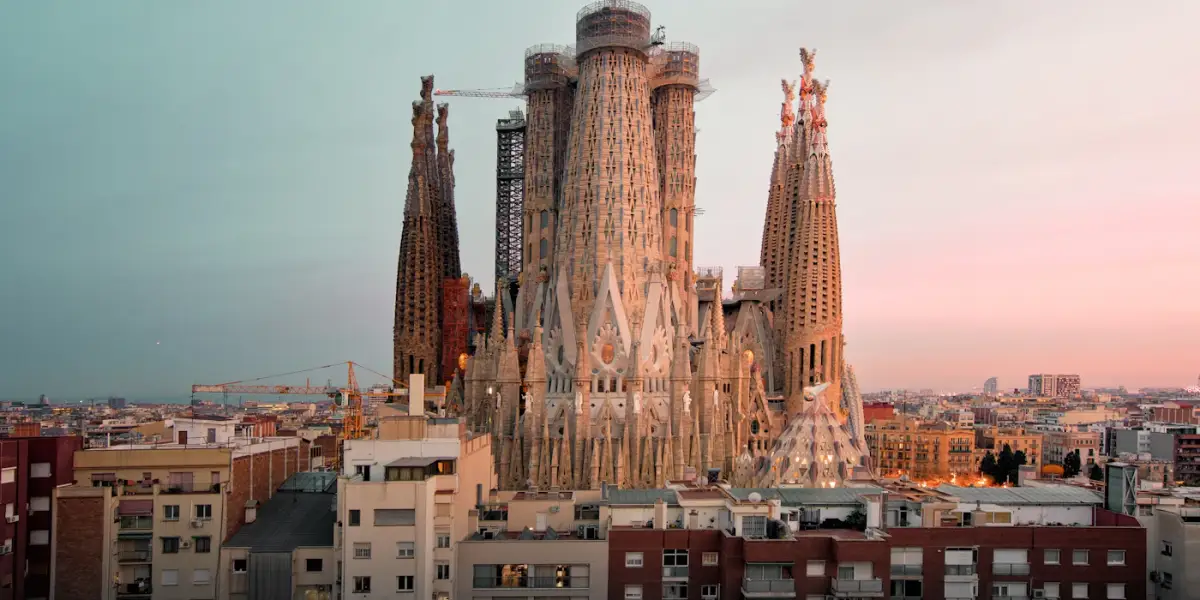
Travel guide from India
Spain
Spain sits at the south-western edge of Europe, a long-haul flight from India, and Barcelona is the gateway we track. A first trip usually links three very different regions by fast train: Barcelona's Gaudí buildings and city beaches, Madrid's royal palace and art museums, and the Moorish palaces and Mosque-Cathedral of Andalusia in the south. For vegetarians, Madrid's tourism board lists vegetarian restaurants across the centre, and Barcelona has plenty of Indian ones.
- Best time
- May–Sep
- First trip
- 10–13 nights
- Visa
- Visa needed, 90 days
- Return flights
- from ₹38,520 ●
- Mumbai, checked in the last 48 h
Places to visit in Spain
10 places in the order you would meet them on a first trip. Tap one for what to do there.
Barcelona
CityGaudí's Sagrada Família and Park Güell, the Gothic Quarter's lanes, tapas and a city beach.
3–4 nights35 min from Barcelona airportBest May–Jun, Sep–Oct
Barcelona
CityGaudí's Sagrada Família and Park Güell, the Gothic Quarter's lanes, tapas and a city beach.
Barcelona, the capital of Catalonia and a big Mediterranean port, is best known for the Modernisme of Antoni Gaudí, seven of whose works are on UNESCO's World Heritage list. Its old town grew out of Roman and medieval Barcelona around the cathedral, the wide avenues around Passeig de Gràcia hold Gaudí's Casa Batlló and La Pedrera, and city beaches line the seafront. It is also the base for day trips to Montserrat and the Costa Brava.
What to do in Barcelona
- Sagrada Família. Gaudí's still-unfinished basilica, begun in 1882, has stone columns that branch like trees inside, and its 172.5 m central Tower of Jesus Christ has made it the world's tallest church; Gaudí is buried here, and visitors are asked not to wear shorts, swimwear or see-through clothes.
- Park Güell. Planned as a garden suburb on a hillside, it became a public park after only two houses were built; climb past the mosaic dragon on the main stairs to the terrace, where a winding tiled bench looks out over the city to the sea.
- Casa Batlló and La Pedrera. Two Gaudí apartment buildings a short walk apart on Passeig de Gràcia: Casa Batlló, with a blue-tiled courtyard and a roof often likened to a dragon's back, and Casa Milà (La Pedrera), built between 1906 and 1912, whose rooftop is crowded with sculpted chimneys.
- Gothic Quarter and La Rambla. Wander the narrow lanes of the Roman and medieval core to the cathedral, built from the 13th to the 15th century, with 13 geese in its cloister, then walk La Rambla to the Boqueria market; pickpocketing is the main risk for visitors, so keep wallets and phones out of trouser pockets.
- Montjuïc and Barceloneta. Take the funicular and cable car up Montjuïc for harbour views, the Catalan national art museum (MNAC) and the Joan Miró Foundation, then come down to Barceloneta, the city beach remade for the 1992 Olympics.
May–June and late August to October are the most comfortable; August is the busiest month, when many locals leave town, and November to April is chilly and at times grey.
Sources: Spain.info (Turespaña): Barcelona, Spain.info (Turespaña): Barcelona in two days, Spain.info (Turespaña): Basilica of La Sagrada Família, Spain.info (Turespaña): Park Güell, Spain.info (Turespaña): Casa Milà "La Pedrera", Barcelona Turisme (This is Barcelona): Basílica de la Sagrada Família, Barcelona Turisme (This is Barcelona): Park Güell, Barcelona Turisme (This is Barcelona): Casa Batlló, Barcelona Turisme (This is Barcelona): Catedral de la Santa Creu i Santa Eulàlia, Barcelona Turisme (This is Barcelona): Gaudí in 24 h, Barcelona Turisme (This is Barcelona): Mercat de la Boqueria, Barcelona Turisme (This is Barcelona): Platja de la Barceloneta, Barcelona Turisme (This is Barcelona): Getting to Barcelona, Wikivoyage: Barcelona (checked 14 Oct)
Montserrat
HeritageDay tripA Benedictine monastery and Catalonia's Black Virgin high on a saw-toothed mountain, a day trip by train.
about 2 h 30 min by train from Barcelona airport
Montserrat
HeritageDay tripA Benedictine monastery and Catalonia's Black Virgin high on a saw-toothed mountain, a day trip by train.
Montserrat is a massif of jagged grey rock pinnacles in the heart of Catalonia; its name refers to its 'serrated' outline. High on the mountain stands a Benedictine monastery founded in 1025, home to La Moreneta, a 12th-century Romanesque statue of the Virgin who is Catalonia's patron saint. The R5 train from Barcelona's Plaça d'Espanya takes about an hour to the foot of the mountain, where a rack railway or a cable car takes over.
What to do in Montserrat
- Ride up by rack railway or cable car. The rack railway climbs more than 600 m over 5 km from Monistrol in about 15 minutes, while the cable car, running since 1930, makes the steep ascent from its own R5 station in about five.
- See La Moreneta in the basilica. Pilgrims travel from all over to pray before the Black Madonna, kept in the basilica that was first built in the 16th century and rebuilt in the 19th.
- Hear the Escolania. The monastery's boys' choir is one of the oldest in Europe, and around 80 Benedictine monks still live in the community.
- Montserrat Museum. More than 1,300 pieces are on show, from paintings by El Greco and Caravaggio to Monet, Picasso and Dalí, along with a collection of Byzantine and Slavic icons.
- Funiculars and mountain trails. The Sant Joan funicular rises to a natural viewpoint where trails lead on to a hermitage and the Sant Jeroni summit, and the Santa Cova funicular drops towards the chapel where the image of the Virgin is said to have been found.
Sources: Spain.info (Turespaña): Montserrat, Spain.info (Turespaña): Montserrat Monastery, Barcelona Turisme (This is Barcelona): Monestir de Montserrat, Barcelona Turisme (This is Barcelona): Muntanya de Montserrat, Montserrat Visita (official): Cremallera rack railway, Montserrat Visita (official): Cable car, Montserrat Visita (official): Montserrat Museum, Wikivoyage: Montserrat (Spain) (checked 14 Oct)
Madrid
CityThe capital's great art museums, a royal palace of over 3,000 rooms, Retiro Park and long tapas evenings.
2–3 nightsabout 3 h 30 min by train from Barcelona airportBest Apr–Jun, Sep–Oct
Madrid
CityThe capital's great art museums, a royal palace of over 3,000 rooms, Retiro Park and long tapas evenings.
Madrid sits in the middle of the country at the hub of Spain's rail network, about two and a half hours from Barcelona by AVE. Its centre lines up the Prado, Reina Sofía and Thyssen-Bornemisza museums along one art walk, and the Paseo del Prado was added to the UNESCO list together with Retiro Park in 2021. Evenings run late, with old taverns, tapas bars and nightlife that keeps going until morning.
What to do in Madrid
- Prado Museum. One of the world's great art galleries, with Velázquez's Las Meninas, Goya's Third of May 1808 and Bosch's Garden of Earthly Delights among some 8,600 paintings in its collection, so choose your rooms before you go in.
- Royal Palace. Built for Philip V in the 18th century where the old Moorish fortress stood, it has more than 3,000 rooms, a throne room ceiling painted by Tiepolo and Stradivarius instruments in the Royal Chapel; the Sabatini Gardens beside it are a sunset spot.
- Retiro Park. Stroll round the great pond and its monument to Alfonso XII, see the Crystal Palace and, in May and June, the rose garden's 4,000-plus bushes in bloom.
- Plaza Mayor and La Latina. Start in the 400-year-old Plaza Mayor, then move on to La Latina, the neighbourhood for hopping between tapas bars; the city's tourism board also lists vegetarian restaurants around the centre.
- Guernica at the Reina Sofía. Picasso's Guernica hangs in this museum of modern and contemporary art on the same art walk as the Prado.
April to June and September–October are the best months; summer is hot and dry, and winter is cold with frosty nights.
Sources: Spain.info (Turespaña): Madrid, Spain.info (Turespaña): Getting around Spain, Spain.info (Turespaña): Royal Palace of Madrid, Spain.info (Turespaña): Buen Retiro Park, esMADRID (Madrid tourism): Museo del Prado, esMADRID (Madrid tourism): Royal Palace, esMADRID (Madrid tourism): Paseo del Prado, esMADRID (Madrid tourism): Madrid through the seasons, esMADRID (Madrid tourism): Madrid top 10, esMADRID (Madrid tourism): Vegetarian restaurants, Wikivoyage: Madrid, Wikivoyage: Spain (checked 14 Oct)
Toledo
HeritageDay tripThe 'city of three cultures' above the Tagus: a Gothic cathedral, synagogues, an ancient mosque and El Greco.
about 4 h by train from Barcelona airport
Toledo
HeritageDay tripThe 'city of three cultures' above the Tagus: a Gothic cathedral, synagogues, an ancient mosque and El Greco.
Toledo stands on a hill above the River Tagus, less than 80 km from Madrid and about half an hour from Atocha station by AVE. Christians, Muslims and Jews lived side by side here for centuries, and the UNESCO-listed old town fits a cathedral, a mosque and two synagogues within a few streets. It was the seat of the royal court until the court moved to Madrid in the mid-1500s, and many visitors come for the day.
What to do in Toledo
- Toledo Cathedral. Begun in 1226 on the site of a mosque, the Gothic cathedral is 120 m long, with stained glass from the 14th to 16th centuries and works by El Greco in the sacristy.
- Mosque of Cristo de la Luz. Built more than a thousand years ago, this small mosque is the oldest monument in Toledo and a landmark of early Islamic building in Spain.
- The old Jewish quarter. Two synagogues survive in its cobbled lanes: Santa María la Blanca, the city's oldest, and El Tránsito, which now holds the Sephardic Museum.
- El Greco's Toledo. The painter made his home here; see his Burial of the Count of Orgaz in the Church of Santo Tomé and more of his work at the El Greco Museum.
- Views from across the river. The Mirador del Valle viewpoint across the Tagus gives the classic view of the whole city, and the Alcántara and San Martín bridges are good places to watch the sun go down.
Sources: Spain.info (Turespaña): Toledo, Spain.info (Turespaña): Toledo Cathedral, esMADRID (Madrid tourism): Day trips from Madrid, Wikivoyage: Toledo (checked 14 Oct)
Córdoba
HeritageThe Mosque-Cathedral's forest of arches, flower-filled courtyards and the ruined palace-city of a caliph.
1 nightabout 5 h 30 min by train from Barcelona airportBest Apr–May
Córdoba
HeritageThe Mosque-Cathedral's forest of arches, flower-filled courtyards and the ruined palace-city of a caliph.
Córdoba was the capital of a Roman province and later of the Caliphate of al-Andalus, and its Mosque-Cathedral still anchors a World Heritage old town of narrow streets, flower-filled courtyards and the old Jewish quarter. On the high-speed line it is under two hours from Madrid and about 40 minutes from Seville, so it works as a one-night stop on the way south or as a day trip.
What to do in Córdoba
- The Mosque-Cathedral. Begun in 785 by the emir Abd al-Rahman I and enlarged over the next two centuries, it is a maze of columns carrying double rows of horseshoe arches, with a mihrab covered in Byzantine mosaic and a cathedral built inside it in the 16th century.
- Jewish quarter and Calleja de las Flores. Wander the lanes north and west of the Mosque-Cathedral, past the old synagogue, to the flower-hung alley of Calleja de las Flores.
- Roman Bridge and Calahorra Tower. Cross the Roman bridge over the Guadalquivir to the Calahorra Tower, a former fortified gate that now holds a museum of life in al-Andalus.
- Medina Azahara. The terraced ruins of the palace-city of the caliph Abd al-Rahman III lie about 10 km from town, on the World Heritage list since 2018, with buses from the city and an underground visitor centre.
- Salmorejo and tapas. Try salmorejo (a thick cold tomato soup), aubergines with honey and mazamorra, a cold almond soup, in the tapas bars of the old quarter and the San Lorenzo and Santa Marina districts.
Spring is when Córdoba is at its best, May above all, when the courtyards festival, the May Crosses and the city fair fill the streets with flowers and flamenco.
Sources: Spain.info (Turespaña): Córdoba, Spain.info (Turespaña): Great Mosque of Córdoba, Spain.info (Turespaña): Medina Azahara, Wikivoyage: Córdoba (city, Spain) (checked 14 Oct)
Seville
CityAndalusia's capital: the Real Alcázar, the cathedral and Giralda, Plaza de España and flamenco in Triana.
2–3 nightsabout 2 h 30 min by flight from Barcelona airportBest Mar–May, Oct–Nov
Seville
CityAndalusia's capital: the Real Alcázar, the cathedral and Giralda, Plaza de España and flamenco in Triana.
Seville, the capital of Andalusia, spreads along the Guadalquivir, and its large old town is easy to explore on foot. Three World Heritage sites stand side by side around Plaza del Triunfo: the cathedral with its Giralda tower, the Real Alcázar and the General Archive of the Indies. The city is famous for its Holy Week, its April Fair and flamenco, and in summer the heat is fierce enough that visitors often spend the early afternoon indoors.
What to do in Seville
- Real Alcázar. A walled group of royal palaces that Peter the Cruel rebuilt in the 14th century on an older Almohad palace, mostly Mudéjar and Renaissance in style, with courtyards and gardens that stay cool in summer.
- Cathedral and the Giralda. Walk up the ramps inside the Giralda, the old minaret of the city's mosque, topped with a bell tower in the 16th century, for views over the city and the Court of the Orange Trees; Columbus is buried in the cathedral below.
- Plaza de España and María Luisa Park. Built for the 1929 Ibero-American Exposition, the huge semicircular square has a tiled bench for each Spanish province and a canal you can take a boat along, and has appeared in films from Lawrence of Arabia to Star Wars.
- Santa Cruz quarter. The old quarter's tangle of lanes beside the Alcázar smells of orange blossom; look for the narrow, flower-lined Callejón del Agua.
- Triana, tapas and flamenco. Across the river, Calle Betis and Triana's ceramics workshops lead into an evening of tapas and live flamenco; vegetarians should say they eat no fish or tuna either, as 'vegetarian' is often taken to mean only no meat.
Spring is widely recommended for a visit; from June to September days usually top 30°C and southern nights can stay above 20°C, while autumn still brings plenty of sun from Madrid southwards.
Sources: Spain.info (Turespaña): Seville, Spain.info (Turespaña): Two-day tours of Seville, Spain.info (Turespaña): Real Alcázar Palace of Seville, Spain.info (Turespaña): La Giralda tower, Spain.info (Turespaña): Plaza de España, Spain.info (Turespaña): Santa Cruz quarter, Spain.info (Turespaña): The weather in Spain, Spain.info (Turespaña): Getting around Spain, Visita Sevilla (Seville tourism): Plaza de España, Visita Sevilla (Seville tourism): Prepare your trip, Wikivoyage: Seville (checked 14 Oct)
Granada
HeritageThe Alhambra's Nasrid palaces and gardens, sunsets from the Albaicín and flamenco in Sacromonte's caves.
2 nightsabout 2 h 30 min by flight from Barcelona airportBest Apr–May, Sep–Oct
Granada
HeritageThe Alhambra's Nasrid palaces and gardens, sunsets from the Albaicín and flamenco in Sacromonte's caves.
Granada lies at the foot of the Sierra Nevada, and in 1492 it was the last city the Catholic Monarchs took from Muslim rule, after some 250 years as capital of the Nasrid kingdom. The Alhambra and Generalife on one hill and the old Moorish quarter of the Albaicín on the next are UNESCO World Heritage sites. Its dry climate makes summer less punishing than in Seville or Córdoba, and the mountains above have skiing in winter.
What to do in Granada
- The Alhambra. The hilltop palace-city of the Nasrid sultans is the only one from the Islamic period to survive, thanks to continuous use; the Comares and Lions palaces remain, beside the Alcazaba fortress, its oldest part, and the 16th-century Palace of Charles V.
- Generalife gardens. The sultans' country estate and orchard on the slope above the palaces, watered by channels cut from the River Darro; the long pool of the Acequia courtyard is the classic photograph.
- Sunset from the Albaicín. Climb the steep lanes of the old Moorish quarter to the San Nicolás or San Cristóbal viewpoint to watch the sun set on the Alhambra with the Sierra Nevada behind.
- Go from bar to bar for tapas. In Granada a small tapa usually comes with each drink, so locals move from bar to bar; the squares around the cathedral and Plaza Nueva are full of them.
- Flamenco in Sacromonte. In this Roma district of cave houses, flamenco is performed inside the caves, and the zambra acts out a Roma wedding in a circle, close to the audience.
Spring and autumn are both excellent; summer is hot but dry, and from about November to April it is cold enough to need a warm jacket.
Sources: Spain.info (Turespaña): Granada, Spain.info (Turespaña): Granada in two days, Spain.info (Turespaña): The Alhambra, Spain.info (Turespaña): The Generalife, Patronato de la Alhambra y Generalife (official): Discover, Andalucia.org (Andalusia tourism): Granada, Wikivoyage: Granada (checked 14 Oct)
Valencia
CityPaella's home city: a Gothic old town, the futuristic City of Arts and Sciences, a riverbed park and long beaches.
2 nightsabout 4 h by train from Barcelona airport
Valencia
CityPaella's home city: a Gothic old town, the futuristic City of Arts and Sciences, a riverbed park and long beaches.
Valencia, Spain's third-largest city, sits on the Mediterranean about three and a quarter hours down the coast from Barcelona by train. Founded as a Roman colony and later a thriving Moorish city, it pairs a compact old town with Santiago Calatrava's City of Arts and Sciences, linked by a 9 km park laid out in the old bed of the River Turia. Paella was born in the rice fields of the Albufera, about 10 km away, and vegetarians can ask for paella de verduras.
What to do in Valencia
- The old town. Climb the 207 steps of the Miguelete, the cathedral's bell tower, visit the Silk Exchange, a Gothic trading hall on the UNESCO list since 1996, and walk through the Modernist Central Market, which both tourism boards call Europe's largest fresh-produce market.
- City of Arts and Sciences. Calatrava's buildings stretch for almost 2 km along the old riverbed, with a science museum, an IMAX cinema and the Oceanogràfic, Europe's largest aquarium, where the city suggests allowing at least three hours.
- Cycle the Turia Garden. The former riverbed is now a 9 km park crossed by 18 bridges, easy to ride or walk from the old town to the City of Arts and Sciences.
- Paella at the Albufera. Take a traditional boat across the Albufera lagoon at sunset and eat paella in El Palmar; Valencians treat it as a lunchtime dish, usually cooked to order for two or more.
- City beaches. Cabanyal, Malvarrosa and Patacona form more than 3 km of sand with a promenade of rice and seafood restaurants, reached from the centre by bus, metro or bike.
Sources: Spain.info (Turespaña): Valencia, Spain.info (Turespaña): City of Arts and Sciences, Spain.info (Turespaña): Getting around Spain, Visit Valencia (official): Must-sees, Visit Valencia (official): Historical centre, Visit Valencia (official): City of Arts and Sciences, Visit Valencia (official): Turia Garden, Visit Valencia (official): L'Albufera Natural Park, Visit Valencia (official): Paella, Visit Valencia (official): City beaches, Wikivoyage: Valencia (checked 14 Oct)
Málaga
CityPicasso's birthplace: a Moorish fortress, a Roman theatre, city beaches and grilled sardines on the Costa del Sol.
2 nightsabout 2 h by flight from Barcelona airportBest Apr–Jun, Sep–Oct
Málaga
CityPicasso's birthplace: a Moorish fortress, a Roman theatre, city beaches and grilled sardines on the Costa del Sol.
Málaga, the biggest city on the Costa del Sol, is also the region's transport hub, with its airport 8 km from the centre and AVE trains to Madrid in under three hours. Behind the port and beaches lies an old town with a Roman theatre, the hilltop Alcazaba and Gibralfaro castle, and the house where Pablo Picasso was born. Granada is about 130 km away, which makes Málaga an easy place to end an Andalusian trip.
What to do in Málaga
- Alcazaba and Gibralfaro. Walk up through the palace-fortress that King Badis of Granada built in the 11th century, then on to Gibralfaro castle for views over the whole city.
- Roman Theatre. The remains of the Roman theatre sit at the foot of the Alcazaba, a reminder of how important the city was in Roman times.
- Picasso's Málaga. See his work at the Picasso Museum in the old town and the house on Plaza de la Merced where he was born.
- The cathedral, 'La Manquita'. The cathedral's nickname comes from its right-hand tower, which was never finished; you can also go up on to its roof.
- La Malagueta and Pedregalejo. Spend an afternoon on La Malagueta, the city beach, walk the Muelle Uno harbour promenade to La Farola lighthouse, and eat charcoal-grilled sardine skewers in the seaside district of Pedregalejo.
April–May and September–October are mild and ideal for sightseeing, with June and September suggested for fewer crowds; summer can pass 30°C, and winter feels colder in the wind.
Sources: Spain.info (Turespaña): Málaga, Spain.info (Turespaña): Alcazaba fortress in Málaga, Spain.info (Turespaña): Getting around Spain, Andalucia.org (Andalusia tourism): Málaga, Wikivoyage: Málaga (checked 14 Oct)
Costa Brava
BeachCoves and cliff paths from Blanes to the French border, walled Tossa de Mar, Cadaqués and Dalí's museums.
2–3 nightsabout 1 h 30 min from Barcelona airportBest Jun–Sep
Costa Brava
BeachCoves and cliff paths from Blanes to the French border, walled Tossa de Mar, Cadaqués and Dalí's museums.
The Costa Brava, the 'rugged coast', runs for about 200 km from Blanes north to Portbou near the French border, mixing sandy bays, pebbly coves under cliffs and fishing towns like Cadaqués and Calella de Palafrugell. Inland are medieval villages, the Greek and Roman ruins of Empúries and the city of Girona, under an hour from Barcelona by AVE. Barcelona's own beaches are busy city beaches, and Wikivoyage points travellers who want a proper beach break north to this coast.
What to do in Costa Brava
- Tossa de Mar. Its walled medieval quarter on the hill above the bay is, according to Wikivoyage, the last fortified town of its kind left anywhere on Catalonia's coast.
- Walk the coastal path. The GR 92 trail runs along the clifftops from Lloret de Mar to Portbou, dropping down to coves and fishing villages on the way.
- The Dalí Triangle. Dalí was born in Figueres in 1904; see his Theatre-Museum there, his house at Portlligat near Cadaqués and the castle at Púbol he gave his wife Gala, ideally over two days.
- Girona's old town. The provincial capital has a cathedral, old walls, a Jewish quarter and medieval streets that have been used as a Game of Thrones setting.
- Dive or snorkel at the Medes Islands. L'Estartit is the jumping-off point for the protected Medes Islands, known around the world for scuba diving.
June to September is Spain's hot, dry summer and the time for swimming and the beach; spring and autumn are milder.
Sources: Spain.info (Turespaña): Costa Brava, Spain.info (Turespaña): The weather in Spain, Costa Brava Girona tourism board: Costa Brava, Costa Brava Girona tourism board: How to get here, Costa Brava Girona tourism board: Beaches and coves, Costa Brava Girona tourism board: The Dalí Triangle, Wikivoyage: Costa Brava, Wikivoyage: Tossa de Mar, Wikivoyage: Girona, Wikivoyage: Barcelona (checked 14 Oct)
A first trip: 10–13 nights
Fly into Barcelona (with a day at Montserrat), take the AVE to Madrid for a day trip to Toledo, continue south by train through Córdoba to Seville and Granada, then fly back to Barcelona from Granada or nearby Málaga. Spring is the season most often recommended for Spain; from June to September days usually pass 30°C and nights in the south can stay above 20°C, so in high summer keep Córdoba and Seville short and give the spare nights to the beaches of the Costa Brava or Valencia.
Getting around
High-speed AVE trains carry most first trips: Barcelona to Madrid takes about two and a half hours, and from Madrid the fast lines continue to Córdoba, Seville, Málaga and Valencia. Domestic flights take under two hours and save a long day on cross-country hops such as Seville or Granada back to Barcelona; because most rail lines fan out from Madrid, some journeys between regional cities are quicker by bus. Inside the cities, the metro, buses and your own feet cover the main sights.
Peak Shoulder Off-season
No official Barcelona page on tourist seasons could be opened, so these ratings follow the NASA POWER climate normals: highs of 23 to 30°C from May to September with little rain in June and July, cooler and showery shoulder months in spring and autumn, and winter highs of 13 to 14°C. Summer is also peak crowd season.
Flights to Spain from India
Visa for Indian passports
Indian passport holders need a visa for Spain before travel. Allow about 40 days for a first-time application. Schengen visa via BLS International; about 15 days after the biometrics appointment.
Before you book, check the Ministry of External Affairs travel advisories for the latest guidance.
Spain: questions
What are the best places to visit in Spain?
Barcelona: Gaudí's Sagrada Família and Park Güell, the Gothic Quarter's lanes, tapas and a city beach. Montserrat: A Benedictine monastery and Catalonia's Black Virgin high on a saw-toothed mountain, a day trip by train. Madrid: The capital's great art museums, a royal palace of over 3,000 rooms, Retiro Park and long tapas evenings. Toledo: The 'city of three cultures' above the Tagus: a Gothic cathedral, synagogues, an ancient mosque and El Greco. Córdoba: The Mosque-Cathedral's forest of arches, flower-filled courtyards and the ruined palace-city of a caliph. Seville: Andalusia's capital: the Real Alcázar, the cathedral and Giralda, Plaza de España and flamenco in Triana. Granada: The Alhambra's Nasrid palaces and gardens, sunsets from the Albaicín and flamenco in Sacromonte's caves. Valencia: Paella's home city: a Gothic old town, the futuristic City of Arts and Sciences, a riverbed park and long beaches. Málaga: Picasso's birthplace: a Moorish fortress, a Roman theatre, city beaches and grilled sardines on the Costa del Sol. Costa Brava: Coves and cliff paths from Blanes to the French border, walled Tossa de Mar, Cadaqués and Dalí's museums.
How many days do you need for Spain?
A first trip takes about 10–13 nights: Barcelona (3–4 nights), Montserrat (1 night), Madrid (2–3 nights), Toledo (1 night), Córdoba (1 night), Seville (2–3 nights), Granada (2 nights). Fly into Barcelona (with a day at Montserrat), take the AVE to Madrid for a day trip to Toledo, continue south by train through Córdoba to Seville and Granada, then fly back to Barcelona from Granada or nearby Málaga. Spring is the season most often recommended for Spain; from June to September days usually pass 30°C and nights in the south can stay above 20°C, so in high summer keep Córdoba and Seville short and give the spare nights to the beaches of the Costa Brava or Valencia.
What is the best time to visit Spain?
Peak season is May–Sep. No official Barcelona page on tourist seasons could be opened, so these ratings follow the NASA POWER climate normals: highs of 23 to 30°C from May to September with little rain in June and July, cooler and showery shoulder months in spring and autumn, and winter highs of 13 to 14°C. Summer is also peak crowd season.
Do Indians need a visa for Spain?
Indian passport holders need a visa for Spain before travel. Allow about 40 days for a first-time application. Schengen visa via BLS International; about 15 days after the biometrics appointment.
How much is a flight to Spain from India?
The lowest return fare FlyBun has seen in the last 14 days is ₹38,520, Mumbai to Barcelona, for February 2027 departures. Fares change daily.
Places and things to do are written by FlyBun from official tourism, heritage and park sources, linked under each place, last checked 14 Oct. We leave out entry fees and opening hours because they change; check them before you go.
Watch a route and FlyBun alerts you free when its fare drops.