

Travel guide from India
Sri Lanka
Sri Lanka lies just south of India, and Colombo is a short flight from several Indian cities, so a week to ten days goes a long way. The island is small but fits in ancient capitals and cave temples on the dry central plains, cool tea country in the hills, and beaches on two coasts whose good seasons fall in different months. Indian visitors will also find Hindu temples and places tied to Ramayana legends alongside the island's Buddhist sites.
- Best time
- Dec–Feb
- First trip
- 10–12 nights
- Visa
- Visa-free, 30 days
- Return flights
- from ₹21,045 ●
- Chennai, checked in the last 48 h
Places to visit in Sri Lanka
10 places in the order you would meet them on a first trip. Tap one for what to do there.
Colombo
CityThe landing city: a colonial Fort district, a seafront promenade, markets and a wide choice of food.
1 nightabout 1 h from Colombo airportBest Dec–Mar
Colombo
CityThe landing city: a colonial Fort district, a seafront promenade, markets and a wide choice of food.
Colombo is Sri Lanka's commercial capital, a port city on the west coast where Dutch- and British-era buildings in the Fort district stand next to new towers and packed market streets. The airport is at Katunayake, about 35 km north of the city, so many travellers head straight out on arrival and keep a Colombo night for the end of the trip.
What to do in Colombo
- Sunset at Galle Face Green. The seafront lawn at the start of Galle Road is where the city comes out in the evening, and the place locals go for kottu and vadai by the sea.
- Pettah markets. The crowded streets and the floating market beside Fort railway station sell everything from clothes and bags to fruit and electronics.
- Gangaramaya temple and Beira Lake. The temple is known for its brass work, carvings and a small museum, and the Seema Malakaya shrine sits on the lake just across the road.
- National Museum. The country's main museum, with ancient paintings, sculpture and sketches covering more than two thousand years.
- Old Dutch Hospital. A 17th-century Dutch colonial building in the Fort district, now restored and filled with restaurants and shops.
December to March, during the north-east monsoon, is the driest stretch on the west coast; July and August bring a shorter dry spell.
Sources: Sri Lanka Tourism: 12 things to do in Colombo, Sri Lanka Tourism: Galle Face Green, Sri Lanka Tourism: Pettah Floating Market, Sri Lanka Tourism: Beira Lake, Sri Lanka Tourism: Dutch Hospital, Wikivoyage: Colombo, Wikivoyage: Sri Lanka (checked 14 Oct)
Sigiriya and Dambulla
HeritageA 5th-century palace on top of a 200 m rock, a painted cave temple, and elephant safaris close by.
2 nightsabout 4 h from Colombo airportBest Mar–Sep
Sigiriya and Dambulla
HeritageA 5th-century palace on top of a 200 m rock, a painted cave temple, and elephant safaris close by.
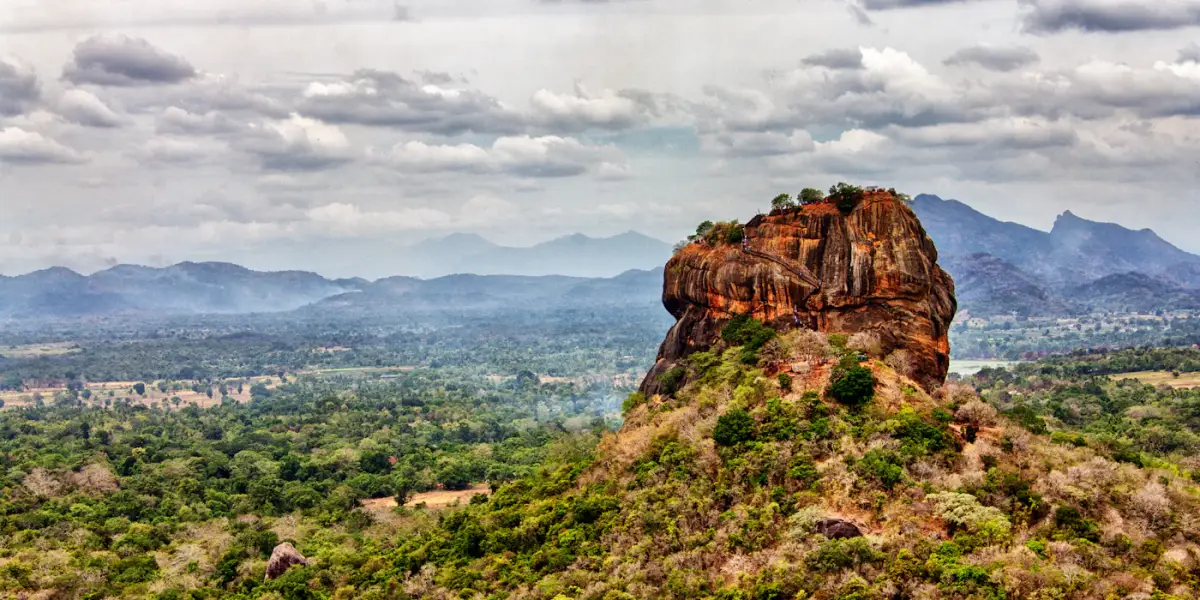
Sigiriya is a 200-metre rock rising out of the dry central plains, with the ruins of King Kashyapa's 5th-century palace on its flat top and terraced water gardens around its base. Dambulla, a short drive away, has the country's best-known cave temple, and together they make the usual base for the cultural triangle, including a day at Polonnaruwa.
What to do in Sigiriya and Dambulla
- Climb Sigiriya rock. Halfway up, the frescoes of painted women are often compared to Ajanta's; start early to beat the heat and carry water, since none is sold inside the site.
- Dambulla cave temple. Five caves at the foot of a 150 m rock, in use since the 1st century BCE, with painted ceilings and rows of Buddha statues; the stone steps up are best climbed in the morning or evening.
- Sunrise from Pidurangala. The neighbouring rock is almost as high and much quieter; the 20 to 30 minute climb passes a working temple, so dress modestly, and ends in a scramble over boulders.
- Elephant safari at Minneriya. In the dry months herds come down to graze on the banks of the ancient Minneriya reservoir, and hotels around Sigiriya book jeep trips here or to neighbouring Kaudulla.
- Day trip to Polonnaruwa. The island's 11th to 13th-century capital has its temple and palace ruins in one compact area you can cover in a day, and its ancient irrigation works still water the farms around it.
Sri Lanka Tourism rates March and April as ideal for the cultural triangle, and the dry zone stays mostly dry through May to September while the monsoon hits the south-west.
Sources: Sri Lanka Tourism: Sigiriya, Sri Lanka Tourism: Marvels of Sri Lanka, Sri Lanka Tourism: Dambulla Cave Temple, Sri Lanka Tourism: Minneriya National Park, Sri Lanka Tourism: Heritage, Sri Lanka Tourism: Sri Lanka weather, Wikivoyage: Sigiriya, Wikivoyage: Dambulla, Wikivoyage: Polonnaruwa (checked 14 Oct)
Kandy
HeritageThe last royal capital: the Temple of the Tooth, a lake in the middle of town and the Peradeniya gardens.
1–2 nightsabout 3 h from Colombo airportBest Jan–Mar
Kandy
HeritageThe last royal capital: the Temple of the Tooth, a lake in the middle of town and the Peradeniya gardens.
Kandy was the seat of the island's last Sinhalese kingdom and is home to the Temple of the Sacred Tooth Relic, a UNESCO-listed shrine beside the town lake and the old royal palace. It sits in the hills about 125 km from Colombo, so it is cooler than the coast, and it is the usual gateway to the tea country.
What to do in Kandy
- Temple of the Sacred Tooth Relic. Time your visit for one of the daily ritual services; shorts, sleeveless tops and revealing clothes are not allowed, and footwear is handed in at the entrance.
- Royal Botanical Gardens, Peradeniya. About 60 hectares just outside Kandy with an avenue of royal palms, a giant Javan fig and around 4,000 plant species; a local bus from Kandy takes about half an hour.
- Kandy Lake and Arthur's Seat. Walk the lake below the temple, then go up to the Arthur's Seat viewpoint for a view over the town and the water.
- Udawattakele forest. The old royal forest next to the temple and palace has quiet trails, ponds and plenty of monkeys; wear long trousers after rain because of leeches.
- Ceylon Tea Museum. A converted tea factory on the Hantana estate, about 5 km out of town, run by the Sri Lanka Tea Board and ending with a cup of tea.
The hill country is at its sunniest from January to March; the south-west monsoon soaks the hills from about April to July, and October to November is unsettled across the island.
Sources: Sri Dalada Maligawa (official site): history, Sri Dalada Maligawa (official site): visitor guidelines, Sri Lanka Tourism: Pilgrimage, Sri Lanka Tourism: Heritage, Sri Lanka Tourism: Botanical Gardens, Wikivoyage: Kandy, Wikivoyage: Sri Lanka, Sri Lanka Railways: disaster recovery status (checked 14 Oct)
Nuwara Eliya
Hill countryCool tea-country town at about 1,870 m, with British-era buildings, tea estates and Horton Plains nearby.
1 nightabout 5 h 30 min from Colombo airportBest Jan–Mar
Nuwara Eliya
Hill countryCool tea-country town at about 1,870 m, with British-era buildings, tea estates and Horton Plains nearby.
At about 1,870 m, Nuwara Eliya is a hill town set up by the British in the 1840s as a cool retreat; the red-brick post office, golf course and old hotels still show it. Evenings are cold by Sri Lankan standards, tea estates cover the slopes around town, and it is the base for Horton Plains. The nearest railway station is Nanu Oya, about 8 km away.
What to do in Nuwara Eliya
- Horton Plains and World's End. A 9 km circular trail, about three hours, across grassland and cloud forest on the island's highest plateau, passing World's End, where the land drops about 880 m; go early, before the mist closes in.
- Tour a tea factory. Working factories near town, such as Pedro, run tours of how tea is processed, and you can walk out through the estates.
- Gregory Lake. A lake built in 1873 on the edge of town, with boating and lakeside paths.
- Hakgala Botanical Garden. A cool-climate garden under Hakgala Rock, known for its roses and orchids.
- St Clair's and Devon falls. St Clair's, about 80 m high and 50 m wide, and the 97 m Devon Falls are both on the Hatton road near Talawakele.
Horton Plains is clearest from January to March; from April to September the rains bring fog that often hides the view from World's End.
Sources: Sri Lanka Tourism: Horton Plains, Sri Lanka Tourism: Gregory Lake, Sri Lanka Tourism: Botanical Gardens, Sri Lanka Tourism: St. Clair's Falls, Sri Lanka Tourism: Devon Falls, Wikivoyage: Nuwara Eliya, Sri Lanka Railways: Badulla to Nanu Oya services resumed (checked 14 Oct)
Ella
Hill countrySmall hill town for easy hikes, tea estates, the Nine Arch Bridge and the best stretch of the hill-country train.
2 nightsabout 6 h 30 min from Colombo airportBest Jan–Mar
Ella
Hill countrySmall hill town for easy hikes, tea estates, the Nine Arch Bridge and the best stretch of the hill-country train.
Ella is a small town on the southern edge of the hill country, ringed by tea estates and forested hills, with the Ella Gap opening a view down to the southern plains. The town is little more than a main street of guesthouses and cafés; people come for the walks around it. Afternoon showers are common, and December can be very wet.
What to do in Ella
- Ride the train from Nanu Oya. The run through tea country between Nanu Oya and Ella is the famous part of the hill-country line, and Sri Lanka Railways restored Badulla-Nanu Oya services in June 2026 after cyclone repairs; reserved seats sell out quickly.
- Little Adam's Peak. An easy climb through tea plantations to a 1,141 m summit with views on all sides; go in the morning before it gets hot.
- Nine Arch Bridge. The old stone railway viaduct is about a 45-minute walk from town; if you walk along the tracks, listen for trains.
- Ella Rock. A harder half-day hike, roughly two hours each way, along the railway line and up through tea estates.
- Ravana Falls. A 40 m waterfall beside the road down through the Ella Gap, tied in local legend to the cave where Ravana is said to have hidden Sita; it is fullest just after the rains.
The hill country is at its sunniest from January to March; October and November are unsettled across the island.
Sources: Sri Lanka Tourism: Ella, Sri Lanka Tourism: Little Adam's Peak, Sri Lanka Tourism: Ravana Falls, Sri Lanka Railways: Badulla to Nanu Oya services resumed, Wikivoyage: Ella, Wikivoyage: Sri Lanka (checked 14 Oct)
Mirissa and Unawatuna (south coast)
BeachSwimmable bays, surf, snorkelling and blue-whale trips, within easy reach of Galle Fort.
2–3 nightsabout 3 h from Colombo airportBest Dec–Mar
Mirissa and Unawatuna (south coast)
BeachSwimmable bays, surf, snorkelling and blue-whale trips, within easy reach of Galle Fort.
The coast east of Galle is a string of beach villages. Unawatuna, about 5 km from Galle, has a sheltered bay that is calm enough to swim in for much of the year, while Mirissa further east is busier, with surf breaks and the boats that go out looking for blue whales. Both are at their best in the north-east monsoon months, when the sea on this side is calm.
What to do in Mirissa and Unawatuna (south coast)
- Whale watching from Mirissa. Boats leave Mirissa harbour to look for blue whales in the November to April season; ask the operator to keep a respectful distance and take seasickness tablets.
- Snorkel at Jungle Beach. A small, sheltered cove below Rumassala hill near Unawatuna with coral close to shore; bring your own mask, and expect a short walk down through the trees.
- Rumassala hill. Local Ramayana legend says this hill is a piece of the Himalaya that fell when Hanuman carried the mountain of herbs to heal Lakshmana.
- Stilt fishermen at Koggala. The long beach at Koggala is one of the places where you can still see fishermen perched on poles in the surf.
- Learn to surf. Mirissa has two surf points, one suited to intermediate surfers and one to advanced.
The sea on the south-west coast is calm and sunny from about November to March, with December to March the most reliable; May to September brings the south-west monsoon.
Sources: Sri Lanka Tourism: Unawatuna, Sri Lanka Tourism: Jungle Beach, Sri Lanka Tourism: Koggala Beach, Sri Lanka Tourism: Whale watching, Sri Lanka Tourism: Top attractions, Sri Lanka Tourism: Pristine beach holidays, Sri Lanka Tourism: Sri Lanka weather, Sri Lanka Navy: Whale watching, Wikivoyage: Mirissa, Wikivoyage: Unawatuna (checked 14 Oct)
Galle
HeritageA walled Dutch fort town on the sea: ramparts, churches, a mosque and museums in narrow old streets.
1 nightabout 2 h 30 min from Colombo airportBest Dec–Mar
Galle
HeritageA walled Dutch fort town on the sea: ramparts, churches, a mosque and museums in narrow old streets.
Galle Fort covers a small rocky headland at the island's south-west corner: the Portuguese built the first fort in the 1580s, and the Dutch, who took it in 1640, expanded it into the walled town that stands today. People still live, work and pray inside the ramparts, and the old town and its fortifications are a UNESCO World Heritage Site. It works as an overnight stop or as a day trip from the nearby beaches.
What to do in Galle
- Walk the ramparts. The full loop of the walls is best at sunset; walk it on your own and ignore unofficial guides who approach you.
- Lighthouse and the Dutch church. The lighthouse, the clock tower and the Dutch Reformed Church (Groote Kerk) are the fort's main landmarks and sit a short walk apart.
- National Maritime Museum. Housed in an old Dutch East India Company warehouse inside the fort.
- Mosque and church lanes. The Meeran mosque and All Saints' Anglican church stand a few lanes apart, a sign of the fort's long-mixed community.
- Galle International Stadium. The international cricket ground is on Colombo Road opposite the main bus station, a short walk from the fort; check the fixture list if you want to catch a match.
The south-west coast is sunny with a calm sea from about November to March, with December to March the most reliable; the south-west monsoon brings rain from May to September.
Sources: Sri Lanka Tourism: Galle Fort, Sri Lanka Tourism: Pristine beach holidays, Wikivoyage: Galle (checked 14 Oct)
Yala National Park
WildlifeJeep safaris for leopards, elephants and birdlife in the country's best-known national park.
1 nightabout 5 h from Colombo airportBest Feb–Jun
Yala National Park
WildlifeJeep safaris for leopards, elephants and birdlife in the country's best-known national park.
Yala is a 979 sq km national park on the dry south-east coast, one of Sri Lanka's two oldest national parks (declared in 1938) and known for one of the highest leopard densities anywhere, as well as elephants and water birds. Most visitors stay in nearby Tissamaharama and go in on a jeep safari, either at dawn or in the afternoon.
What to do in Yala National Park
- Jeep safari. Guesthouses in Tissamaharama arrange half-day and full-day jeeps, leaving early in the morning or in the afternoon; sharing a jeep with others splits the cost.
- Leopards in Block 1. Block 1, the western section of the park, is where leopards are most concentrated.
- Birdwatching. The park has recorded 215 bird species, six of them found only in Sri Lanka, and its lagoons and tanks draw large numbers of water birds.
- Kataragama. A pilgrimage town on the park's edge where Murugan is the main deity, sacred to Buddhists, Hindus, Muslims and the Vedda, and visited by pilgrims from South India.
February to June, before the late dry season, is the usual time for game drives; check with the Department of Wildlife Conservation for any seasonal closure before planning a later visit.
Sources: Sri Lanka Tourism: Yala National Park, Sri Lanka Tourism: Sri Lanka weather, Sri Lanka Tourism: Pilgrimage, Department of Wildlife Conservation: National Parks, Wikivoyage: Yala National Park (checked 14 Oct)
Trincomalee and Nilaveli
BeachEast-coast beaches with calm summer seas, Pigeon Island snorkelling and the clifftop Koneswaram temple.
2–3 nightsabout 5 h 30 min from Colombo airportBest May–Sep
Trincomalee and Nilaveli
BeachEast-coast beaches with calm summer seas, Pigeon Island snorkelling and the clifftop Koneswaram temple.
Trincomalee, a long-time centre of Tamil culture, is a port town on one of the world's largest natural harbours, with the white-sand beaches of Uppuveli and Nilaveli just to the north. It is the east coast's summer destination: the sea is calm and clear from about May to September, when the south-west of the island is under the monsoon. Nilaveli, 16 km north of town, is quieter and is the jumping-off point for Pigeon Island.
What to do in Trincomalee and Nilaveli
- Snorkel at Pigeon Island. A marine national park reached by boat from Nilaveli beach, with reef fish, turtles and blacktip reef sharks in the shallows.
- Koneswaram temple. A Shiva temple on a headland high above the sea, one of the island's five ancient Ishwarams; the original was destroyed by the Portuguese in the 1620s and the present temple was rebuilt in the 20th century.
- Fort Frederick. A Dutch fort from 1665 on the peninsula north-east of town; it is still a military base but open to visitors.
- Whale and dolphin trips. Trincomalee is the east coast's whale-watching base, with trips running in the May to October season from Uppuveli guesthouses and the harbour.
- Beach days at Uppuveli and Nilaveli. An offshore reef keeps these beaches shallow and gentle enough for swimming in season, but they are not good for swimming during the December to March monsoon.
May to September, the south-west monsoon months, is the east coast's dry season; from October the rain and rougher seas arrive.
Sources: Sri Lanka Tourism: Nilaveli and Uppaveli, Sri Lanka Tourism: Pigeon Island National Park, Sri Lanka Tourism: Koneswaram Kovil, Sri Lanka Tourism: Whale watching, Sri Lanka Tourism: Sri Lanka weather, Sri Lanka Navy: Whale watching, Wikivoyage: Trincomalee, Wikivoyage: Nilaveli (checked 14 Oct)
Arugam Bay
BeachThe island's main surf town, with April to October waves, lagoon trips and Kumana park nearby.
3–4 nightsabout 7 h from Colombo airportBest Apr–Oct
Arugam Bay
BeachThe island's main surf town, with April to October waves, lagoon trips and Kumana park nearby.
Arugam Bay is a surf town on the dry south-east coast, about 320 km east of Colombo, laid out along one road behind a long beach with point breaks to the north and south. It runs on the surf season: busy from April to October, at its fullest in July and August, and largely shut from November to March, when many hotels and restaurants close.
What to do in Arugam Bay
- Surf the point breaks. The main point is a short walk from town, and Crocodile Rock and Pottuvil Point are a tuk-tuk ride away; surf schools along the main road teach beginners.
- Pottuvil Point and Peanut Farm. A long, empty beach with big boulders at the water's edge, reached by a short drive through forest where elephants live.
- Kumana National Park. The park south of town, once called Yala East, is best for birds such as peacocks, storks and flamingos; jeep trips leave Arugam Bay early in the morning or after lunch.
- Pottuvil lagoon by boat. Local fishermen take small boats around the lagoon to spot crocodiles, birds and sometimes elephants; go late in the afternoon because the boats have no shade.
- Sunrise on the main beach. Early morning is when the fishing boats come in with the night's catch.
The surf season runs from April to October, which is also the east coast's dry season while the south-west monsoon hits the other side of the island.
Sources: Sri Lanka Tourism: Arugam Bay & Pottuvil Point, Sri Lanka Tourism: Arugam Bay, Sri Lanka Tourism: Sri Lanka weather, Wikivoyage: Arugam Bay (checked 14 Oct)
A first trip: 10–12 nights
- Sigiriya and Dambulla · 2n
- →Kandy · 1–2n
- →Nuwara Eliya · 1n
- →Ella · 2n
- →Mirissa and Unawatuna (south coast) · 2–3n
- →Galle · 1n
- →Colombo · 1n
Land in Colombo and drive straight to Sigiriya, then loop south through Kandy and the tea country (the Nanu Oya to Ella train is the scenic leg) to the south coast, stopping at Galle on the drive back to the airport; this order suits January to March. From May to September the south-west monsoon hits the south coast, so swap the beach days for Trincomalee after Sigiriya or Arugam Bay after Ella.
Getting around
Many first-time visitors hire a car with a driver for the loop, which makes slow, busy roads easier and lets you fit two sights into a day; Sri Lanka Tourism publishes a register of authorised tourist drivers. Buses reach almost everywhere and are cheap but crowded, and trains are slow but scenic in the hill country. Cyclone Ditwah damaged much of the rail network in late 2025 and lines are reopening in stages (Badulla to Nanu Oya, the Ella stretch, restarted in June 2026), so check the Colombo-Kandy line with Sri Lanka Railways before planning around it.
Peak Shoulder Off-season
Sri Lanka Tourism marks December to February as the peak on the southwest coast, where Colombo sits, with March and April a transition of afternoon thunderstorms, May to September the southwest monsoon and October to November a second showery spell. The climate table puts October and November at around 300 mm each, more than any other month.
Flights to Sri Lanka from India
Visa for Indian passports
Indian passport holders can visit Sri Lanka without a visa for up to 30 days. Free ETA required online (eta.gov.lk) before travel; free since 25 May 2026.
Before you book, check the Ministry of External Affairs travel advisories for the latest guidance.
Sri Lanka: questions
What are the best places to visit in Sri Lanka?
Colombo: The landing city: a colonial Fort district, a seafront promenade, markets and a wide choice of food. Sigiriya and Dambulla: A 5th-century palace on top of a 200 m rock, a painted cave temple, and elephant safaris close by. Kandy: The last royal capital: the Temple of the Tooth, a lake in the middle of town and the Peradeniya gardens. Nuwara Eliya: Cool tea-country town at about 1,870 m, with British-era buildings, tea estates and Horton Plains nearby. Ella: Small hill town for easy hikes, tea estates, the Nine Arch Bridge and the best stretch of the hill-country train. Mirissa and Unawatuna (south coast): Swimmable bays, surf, snorkelling and blue-whale trips, within easy reach of Galle Fort. Galle: A walled Dutch fort town on the sea: ramparts, churches, a mosque and museums in narrow old streets. Yala National Park: Jeep safaris for leopards, elephants and birdlife in the country's best-known national park. Trincomalee and Nilaveli: East-coast beaches with calm summer seas, Pigeon Island snorkelling and the clifftop Koneswaram temple. Arugam Bay: The island's main surf town, with April to October waves, lagoon trips and Kumana park nearby.
How many days do you need for Sri Lanka?
A first trip takes about 10–12 nights: Sigiriya and Dambulla (2 nights), Kandy (1–2 nights), Nuwara Eliya (1 night), Ella (2 nights), Mirissa and Unawatuna (south coast) (2–3 nights), Galle (1 night), Colombo (1 night). Land in Colombo and drive straight to Sigiriya, then loop south through Kandy and the tea country (the Nanu Oya to Ella train is the scenic leg) to the south coast, stopping at Galle on the drive back to the airport; this order suits January to March. From May to September the south-west monsoon hits the south coast, so swap the beach days for Trincomalee after Sigiriya or Arugam Bay after Ella.
What is the best time to visit Sri Lanka?
Peak season is Dec–Feb. Sri Lanka Tourism marks December to February as the peak on the southwest coast, where Colombo sits, with March and April a transition of afternoon thunderstorms, May to September the southwest monsoon and October to November a second showery spell. The climate table puts October and November at around 300 mm each, more than any other month.
Do Indians need a visa for Sri Lanka?
Indian passport holders can visit Sri Lanka without a visa for up to 30 days. Free ETA required online (eta.gov.lk) before travel; free since 25 May 2026.
How much is a flight to Sri Lanka from India?
The lowest return fare FlyBun has seen in the last 14 days is ₹19,789, Chennai to Colombo, for October 2026 departures. Fares change daily.
Places and things to do are written by FlyBun from official tourism, heritage and park sources, linked under each place, last checked 14 Oct. We leave out entry fees and opening hours because they change; check them before you go.
Watch a route and FlyBun alerts you free when its fare drops.