

Travel guide from India
Switzerland
Switzerland is a long-haul flight from India into Zurich, and a first trip strings together lake cities, glacier viewpoints and car-free mountain villages, all joined up by famously punctual trains. Many Indian visitors head for Interlaken, where Yash Chopra shot many of his films and where his statue now stands. Vegetarian cooking is still mostly a big-town thing, but Switzerland Tourism lists Indian restaurants with vegetarian dishes in Zurich, Lucerne and Grindelwald, and there is even one at the Jungfraujoch.
- Best time
- Jun–Aug, Dec
- First trip
- 9 nights
- Visa
- Visa needed, 90 days
- Return flights
- from ₹40,424 ●
- Delhi, checked in the last 48 h
Places to visit in Switzerland
10 places in the order you would meet them on a first trip. Tap one for what to do there.
Zurich
CitySwitzerland's biggest city and your landing point: an old town on the Limmat, Lake Zurich and the Rhine Falls nearby.
2 nights10 min by train from Zurich airport
Zurich
CitySwitzerland's biggest city and your landing point: an old town on the Limmat, Lake Zurich and the Rhine Falls nearby.
Zurich is Switzerland's largest city, spread along the Limmat river and the shore of Lake Zurich, and its airport is only about 10 km out, ten minutes from the main station by train. The old town lines both banks of the river, with the twin towers of the Grossmünster as its landmark and the Bahnhofstrasse shopping street running from the station down to the lake. It also has the country's widest choice of places to eat, including a vegetarian restaurant that goes back to 1898 and an Indian restaurant, listed by Switzerland Tourism, with vegetarian and vegan dishes.
What to do in Zurich
- Old town walk. Start on the Lindenhof for a view over the city and the lake, then cross the Münsterbrücke between the Grossmünster and the Fraumünster and get lost in the car-free lanes of the Niederdorf on the right bank.
- Chagall windows in the Fraumünster. The church, founded in 853 as a convent for noblewomen, has a five-part stained-glass cycle by Marc Chagall in its chancel and windows by Augusto Giacometti in the north transept.
- Bahnhofstrasse to the lake. Walk the city's famous shopping street from the main station to Lake Zurich, then take a boat out on the lake or, in summer, join the locals at the lake and river swimming spots.
- Day trip to the Rhine Falls. Near Schaffhausen, the Rhine pours 23 m over a ledge 150 m wide in what Switzerland Tourism calls the largest waterfall in Europe; viewing platforms sit right over the spray, and boats cross to a rock in the middle of the falls when the water level allows.
Sources: MySwitzerland (Switzerland Tourism): Zurich, Zürich Tourism (zuerich.com): From Zurich Airport to the city center, Zürich Tourism: Old town attractions, Zürich Tourism: Fraumünster, Zürich Tourism: Grossmünster, Zürich Tourism: Seasons and climate, MySwitzerland: The Rhine Falls, MySwitzerland: The 14 best fully or partially vegetarian and vegan restaurants in Switzerland, MySwitzerland: Indian restaurant listing, Zurich, Wikivoyage: Switzerland, Wikivoyage: Rail travel in Switzerland, Wikivoyage: Zurich Airport (checked 14 Oct)
Lucerne
CityOld wooden bridges and a lakefront old town, with trips up Pilatus and Rigi, and Titlis by cable car.
2 nights1 h by train from Zurich airportBest May–Oct
Lucerne
CityOld wooden bridges and a lakefront old town, with trips up Pilatus and Rigi, and Titlis by cable car.
Lucerne sits at the north-west tip of Lake Lucerne in the middle of the country, about an hour by train from Zurich Airport. Its compact old town, with the 14th-century Chapel Bridge, the Water Tower and painted house fronts, is easy to see on foot, and the lake boats connect with the mountain railways and cable cars around it, so it makes a good base for two or three summit trips. Switzerland Tourism also lists an Indian restaurant near the Lion Monument that caters for vegetarians.
What to do in Lucerne
- Chapel Bridge and the Water Tower. Walk the 204 m timber bridge, rebuilt in eight months after a fire in August 1993, and look up at the painted gable panels of Lucerne and Swiss history; the eight-sided Water Tower beside it is even older, from around 1300.
- Lion Monument. A huge lion carved into a rock face in a quiet park, unveiled in 1821 in memory of the Swiss Guards killed defending King Louis XVI at the Tuileries in Paris in 1792.
- Pilatus by boat and cogwheel railway. Sail across the lake to Alpnachstad, ride the world's steepest cogwheel railway (gradients up to 48 per cent) to the 2,132 m summit, then come down by cable car and gondola to Kriens and a bus back to town.
- Rigi, the 'Queen of the Mountains'. From Vitznau on the lake, Europe's oldest mountain railway climbs to Rigi Kulm, with views over the arms of Lake Lucerne and walking trails across the top.
- Snow on Titlis. Engelberg is about an hour by train, and from there gondolas and the Rotair, the world's first revolving cable car, rise to the 3,062 m summit with its glacier cave and the Cliff Walk suspension bridge.
Pilatus's Golden Round Trip, combining the lake boat, the cogwheel railway and the cable cars, runs from May to October.
Sources: MySwitzerland (Switzerland Tourism): Lucerne, Lucerne Tourism (luzern.com): Travel here and mobility, Lucerne Tourism: Top sights, Lucerne Tourism: The Chapel Bridge and its Water Tower, MySwitzerland: Chapel Bridge and Water Tower, Lucerne Tourism: Lion Monument, Lucerne Tourism: Lake and mountains, MySwitzerland: Pilatus, Pilatus-Bahnen: Cogwheel railway, Pilatus-Bahnen: Golden Round Trip, MySwitzerland: Rigi, MySwitzerland: Engelberg, MySwitzerland: Titlis, MySwitzerland: Indian restaurant listing, Lucerne, Wikivoyage: Lucerne (checked 14 Oct)
Interlaken
Hill countryThe base for the Jungfrau region between two lakes, with paragliders landing in town and a Yash Chopra statue.
3 nightsabout 2 h 30 min by train from Zurich airportBest Jun–Sep
Interlaken
Hill countryThe base for the Jungfrau region between two lakes, with paragliders landing in town and a Yash Chopra statue.
Interlaken stands on the strip of flat land between Lake Thun and Lake Brienz, with the snowy Eiger, Mönch and Jungfrau rising behind it, and from Interlaken Ost station the Bernese Oberland Railway runs up to Grindelwald and Lauterbrunnen for the Jungfraujoch. It markets itself as Europe's adventure-sports capital, and tandem paragliders drift down onto the Höhematte meadow in the middle of town. Yash Chopra shot many of his films around Interlaken, which made him an honorary citizen in 2011, and as a result many Indian visitors come here.
What to do in Interlaken
- Yash Chopra statue. The life-size statue of the director stands among the flower beds and floral clock of the Kursaal garden, the town's cultural centre since 1859.
- Harder Kulm. A funicular from near Interlaken Ost takes about ten minutes up to a viewpoint at 1,322 m, where a platform with a glass floor looks out over both lakes to the Eiger, Mönch and Jungfrau.
- Paragliding over the town. Fly tandem with a pilot or simply watch from the Höhematte, which counts around 35,000 paraglider landings a year.
- A boat on Lake Brienz or Lake Thun. Boats run along both lakes to stops such as Iseltwald, Brienz, Thun, the Giessbach Falls and the St. Beatus Caves, and Lake Thun is the warmer one for a swim in July and August.
The hiking season around Interlaken runs roughly from June to September, with Lake Thun at its warmest in July and August; in winter the town is a base for the Jungfrau ski areas.
Sources: MySwitzerland (Switzerland Tourism): Interlaken, Interlaken Tourism: Interlaken, Interlaken Tourism: Kursaal garden, Interlaken Tourism: Experiences in the air, Interlaken Tourism: Getting here, Jungfrau Railways (jungfrau.ch): Interlaken, MySwitzerland: Harder Kulm, Grindelwald Tourism: Arrival by plane, Wikivoyage: Interlaken (checked 14 Oct)
Jungfraujoch
Hill countryDay tripEurope's highest railway station at 3,454 m, above the Aletsch Glacier, with an ice palace and snow all year.
about 4 h by train from Zurich airport
Jungfraujoch
Hill countryDay tripEurope's highest railway station at 3,454 m, above the Aletsch Glacier, with an ice palace and snow all year.
The Jungfraujoch is the saddle between the Mönch and the Jungfrau, and since 1912 the Jungfrau Railway has climbed through tunnels inside the Eiger and Mönch to a station 3,454 m above sea level, the highest in Europe. From the Sphinx terrace you look down the Aletsch Glacier, the longest in the Alps and the heart of the UNESCO-listed Swiss Alps Jungfrau-Aletsch area, and the glacier plateau keeps its snow and ice all year. The fastest way up from Interlaken Ost, via Grindelwald and the Eiger Express gondola, takes about an hour and a half, so give it a whole day.
What to do in Jungfraujoch
- Sphinx terrace. Look south along the Aletsch Glacier, flanked by four-thousand-metre peaks, and on a clear day north across the Swiss plateau to Germany's Black Forest and the Vosges in France.
- Ice Palace. Walk through tunnels cut into the glacier ice, where sculptures of an eagle, a penguin and a bear stand in niches along the way.
- Up by gondola, down by train. The Eiger Express gondola takes 15 minutes from Grindelwald Terminal to Eigergletscher, where you change to the tunnel railway, which pauses for five minutes at a viewing gallery about 3,160 m up; the slower return via Kleine Scheidegg and Lauterbrunnen gives a different view.
- Indian food at 3,454 m. One of the restaurants at the top serves Indian food, with curries and vegetarian dishes, looking out over the glacier.
- Dress for the cold. Expect temperatures below freezing even in summer and sudden weather changes; Jungfrau Railways suggests layers, a jacket, closed shoes, a hat, gloves and sunglasses against the high-altitude sun.
Sources: Jungfrau Railways (jungfrau.ch): Jungfraujoch – Top of Europe, MySwitzerland (Switzerland Tourism): Jungfraujoch, MySwitzerland: UNESCO World Heritage Swiss Alps Jungfrau-Aletsch, MySwitzerland: The Jungfrau Region, Wikivoyage: Kleine Scheidegg (Jungfraujoch) (checked 14 Oct)
Zermatt and the Matterhorn
Hill countryCar-free village below the Matterhorn: the Gornergrat railway, Europe's highest cable-car station, summer skiing.
2 nights3 h 30 min by train from Zurich airport
Zermatt and the Matterhorn
Hill countryCar-free village below the Matterhorn: the Gornergrat railway, Europe's highest cable-car station, summer skiing.
Zermatt is a car-free village in the canton of Valais at the foot of the Matterhorn, the 4,478 m pyramid that is Switzerland's best-known landmark, and you can see the peak from the church square in the village itself. Private cars stop at Täsch, five kilometres down the valley, so almost everyone arrives by train; Zermatt Tourism reckons on a three-and-a-half-hour train ride from Zurich Airport. Above the village, railways and cable cars climb to Matterhorn viewpoints, hiking trails and ski runs, including a glacier area where you can ski in summer.
What to do in Zermatt and the Matterhorn
- Gornergrat railway. Europe's highest open-air cog railway has run since 1898, a 33-minute ride up to 3,089 m and a view of the Matterhorn plus 28 other peaks over 4,000 m, among them the Dufourspitze, Switzerland's highest mountain.
- Matterhorn Glacier Paradise. Cable cars climb via Furi and Trockener Steg to the Klein Matterhorn at 3,883 m, the highest mountain station in Europe, with a viewing platform, a glacier palace of ice sculptures and Europe's highest summer ski area.
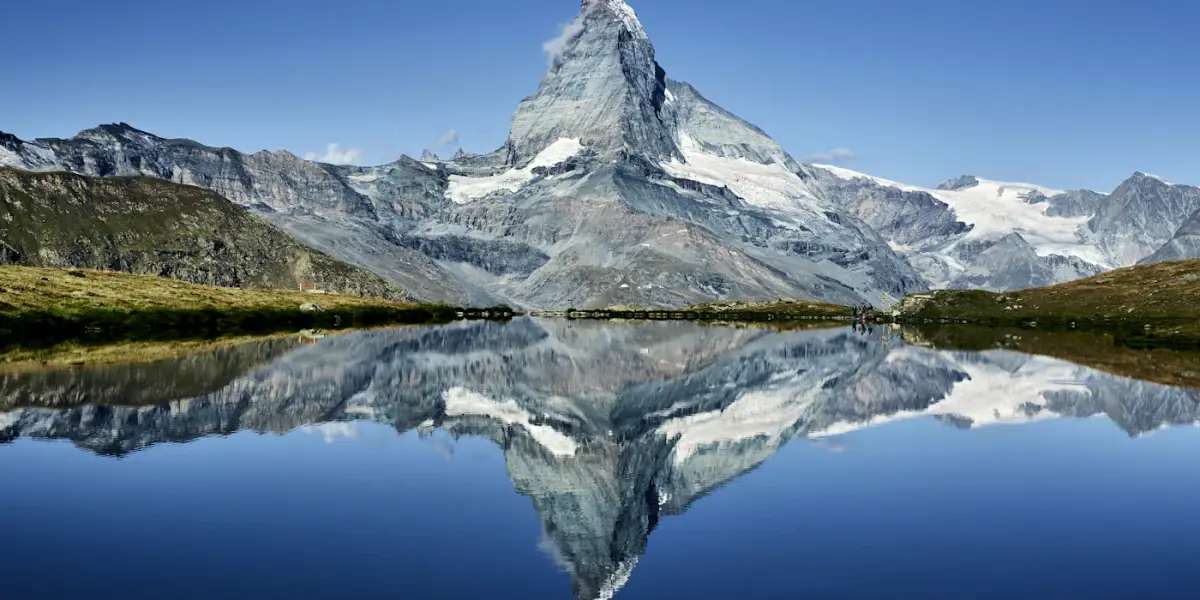
- Matterhorn reflections. In summer, hike the 5-Lakes Trail, or walk round the Riffelsee, where the Matterhorn is mirrored in the water on a calm day.
- Matterhorn Museum. The Zermatlantis museum covers the history of climbing the Matterhorn and of Zermatt's development as a resort.
- Glacier Express to St. Moritz. The panoramic train leaves Zermatt for an eight-hour run over 291 bridges and through 91 tunnels to the Engadine lakes near St. Moritz, with meals served at your seat.
Sources: MySwitzerland (Switzerland Tourism): Zermatt, MySwitzerland: Matterhorn, Zermatt Tourism (zermatt.swiss): Arrival, Zermatt Tourism: Summer skiing, MySwitzerland: Photo spot Gornergrat, MySwitzerland: Matterhorn Glacier Paradise, Glacier Express (official site), Wikivoyage: Zermatt (checked 14 Oct)
Grindelwald
Hill countryA chalet village under the Eiger's north face, with First's cliff walk, the Bachalpsee hike and the Eiger Express.
2–3 nights3 h by train from Zurich airport
Grindelwald
Hill countryA chalet village under the Eiger's north face, with First's cliff walk, the Bachalpsee hike and the Eiger Express.
Grindelwald is a village of wooden chalets in the Jungfrau region, at the very foot of the Eiger and its north face, about half an hour from Interlaken Ost on the Bernese Oberland Railway. Gondolas leave from the village for First and Männlichen, and the Eiger Express from Grindelwald Terminal is the quickest way towards the Jungfraujoch, so it is a good alternative to Interlaken if you would rather wake up in the mountains. Switzerland Tourism lists an Indian restaurant here with a wide vegetarian choice.
What to do in Grindelwald
- First Cliff Walk. A three-stage gondola climbs to First at 2,166 m, where the Cliff Walk leads out to the First View platform, with the Eiger's north face across the valley.
- Hike to the Bachalpsee. An easy walk of about two hours from First reaches a mountain lake that reflects the snow peaks behind it.
- First Flyer and mountain carts. Zip 800 m down a steel cable at up to 84 km/h, then ride a mountain cart or scooter bike down towards the valley.
- Männlichen and the Royal Walk. Take the gondola up to Männlichen for a view across to the Eiger, Mönch and Jungfrau on one side and down to Grindelwald and the Lauterbrunnen valley on the other.
- Glacier Canyon. Explore the wild glacier canyon and step out onto its 'spiderweb', a net stretched across the full width of the gorge.
Sources: MySwitzerland (Switzerland Tourism): Grindelwald, MySwitzerland: Grindelwald-First, Jungfrau Railways (jungfrau.ch): Jungfraujoch – Top of Europe, Grindelwald Tourism: Arrival by plane, Grindelwald Tourism: Arrival by train, MySwitzerland: Indian restaurant listing, Grindelwald, Wikivoyage: Grindelwald (checked 14 Oct)
Lauterbrunnen valley
Hill countryA sheer-walled valley of more than 70 waterfalls, with car-free Wengen and Mürren high above.
2 nightsabout 3 h by train from Zurich airportBest Jun–Jul
Lauterbrunnen valley
Hill countryA sheer-walled valley of more than 70 waterfalls, with car-free Wengen and Mürren high above.
Lauterbrunnen lies on the floor of a deep, steep-sided valley between Interlaken and the Jungfrau massif, 20 minutes by train from Interlaken Ost, and the Staubbach Falls drop 297 m off the cliff beside the village. High on either side sit the car-free villages of Wengen and Mürren, reached by cogwheel railway and cable car, and the valley is also where trains start up to Kleine Scheidegg and the Jungfraujoch and cable cars to the Schilthorn.
What to do in Lauterbrunnen valley
- Staubbach Falls. Lauterbrunnen's tourism office calls the 297 m drop Switzerland's highest free-falling waterfall; in summer a path climbs to a tunnel that comes out on a ledge behind it.
- Trümmelbach Falls. Ten glacier-fed waterfalls crash down inside the mountain, reached by a tunnel lift, draining the glaciers of the Eiger, Mönch and Jungfrau.
- Up to Wengen. The cogwheel railway climbs to car-free Wengen on the sunny side of the valley, on the line to Kleine Scheidegg, and Switzerland Tourism lists a seasonal Indian restaurant there, open in the warmer months, with a vegetarian and non-vegetarian buffet.
- Mürren and the Schilthorn. Ride up to car-free Mürren on its cliff-top shelf, then on by cable car to the 2,970 m Schilthorn, whose revolving summit restaurant appeared in the 1969 Bond film On Her Majesty's Secret Service.
The Staubbach is at its fullest with the early-summer snowmelt or after heavy rain, and can shrink to a dribble by September.
Sources: MySwitzerland (Switzerland Tourism): Lauterbrunnen, Lauterbrunnen Tourism (lauterbrunnen.swiss), Trümmelbach Falls (official site), MySwitzerland: Schilthorn, MySwitzerland: Indian restaurant listing, Wengen, Wikivoyage: Lauterbrunnen, Wikivoyage: Wengen, Wikivoyage: Mürren (checked 14 Oct)
Montreux and Lake Geneva
CityLake Geneva's Swiss Riviera: Chillon Castle on its rock, a lakeside promenade and the Lavaux vineyard terraces.
1–2 nightsabout 3 h by train from Zurich airport
Montreux and Lake Geneva
CityLake Geneva's Swiss Riviera: Chillon Castle on its rock, a lakeside promenade and the Lavaux vineyard terraces.
Montreux is a French-speaking resort on the shore of Lake Geneva, with a mild climate, an Alpine backdrop and a reputation as the 'Pearl of Lake Geneva'; it is also home to the Montreux Jazz Festival. Chillon Castle stands on the water a short way along the shore, the Lavaux vineyards climb the slopes towards Lausanne, and the GoldenPass Express runs from here through the mountains to Interlaken, so Montreux fits neatly into a longer loop between the Jungfrau region and Zermatt.
What to do in Montreux and Lake Geneva
- Chillon Castle. Switzerland's most visited historic monument sits on a rocky island right at the lake's edge about 3 km from Montreux, built where the road from the St. Bernard pass squeezed between lake and cliff so its owners could take tolls.
- Lakeside promenade. Stroll the waterfront to the statue of Freddie Mercury, one of several artists, along with Charlie Chaplin, who made their homes in Montreux.
- Rochers-de-Naye. A cogwheel railway climbs from Montreux to the 2,045 m summit for views over the lake and the Swiss and French Alps, and there is a marmot park near the top.
- Lavaux vineyard terraces. The UNESCO-listed terraces form Switzerland's largest continuous wine-growing area; the little 'Train des Vignes' climbs from Vevey through the vines in twelve minutes, and a 32 km path runs from Lausanne-Ouchy to Chillon.
- Paddle steamer on the lake. Belle Époque paddle steamers link Montreux with Vevey, Lausanne and Geneva.
Sources: MySwitzerland (Switzerland Tourism): Montreux, MySwitzerland: Lake Geneva (Lac Léman), MySwitzerland: Lavaux vineyard terraces, Wikivoyage: Montreux (checked 14 Oct)
Geneva
CityThe French-speaking city of the UN, the Red Cross and CERN, with the 140 m Jet d'Eau and a hilltop old town.
2 nightsabout 3 h by train from Zurich airport
Geneva
CityThe French-speaking city of the UN, the Red Cross and CERN, with the 140 m Jet d'Eau and a hilltop old town.
Geneva is the French-speaking city on Lake Geneva in the south-west of the country, home to CERN, the International Committee of the Red Cross and the United Nations' European headquarters. Its old town, the largest historic old town in Switzerland, climbs the hill around St. Peter's Cathedral, while the Jet d'Eau fountain marks the lakefront. It is a long train ride from Zurich, with direct trains every half hour, so it suits a longer trip or a stay paired with Montreux.
What to do in Geneva
- Jet d'Eau. The city's emblem fires 500 litres of lake water a second 140 m into the air at 200 km/h; cross the harbour on one of the little mouette boat taxis.
- Old town and St. Peter's Cathedral. Climb the cathedral tower for the view over the city and lake, then find Maison Tavel, the oldest house in the city, in the cobbled lanes nearby.
- International Geneva. See the Broken Chair sculpture outside the Palais des Nations, the UN's European headquarters, in a city that hosts about 40 international organisations and more than 400 NGOs.
- CERN. The particle physics laboratory, founded in 1954, welcomes visitors with exhibitions, shows and practical workshops for children and adults alike.
- Carouge. This neighbouring town, with an Italian-village feel, is full of boutiques, cafés and markets and is liveliest in the evenings and at weekends.
Sources: MySwitzerland (Switzerland Tourism): Geneva, Geneva Tourism (geneve.com): The Jet d'Eau, Geneva Tourism: The Old Town, MySwitzerland: Lake Geneva (Lac Léman), Wikivoyage: Geneva (checked 14 Oct)
St. Moritz
Hill countryA sunny Engadine resort at 1,856 m, end of the Glacier Express and start of the Bernina line over the Alps to Italy.
1–2 nightsabout 3 h 30 min by train from Zurich airport
St. Moritz
Hill countryA sunny Engadine resort at 1,856 m, end of the Glacier Express and start of the Bernina line over the Alps to Italy.
St. Moritz is a resort in the Engadine valley of Graubünden, in the south-east of Switzerland, set above its lake at 1,856 m, and Switzerland Tourism calls it the birthplace of Alpine winter sports. Luxury hotels and boutiques give it a glamorous name, but for most first-time visitors the draw is the railway: the Glacier Express from Zermatt ends here, the Bernina line climbs from here over the Bernina Pass to Tirano in Italy, and the train from Zurich main station takes about three hours via Chur and the Albula line.
What to do in St. Moritz
- The Bernina line to Tirano. Ride south past glaciers and the deep-blue Lago Bianco, over the Bernina Pass and down to the palm trees of Tirano; UNESCO added the Albula and Bernina lines to its World Heritage list in 2008.
- Around the lake and village. Start at Lake St. Moritz, then head up into the village for the leaning church tower and the Segantini Museum, devoted to the painter Giovanni Segantini.
- Muottas Muragl panorama trail. Walk the panorama trail from Muottas Muragl across to Alp Languard above Pontresina.
- Snow sports in winter. Ski Corviglia, Corvatsch or Diavolezza, or cross-country ski over the frozen lakes along the route of the Engadin ski marathon.
Sources: MySwitzerland (Switzerland Tourism): St. Moritz, St. Moritz Tourism (stmoritz.com), St. Moritz Tourism: Arrival, Rhaetian Railway (rhb.ch): Bernina Express, Rhaetian Railway: Tips for the Bernina line, Glacier Express (official site), Wikivoyage: St. Moritz (checked 14 Oct)
A first trip: 9 nights
Land in Zurich, take the train to Lucerne for the lake and its mountains, cross on the Lucerne–Interlaken Express to Interlaken as the base for the Jungfraujoch and the Grindelwald and Lauterbrunnen valleys, then finish in car-free Zermatt, about three and a half hours by train from Zurich Airport for the flight home. June to September is hiking season around Interlaken and mid-December to mid-April is ski season; with more time, add Montreux by the GoldenPass Express between Interlaken and Zermatt, or ride the Glacier Express on from Zermatt to St. Moritz and take the train back to Zurich from there.
Getting around
Trains, PostBuses, lake boats and mountain railways run as one coordinated network, with the SBB timetable and app covering almost all of it, and most routes see at least one service an hour, many every 30 or 15 minutes. Panoramic trains turn the transfers into sightseeing: the Lucerne–Interlaken Express, the GoldenPass Express between Interlaken and Montreux, the Glacier Express from Zermatt to St. Moritz and the Bernina Express over the Bernina Pass to Tirano, while cogwheel railways and cable cars take over for the final climb to the peaks. If you land at Zurich, SBB can send your suitcases from the airport straight to your hotel.
Peak Shoulder Off-season
Zurich Tourism describes four distinct seasons: summer days that can pass 30°C with swimming in the lake and river, a December Christmas-market season, and winters that dip below zero. The climate table shows May to August as a wet stretch at around 140 mm a month, so pack for showers even in summer; November and January to March are cold and grey.
Flights to Switzerland from India
Visa for Indian passports
Indian passport holders need a visa for Switzerland before travel. Allow about 40 days for a first-time application. Schengen visa via VFS; one visa covers the whole Schengen area.
Before you book, check the Ministry of External Affairs travel advisories for the latest guidance.
Switzerland: questions
What are the best places to visit in Switzerland?
Zurich: Switzerland's biggest city and your landing point: an old town on the Limmat, Lake Zurich and the Rhine Falls nearby. Lucerne: Old wooden bridges and a lakefront old town, with trips up Pilatus and Rigi, and Titlis by cable car. Interlaken: The base for the Jungfrau region between two lakes, with paragliders landing in town and a Yash Chopra statue. Jungfraujoch: Europe's highest railway station at 3,454 m, above the Aletsch Glacier, with an ice palace and snow all year. Zermatt and the Matterhorn: Car-free village below the Matterhorn: the Gornergrat railway, Europe's highest cable-car station, summer skiing. Grindelwald: A chalet village under the Eiger's north face, with First's cliff walk, the Bachalpsee hike and the Eiger Express. Lauterbrunnen valley: A sheer-walled valley of more than 70 waterfalls, with car-free Wengen and Mürren high above. Montreux and Lake Geneva: Lake Geneva's Swiss Riviera: Chillon Castle on its rock, a lakeside promenade and the Lavaux vineyard terraces. Geneva: The French-speaking city of the UN, the Red Cross and CERN, with the 140 m Jet d'Eau and a hilltop old town. St. Moritz: A sunny Engadine resort at 1,856 m, end of the Glacier Express and start of the Bernina line over the Alps to Italy.
How many days do you need for Switzerland?
A first trip takes about 9 nights: Zurich (2 nights), Lucerne (2 nights), Interlaken (3 nights), Jungfraujoch (1 night), Zermatt and the Matterhorn (2 nights). Land in Zurich, take the train to Lucerne for the lake and its mountains, cross on the Lucerne–Interlaken Express to Interlaken as the base for the Jungfraujoch and the Grindelwald and Lauterbrunnen valleys, then finish in car-free Zermatt, about three and a half hours by train from Zurich Airport for the flight home. June to September is hiking season around Interlaken and mid-December to mid-April is ski season; with more time, add Montreux by the GoldenPass Express between Interlaken and Zermatt, or ride the Glacier Express on from Zermatt to St. Moritz and take the train back to Zurich from there.
What is the best time to visit Switzerland?
Peak season is Jun–Aug, Dec. Zurich Tourism describes four distinct seasons: summer days that can pass 30°C with swimming in the lake and river, a December Christmas-market season, and winters that dip below zero. The climate table shows May to August as a wet stretch at around 140 mm a month, so pack for showers even in summer; November and January to March are cold and grey.
Do Indians need a visa for Switzerland?
Indian passport holders need a visa for Switzerland before travel. Allow about 40 days for a first-time application. Schengen visa via VFS; one visa covers the whole Schengen area.
How much is a flight to Switzerland from India?
The lowest return fare FlyBun has seen in the last 14 days is ₹40,424, Delhi to Zurich, for December 2026 departures. Fares change daily.
Places and things to do are written by FlyBun from official tourism, heritage and park sources, linked under each place, last checked 14 Oct. We leave out entry fees and opening hours because they change; check them before you go.
Watch a route and FlyBun alerts you free when its fare drops.