

Travel guide from India
Taiwan
Taiwan is a mountainous island off the coast of China, a long flight east of India, and most international flights land at Taoyuan airport, 40 km west of Taipei. One trip can take in Taipei's museums and night markets, the old gold-mining lanes of Jiufen, Sun Moon Lake, the cypress forests of Alishan and the Dutch-era forts and temples of Tainan. Vegetarians eat well: Buddhist vegetarian restaurants, signed 素食, are found all over the island, and most of them also leave out onion and garlic.
- Best time
- Mar–Apr, Oct–Nov
- First trip
- 9–10 nights
- Visa
- Visa needed
- Return flights
- from ₹29,999 ●
- Chennai, checked in the last 48 h
Places to visit in Taiwan
8 places in the order you would meet them on a first trip. Tap one for what to do there.
Taipei
CityTaipei 101, the National Palace Museum, Longshan Temple, night markets and vegetarian buffets, plus easy day trips.
4 nightsabout 1 h by train from Taipei airportBest Sep–Nov
Taipei
CityTaipei 101, the National Palace Museum, Longshan Temple, night markets and vegetarian buffets, plus easy day trips.
Taipei, the capital since Taiwan became a province in 1887, fills a basin ringed by mountains in the north of the island. Its metro is signed in English and announces stops in English too, and the Airport MRT express reaches Taipei Main Station from Taoyuan in about 38 minutes. Wikivoyage counts more than two hundred vegetarian restaurants and stalls in the city, including buffets that charge by the weight of your plate, and many of the Buddhist ones cook without garlic or onion.
What to do in Taipei
- Taipei 101. The tourism board describes Taiwan's tallest building as eight-floor sections stacked like bamboo, a nod to the lucky number eight; the 89th-floor observatory, 382 m up, looks across the whole basin and puts the tower's 660-tonne damper on display.
- National Palace Museum. More than 600,000 objects, mostly from the Chinese imperial collection begun in the early Song dynasty, cover close to 5,000 years of Chinese history, and only about one percent of them is on show at any one time.
- Longshan Temple. Built in 1740 under the Qing and restored several times since, this temple to Guanyin in old Wanhua is a national heritage site, and the lanes around it are full of herbal medicine and Buddhist-supply shops.
- Night markets. Shilin, near Jiantan MRT station, is the best known, though locals find it touristy; Raohe Street by Songshan station and Ningxia near Zhongshan station are good alternatives for oyster omelettes, stinky tofu and aiyu jelly.
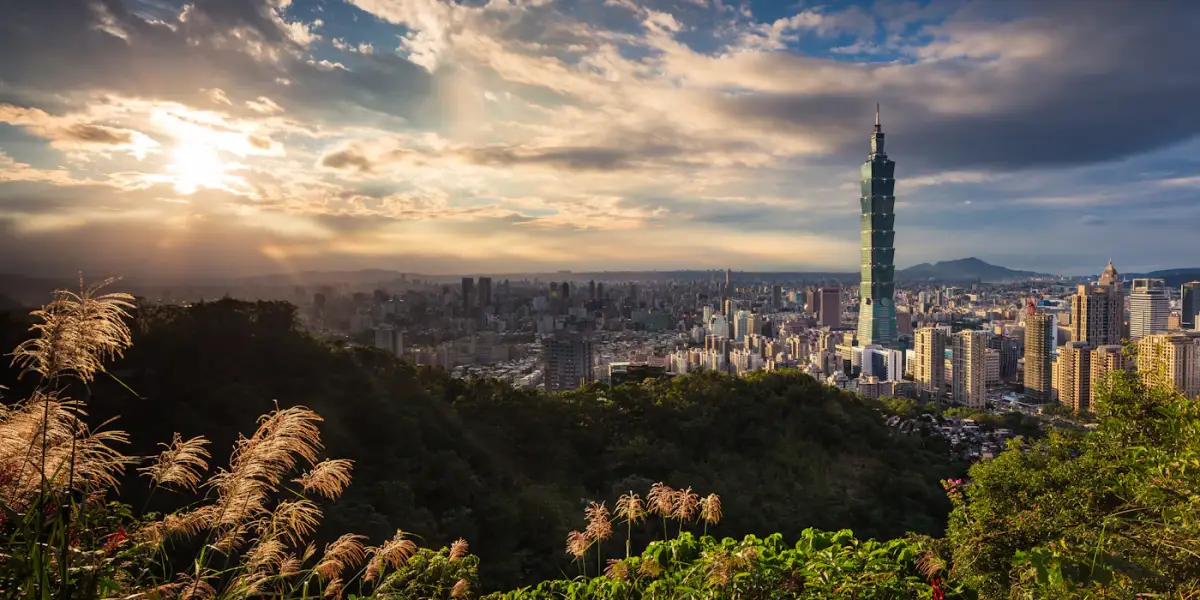
- Elephant Mountain at sunset. Steep steps on the edge of Xinyi climb to lookouts where Taipei 101 stands high over the low-rise city around it, at its best as the sky turns orange.
The tourism board calls autumn (September to November) cool and comfortable; March to May brings spells of drizzle, and typhoons sometimes approach or hit between June and August.
Sources: Taiwan Tourism Administration: Taipei 101, Taiwan Tourism Administration: National Palace Museum, Taiwan Tourism Administration: Lungshan Temple, Taiwan Tourism Administration: General information (climate), Taiwan Tourism Administration: Northern Taiwan, Wikivoyage: Taipei, Wikivoyage: Taiwan Taoyuan International Airport, Wikivoyage: Taiwan (checked 14 Oct)
Beitou and Yangmingshan
Hill countryDay tripTaipei's hot-spring district: a Japanese-era bathhouse museum, a steaming sulphur valley and volcanic hills above.
about 1 h 30 min by train from Taipei airportBest Dec–Feb
Beitou and Yangmingshan
Hill countryDay tripTaipei's hot-spring district: a Japanese-era bathhouse museum, a steaming sulphur valley and volcanic hills above.
Beitou, in the north of Taipei, takes its name from an indigenous word for 'witch', after the steam and sulphur smell of its valley, and the Japanese turned it into a hot-spring resort in the early 1900s. The red MRT line runs to Beitou station, where a one-stop branch carries on to Xinbeitou beside Beitou Park and many of the hot-spring hotels. Behind the town rise the volcanic hills of Yangmingshan National Park.
What to do in Beitou and Yangmingshan
- Beitou Hot Spring Museum. The Japanese-era magistrate of Taipei Prefecture opened this public bathhouse in 1913, modelled on one at Izu in Japan; it lay abandoned after the war until local schoolchildren and teachers campaigned to save it, and it reopened as a museum in 1998.
- Thermal Valley. Also called Hell Valley, this steaming sulphur spring next to Beitou Park can reach 100°C, so look but keep your hands out of the water.
- Take a soak. The local water is high in sulphur and acidic, so take off pearls and delicate jewellery; in single-sex baths wash first, bathe without clothes and tie up long hair, mixed outdoor pools need swimwear, and people with high blood pressure or heart disease should stay out.
- Yangmingshan National Park. Buses climb from Beitou into these volcanic hills, with steaming sulphur vents, trails up Qixingshan, the park's highest peak, and valleys of calla lilies and cherry blossom in spring.
The tourism board says the cold fronts of Taiwan's short winter, December to February, make it a favourite time for hot springs.
Sources: Taiwan Tourism Administration: Beitou Hot Spring Museum, Taiwan Tourism Administration: Xinbeitou Hot Springs, Taiwan Tourism Administration: Beitou, a beautiful small town known for sulfur springs, Taiwan Tourism Administration: General information (climate), Wikivoyage: Taipei/Beitou, Wikivoyage: Taipei, Wikivoyage: Taiwan Taoyuan International Airport (checked 14 Oct)
Jiufen, Shifen and Yehliu
HeritageDay tripGold-rush lanes and teahouses above the sea, a waterfall on an old coal railway and sea-carved rocks at Yehliu.
about 2 h 30 min from Taipei airport
Jiufen, Shifen and Yehliu
HeritageDay tripGold-rush lanes and teahouses above the sea, a waterfall on an old coal railway and sea-carved rocks at Yehliu.
Jiufen, in the hills of Ruifang district facing the sea, boomed after gold was struck nearby in 1890 and faded as mining declined, until films such as A City of Sadness, winner at Venice in 1989, brought visitors back. Its stepped lanes are often linked to the anime Spirited Away, though its director Hayao Miyazaki has denied the connection. From Taipei, Jiufen is about 90 minutes by direct bus, Shifen is reached by train with a change at Ruifang, and Yehliu by bus along the north coast; go on a weekday or before noon to beat the tour buses.
What to do in Jiufen, Shifen and Yehliu
- Jiufen Old Street and the teahouses. Wander Jishan Street and the steep steps of Shuqi Street past stalls selling taro balls, then sit in a teahouse looking out over the sea, or stay overnight in a local inn for the starlight and the lights of the fishing boats.
- Gold Museum, Jinguashi. In the quiet neighbouring hillside town, this park, which the tourism board calls Taiwan's first ecology museum, tells the story of Jinguashi's gold mines and the community that worked them.
- Shuinandong. The third of Ruifang's old mining towns has the abandoned 13-Level Smelter, the two-toned yellow and blue water of the Yin Yang Sea, and the Golden Waterfall.
- Shifen on the Pingxi line. The 12.9 km branch line, built in 1918 to carry coal and turned over to visitors in 1992, runs past Shifen's houses crowded up to the tracks and on to Shifen Waterfall, a wide curtain fall nicknamed Taiwan's Niagara; Pingxi is also known for its Sky Lantern Festival.
- Yehliu Geopark. On a cape about 1,700 m long on the north coast, sea erosion and weathering have shaped candle-like and mushroom rocks, among them the Queen's Head, whose slender neck has been wearing thinner over the decades.
Sources: Taiwan Tourism Administration: Jiufen, Taiwan Tourism Administration: Ruifang District, gold mines of discovery in Shuinandong, Jinguashi and Jiufen, Taiwan Tourism Administration: Gold Museum, Taiwan Tourism Administration: Shifen Scenic Area, Taiwan Tourism Administration: Pingxi, Taiwan Tourism Administration: Yehliu Geopark, Taiwan Tourism Administration: Queen's Head, Wikivoyage: Jiufen, Wikivoyage: Pingxi, Wikivoyage: Wanli, Wikivoyage: Taiwan Taoyuan International Airport (checked 14 Oct)
Sun Moon Lake
Hill countryTaiwan's largest natural lake: a lakeside bikeway, a Thao village and temples to Xuanzang, the monk who went to India.
1 nightabout 3 h from Taipei airportBest Oct–Apr
Sun Moon Lake
Hill countryTaiwan's largest natural lake: a lakeside bikeway, a Thao village and temples to Xuanzang, the monk who went to India.
Sun Moon Lake lies 748 m up in the hills of Nantou County in the middle of Taiwan, and takes its name from Lalu Island, which splits the water into a round 'sun' and a crescent 'moon'. The scenic area calls it Taiwan's largest natural lake; it has been tapped for hydropower since the Japanese era, and the Thao, the area's earliest people, still live at Ita Thao. No train reaches the lake: Taiwan Tourist Shuttle buses from the Taichung high-speed rail station take about 90 minutes.
What to do in Sun Moon Lake
- Cycle the lakeshore. A road loops about 30 km around the lake, which Wikivoyage reckons takes four and a half to six hours by bike with stops, and on the 400 m Shuishang stretch between Shuishe and Xiangshan riding feels like boating on the water.
- Xuanguang and Xuanzang temples. Take a boat to Xuanguang Temple's pier and walk the 560 m 'pilgrim path' to Xuanzang Temple; both honour Xuanzang, the Tang-dynasty monk sent to India for Buddhist scriptures, whose bone relic was taken from Nanjing to Japan in wartime and later brought to Taiwan and enshrined here.
- Ita Thao and Lalu Island. Ita Thao is the village of the Thao people, where many craft shops are indigenous-owned; Lalu Island, out on the water, is land the Thao hold sacred, and its Thao name was restored after the 1999 earthquake.
- Ropeway to the Aboriginal Culture Village. The cable car from the lakeshore near Ita Thao links the lake with the Formosan Aboriginal Culture Village, a theme park built around the cultures of nine of Taiwan's indigenous peoples.
- Ci'en Pagoda. Chiang Kai-shek had this 46 m pagoda built in memory of his mother on a hill south-east of the lake, completed in 1971, and Wikivoyage rates it the best spot to look out over the water.
Wikivoyage suggests autumn, winter or spring for milder weather than the hot, crowded summer, and weekdays to avoid the weekend rush.
Sources: Sun Moon Lake National Scenic Area: Discover Sun Moon Lake, Sun Moon Lake National Scenic Area: Getting here, Taiwan Tourism Administration: Sun Moon Lake National Scenic Area - Xiangshan Visitor Center, Taiwan Tourism Administration: Xuanguang Temple, Taiwan Tourism Administration: Xuanzang Temple, Taiwan Tourism Administration: Sun Moon Lake Ropeway, Wikivoyage: Sun Moon Lake, Wikivoyage: Taichung (checked 14 Oct)
Alishan
Hill countryMisty cypress forest at about 2,200 m, sunrise over a sea of clouds and a mountain railway built for logging.
1 nightabout 4 h 30 min from Taipei airport
Alishan
Hill countryMisty cypress forest at about 2,200 m, sunrise over a sea of clouds and a mountain railway built for logging.
Alishan is not one peak but a range in Chiayi County averaging about 2,500 m, and its forest recreation area sits at about 2,200 m, where the average temperature is 10.6°C and fog settles on some 244 days a year. The Japanese opened the narrow-gauge forest railway in 1912 to carry out timber, and once logging had ended by the 1970s the area turned to tourism. Buses from Chiayi take two to three hours up a winding road, so stay a night to catch the sunrise.
What to do in Alishan
- Sunrise at Zhushan. Before dawn, take the sunrise train or walk up, about an hour on foot, to Zhushan, at 2,451 m the highest railway station in Taiwan, to watch the sun come up over Yushan and the sea of clouds.
- Giant Trees trails. Only about 40 giant red cypresses survived the logging along the two giant-tree walks, and the tallest, the Xianglin Sacred Tree, stands about 45 m high and is some 2,300 years old.
- Sister Ponds. Two small ponds in the forest, the larger of which has a little octagonal pavilion in the middle.
- Fenqihu. Halfway up the forest railway, this station village is known for its old street, bamboo and railway lunch boxes, and some buses from Chiayi detour through it.
- High-mountain oolong. Tea gardens line the road up, and tea shops in the village will brew Alishan's high-mountain oolong for you to taste.
Sources: Taiwan Tourism Administration: Alishan National Forest Recreation Area, Forestry and Nature Conservation Agency (Taiwan Forest Recreation): Alishan National Forest Recreation Area, Taiwan Forest Recreation: Alishan Forest Railway, Alishan Forest Railway and Cultural Heritage Office: stations, Wikivoyage: Alishan, Wikivoyage: Chiayi (checked 14 Oct)
Tainan
HeritageOne of Taiwan's oldest cities: Dutch-era forts, a 1665 Confucius temple and a famous street-snack scene.
2 nightsabout 2 h 30 min by train from Taipei airport
Tainan
HeritageOne of Taiwan's oldest cities: Dutch-era forts, a 1665 Confucius temple and a famous street-snack scene.
Tainan, on the south-west coast and a former capital of Taiwan, grew from the base the Dutch East India Company set up at Anping in 1624, which the Ming loyalist Koxinga captured in 1662. Its low-rise streets hide temples on almost every corner, and it is known as the City of Snacks. High-speed trains from Taoyuan take about 1½ hours to Tainan station, some 10 km from the centre, which is linked by a corridor to Shalun station for local trains into town.
What to do in Tainan
- Anping Old Fort. The Dutch built Fort Zeelandia here after taking Anping in 1624 and Koxinga took it in 1662; the best-known Dutch-era remnant is the south brick wall outside the gate, gripped by old banyan roots.
- Anping Tree House. Close to the fort, a former warehouse has been swallowed by a banyan's aerial roots, and stairs inside lead up to a view over the roof.
- Chihkan Tower. Built by the Dutch in the 1650s as Provintia, its surviving gate and wall use bricks from Java bound with a mortar of glutinous rice, syrup, sand and oyster shell, and two pavilions were added on its old base under the Qing in 1886.
- Confucius Temple. Built in 1665 and the earliest Confucius temple in Taiwan, it has a spacious, quiet courtyard.
- Eat your way round. Try danzai noodles, milkfish soup, beef soup and shrimp rolls; vegetarians should ask first, as many broths are made with meat.
Sources: Tainan Travel (Tainan City Government): Anping Old Fort, Tainan Travel: Chihkan Culture Park, Tainan Travel: Trip deep into Tainan, Anping District chapter, Tainan Travel: Trip deep into Tainan, West Central District section, Taiwan Tourism Administration: Southern Taiwan, Taiwan High Speed Rail: Tainan station information, Wikivoyage: Tainan, Wikivoyage: Taiwan (dietary restrictions) (checked 14 Oct)
Kaohsiung
CityTaiwan's big southern port: temple-lined Lotus Pond, a vast Buddha museum, harbour art warehouses and Cijin's seafood.
1–2 nightsabout 2 h 30 min by train from Taipei airportBest Nov–Mar
Kaohsiung
CityTaiwan's big southern port: temple-lined Lotus Pond, a vast Buddha museum, harbour art warehouses and Cijin's seafood.
Kaohsiung, on the south-west coast, has Taiwan's largest port and, with about 2.7 million people, is its third most populous city; it began as a fishing village called Takao and is now a planned city of wide streets along the Love River. High-speed trains end at Zuoying on its northern edge, from where the red MRT line runs into the centre. Wikivoyage finds it milder and drier than northern Taiwan.
What to do in Kaohsiung
- Lotus Pond. Walk in through the dragon's throat and out through the tiger's mouth at the Dragon and Tiger Pagodas, a route said to turn bad luck to good, past paintings of heaven and hell, then watch the sunset over the temple-lined pond.
- Fo Guang Shan Buddha Museum. Completed in 2011 in what the tourism board calls a blend of Indian and Chinese styles, the museum holds relics of the Buddha and, by the board's account, Asia's largest and tallest seated Buddha.
- Pier-2 Art Center. Where the Love River meets the harbour, 25 old warehouses reopened in 2000 as spaces for exhibitions, public art and street performance along the portside cycle paths.
- Cijin Island. Cross by ferry to this long, narrow island for seafood on the old street by the pier, a Matsu temple some 300 years old and a lighthouse view over the port.
- Dome of Light and Liuhe Night Market. Formosa Boulevard MRT station holds a stained-glass dome 30 m across by the artist Narcissus Quagliata, and nearby Liuhe Night Market is mostly snack stalls, where papaya milk is the local drink to try.
Wikivoyage's climate figures show Kaohsiung's driest months running from November to March, while June to August bring the most rain.
Sources: Taiwan Tourism Administration: Lianchihtan (Lotus Pond), Taiwan Tourism Administration: Fo Guang Shan Buddha Museum, Taiwan Tourism Administration: The Pier-2 Art Center, Taiwan Tourism Administration: Qijin, Taiwan Tourism Administration: The Dome of Light, Taiwan Tourism Administration: Liuhe Night Market, Wikivoyage: Kaohsiung (checked 14 Oct)
Kenting National Park
BeachTaiwan's only tropical national park: beaches, coral-limestone forest and grassy clifftops at the island's southern tip.
2 nightsabout 5 h from Taipei airport
Kenting National Park
BeachTaiwan's only tropical national park: beaches, coral-limestone forest and grassy clifftops at the island's southern tip.
Kenting National Park, on the Hengchun Peninsula at Taiwan's southern tip, is what the tourism board calls the country's only tropical national park: set up in 1982, it takes in 33,268 hectares of land and sea, with beaches, coral reefs, sand dunes, forest and farmland. It is about 2½ hours by bus from Kaohsiung, and the sights are spread out, so many visitors rent a scooter, which needs a Taiwanese or international motorbike licence. In typhoon season rough seas can close all the beaches.
What to do in Kenting National Park
- Eluanbi. Eluanbi Park, around the 21.4 m Eluanbi Lighthouse, marks Taiwan's southernmost point, and the park is also an old site of Kenting's prehistoric cultures.
- Longpan Park. North of Eluanbi on the east coast, a broad grassland runs to cliffs above the Pacific, with sinkholes, limestone caves and red soil, and the park's own two-day itinerary suggests stargazing here.
- Kenting National Forest Recreation Area. Trails lead through raised coral limestone full of caves and stalactites, in a tropical forest where Formosan macaques roam and migrating birds of prey roost in autumn and winter.
- South Bay and Sail Rock. Swim at South Bay (Nanwan), or stop at Sail Rock, a huge boulder off a stony beach.
Sources: Taiwan Tourism Administration: Kenting National Park, Taiwan Tourism Administration: Eluanbi Lighthouse, Taiwan Tourism Administration: Longpan Park, Taiwan Tourism Administration: General information (climate), Kenting National Park Headquarters: Two-day tour, Wikivoyage: Kenting National Park, Wikivoyage: Kaohsiung (checked 14 Oct)
A first trip: 9–10 nights
- Taipei · 4n
- →Beitou and Yangmingshan
- →Jiufen, Shifen and Yehliu
- →Sun Moon Lake · 1n
- →Alishan · 1n
- →Tainan · 2n
- →Kaohsiung · 1–2n
Fly into Taoyuan and base yourself in Taipei for the city and day trips to Beitou and the Jiufen coast, then take the high-speed train to Taichung for the bus to Sun Moon Lake, go on by bus to Alishan, come down to Chiayi for the train south to Tainan and Kaohsiung, and ride the high-speed rail back to Taoyuan. The tourism board points to autumn (September to November), while March to May is drizzly and typhoons can strike in summer and early autumn; add Kenting's beaches from Kaohsiung if you have the time.
Getting around
The Airport MRT links Taoyuan airport with Taipei Main Station (about 38 minutes on the express) and with the THSR Taoyuan station (about a quarter of an hour), so you can head south without going into Taipei. High-speed trains run down the west coast from Taipei to Zuoying in Kaohsiung in as little as 95 minutes, stopping at Taichung for the Sun Moon Lake buses, Chiayi for the Alishan buses and Tainan, while Taiwan Railways circles the island, east coast included. An EasyCard works on metros, buses and ordinary trains, but not on the high-speed rail.
Peak Shoulder Off-season
No official Taiwan tourism page describing seasons could be opened, so these ratings follow the NASA POWER climate normals: June to September are hot at 28 to 30°C and very wet, with 170 to 270 mm a month and the typhoon risk; March, April, October and November are mild and drier; December to February are cool, grey and drizzly at 17 to 18°C.
Flights to Taiwan from India
Visa for Indian passports
Indian passport holders need a visa for Taiwan before travel. Allow about 14 days for a first-time application. Free online Travel Authorization Certificate if you hold a current (or recently expired) US, UK, Canada, Australia, NZ, Japan, Korea or Schengen visa. Visitor visa from TECC in Delhi, Mumbai or Chennai.
Before you book, check the Ministry of External Affairs travel advisories for the latest guidance.
Taiwan: questions
What are the best places to visit in Taiwan?
Taipei: Taipei 101, the National Palace Museum, Longshan Temple, night markets and vegetarian buffets, plus easy day trips. Beitou and Yangmingshan: Taipei's hot-spring district: a Japanese-era bathhouse museum, a steaming sulphur valley and volcanic hills above. Jiufen, Shifen and Yehliu: Gold-rush lanes and teahouses above the sea, a waterfall on an old coal railway and sea-carved rocks at Yehliu. Sun Moon Lake: Taiwan's largest natural lake: a lakeside bikeway, a Thao village and temples to Xuanzang, the monk who went to India. Alishan: Misty cypress forest at about 2,200 m, sunrise over a sea of clouds and a mountain railway built for logging. Tainan: One of Taiwan's oldest cities: Dutch-era forts, a 1665 Confucius temple and a famous street-snack scene. Kaohsiung: Taiwan's big southern port: temple-lined Lotus Pond, a vast Buddha museum, harbour art warehouses and Cijin's seafood. Kenting National Park: Taiwan's only tropical national park: beaches, coral-limestone forest and grassy clifftops at the island's southern tip.
How many days do you need for Taiwan?
A first trip takes about 9–10 nights: Taipei (4 nights), Beitou and Yangmingshan (1 night), Jiufen, Shifen and Yehliu (1 night), Sun Moon Lake (1 night), Alishan (1 night), Tainan (2 nights), Kaohsiung (1–2 nights). Fly into Taoyuan and base yourself in Taipei for the city and day trips to Beitou and the Jiufen coast, then take the high-speed train to Taichung for the bus to Sun Moon Lake, go on by bus to Alishan, come down to Chiayi for the train south to Tainan and Kaohsiung, and ride the high-speed rail back to Taoyuan. The tourism board points to autumn (September to November), while March to May is drizzly and typhoons can strike in summer and early autumn; add Kenting's beaches from Kaohsiung if you have the time.
What is the best time to visit Taiwan?
Peak season is Mar–Apr, Oct–Nov. No official Taiwan tourism page describing seasons could be opened, so these ratings follow the NASA POWER climate normals: June to September are hot at 28 to 30°C and very wet, with 170 to 270 mm a month and the typhoon risk; March, April, October and November are mild and drier; December to February are cool, grey and drizzly at 17 to 18°C.
Do Indians need a visa for Taiwan?
Indian passport holders need a visa for Taiwan before travel. Allow about 14 days for a first-time application. Free online Travel Authorization Certificate if you hold a current (or recently expired) US, UK, Canada, Australia, NZ, Japan, Korea or Schengen visa. Visitor visa from TECC in Delhi, Mumbai or Chennai.
How much is a flight to Taiwan from India?
The lowest return fare FlyBun has seen in the last 14 days is ₹29,999, Chennai to Taipei, for February 2027 departures. Fares change daily.
Places and things to do are written by FlyBun from official tourism, heritage and park sources, linked under each place, last checked 14 Oct. We leave out entry fees and opening hours because they change; check them before you go.
Watch a route and FlyBun alerts you free when its fare drops.