

Travel guide from India
Thailand
Thailand is a few hours' flight from India's big cities, with direct flights to both Bangkok and Phuket, and one trip can take in Bangkok's palace, temples, markets and street food, the beaches of Pattaya close to the capital, and the limestone islands and bays around Phuket and Krabi. Indian visitors will find links to home along the way: shrines to Brahma and Ganesha in Bangkok, a Little India at Phahurat, and Ayutthaya, the old capital named after Ayodhya.
- Best time
- Nov–Feb
- First trip
- 10–11 nights
- Visa
- Visa-free, 30 days
- Return flights
- from ₹19,815 ●
- Kolkata, checked in the last 48 h
Places to visit in Thailand
12 places in the order you would meet them on a first trip. Tap one for what to do there.
Bangkok
CityThe capital: the Grand Palace and riverside temples, huge markets, street food and a Little India.
3 nightsabout 1 h from Bangkok airportBest Nov–Feb
Bangkok
CityThe capital: the Grand Palace and riverside temples, huge markets, street food and a Little India.
Bangkok spreads along the Chao Phraya River, with the Grand Palace and the big temples on the old royal island of Rattanakosin, and malls, markets and nightlife across the newer districts. The Skytrain, Metro and river boats get round the worst of the traffic. Suvarnabhumi Airport is about 30 km east of the city: 45 to 60 minutes by taxi, or under half an hour on the Airport Rail Link to Phaya Thai.
What to do in Bangkok
- Grand Palace and the Emerald Buddha. Wat Phra Kaew, inside the palace walls, is Thailand's most sacred temple, home to the Emerald Buddha, and has an enormous Ramayana mural; sleeveless tops, see-through tops and mini skirts are turned away at the gate.
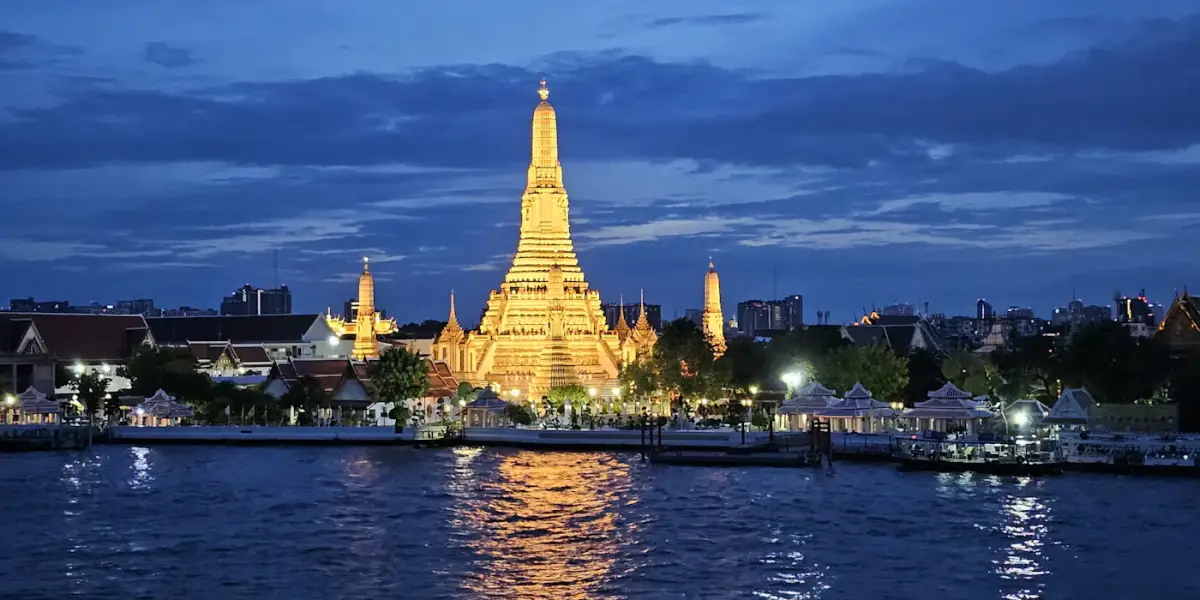
- Wat Pho and Wat Arun. Wat Pho, a short walk from the palace, has a huge reclining Buddha and a famous massage school, and a short ferry crosses the river to Wat Arun, whose towers are decorated with pieces of broken Chinese porcelain.
- Phahurat, Bangkok's Little India. Fabric lanes run by traders of Indian descent, the white, gold-domed Gurdwara Siri Guru Singh Sabha and Indian restaurants on Phahurat and Chakphet roads, right beside Yaowarat, the Chinatown.
- Erawan Shrine and the Brahmin shrine. Thais come to pray to Brahma at the Erawan Shrine on the Ratchaprasong intersection, and the Brahmin shrine beside the Giant Swing has an image of Brahma at its gate and chapels to Ganesha and Shiva.
- Chatuchak Weekend Market. More than 8,000 stalls in the north of the city sell almost anything you can think of; as the name says, it is a weekend market.
November to February is the coolest and driest stretch; March and April are fiercely hot, and September and October bring the heaviest rain.
Sources: Thailand Tourism Directory: Wat Phra Kaew (The Temple of the Emerald Buddha), Thailand Tourism Directory: Phahurat Market, Thailand Tourism Directory: Thao Mahaprom Shrine (Erawan Hotel), Thailand Tourism Directory: Brahmin Shrines, The Grand Palace (official site): home, The Grand Palace (official site): practical information, Wikivoyage: Bangkok, Wikivoyage: Bangkok/Rattanakosin, Wikivoyage: Bangkok/Yaowarat and Phahurat, Wikivoyage: Bangkok/Siam Square (checked 14 Oct)
Ayutthaya
HeritageDay tripRuined royal capital named after Ayodhya, now a UNESCO site and an easy day trip north of Bangkok.
about 1 h 30 min from Bangkok airportBest Nov–Feb
Ayutthaya
HeritageDay tripRuined royal capital named after Ayodhya, now a UNESCO site and an easy day trip north of Bangkok.
Founded around 1350 and named after Ayodhya, Rama's capital in the Ramayana, Ayutthaya was the capital of Siam for four centuries and grew into a great trading city before a Burmese army burned it in 1767. Its brick towers, monasteries and headless Buddhas stand on a river island north of Bangkok, and the historical park, with more than 425 sites found in and around the old city, is a UNESCO World Heritage Site.
What to do in Ayutthaya
- The Buddha head in the tree. At Wat Mahathat, tree roots have grown around a Buddha head among rows of headless statues; Thais hold it sacred, so kneel when you take a photo with it.
- Wat Phra Si Sanphet. The row of three restored Sri Lankan-style chedis in the old palace grounds appears in many pictures of the city; like Wat Phra Kaew in Bangkok, the temple had no monks and served only royal ceremonies.
- Wat Chaiwatthanaram. Built by King Prasat Thong in a style influenced by Khmer temples, with a tall central tower ringed by smaller chedis along a gallery; it is the temple on Ayutthaya's official tourist pamphlet.
- Bang Pa-In Palace. A royal palace on the way up from Bangkok, dating from the Ayutthaya period and still used for royal ceremonies, with a pavilion standing in the middle of a pond; dress modestly to get in.
- Go by train. Trains from Bangkok take roughly 80 minutes to two hours and stop on the east bank, a short ferry ride from the old city, where tuk-tuk drivers know the standard temple circuit.
The cool, dry months from November to February are the easiest for walking the ruins; March and April are the hottest of the year.
Sources: Thailand Tourism Directory: Ayutthaya Historical Park, Thailand Tourism Directory: Wat Mahathat, Thailand Tourism Directory: Wat Phra Si Sanphet, Thailand Tourism Directory: Bang Pa-In Palace, Wikivoyage: Ayutthaya, Wikivoyage: Thailand (checked 14 Oct)
Pattaya
BeachBig, busy beach city close to Bangkok's airport: Coral Island trips, shows, gardens and Walking Street.
2 nightsabout 1 h 30 min from Bangkok airportBest Nov–Feb
Pattaya
BeachBig, busy beach city close to Bangkok's airport: Coral Island trips, shows, gardens and Walking Street.
Pattaya is a large resort city on the Gulf coast about 150 km south-east of Bangkok and only about 110 km from Suvarnabhumi Airport. It is best known for its bars and the Walking Street strip, and its town beach is ordinary by Thai standards, but it has a huge choice of hotels and food, and a growing number of family attractions, from island trips to gardens and shows.
What to do in Pattaya
- Coral Island (Ko Lan). Ferries from Bali Hai Pier take about half an hour to this island 7 km offshore, with jet skis and scuba diving on offer; Tawaen, its best-known beach, has far clearer water than Pattaya's own but is packed from late morning.
- Sanctuary of Truth. A huge seafront temple-palace carved entirely from wood and joined without nails, under construction since 1981; visitors wear helmets because the carvers are still at work.
- Nong Nooch Tropical Garden. Themed gardens with orchids, cacti and palms, a dinosaur valley, a mini zoo and a large theatre staging Thai dance, ancient fencing and an elephant show.
- Pattaya viewpoint. Khao Phra Tamnak, the hill between Pattaya Beach and Jomtien, gives the classic view over the curve of the bay, and its summit has Pattaya's biggest Buddha statue.
- Walking Street after dark. The pedestrian strip at the south end of the beach, running to Bali Hai Pier, is Pattaya's main nightlife area of bars and clubs; it is adult territory, and a cabaret show is the tamer evening out.
The cool, dry season from November to February is the most comfortable and the most popular; the rains are heaviest from September.
Sources: Thailand Tourism Directory: Koh Lan, Thailand Tourism Directory: Tawaen Beach (Koh Larn), Thailand Tourism Directory: The Sanctuary of Truth, Thailand Tourism Directory: Nong Nooch Tropical Botanical Garden, Thailand Tourism Directory: Phra Tamnak Mountain (Khao Phra Phutthabat), Thailand Tourism Directory: Walking Street Pattaya, Wikivoyage: Pattaya, Wikivoyage: Ko Lan, Wikivoyage: Thailand (checked 14 Oct)
Patong, Phuket
BeachPhuket's busiest beach: a 3 km bay, water sports, Indian restaurants and Bangla Road nightlife.
3 nightsabout 1 h from Phuket airportBest Nov–Feb
Patong, Phuket
BeachPhuket's busiest beach: a 3 km bay, water sports, Indian restaurants and Bangla Road nightlife.
Patong is the biggest and most developed resort on Phuket's west coast, a 3 km bay lined with hotels, restaurants and malls about 35 km from the airport. After dark Bangla Road closes to traffic and fills with bars and clubs, but the town caters to families and couples too, and agencies all over town sell day trips to Phi Phi. Kata and Karon, further south, are calmer bases.
What to do in Patong, Phuket
- Beach and water sports. Parasailing, jet skis and other water sports run off the main beach; if you rent a jet ski, photograph it out of the water first and never leave your passport, because false damage claims are a long-running scam.
- Bangla Road at night. Phuket's busiest nightlife street closes to cars at sunset, with bars and pubs side by side and loud music.
- Phang Nga Bay day trip. Boat and sea-canoe tours wind between limestone towers to Khao Phing Kan, known as James Bond Island since the 1974 film, with the needle of Ko Tapu standing in front; it gets crowded with boats in high season.
- Indian food. Patong's restaurants cover most cuisines, and there are several Indian restaurants, some with vegetarian dishes.
- Sunset at Kalim. The rocky northern end of Patong Bay is the local sunset spot, and it has surfable waves between April and September.
November to February is the cooler, drier season; from May to October the monsoon brings evening rain and murkier water, and March to early May is the hottest stretch.
Sources: Thailand Tourism Directory: Bangla Road, Thailand Tourism Directory: James Bond Island, Wikivoyage: Patong, Wikivoyage: Phuket, Wikivoyage: Ao Phang Nga National Park (checked 14 Oct)
Phuket Old Town
HeritageDay tripSino-Portuguese shophouses, Chinese shrines, street art and a Sunday market in Phuket's tin-boom town.
about 30 min from Phuket airport
Phuket Old Town
HeritageDay tripSino-Portuguese shophouses, Chinese shrines, street art and a Sunday market in Phuket's tin-boom town.
Phuket Town, the provincial capital on the island's south-east side about 30 km from the airport, grew rich on tin in the 19th century, and the merchants' Sino-Portuguese shophouses and mansions still line Thalang, Dibuk and Krabi roads. Beyond the old quarter it is an ordinary working town, cheaper than the beaches, and the old streets make an easy half day of walking, eating and looking at murals.
What to do in Phuket Old Town
- Walk Thalang and Dibuk roads. Narrow-fronted shophouses that run a long way back, many on Dibuk Road with old wooden doors carved in Chinese fretwork, now filled with cafés, shops and restaurants.
- Sunday Walking Street. On Sunday evenings a night market with food stalls fills Thalang Road.
- Jui Tui and Put Jaw shrines. Put Jaw, over 200 years old and the oldest Chinese Taoist temple on Phuket, is dedicated to the Goddess of Mercy; ask your question and throw the two red mango-shaped blocks to get a yes or no.
- Thai Hua Museum. An old Chinese-language school that now tells the story of the Chinese immigrants who settled on Phuket.
- Khao Rang viewpoint. The hill on the town's north-west edge looks over Phuket Town, the south of the island and the islands offshore.
Sources: Thailand Tourism Directory: Phuket Old Town, Thailand Tourism Directory: Phuket Old Town (Thung Kha), Wikivoyage: Phuket Town (checked 14 Oct)
Phi Phi Islands
IslandDay tripCliff-ringed islands in a marine national park: Maya Bay, the Pileh lagoon and snorkelling, mostly on day trips.
about 2 h by boat from Phuket airportBest Nov–Apr
Phi Phi Islands
IslandDay tripCliff-ringed islands in a marine national park: Maya Bay, the Pileh lagoon and snorkelling, mostly on day trips.
The Phi Phi islands lie in the Andaman Sea between Phuket and Krabi and make up much of the Hat Noppharat Thara–Mu Ko Phi Phi National Park. Phi Phi Don, the main island, has the village, the hotels and the twin bays of Ton Sai and Loh Dalum; smaller Phi Phi Leh, ringed by cliffs, holds Maya Bay and Pileh Bay. Speedboat day tours are sold all over Phuket, and you can also stay the night on Phi Phi Don.
What to do in Phi Phi Islands
- Maya Bay. The crescent of white sand under sheer cliffs on Phi Phi Leh, made famous by the film The Beach; access is controlled by the national park, which has closed the bay before to let the coral recover, so check the current rules before you go.
- Swim in Pileh Bay. A narrow inlet almost closed off by cliffs, calm as a lake, where tour boats stop for a swim; there is coral around its entrance.
- Ton Sai and Loh Dalum. Phi Phi Don's twin bays sit back to back on a sandy neck of land with coconut palms, and between them hold the pier, the village and most of the places to eat and sleep.
- Pick a smaller boat. Budget speedboat tours can carry 30 to 60 people or more, while better ones take about 15 to 18; fewer passengers means more time ashore and a safer ride in waves, so ask the number before booking.
- Cover up in the village. Many islanders are Muslim, so throw on shorts or a sarong over swimwear when you leave the beach.
November to April brings dry north-east winds and blue skies; from June to November this coast gets more rain than most of the country.
Sources: Thailand Tourism Directory: Phi Phi Islands, Thailand Tourism Directory: Maya Bay, Thailand Tourism Directory: Pileh Bay, TAT Newsroom: Krabi's world-famous Maya Bay eyeing 1 January 2022 reopening, Wikivoyage: Ko Phi Phi, Wikivoyage: Phuket, Wikivoyage: Krabi Province (checked 14 Oct)
Krabi: Ao Nang and Railay
BeachLimestone cliffs over the sea: Ao Nang's beach town, boat-only Railay and the four-island tour.
2–3 nightsabout 3 h from Phuket airportBest Nov–Apr
Krabi: Ao Nang and Railay
BeachLimestone cliffs over the sea: Ao Nang's beach town, boat-only Railay and the four-island tour.
Krabi province, across Phang Nga Bay from Phuket, is known for limestone karsts that rise straight out of rice fields and the sea. Ao Nang is its main beach town, with hotels, restaurants and the longtail boats that run to Railay, a peninsula walled off by cliffs that can only be reached by sea. Krabi has its own airport, but from Phuket it is about 176 km by road.
What to do in Krabi: Ao Nang and Railay
- Longtail to Railay. Boats from the east end of Ao Nang beach take about ten minutes to Railay West; there is no pier, so expect to wade out to the boat with your bags.
- Phra Nang Cave Beach. At the southern tip of the Railay peninsula, white sand under sheer cliffs, with a small cave shrine to the drowned princess the beach is named after.
- Four-island tour. Boats from Ao Nang visit Ko Poda, Ko Kai, Ko Mor and Ko Tup, and at low tide a strip of sand lets you walk between Ko Kai and Ko Tup.
- Rock climbing. The cliffs of East Railay, Ton Sai and around Phra Nang Cave draw climbers from around the world; most routes are steep, but guides on Railay and Ton Sai run introductory courses.
- Tiger Cave Temple. A temple built into a cliff about 3 km from Krabi Town, with more than 1,200 steps up to a hilltop Buddha shrine and views all round; don't feed the monkeys, which can bite.
November to April is the dry, cooler season; from June to November Krabi gets more rain than most of the country.
Sources: Thailand Tourism Directory: Ao Nang Beach, Thailand Tourism Directory: Railay Beach, Thailand Tourism Directory: Phra Nang Cave Beach, Thailand Tourism Directory: Poda Island, Thailand Tourism Directory: Thale Waek (Separated Sea), Thailand Tourism Directory: Wat Tham Suea (Tiger Cave Temple), Wikivoyage: Krabi Province, Wikivoyage: Ao Nang, Wikivoyage: Rai Leh, Wikivoyage: Krabi Town (checked 14 Oct)
Kata and Karon, Phuket
BeachCalmer beaches south of Patong: gentle swimming at Kata, a long sandy bay at Karon, sunset at Promthep.
3 nightsabout 1 h from Phuket airportBest Nov–Feb
Kata and Karon, Phuket
BeachCalmer beaches south of Patong: gentle swimming at Kata, a long sandy bay at Karon, sunset at Promthep.
Karon and Kata sit side by side on Phuket's west coast, south of Patong and about 20 km from Phuket Town. Karon is a long beach with most resorts across a quiet road, while Kata, over a small headland, has a village feel and is more family-oriented; Kata Noi beyond it is smaller and quieter still. Evenings here mostly mean dinner and a few bars rather than clubs.
What to do in Kata and Karon, Phuket
- Swim and snorkel at Kata. The bay has no sudden drop-offs, so it suits children and weak swimmers, and a reef on its northern side runs out toward Ko Pu for snorkelling; follow the warning flags.
- Walk Karon Beach. White sand that squeaks underfoot and a path along the road; strong winds and tides make it better for walking and sunbathing than swimming.
- Karon Viewpoint. On the coast road between Kata Noi and Nai Harn, it looks back over the three bays of Kata Noi, Kata and Karon.
- Big Buddha. A 45 m Buddha faced in white Burmese marble on the Nakkerd hills, with views over the south of the island from Kata and Karon to Chalong Bay and Phuket Town.
- Sunset at Promthep Cape. A headland in the far south of the island where crowds gather for the sunset; arrive at least an hour early, because traffic is heavy and parking is limited.
November to February is the cooler, drier season; from May to October the monsoon brings evening rain and murkier water.
Sources: Thailand Tourism Directory: Kata Beach, Thailand Tourism Directory: Kata Noi Beach, Thailand Tourism Directory: Karon Beach, Thailand Tourism Directory: Karon View Point, Thailand Tourism Directory: Big Buddha Temple, Thailand Tourism Directory: Promthep Cape, Wikivoyage: Kata, Wikivoyage: Karon, Wikivoyage: Phuket (checked 14 Oct)
Chiang Mai
CityThe old Lanna capital: moated old city temples, Doi Suthep, night markets and cool winter evenings.
3 nightsabout 1 h 30 min by flight from Bangkok airportBest Nov–Jan
Chiang Mai
CityThe old Lanna capital: moated old city temples, Doi Suthep, night markets and cool winter evenings.
Chiang Mai, about 700 km north of Bangkok, was the capital of the Lanna kingdom and is now Thailand's second-largest city. The old city inside its moat holds more than 30 temples, and Wat Phrathat Doi Suthep looks down on it from a mountainside about 13 km away. It is greener and calmer than Bangkok, and its airport is only about 3 km from the centre.
What to do in Chiang Mai
- Wat Phrathat Doi Suthep. Climb the 306 steps of the Naga staircase, or take the cable car, to the gilded chedi; Thais walk around it clockwise three times, and the terrace looks out over the whole city.
- Old city temples. Wat Phra Singh houses the revered Phra Singh Buddha and Lanna murals in its Wihan Lai Kham, and Wat Chedi Luang's massive chedi, toppled by an earthquake in 1545, was only partly rebuilt in the 1990s.
- Sunday Walking Street. Every Sunday evening the road from Tha Phae Gate to Wat Phra Singh closes to traffic for handicrafts, northern-style bags, silverware and local food; smoking and drinking are banned.
- Choose an ethical elephant park. Sanctuaries north past Mae Rim and west near Samoeng offer day visits with hotel pickup, but practices vary and riding harms elephants, so check how a park treats its animals before you book.
- Doi Inthanon. Thailand's highest mountain, with waterfalls, the Kew Mae Pan nature trail, a sea of mist in the cool season and rice terraces at Ban Mae Klang Luang.
The cool season starts in November; from February to April farm fires bring severe smog that often reaches hazardous levels and hides the mountains.
Sources: Thailand Tourism Directory: Wat Phra Borommathat Doi Suthep, Thailand Tourism Directory: Wat Chedi Luang, Thailand Tourism Directory: Wat Phra Singh Worawihan, Thailand Tourism Directory: Thapae Walking Street, Thailand Tourism Directory: Doi Inthanon summit, Wikivoyage: Chiang Mai, Wikivoyage: Thailand (checked 14 Oct)
Chiang Rai
HeritageDay tripA long day out from Chiang Mai to the White Temple, the Blue Temple and the Black House.
about 1 h 30 min by flight from Bangkok airport
Chiang Rai
HeritageDay tripA long day out from Chiang Mai to the White Temple, the Blue Temple and the Black House.
Chiang Rai is a small city in the far north and the commercial centre of the Golden Triangle border region, where Thailand, Myanmar and Laos meet. Most visitors come for its modern art temples, above all Wat Rong Khun, the White Temple, either on a long day trip from Chiang Mai, over three hours each way by bus, or on a direct flight from Bangkok to its airport 8 km from the centre.
What to do in Chiang Rai
- White Temple (Wat Rong Khun). The artist Chalermchai Kositpipat's all-white ordination hall, set with mirror glass, is reached by a bridge over sculptures of hell, and he painted the murals inside himself; work on the temple is still going on.
- Blue Temple (Wat Rong Suea Ten). A newer temple decorated in deep blue by a local artist who studied under Chalermchai, just across the Kok River from town.
- Baan Dam (Black House). About 40 black wooden and brick houses built by the national artist Thawan Duchanee, filled with his paintings and collections of bones, skins and horns; not for animal lovers.
Sources: Thailand Tourism Directory: Wat Rong Khun, Thailand Tourism Directory: Wat Rong Suea Ten, Wikivoyage: Chiang Rai (checked 14 Oct)
Kanchanaburi
HeritageDay tripThe Bridge over the River Kwai, war cemeteries, the Death Railway and the seven-tier Erawan Falls.
about 3 h from Bangkok airport
Kanchanaburi
HeritageDay tripThe Bridge over the River Kwai, war cemeteries, the Death Railway and the seven-tier Erawan Falls.
Kanchanaburi is a riverside town west of Bangkok where the Kwai Noi and Kwai Yai rivers meet. It is known for the bridge at the start of the Second World War Death Railway to Burma, built by Allied prisoners of war and Asian labourers under the Japanese army, and for the waterfalls and national parks in the hills beyond. Bangkok travel agents sell day trips covering the bridge and Erawan Falls, but a growing riverside backpacker scene makes it easy to stay over.
What to do in Kanchanaburi
- Bridge over the River Kwai. Built in a single year by prisoners of war under the Japanese army, then bombed by Allied aircraft until its middle section collapsed.
- Kanchanaburi War Cemetery. Well-kept lawns on Saeng Chuto Road in town hold the graves of 6,982 prisoners of war who died building the railway.
- Ride the Death Railway. Trains still run 77 km on from Kanchanaburi to Nam Tok, crossing the bridge and edging along a cliff past Krasae Cave, where prisoners once sheltered.
- Erawan Falls. A seven-tier waterfall in Erawan National Park, about 70 km from town, with pools you can swim in at every level.
- Hellfire Pass. The railway's museum of remembrance is about 80 km from town, on the road towards Thong Pha Phum.
Sources: Thailand Tourism Directory: Bridge over the River Kwai, Thailand Tourism Directory: Kanchanaburi War Cemetery, Thailand Tourism Directory: The Death Railway, Thailand Tourism Directory: Krasae Cave, Thailand Tourism Directory: Erawan Waterfall (Erawan National Park), Thailand Tourism Directory: Hellfire Pass - The Museum of Remembrance, Wikivoyage: Kanchanaburi (checked 14 Oct)
Koh Samui
IslandGulf of Thailand island with its own airport, quieter north-coast beaches and a dry season unlike Phuket's.
3–4 nightsabout 1 h 30 min by flight from Bangkok airportBest Jan–Sep
Koh Samui
IslandGulf of Thailand island with its own airport, quieter north-coast beaches and a dry season unlike Phuket's.
Ko Samui, Thailand's second-largest island, lies in the Gulf of Thailand about 700 km south of Bangkok, with rainforest on its granite hills and beaches all round. Chaweng and Lamai are the busy, developed beaches, while the north coast around Bophut, Mae Nam and Choeng Mon is quieter. Its small airport has frequent flights from Bangkok.
What to do in Koh Samui
- Ang Thong Marine Park. An archipelago of 42 islands, protected as a national marine park and known for kayaking and snorkelling.
- Big Buddha. A 12 m golden Buddha on Ko Fan, a small islet off the north-east coast joined to Samui by a causeway.
- Fisherman's Village, Bophut. The Fisherman's Village is at Bophut, on the quieter north coast.
- Hin Ta and Hin Yai. Granite rocks on Lamai Beach, worn by the sea into shapes Thais call the Grandfather and Grandmother stones; also a good sunset spot.
- Na Muang Waterfall. Water tumbles over tall granite boulders into a cool pool where you can swim.
Samui runs on a different calendar from Phuket: it stays fairly dry from April to September and is wet from October to December, with January and February the best months.
Sources: Thailand Tourism Directory: Mu Ko Angthong National Marine Park, Thailand Tourism Directory: Big Buddha Temple, Ko Fan, Thailand Tourism Directory: Grandfather and Grandmother stone (Hin Ta Hin Yai), Thailand Tourism Directory: Na Muang Waterfall, Wikivoyage: Ko Samui, Wikivoyage: Thailand (checked 14 Oct)
A first trip: 10–11 nights
- Bangkok · 3n
- →Ayutthaya
- →Pattaya · 2n
- →Patong, Phuket · 3n
- →Phuket Old Town
- →Phi Phi Islands
- →Krabi: Ao Nang and Railay · 2–3n
Land in Bangkok, take a day trip to Ayutthaya and drive down to Pattaya, then fly from Bangkok to Phuket for the beaches, a boat day to Phi Phi and a stay in Krabi before heading back to Phuket airport; this order suits November to February, and the Andaman islands stay dry into April. For a shorter trip keep to Bangkok and Pattaya, or to Phuket and Krabi, and from May to September, when the monsoon reaches Phuket and Krabi, Koh Samui on the Gulf side is the drier beach choice.
Getting around
Domestic flights are the quick way to cover distance: Bangkok to Phuket, Chiang Mai or Koh Samui takes about an hour in the air, and Phuket and Chiang Mai are regional hubs in their own right. Pattaya, Ayutthaya and Kanchanaburi are road trips from Bangkok by bus, minivan or taxi, while trains are slower but reach Ayutthaya and run overnight sleepers to Chiang Mai. In the south, ferries and speedboats link Phuket with Phi Phi and Krabi, and inside Bangkok the Skytrain, Metro and Chao Phraya river boats get round the worst of the traffic.
Peak Shoulder Off-season
Thailand's government tourism pages describe a cool, dry season from November to February, a hot season from March to May and a rainy season from June to October. April is the hottest month but also Songkran, so it is busy despite the heat.
Flights to Thailand from India
Visa for Indian passports
Indian passport holders can visit Thailand without a visa for up to 30 days. For longer stays, apply for a tourist e-visa at thaievisa.go.th. Cut from 60 to 30 days on 15 Sep 2026. Fill the free TDAC arrival card before landing.
Before you book, check the Ministry of External Affairs travel advisories for the latest guidance.
Thailand: questions
What are the best places to visit in Thailand?
Bangkok: The capital: the Grand Palace and riverside temples, huge markets, street food and a Little India. Ayutthaya: Ruined royal capital named after Ayodhya, now a UNESCO site and an easy day trip north of Bangkok. Pattaya: Big, busy beach city close to Bangkok's airport: Coral Island trips, shows, gardens and Walking Street. Patong, Phuket: Phuket's busiest beach: a 3 km bay, water sports, Indian restaurants and Bangla Road nightlife. Phuket Old Town: Sino-Portuguese shophouses, Chinese shrines, street art and a Sunday market in Phuket's tin-boom town. Phi Phi Islands: Cliff-ringed islands in a marine national park: Maya Bay, the Pileh lagoon and snorkelling, mostly on day trips. Krabi: Ao Nang and Railay: Limestone cliffs over the sea: Ao Nang's beach town, boat-only Railay and the four-island tour. Kata and Karon, Phuket: Calmer beaches south of Patong: gentle swimming at Kata, a long sandy bay at Karon, sunset at Promthep. Chiang Mai: The old Lanna capital: moated old city temples, Doi Suthep, night markets and cool winter evenings. Chiang Rai: A long day out from Chiang Mai to the White Temple, the Blue Temple and the Black House. Kanchanaburi: The Bridge over the River Kwai, war cemeteries, the Death Railway and the seven-tier Erawan Falls. Koh Samui: Gulf of Thailand island with its own airport, quieter north-coast beaches and a dry season unlike Phuket's.
How many days do you need for Thailand?
A first trip takes about 10–11 nights: Bangkok (3 nights), Ayutthaya (1 night), Pattaya (2 nights), Patong, Phuket (3 nights), Phuket Old Town (1 night), Phi Phi Islands (1 night), Krabi: Ao Nang and Railay (2–3 nights). Land in Bangkok, take a day trip to Ayutthaya and drive down to Pattaya, then fly from Bangkok to Phuket for the beaches, a boat day to Phi Phi and a stay in Krabi before heading back to Phuket airport; this order suits November to February, and the Andaman islands stay dry into April. For a shorter trip keep to Bangkok and Pattaya, or to Phuket and Krabi, and from May to September, when the monsoon reaches Phuket and Krabi, Koh Samui on the Gulf side is the drier beach choice.
What is the best time to visit Thailand?
Peak season is Nov–Feb. Thailand's government tourism pages describe a cool, dry season from November to February, a hot season from March to May and a rainy season from June to October. April is the hottest month but also Songkran, so it is busy despite the heat.
Do Indians need a visa for Thailand?
Indian passport holders can visit Thailand without a visa for up to 30 days. For longer stays, apply for a tourist e-visa at thaievisa.go.th. Cut from 60 to 30 days on 15 Sep 2026. Fill the free TDAC arrival card before landing.
How much is a flight to Thailand from India?
The lowest return fare FlyBun has seen in the last 14 days is ₹17,673, Kolkata to Bangkok, for March 2027 departures. Fares change daily.
Places and things to do are written by FlyBun from official tourism, heritage and park sources, linked under each place, last checked 14 Oct. We leave out entry fees and opening hours because they change; check them before you go.
Watch a route and FlyBun alerts you free when its fare drops.