

Travel guide from India
Turkey
Istanbul, a long flight west of India, sits on both banks of the Bosphorus, half in Europe and half in Asia. A first trip usually pairs its mosques, palaces and bazaars with the rock valleys of Cappadocia and the Roman ruins and white travertine terraces of the Aegean side, adding Mediterranean beaches in the warm months. Vegetarians eat best from the olive-oil vegetable dishes (zeytinyağlı) of traditional canteens, above all in the Aegean region; dedicated vegetarian restaurants are rare outside big-city centres and tourist areas.
- Best time
- May–Sep
- First trip
- 7–10 nights
- Visa
- Visa needed
- Return flights
- from ₹23,905 ●
- Delhi, checked in the last 48 h
Places to visit in Turkey
9 places in the order you would meet them on a first trip. Tap one for what to do there.
Istanbul old city (Sultanahmet)
HeritageHagia Sophia, the Blue Mosque, Topkapı Palace and the Grand Bazaar, close together inside the old walls.
2–3 nightsabout 1 h from Istanbul airportBest May–Jun, Sep–Oct
Istanbul old city (Sultanahmet)
HeritageHagia Sophia, the Blue Mosque, Topkapı Palace and the Grand Bazaar, close together inside the old walls.
The walled peninsula between the Golden Horn and the Sea of Marmara was the capital first of the Eastern Roman (Byzantine) empire and then of the Ottomans, and most of Istanbul's best-known monuments stand in or around Sultanahmet Square. The Theodosian land walls still run along its western edge. Staying here puts the big sights within walking distance, and the T1 tram runs through the area to the ferry piers at Eminönü and over the Galata Bridge.
What to do in Istanbul old city (Sultanahmet)
- Hagia Sophia. Finished in 537 as a church, it became a mosque in 1453, a museum for most of the 20th century and a mosque again in 2020, so dress modestly and work around prayer times.
- The Blue Mosque. Sultan Ahmed I's mosque, completed in 1617, has six minarets and a prayer hall covered in blue tiles; it is still in use, so shoes come off at the door and visits fit between prayers.
- Topkapı Palace. The sultans' seat for about four hundred years, with four courtyards, the harem, the treasury and terraces looking over the Bosphorus; give it several hours.
- Basilica Cistern. A Byzantine underground reservoir whose 336 columns you walk between on boardwalks in dim light, with an upside-down Medusa head at the base of one column at the far end.
- Grand Bazaar and Spice Bazaar. The covered Grand Bazaar has more than 4,000 shops grouped by trade, and the smaller Spice Bazaar by the New Mosque at Eminönü deals in herbs and spices; haggling is normal in both.
Late May to early June and late September to early October are the most pleasant; July and August are warm and humid, and December to March is chilly with frequent rain.
Sources: GoTürkiye: Historic Peninsula, GoTürkiye: Top 10 things to do in İstanbul, GoTürkiye: İstanbul's most famous architectural wonders, Wikivoyage: Istanbul, Wikivoyage: Istanbul/Historical Peninsula, Wikivoyage: Turkey (checked 14 Oct)
Cappadocia (Göreme)
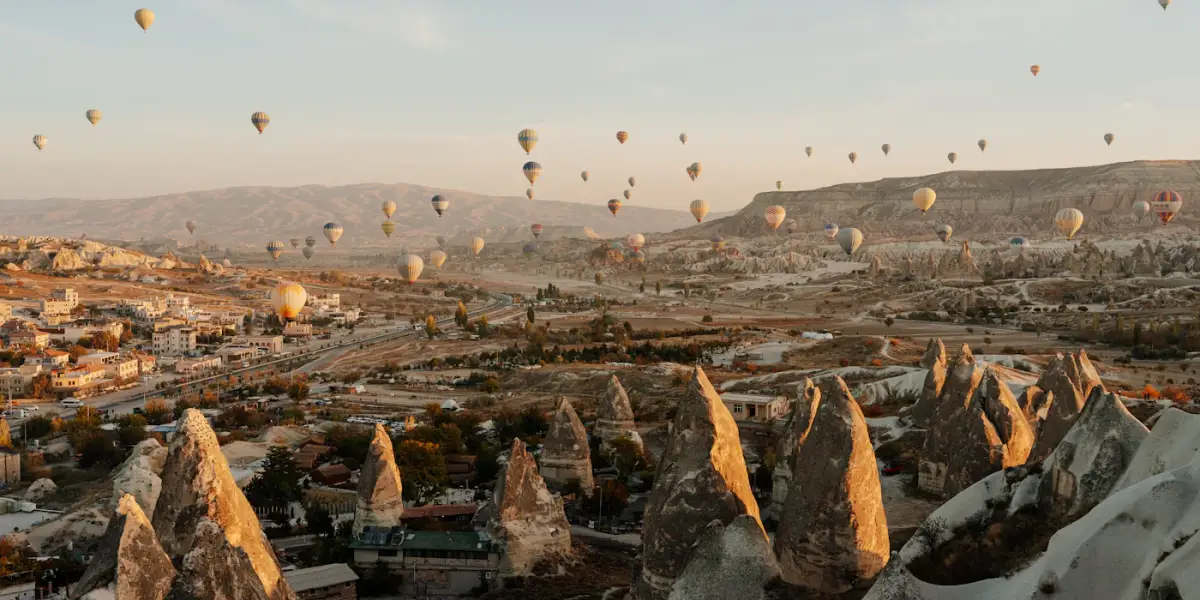
HeritageFairy-chimney valleys, sunrise balloons, cave hotels, frescoed rock churches and underground cities.
2 nightsabout 2 h 30 min by flight from Istanbul airportBest Sep–Oct
Cappadocia (Göreme)
HeritageFairy-chimney valleys, sunrise balloons, cave hotels, frescoed rock churches and underground cities.
Millions of years ago Mount Erciyes and Mount Hasan buried this part of central Anatolia in volcanic ash, which hardened into soft rock that wind and rain have carved into cones, pillars and canyons, the 'fairy chimneys'. People hollowed homes, churches and pigeon houses out of them and dug whole settlements underground. Göreme, in the middle of the landscape and a short walk from its Open-Air Museum, is the main base, with Uçhisar, Ürgüp and Avanos as other choices, and cave hotels are the local speciality.
What to do in Cappadocia (Göreme)
- Balloons at sunrise. Balloons go up at dawn, when the wind is lightest, and where they fly depends on each morning's conditions; from the ground, Lovers' Hill (Aşıklar Tepesi) and the rim of Love Valley are good places to watch.
- Göreme Open-Air Museum. A UNESCO-listed cluster of rock-cut churches and monks' quarters in use from the 4th to the 13th century; the Dark Church kept its frescoes vivid because so little light reached them, and Tokalı Church sits just outside the main enclosure.
- Kaymaklı and Derinkuyu underground cities. South of Nevşehir, tunnels lead down through stables, storerooms, wineries, chapels and shared kitchens to about 85 m at Derinkuyu; the kitchens have tandoor ovens of the kind Cappadocian villages still use.
- Walk the valleys. Pigeon Valley is a downhill walk of about 4 km from Uçhisar to Göreme, and Rose, Red and Meskendir valleys join into a five-hour hike past rock churches; set off at dawn to beat the heat and the tour jeeps.
- Uçhisar Castle and Avanos pottery. Climb the hollowed-out rock of Uçhisar for a view over Göreme, Çavuşin and Pigeon Valley, then visit a workshop in Avanos, where potters have shaped clay from the Kızılırmak river since Hittite times.
Autumn is mild and dry, September especially; spring brings heavy thunderstorms, summer days are hot, and winters are cold and snowy.
Sources: GoTürkiye: Cappadocia, GoTürkiye: 48 hours in Cappadocia, GoTürkiye: See Cappadocia, GoTürkiye Cultural Journeys: Hot-air balloon, Ministry of Culture and Tourism museums: Göreme Open Air Museum, Ministry of Culture and Tourism museums: Kaymaklı Underground City, Ministry of Culture and Tourism museums: Derinkuyu Underground City, Wikivoyage: Cappadocia, Wikivoyage: Göreme, Wikivoyage: Nevşehir, Wikivoyage: Kayseri (checked 14 Oct)
Pamukkale and Hierapolis
HeritageWhite travertine terraces you wade up barefoot, a warm spring-fed pool and a Roman spa city on the hilltop.
1 nightabout 2 h 30 min by flight from Istanbul airportBest May–Jun
Pamukkale and Hierapolis
HeritageWhite travertine terraces you wade up barefoot, a warm spring-fed pool and a Roman spa city on the hilltop.
Pamukkale, 'cotton castle', is a hillside of glaring white travertine terraces and shallow pools laid down by hot, mineral-laden springs, with the ruins of the Roman spa city of Hierapolis spread over the plateau above. The terraces and the ancient city are both on the UNESCO list and are visited together through any of three gates. Hotels were cleared off the plateau when it was protected, so places to stay are in Pamukkale village at the foot of the terraces, about 20 km north of Denizli.
What to do in Pamukkale and Hierapolis
- Wade up the travertines. Only one cascade of pools, from the town gate up to the museum, is open to walkers; shoes are not allowed on the travertine, the pools are shin-deep and crowded, so wear shorts and go carefully.
- Explore Hierapolis. See the Roman city's restored theatre, which seats about 12,000 and is carved with scenes from myth, then walk Frontinus Street and the long necropolis of tombs to the Martyrium of St Philip the Apostle.
- Swim in the Antique Pool. Also called Cleopatra's Pool, it is fed by warm spring water, with pieces of fluted columns lying on the bottom.
- Laodikeia. A large Roman city near Denizli whose early Christian church is among the seven in Asia that the Book of Revelation addresses.
- Karahayıt red springs. A few kilometres north, outside the main site, iron in the water stains a smaller set of terraces rust-red; it is a good stop with small children.
Late spring and early summer are best; in high summer there is no shade and the white rock glares, the pools can run dry late in the season, and in winter the water is cold underfoot.
Sources: GoTürkiye: Pamukkale, GoTürkiye: See Pamukkale, Wikivoyage: Pamukkale, Wikivoyage: Denizli (checked 14 Oct)
Ephesus and Selçuk
HeritageThe marble streets, Library of Celsus and great theatre of Roman Ephesus, with St John's Basilica in Selçuk.
1–2 nightsabout 2 h by flight from Istanbul airport
Ephesus and Selçuk
HeritageThe marble streets, Library of Celsus and great theatre of Roman Ephesus, with St John's Basilica in Selçuk.
Ephesus grew up around an ancient shrine of the goddess Artemis and became the capital of Rome's province of Asia and an early centre of Christianity, where St Paul preached; as the river silted up and the coast retreated, the port died and the city was left inland. The ruins lie 4 km west of Selçuk, a small town that makes a handy base and has sights of its own on Ayasuluk Hill; the beach resort of Kuşadası, about 19 km away, is the other choice.
What to do in Ephesus and Selçuk
- Curetes Street to the Library of Celsus. Enter at the upper gate and walk downhill past the Temple of Hadrian to the library's facade, built from 117 AD and pieced back together from its fragments in the 1970s; in summer go early, as there is little shade.
- Terrace Houses. Under a protective roof above the main street, the homes of wealthy Ephesians keep their marble and mosaics, seen from raised walkways.
- The Great Theatre. Cut into the hillside for about 24,000 spectators; this is where St Paul is said to have backed away from a crowd chanting for Artemis.
- Ayasuluk Hill in Selçuk. The ruined basilica raised under Justinian over the traditional tomb of St John the Apostle stands below a Byzantine citadel, and at the foot of the hill a single re-erected column marks the site of the Temple of Artemis, counted among the ancient world's Seven Wonders.
- House of the Virgin Mary and Şirince. Up on Bülbül Mountain, a short drive from Selçuk, a small house revered by Christian and Muslim pilgrims is said to be where Mary spent her last years; Şirince, in the hills east of Selçuk, is a village of old Greek houses known for its wine and olive oil.
Sources: Ministry of Culture and Tourism museums: Ephesus, GoTürkiye: See İzmir, Wikivoyage: Ephesus, Wikivoyage: Selçuk (checked 14 Oct)
Istanbul: Beyoğlu and Galata
CityGalata Tower views, İstiklal Avenue and its vintage tram, Bosphorus ferries and the heart of the city's nightlife.
1–2 nightsabout 1 h from Istanbul airportBest May–Jun, Sep–Oct
Istanbul: Beyoğlu and Galata
CityGalata Tower views, İstiklal Avenue and its vintage tram, Bosphorus ferries and the heart of the city's nightlife.
Across the Golden Horn from the old city, Galata rose to prominence as a Genoese trading colony, and Beyoğlu above it, the old European quarter of Pera, grew in the 19th century into the city's diplomatic quarter, while Galata was its financial centre. Its spine is İstiklal Avenue, a 2 km pedestrian street from the Galata Tower end up to Taksim Square, lined with shops, restaurants, cinemas and churches, with cafés and bars in the lanes on either side. It suits travellers who want food and nightlife on the doorstep, and funiculars link it to the ferry piers at Karaköy and Kabataş.
What to do in Istanbul: Beyoğlu and Galata
- Galata Tower. The Genoese raised the present tower in the 14th century, and the walkway around its top looks across the Golden Horn to the old city's palace, domes and minarets, Hagia Sophia and the Blue Mosque among them; a sunset visit leads nicely into an evening in Beyoğlu.
- İstiklal Avenue. Walk from Tünel Square to Taksim past old arcades such as Çiçek Pasajı and the Hagia Triada church, or ride the red vintage tram that runs the length of the street.
- Galata Mevlevi Lodge. Istanbul's oldest lodge of the Mevlevi order, the Sufi followers of the poet Rumi, was founded in 1491 and is now a museum of the order with a quiet garden.
- Cross the Bosphorus by ferry. Public ferries from Karaköy, Kabataş and Eminönü reach Kadıköy and Üsküdar on the Asian side in minutes, and the long Bosphorus trip from Eminönü runs north past palaces, Ottoman-era waterfront mansions and Rumeli Fortress towards the Black Sea.
- Dolmabahçe Palace. The European-style palace on the water at Beşiktaş, where the late Ottoman sultans moved from Topkapı and where Atatürk died in 1938; allow about three hours to see everything.
Late May to early June and late September to early October are the most pleasant; July and August are warm and humid, and December to March is chilly with frequent rain.
Sources: GoTürkiye: Beyoğlu, GoTürkiye: Bosphorus, GoTürkiye: 3 historical towers of İstanbul, GoTürkiye: İstanbul's most famous architectural wonders, GoTürkiye: Top 10 things to do in İstanbul, Wikivoyage: Istanbul/Galata, Wikivoyage: Istanbul/European Bosphorus, Wikivoyage: Istanbul, Wikivoyage: Turkey (checked 14 Oct)
Antalya and Kaleiçi
CityA walled old harbour town, long city beaches, a waterfall into the sea and Roman theatres within a short drive.
2–3 nightsabout 2 h by flight from Istanbul airportBest Apr–May, Oct–Nov
Antalya and Kaleiçi
CityA walled old harbour town, long city beaches, a waterfall into the sea and Roman theatres within a short drive.
Antalya is the big city of the Turkish Mediterranean, set between the Taurus Mountains and the sea and surrounded by the resort strip known as the Turkish Riviera. Its old quarter, Kaleiçi, sits inside a horseshoe of walls beside the old Roman harbour, a maze of lanes and tile-roofed houses now full of small hotels, cafés and shops. Konyaaltı beach runs west of the centre and sandy Lara beach to the east, and the Roman cities of Perge and Aspendos are within easy reach.
What to do in Antalya and Kaleiçi
- Hadrian's Gate and the old town. Enter Kaleiçi through the triple arch built for Emperor Hadrian's visit in 130 AD and wander down through the lanes to the harbour.
- Fluted Minaret. The 38 m Seljuk minaret of the Yivli Minare mosque rises over a group of old madrasas and a former lodge of the Mevlevi dervishes.
- Boat to the Düden waterfall. Boat trips from the old harbour run along the cliffs to the Lower Düden falls, where the river drops about 40 m straight into the sea.
- Antalya Museum. One of Turkey's largest museums, best known for the Roman statues found at Perge.
- Perge and Aspendos. East of the city, Perge has colonnaded streets, baths and a stadium, and Aspendos has one of the best-preserved Roman theatres in the world, along with long stretches of aqueduct.
April-May and October-November are best for sightseeing, and the sea stays warm well into autumn; summer days run at 30-35°C, and winter brings storms and heavy rain.
Sources: GoTürkiye: Antalya, GoTürkiye: See Antalya, GoTürkiye: 48 hours in Antalya, Wikivoyage: Antalya (checked 14 Oct)
Fethiye and Ölüdeniz
BeachThe calm Blue Lagoon at Ölüdeniz, tandem paragliding off Babadağ, Lycian rock tombs and island boat days.
2–3 nightsabout 2 h 30 min by flight from Istanbul airportBest Sep–Oct
Fethiye and Ölüdeniz
BeachThe calm Blue Lagoon at Ölüdeniz, tandem paragliding off Babadağ, Lycian rock tombs and island boat days.
Fethiye is a harbour town at the western end of Turkey's Mediterranean coast, built over the Lycian city of Telmessos, whose temple-fronted tombs are cut into the cliff above the streets. Just south, the resort of Ölüdeniz curls around a sheltered lagoon below the 1,969 m Babadağ, with the abandoned 'ghost village' of Kayaköy in the hills between the two. Dalaman airport is about an hour away from either by road.
What to do in Fethiye and Ölüdeniz
- Ölüdeniz Blue Lagoon. The lagoon's water lies flat and calm; its spit is pebbly, so bring beach shoes, while Belceğiz beach beside it is sandy and the easiest for small children.
- Tandem paragliding from Babadağ. Pilots take beginners off the top of the mountain for a long glide down to land on the beach; wear proper trainers and something warm, as it is cold at the launch.
- Twelve Islands boat trip. Day cruises from Fethiye harbour stop at several islets around the bay for swimming and snorkelling, with lunch on board.
- Rock tombs and Kayaköy. Climb to the 4th-century BC Tomb of Amyntas above town, best in the evening light, or walk the first 9 km stage of the Lycian Way over the hill to the roofless stone houses of Kayaköy.
- Saklıkent Gorge. South-east of Fethiye, walkways lead into a canyon up to 300 m deep where, in summer, you can wade up the cold river; in winter the water is too high to enter.
September and October are cooler than high summer, when days reach 30-35°C, while the sea is still around 24°C.
Sources: GoTürkiye: Fethiye, GoTürkiye: Ölüdeniz, GoTürkiye: Paragliding, GoTürkiye: Telmessos, GoTürkiye: Saklıkent Canyon, GoTürkiye: The ghost town, Fethiye's Kayaköy village, Wikivoyage: Fethiye, Wikivoyage: Ölüdeniz, Wikivoyage: Dalaman (checked 14 Oct)
Bodrum
BeachA harbour town under a Knights Hospitaller castle, with bays, gulet trips, sandy beaches nearby and busy nightlife.
2–3 nightsabout 2 h by flight from Istanbul airportBest Jun–Oct
Bodrum
BeachA harbour town under a Knights Hospitaller castle, with bays, gulet trips, sandy beaches nearby and busy nightlife.
Bodrum stands on the site of ancient Halicarnassus, whose tomb of Mausolus gave the world the word 'mausoleum' and was counted among the ancient world's Seven Wonders. Its castle, which the Knights Hospitaller raised in the 1400s partly with stone taken from that tomb, guards a harbour of wooden gulets, and the peninsula around it is ringed with bays and resort villages. In season it fills with Turkish and foreign holidaymakers and is known for its nightlife.
What to do in Bodrum
- Bodrum Castle and the Museum of Underwater Archaeology. The towers of the Castle of St Peter now display finds from ancient wrecks off this coast, the highlight being the Bronze Age Uluburun ship and its cargo of copper ingots.
- Mausoleum of Halicarnassus. Only the foundations remain of the 45 m tomb, toppled by earthquakes and quarried for the castle, and exhibits on the site tell its story.
- A day on a gulet. Boats of the traditional wooden kind built in Bodrum leave the harbour for swimming stops around the bays and islands of the peninsula, such as Kara Ada.
- Sunset at Gümüşlük. This fishing village on the west of the peninsula is known for its sunsets, watched over meze and fish from tables set right at the water's edge.
- Pick a beach. The town beaches are pebbly but fine for swimming; for sand, head west to Gümbet or Bitez.
May suits sightseeing on land, but the sea lags about a month behind, so June to October, with the water above 24°C, is the time for swimming and boat trips.
Sources: GoTürkiye: Bodrum, GoTürkiye: See Bodrum, GoTürkiye: 48 hours in Bodrum, GoTürkiye: Touch Bodrum, Wikivoyage: Bodrum (checked 14 Oct)
Princes' Islands
IslandDay tripCar-free islands of wooden summer mansions, pine woods and bike rides, a ferry ride from central Istanbul.
about 2 h 30 min by boat from Istanbul airportBest Apr–May, Sep–Oct
Princes' Islands
IslandDay tripCar-free islands of wooden summer mansions, pine woods and bike rides, a ferry ride from central Istanbul.
The Princes' Islands are a group of nine islands lying roughly 5 km off Istanbul's Asian shore in the Sea of Marmara, where from the mid-19th century Greek, Jewish and Armenian merchant families built wooden summer mansions. There are no private cars, so people walk, cycle or ride electric minibuses. Büyükada, the largest, has the most to see, and many visitors come just for the day: the ferry takes about 90 minutes from the European-side piers and 45 from the Asian side.
What to do in Princes' Islands
- Büyükada's mansions. Walk east or west from the clock-tower square near the pier to find the 19th-century wooden summer houses, among them the ruined villa where Trotsky lived in exile.
- Climb to St George's church. A steep 30-minute path from Birlik Meydanı leads to the Greek Orthodox church at the highest point of the islands, with views over the rest of the archipelago.
- Cycle round Büyükada. Bikes can be hired near the pier, and electric minibuses run to the centre of the island and down its east coast; the horse carriages were retired in 2020.
- Swim away from the piers. All four main islands have beaches, from sand to rocks and bathing platforms, and the water gets better on the far sides of the islands, with good spots on Burgazada and Kınalıada.
- Heybeliada. The second-largest island, ten minutes from Büyükada by ferry, has the old Halki seminary on its hilltop and a park on its northern headland.
April-May and September-October are pleasant and uncrowded; June to August is crowded, and from November to March the islands are gloomy, with cold winds.
Sources: GoTürkiye: Princes' Islands, Wikivoyage: Istanbul/Princes' Islands, Wikivoyage: Istanbul (checked 14 Oct)
A first trip: 7–10 nights
- Istanbul old city (Sultanahmet) · 2–3n
- →Cappadocia (Göreme) · 2n
- →Pamukkale and Hierapolis · 1n
- →Ephesus and Selçuk · 1–2n
- →Istanbul: Beyoğlu and Galata · 1–2n
Start in Istanbul's old city, fly to Nevşehir or Kayseri for Cappadocia, then take the overnight bus (about 10 hours) or fly back through Istanbul to Denizli for Pamukkale; trains and buses go on to Selçuk for Ephesus, and from İzmir airport, 55 km north, fly back to Istanbul for the last nights in Beyoğlu. Spring and autumn suit the loop (late May and late September in Istanbul, autumn in Cappadocia, late spring at Pamukkale); for beach days add Bodrum, where the sea is warm from June to October, or Fethiye and Antalya in autumn, and in winter expect cold rain in Istanbul and snow in Cappadocia.
Getting around
Turkey is large and mountainous, so most visitors fly between regions: domestic routes to Istanbul are frequent and competitive, and even smaller cities have at least a daily flight. Long-distance buses with reserved seats leave the otogar (bus station) of every big town for almost anywhere, which suits shorter hops such as Pamukkale to Selçuk; the fast YHT trains reach Ankara and Konya from Istanbul in under five hours, but the Aegean and Mediterranean resorts have no railway. Within Cappadocia and around Fethiye, dolmuş minibuses run between the towns.
Peak Shoulder Off-season
GoTürkiye calls spring and autumn the most pleasant seasons and describes warm, humid summers of 25 to 30°C and cool, wet winters of 5 to 10°C. May to September are the warm, dry months; November to March is cold and the wettest stretch of the year.
Flights to Turkey from India
Visa for Indian passports
Indian passport holders need a visa for Turkey before travel. Allow about 21 days for a first-time application. 30-day e-Visa if you hold a valid US, UK, Irish or Schengen visa or residence permit. Otherwise a sticker visa via the Turkish mission or VFS.
Before you book, check the Ministry of External Affairs travel advisories for the latest guidance.
Turkey: questions
What are the best places to visit in Turkey?
Istanbul old city (Sultanahmet): Hagia Sophia, the Blue Mosque, Topkapı Palace and the Grand Bazaar, close together inside the old walls. Cappadocia (Göreme): Fairy-chimney valleys, sunrise balloons, cave hotels, frescoed rock churches and underground cities. Pamukkale and Hierapolis: White travertine terraces you wade up barefoot, a warm spring-fed pool and a Roman spa city on the hilltop. Ephesus and Selçuk: The marble streets, Library of Celsus and great theatre of Roman Ephesus, with St John's Basilica in Selçuk. Istanbul: Beyoğlu and Galata: Galata Tower views, İstiklal Avenue and its vintage tram, Bosphorus ferries and the heart of the city's nightlife. Antalya and Kaleiçi: A walled old harbour town, long city beaches, a waterfall into the sea and Roman theatres within a short drive. Fethiye and Ölüdeniz: The calm Blue Lagoon at Ölüdeniz, tandem paragliding off Babadağ, Lycian rock tombs and island boat days. Bodrum: A harbour town under a Knights Hospitaller castle, with bays, gulet trips, sandy beaches nearby and busy nightlife. Princes' Islands: Car-free islands of wooden summer mansions, pine woods and bike rides, a ferry ride from central Istanbul.
How many days do you need for Turkey?
A first trip takes about 7–10 nights: Istanbul old city (Sultanahmet) (2–3 nights), Cappadocia (Göreme) (2 nights), Pamukkale and Hierapolis (1 night), Ephesus and Selçuk (1–2 nights), Istanbul: Beyoğlu and Galata (1–2 nights). Start in Istanbul's old city, fly to Nevşehir or Kayseri for Cappadocia, then take the overnight bus (about 10 hours) or fly back through Istanbul to Denizli for Pamukkale; trains and buses go on to Selçuk for Ephesus, and from İzmir airport, 55 km north, fly back to Istanbul for the last nights in Beyoğlu. Spring and autumn suit the loop (late May and late September in Istanbul, autumn in Cappadocia, late spring at Pamukkale); for beach days add Bodrum, where the sea is warm from June to October, or Fethiye and Antalya in autumn, and in winter expect cold rain in Istanbul and snow in Cappadocia.
What is the best time to visit Turkey?
Peak season is May–Sep. GoTürkiye calls spring and autumn the most pleasant seasons and describes warm, humid summers of 25 to 30°C and cool, wet winters of 5 to 10°C. May to September are the warm, dry months; November to March is cold and the wettest stretch of the year.
Do Indians need a visa for Turkey?
Indian passport holders need a visa for Turkey before travel. Allow about 21 days for a first-time application. 30-day e-Visa if you hold a valid US, UK, Irish or Schengen visa or residence permit. Otherwise a sticker visa via the Turkish mission or VFS.
How much is a flight to Turkey from India?
The lowest return fare FlyBun has seen in the last 14 days is ₹22,355, Delhi to Istanbul, for March 2027 departures. Fares change daily.
Places and things to do are written by FlyBun from official tourism, heritage and park sources, linked under each place, last checked 14 Oct. We leave out entry fees and opening hours because they change; check them before you go.
Watch a route and FlyBun alerts you free when its fare drops.