

Travel guide from India
London and the UK
Britain is a long-haul flight from India, and most first trips begin in London, about 45 minutes from Heathrow. From there you can head out to royal Windsor, the colleges of Oxford, the stone villages of the Cotswolds, Roman Bath and Stonehenge, then north through York to Edinburgh and the lochs and mountains of the Scottish Highlands. London's large South Asian communities mean Hindu temples, gurdwaras and Indian food, vegetarian included, are easy to find.
- Best time
- Jun–Aug
- First trip
- 12–17 nights
- Visa
- Visa needed, 180 days
- Return flights
- from ₹46,816 ●
- Mumbai, checked in the last 48 h
Places to visit in London and the UK
11 places in the order you would meet them on a first trip. Tap one for what to do there.
London
CityWestminster, the Tower and Crown Jewels, big museums, Thames walks, food markets and Lord's, the home of cricket.
4–5 nights45 min by train from London airportBest Jun–Sep
London
CityWestminster, the Tower and Crown Jewels, big museums, Thames walks, food markets and Lord's, the home of cricket.
London is Britain's capital and biggest city, a patchwork of neighbourhoods along the Thames, from the parliament and abbey at Westminster to the Tower of London further east and the galleries and markets of the South Bank. Heathrow is roughly 45 minutes from the centre on the Heathrow Express, the Elizabeth line or the Tube. London is famous for its Indian food, and Drummond Street, just behind Euston station, has a run of mostly Indian vegetarian restaurants.
What to do in London
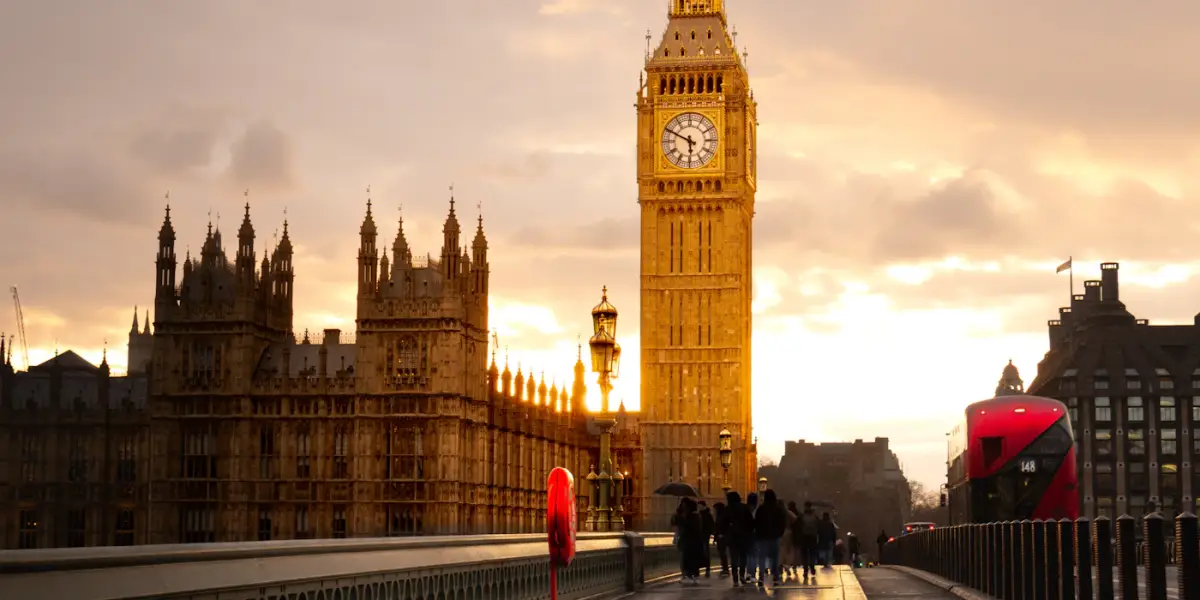
- Westminster and the Abbey. Start at the neo-Gothic Houses of Parliament and the Elizabeth Tower, which holds the Big Ben bell, then cross to Westminster Abbey, the coronation church, where many past monarchs are buried.
- Tower of London and Tower Bridge. The fortress William the Conqueror began in 1066 guards the Crown Jewels, and Beefeaters lead tours; next door a lift takes you up Tower Bridge to walkways with glass floors over the river.
- South Kensington museums. The V&A's South and South-East Asian collections run to nearly 60,000 objects, from Mughal jades to Tipu's Tiger, made for Tipu Sultan of Mysore, and the nearby Natural History Museum has a dinosaur gallery and a blue whale towering over its entrance hall.
- South Bank to Borough Market. Walk east along the river from the 135 m London Eye, past Tate Modern in a converted power station, to Borough Market, a food market with roots in the 13th century.
- Lord's, the home of cricket. The St John's Wood ground usually stages two Test matches each summer, and its MCC Museum holds the original Ashes urn among a large collection of cricket memorabilia.
Summer has the longest days and average highs in the low to mid 20s °C in July and August; September keeps plenty of daylight and some sights are quieter once schools go back, while winter days are short.
Sources: VisitBritain: London, VisitBritain: Travelling to Britain (Heathrow transfer time), VisitBritain: Travelling around Britain, Westminster Abbey (official site), V&A: Tipu's Tiger, V&A: South Asia collection, Wikivoyage: London, Wikivoyage: Heathrow Airport, Wikivoyage: London/Westminster, Wikivoyage: London/City of London, Wikivoyage: London/South Bank, Wikivoyage: London/South Kensington-Chelsea, Wikivoyage: London/Paddington-Maida Vale (Lord's), Wikivoyage: Cricket (checked 14 Oct)
Indian London: Neasden, Southall and Wembley
CityDay tripEurope's first traditional Hindu stone mandir, Southall's great gurdwara and its langar, and Indian food streets.
about 30 min by train from London airport
Indian London: Neasden, Southall and Wembley
CityDay tripEurope's first traditional Hindu stone mandir, Southall's great gurdwara and its langar, and Indian food streets.
West and north-west London have large communities of Indian origin, and a half-day out here is a taste of home for many visitors. Neasden's BAPS Shri Swaminarayan Mandir, Europe's first traditional Hindu stone temple, is a short bus ride from Wembley Park station, and Southall, often called Little India, is a few stops from Heathrow on the Elizabeth line.
What to do in Indian London: Neasden, Southall and Wembley
- BAPS Shri Swaminarayan Mandir, Neasden. Over 5,000 tonnes of Bulgarian limestone and Italian and Indian marble were carved by hand at sites across India into 26,300 pieces, then fitted together in London like a giant jigsaw, with no structural steel.
- Dress and etiquette at the mandir. The mandir asks that tops cover the shoulders and upper arms and that clothing reach below the knee; shoes come off on entering, and photography is not allowed indoors.
- Gurdwara Sri Guru Singh Sabha, Southall. The Guru Nanak Road gurdwara's main hall seats up to 3,000, and the langar hall serves strictly vegetarian meals to all comers; cover your head (scarves are kept at the entrance) and take off your shoes before entering the prayer hall.
- Eat in Southall and Wembley. Both are known for their Indian restaurants and takeaways.
- Wembley Stadium. The stadium's giant arch is often lit up for special occasions, and stadium tours go behind the scenes at what it calls the home of football.
Sources: BAPS Shri Swaminarayan Mandir London (official site), BAPS Shri Swaminarayan Mandir London: The Mandir, BAPS Shri Swaminarayan Mandir London: How it was made, BAPS Shri Swaminarayan Mandir London: Getting here, BAPS Shri Swaminarayan Mandir London: Visitor guidelines, Sri Guru Singh Sabha Southall (official site), Sri Guru Singh Sabha Southall: History, Sri Guru Singh Sabha Southall: Visits, Wembley Stadium (official site), Wikivoyage: London, Wikivoyage: London/West, Wikivoyage: London/North, Wikivoyage: Heathrow Airport (checked 14 Oct)
Windsor and Eton
HeritageDay tripThe world's oldest and largest occupied castle, Queen Elizabeth II's resting place and LEGOLAND, close to Heathrow.
about 30 min from London airport
Windsor and Eton
HeritageDay tripThe world's oldest and largest occupied castle, Queen Elizabeth II's resting place and LEGOLAND, close to Heathrow.
Windsor grew up beside its castle, which William the Conqueror founded in the 11th century, home to 40 monarchs since and still one of the King's official residences. The town is about 8 miles from Heathrow and under an hour from London by train, with Eton and its college, founded by Henry VI in 1440, across a footbridge over the Thames. Being so close to the airport, it suits the first or last day of a trip.
What to do in Windsor and Eton
- Windsor Castle's State Apartments. The ceremonial rooms used for state visits hang paintings by Van Dyck and Rubens, and Queen Mary's Dolls' House, finished in 1924, has electric light, working lifts and running water.
- St George's Chapel. Queen Elizabeth II lies in the King George VI Memorial Chapel here, and ten other monarchs are buried in the chapel, Henry VIII and Charles I among them.
- Changing the Guard. On guard-change days the soldiers march through the town to the castle, usually with a band; the schedule shifts month by month, so check it first.
- The Long Walk and Windsor Great Park. The Long Walk runs from the castle to the Copper Horse statue across Windsor Great Park, 4,800 acres of meadows and woods where you can spot deer.
- LEGOLAND Windsor. The LEGO-brick theme park, not far from the town centre, is aimed at younger children.
Sources: Visit Windsor (official tourist information), Visit Windsor: Windsor Castle, Visit Windsor: Top 10 things to do, Visit Windsor: Windsor Great Park, Visit Windsor: Eton, VisitBritain: Royalty, Wikivoyage: Windsor and Eton (checked 14 Oct)
Oxford
HeritageDay tripThe UK's oldest university city: Christ Church, the Bodleian, the Ashmolean, punting and Blenheim Palace nearby.
1 h 30 min from London airport
Oxford
HeritageDay tripThe UK's oldest university city: Christ Church, the Bodleian, the Ashmolean, punting and Blenheim Palace nearby.
Oxford's university dates from the 12th century and is the oldest English-speaking university, made up of about 40 colleges with no single campus, whose spires fill a flat, compact centre that is easy to walk. Trains from London Paddington or Marylebone take about an hour, so it is an easy day out from London, or a stop on the way to the Cotswolds.
What to do in Oxford
- Christ Church. Cardinal Wolsey founded the college in 1525; it has its own small cathedral, and its Tudor dining hall inspired the Great Hall of Hogwarts in the Harry Potter films.
- Radcliffe Square and the Bodleian. The Bodleian Library opened in 1602, and beside it stands the round Radcliffe Camera of 1737–49, a students' reading room best admired from the square.
- The Ashmolean. Founded in 1683, Britain's oldest public museum covers ancient Egypt, Greece and Rome, Western art and a sizeable Eastern art collection.
- Go punting. In summer you can hire a wooden punt and push it along the river with a pole yourself, or hire someone to do the punting.
- Blenheim Palace. Eight miles north-west in Woodstock, Winston Churchill's birthplace is a World Heritage Site with gardens landscaped by Capability Brown, and local buses run there from Oxford.
Sources: Experience Oxfordshire (official tourism site): Oxford, Experience Oxfordshire: Plan your trip, Experience Oxfordshire: Woodstock and Blenheim Palace, Wikivoyage: Oxford (checked 14 Oct)
The Cotswolds
Hill countryVillages of honey-coloured stone, wool churches and footpaths across rolling limestone hills between Oxford and Bath.
1–2 nightsabout 2 h from London airport
The Cotswolds
Hill countryVillages of honey-coloured stone, wool churches and footpaths across rolling limestone hills between Oxford and Bath.
The Cotswolds are an area of limestone hills covering almost 800 square miles across five counties, scattered with villages and market towns of golden stone and grand 'wool churches' paid for by the medieval wool trade. Trains reach only a few towns such as Moreton-in-Marsh, so a car or a guided tour from Oxford or Bath is the easiest way round. The best-known villages fill up with day-trippers at summer weekends, which makes an overnight stay the way to see them quiet.
What to do in The Cotswolds
- Bourton-on-the-Water. The River Windrush runs through the middle of the village under low stone bridges, and the Model Village is a one-ninth-scale copy of Bourton itself.
- Walk to the Slaughters. A well-used circular footpath across farmland links Bourton with the neighbouring villages known as the Slaughters.
- Chipping Campden. Laid out in the late 12th century as a planned market town, it has a Market Hall of 1627, the wool church of St James and the start of the 104-mile Cotswold Way, which runs south to Bath.
- Broadway and Broadway Tower. Broadway's wide high street is lined with honey-coloured stone houses, and the hilltop folly of Broadway Tower above it, once an occasional home of William Morris, is known for its views.
Sources: Cotswolds Tourism (official): Welcome to the Cotswolds, Cotswolds Tourism: Getting around the Cotswolds, Cotswolds Tourism: Bourton-on-the-Water, Cotswolds Tourism: Chipping Campden, Cotswolds Tourism: Broadway, Cotswolds National Landscape, Experience Oxfordshire: The Cotswolds, Wikivoyage: Cotswolds (checked 14 Oct)
Bath and Stonehenge
HeritageRoman baths on hot springs, Georgian crescents, a rooftop spa pool and Stonehenge within a day trip.
2 nightsabout 2 h 30 min by train from London airport
Bath and Stonehenge
HeritageRoman baths on hot springs, Georgian crescents, a rooftop spa pool and Stonehenge within a day trip.
Bath is the UK's only city designated a World Heritage Site by UNESCO; it grew up around hot springs that the Romans turned into a bathing complex about 2,000 years ago, and was rebuilt in honey-coloured Georgian terraces in the 18th century. GWR trains from London Paddington take about 80 minutes. The city is also a base for day trips to Stonehenge, the prehistoric stone circle on Salisbury Plain, and to villages such as Lacock and Castle Combe.
What to do in Bath and Stonehenge
- The Roman Baths. Walk round the open-air Great Bath and the Roman rooms beside it, fed by England's only mineral hot springs, and taste the filtered spa water at a fountain near the exit.
- The Circus and the Royal Crescent. John Wood the Elder designed the Circus, a ring of townhouses his son finished in 1768, and the sweeping Royal Crescent followed in 1774; No. 1 Royal Crescent is furnished to show Georgian home life.
- Thermae Bath Spa. Bathe in the same natural hot spring water at a modern spa whose rooftop pool looks out across the city's roofs and hills.
- Stonehenge. Start at the visitor centre and ride the shuttle or walk across the chalk downs to the circle, begun around 3000 BC, with bluestones brought from Wales.
- Salisbury Cathedral. Salisbury, a rail gateway for Stonehenge, has a Gothic cathedral built between 1220 and 1258 whose 123 m spire is the highest in the UK.
Sources: Visit Bath (official tourist guide), Visit Bath: Top ten things to do, Visit Bath: Travelling to Bath, Visit Bath: World Heritage city, National Trust: Stonehenge Landscape, Wikivoyage: Bath, Wikivoyage: Stonehenge, Wikivoyage: Salisbury (England) (checked 14 Oct)
York
HeritageRoman-founded, once Viking-ruled: walls to walk, the Minster's medieval glass, the Shambles and a huge railway museum.
1–2 nightsabout 3 h by train from London airport
York
HeritageRoman-founded, once Viking-ruled: walls to walk, the Minster's medieval glass, the Shambles and a huge railway museum.
The Romans founded York in 71 AD and the Vikings later made it their own, and its compact, mostly pedestrian centre keeps much of its medieval wall, with the Minster rising over the rooftops. It sits on the East Coast main line about 2 hours from London King's Cross and 2.5 hours from Edinburgh, so it breaks the journey north neatly.
What to do in York
- York Minster. Christianity's centre in northern England since the 7th century, the cathedral is famed for its medieval stained glass, and 275 steps climb its central tower to the highest viewpoint in the city.
- Walk the city walls. The walls, medieval stonework on Roman foundations, make a circuit of about 2 miles, and the stretch from Bootham Bar to Monk Bar runs right by the Minster.
- The Shambles. Overhanging timber-framed buildings lean over this narrow medieval street, once the butchers' row and now full of gift shops and places to eat.
- Jorvik Viking Centre. A ride carries you through a reconstruction of 10th-century Viking York, built on the dig where the real Jorvik was found, with commentary in 15 languages.
- National Railway Museum. Beside the station, it holds Queen Victoria's Royal Train, Stephenson's Rocket, the Mallard and a first-generation Japanese shinkansen.
Sources: York Minster (official site), Wikivoyage: York, Wikivoyage: Heathrow Airport (checked 14 Oct)
Edinburgh
CityA castle on volcanic rock, the Royal Mile down to Holyrood, the Georgian New Town and Arthur's Seat to climb.
2–3 nightsabout 5 h 30 min by train from London airportBest May–Sep
Edinburgh
CityA castle on volcanic rock, the Royal Mile down to Holyrood, the Georgian New Town and Arthur's Seat to climb.
Scotland's capital is split between the medieval Old Town, strung along the Royal Mile from the castle down to Holyrood Palace, and the elegant Georgian New Town laid out from the 1770s; together they have been a UNESCO World Heritage Site since 1995. LNER trains from London King's Cross take as little as 4 hours 20 minutes to Waverley station, between the two towns, and the centre is compact enough to explore on foot.
What to do in Edinburgh
- Edinburgh Castle. Set on volcanic rock above the city and in use for some 1,100 years, the castle keeps the Honours of Scotland (Scotland's crown jewels) and the 12th-century St Margaret's Chapel.
- Down the Royal Mile to Holyroodhouse. The old main street runs downhill from the castle to the Palace of Holyroodhouse, the King's official home in Scotland, where you can see Mary Queen of Scots' bedchamber.
- Climb Arthur's Seat. The 251 m summit of an extinct volcano rises right inside the city; the gentlest way up is from the east side, and the top looks over the city to the Firth of Forth.
- National Museum of Scotland. Galleries range from Scottish history to science and natural history, and Dolly the sheep and the 12th-century Lewis chessmen are among the stars.
- Calton Hill. A short paved path leads up to the Parthenon-inspired National Monument and wide views across the city skyline.
May to September is the most comfortable time to visit, though August, festival month, is the busiest time of year, and New Year (Hogmanay) is crowded too.
Sources: VisitScotland: Edinburgh, VisitScotland: Things to do in Edinburgh, VisitScotland: 72 hours in Edinburgh, Wikivoyage: Edinburgh, Wikivoyage: Edinburgh/Old Town, Wikivoyage: Heathrow Airport (checked 14 Oct)
Inverness, Loch Ness and the Highlands
Hill countryLoch Ness and Urquhart Castle, the Culloden battlefield, Glencoe and Ben Nevis, with Inverness as the base.
2–3 nightsabout 2 h 30 min by flight from London airportBest Jun–Aug
Inverness, Loch Ness and the Highlands
Hill countryLoch Ness and Urquhart Castle, the Culloden battlefield, Glencoe and Ben Nevis, with Inverness as the base.
Inverness, the Highlands' one sizeable city, is the usual base for Loch Ness, the Culloden battlefield and the Cairngorms. British Airways flies there from Heathrow, LNER and the overnight Caledonian Sleeper run from London, and trains from Edinburgh take about 4 hours. Midges, tiny biting flies, are about from roughly May to October, worst on calm mornings and evenings, so pack repellent.
What to do in Inverness, Loch Ness and the Highlands
- Loch Ness and Urquhart Castle. Boat trips leave from Inverness, Drumnadrochit and Fort Augustus on the 23-mile loch, which holds more fresh water than every lake in England and Wales put together, and the ruins of 13th- to 16th-century Urquhart Castle stand on a headland near Drumnadrochit.
- Culloden Battlefield. Near Inverness, the battlefield marks the final Jacobite Rising and the last pitched battle fought on British soil.
- Glencoe. The main road north runs through this glacier-carved valley, ten miles long and under half a mile wide, beneath the Three Sisters ridges, scene of the infamous Glencoe Massacre of 1692.
- Ben Nevis and Fort William. Half an hour on from Glencoe, Fort William is the town for Ben Nevis, the UK's highest mountain.
- Isle of Skye. On a longer trip, cross the Skye Bridge from Kyle of Lochalsh to an island of mountain ranges and long coastline, where some roads are single-track and buses also run from Inverness.
June to August are Scotland's warmest months, with average highs around 17°C, and the days are long, with the far north never getting fully dark at midsummer.
Sources: VisitScotland: The Highlands, VisitScotland: Inverness, VisitScotland: Loch Ness, VisitScotland: Glencoe, VisitScotland: Fort William, VisitScotland: Isle of Skye, VisitScotland: Weather in Scotland, VisitScotland: Midges and ticks, Wikivoyage: Inverness, Wikivoyage: Loch Ness, Wikivoyage: Glencoe, Wikivoyage: Scotland (checked 14 Oct)
The Lake District
Hill countryEngland's largest national park: lake boats on Windermere, walks round Buttermere and England's highest peak.
2 nightsabout 4 h 30 min by train from London airportBest Mar–Jun
The Lake District
Hill countryEngland's largest national park: lake boats on Windermere, walks round Buttermere and England's highest peak.
The Lake District in Cumbria is England's largest national park, also on UNESCO's World Heritage list, with 16 bodies of water and more than 350 fells, including Scafell Pike, England's highest mountain, and Wastwater, its deepest lake. West Coast main line trains from London stop at Oxenholme near Kendal, where a branch line runs to Windermere, and a direct train also runs from Manchester; buses and lake boats link the main villages.
What to do in The Lake District
- Cruise Windermere. England's longest lake, 10.5 miles end to end, has passenger boats calling at Lakeside, Bowness, Wray Castle, Brockhole and Ambleside.
- Walk round Buttermere. In the quieter north-west, a 4-mile path circles the lake beneath Haystacks, the favourite fell of the guidebook writer Alfred Wainwright.
- Derwentwater from Keswick. A launch makes a roughly 50-minute loop of the lake from Keswick, calling at a string of landing stages round the shore.
- Coniston Water. The National Trust runs a rebuilt Victorian steam yacht on this five-mile glacial lake below the Old Man of Coniston, beside a village shaped by old mining and quarrying.
The visitor season runs from March to October and March to June is usually the driest stretch, though rain is frequent all year and the weather can turn within a day.
Sources: Lake District National Park Authority: Facts and figures, Lake District National Park Authority: Getting to and around, Lake District National Park Authority: Lake District weather, Lake District National Park Authority: Explore the Southern Lakes, Lake District National Park Authority: Explore the Northern Lakes, Wikivoyage: Lake District National Park, Wikivoyage: Windermere (checked 14 Oct)
Manchester
CityOld Trafford and the Etihad, Test cricket, the National Football Museum and the Curry Mile in Rusholme.
1–2 nightsabout 3 h 30 min by train from London airport
Manchester
CityOld Trafford and the Etihad, Test cricket, the National Football Museum and the Curry Mile in Rusholme.
Once nicknamed Cottonopolis after its most famous export, Manchester has turned old mills and warehouses into shops, museums and restaurants, and it is a must for football fans, with Manchester United at Old Trafford and Manchester City at the Etihad. Avanti trains run from London Euston in just over 2 hours, and direct trains go on to York and to Windermere in the Lake District, so it suits a west-coast route north.
What to do in Manchester
- Old Trafford, football and cricket. Manchester United's 75,000-capacity ground offers stadium tours, and the Lancashire cricket ground in the same district hosts five-day Test matches against sides such as India.
- The Etihad. Manchester City's 55,000-capacity stadium, built for the 2002 Commonwealth Games, has a club museum and tours; take the tram to Etihad Campus.
- National Football Museum. England's national museum of the game fills six floors of the sloping glass Urbis building near Victoria station, with a Hall of Fame for great players and managers.
- Science and Industry Museum. Built around one terminus of the world's first passenger railway, it runs working cotton-weaving machines and tells how the city's mill workers lived.
- The Curry Mile, Rusholme. An 800 m stretch of curry houses, sari shops and jewellers in the university quarter.
Sources: VisitBritain: Manchester, VisitBritain: Britain's best footballing cities, Wikivoyage: Manchester, Wikivoyage: Manchester/The Quays, Wikivoyage: Manchester/North, Wikivoyage: Manchester/Victoria-Shopping District, Wikivoyage: Manchester/Castlefield-Petersfield, Wikivoyage: York (Manchester-York trains), Lake District National Park Authority: Getting to and around (checked 14 Oct)
A first trip: 12–17 nights
- London · 4–5n
- →Indian London: Neasden, Southall and Wembley
- →Windsor and Eton
- →Oxford
- →The Cotswolds · 1–2n
- →Bath and Stonehenge · 2n
- →York · 1–2n
- →Edinburgh · 2–3n
- →Inverness, Loch Ness and the Highlands · 2–3n
Fly into Heathrow and base yourself in London, with a half-day in Neasden or Southall, then head west past Windsor and Oxford to stay in the Cotswolds and in Bath for Stonehenge, before taking the train north to York, Edinburgh and Inverness and flying back to Heathrow from there. Scotland is warmest, with the longest days, from June to August; Manchester and the Lake District make a west-coast alternative to York.
Getting around
Trains cover most of the route: Great Western Railway runs from London Paddington to Oxford and Bath, LNER runs up the east coast from King's Cross to York, Edinburgh and Inverness, and Avanti West Coast runs from Euston to Manchester and the Lake District. In London, contactless bank cards and phone payments work across the Tube, buses and trains. The Cotswolds, where trains reach only a few towns, and the remoter Highland glens are easiest by car or on a guided tour.
Peak Shoulder Off-season
Derived from NASA POWER climate normals: June to August are the warmest, lightest months and the school-holiday peak; April, May, September and October are mild with similar rain; November to March is cold, damp and dark by late afternoon. December is busy for Christmas lights despite the weather.
Flights to London and the UK from India
Visa for Indian passports
Indian passport holders need a visa for UK before travel. Allow about 28 days for a first-time application. Standard Visitor visa with VFS biometrics, about 3 weeks; paid priority options exist.
Before you book, check the Ministry of External Affairs travel advisories for the latest guidance.
London and the UK: questions
What are the best places to visit in London and the UK?
London: Westminster, the Tower and Crown Jewels, big museums, Thames walks, food markets and Lord's, the home of cricket. Indian London: Neasden, Southall and Wembley: Europe's first traditional Hindu stone mandir, Southall's great gurdwara and its langar, and Indian food streets. Windsor and Eton: The world's oldest and largest occupied castle, Queen Elizabeth II's resting place and LEGOLAND, close to Heathrow. Oxford: The UK's oldest university city: Christ Church, the Bodleian, the Ashmolean, punting and Blenheim Palace nearby. The Cotswolds: Villages of honey-coloured stone, wool churches and footpaths across rolling limestone hills between Oxford and Bath. Bath and Stonehenge: Roman baths on hot springs, Georgian crescents, a rooftop spa pool and Stonehenge within a day trip. York: Roman-founded, once Viking-ruled: walls to walk, the Minster's medieval glass, the Shambles and a huge railway museum. Edinburgh: A castle on volcanic rock, the Royal Mile down to Holyrood, the Georgian New Town and Arthur's Seat to climb. Inverness, Loch Ness and the Highlands: Loch Ness and Urquhart Castle, the Culloden battlefield, Glencoe and Ben Nevis, with Inverness as the base. The Lake District: England's largest national park: lake boats on Windermere, walks round Buttermere and England's highest peak. Manchester: Old Trafford and the Etihad, Test cricket, the National Football Museum and the Curry Mile in Rusholme.
How many days do you need for London and the UK?
A first trip takes about 12–17 nights: London (4–5 nights), Indian London: Neasden, Southall and Wembley (1 night), Windsor and Eton (1 night), Oxford (1 night), The Cotswolds (1–2 nights), Bath and Stonehenge (2 nights), York (1–2 nights), Edinburgh (2–3 nights), Inverness, Loch Ness and the Highlands (2–3 nights). Fly into Heathrow and base yourself in London, with a half-day in Neasden or Southall, then head west past Windsor and Oxford to stay in the Cotswolds and in Bath for Stonehenge, before taking the train north to York, Edinburgh and Inverness and flying back to Heathrow from there. Scotland is warmest, with the longest days, from June to August; Manchester and the Lake District make a west-coast alternative to York.
What is the best time to visit London and the UK?
Peak season is Jun–Aug. Derived from NASA POWER climate normals: June to August are the warmest, lightest months and the school-holiday peak; April, May, September and October are mild with similar rain; November to March is cold, damp and dark by late afternoon. December is busy for Christmas lights despite the weather.
Do Indians need a visa for UK?
Indian passport holders need a visa for UK before travel. Allow about 28 days for a first-time application. Standard Visitor visa with VFS biometrics, about 3 weeks; paid priority options exist.
How much is a flight to London and the UK from India?
The lowest return fare FlyBun has seen in the last 14 days is ₹46,816, Mumbai to London, for November 2026 departures. Fares change daily.
Places and things to do are written by FlyBun from official tourism, heritage and park sources, linked under each place, last checked 14 Oct. We leave out entry fees and opening hours because they change; check them before you go.
Watch a route and FlyBun alerts you free when its fare drops.