

Travel guide from India
Uzbekistan
Uzbekistan is a short flight from north India, and its Silk Road cities of Samarkand, Bukhara and Khiva are full of tiled mosques, madrasahs and mausoleums inside old centres that UNESCO lists as World Heritage. The history runs close to India's: Timur, who captured Delhi, is buried in Samarkand, and his descendant Babur, founder of the Mughal dynasty, came from the Fergana Valley. Meals lean on mutton, beef and bread, but the tourism board says staff will offer vegetarian dishes if you ask.
- Best time
- Apr–May, Sep–Oct
- First trip
- 7–10 nights
- Visa
- e-Visa, 30 days
- Return flights
- from ₹30,328 ●
- Delhi, checked in the last 48 h
Places to visit in Uzbekistan
7 places in the order you would meet them on a first trip. Tap one for what to do there.
Tashkent
CityThe arrival city: Soviet-era boulevards, ornate metro stations, the Khast Imam complex and Chorsu Bazaar.
2 nightsabout 30 min from Tashkent airportBest Apr–May, Sep–Oct
Tashkent
CityThe arrival city: Soviet-era boulevards, ornate metro stations, the Khast Imam complex and Chorsu Bazaar.
Tashkent is the capital and largest city, and most of it is modern: an earthquake in 1966 wrecked much of the city, which was rebuilt with long, wide Soviet boulevards. The oldest buildings are in the quarter around Chorsu Bazaar, and the airport is only about 8 km south of the centre. Domestic flights to Urgench and Nukus use a separate terminal on the other side of the runway, so leave time if you connect straight from an international arrival.
What to do in Tashkent
- Khast Imam complex. This old-town group of mosques and madrasahs grew up around the tomb of Kaffal Shashi, the city's first imam, and its Moyi Mubarek library keeps a 7th-century Quran manuscript linked to the caliph Uthman.
- Chorsu Bazaar. Spices, fruit and vegetables fill the big central dome and craft stalls the smaller ones, and the 16th-century Kukeldash madrasah stands close by.
- Ride the metro. Opened in 1977, the metro gives every station its own design, from mosaics and portraits to Kosmonavtlar's tribute to the Soviet space programme, and it is a fast way around the centre.
- Amir Temur Square and the Temurid museum. A bronze statue of Timur on horseback stands in the square, and the domed State Museum of the Temurids next to it, opened in 1996, covers his dynasty with letters, jewellery and models of its buildings.
- Lal Bahadur Shastri memorial. A bronze bust and a street named after him remember India's prime minister, who died in Tashkent in January 1966, hours after signing the Tashkent Declaration with Pakistan.
Tashkent has hot summers and cold winters; April-May and September-October are the most comfortable months to visit.
Sources: Uzbekistan Tourism: Tashkent, Uzbekistan Tourism: The complex of Khazrati Imam, Uzbekistan Tourism: Muyi Muborak madrasah, Uzbekistan Tourism: Kukeldash madrasah, Uzbekistan Tourism: Tashkent Metropolitan, Uzbekistan Tourism: Amir Temur Square, Uzbekistan Tourism: The State Museum of the Temurids History, UzA (national news agency): Tribute paid to the memory of Lal Bahadur Shastri, Uzbekistan Tourism: Travel Guideline, Uzbekistan Tourism: Travel tips, Wikivoyage: Tashkent (checked 14 Oct)
Samarkand
HeritageTimur's capital: the Registan, his tomb at Gur-e-Amir and the blue-tiled street of tombs at Shah-i-Zinda.
2–3 nightsabout 3 h by train from Tashkent airportBest Apr–May, Sep–Oct
Samarkand
HeritageTimur's capital: the Registan, his tomb at Gur-e-Amir and the blue-tiled street of tombs at Shah-i-Zinda.
Samarkand became the capital of Timur's empire in 1369, and most of the domes and portals visitors come for date from the Timurid heyday that followed; the old city is a UNESCO World Heritage Site. The main sights fall into two clusters you can walk between, the Registan with Gur-e-Amir, and Bibi-Khanym with Siyob Bazaar and Shah-i-Zinda, while the Ulugbek Observatory is a short ride beyond the Afrosiyob mound.
What to do in Samarkand
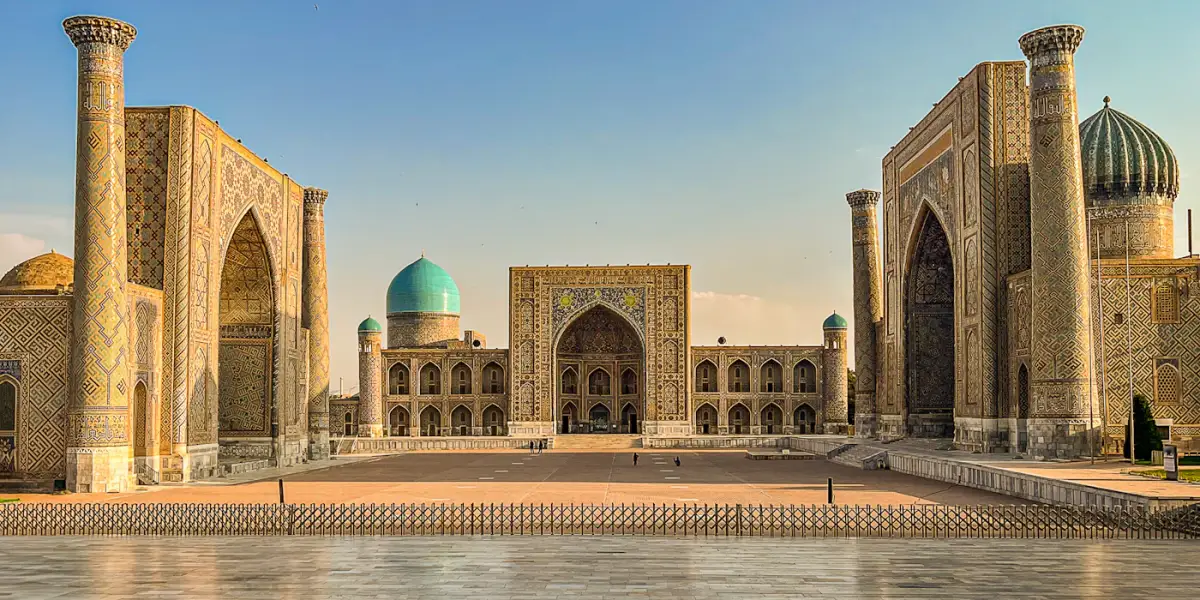
- The Registan. Three madrasahs face the square: Ulugbek's from 1417, Sher-Dor from 1619, whose portal unusually shows big cats hunting deer, and Tilla-Kori, which also served as the city's main mosque.
- Gur-e-Amir, Timur's tomb. Built for his grandson, the mausoleum became the family crypt where Timur lies beneath a block of jade; his descendant Babur went on to found the Mughal dynasty in India.
- Shah-i-Zinda. A stepped lane of tiled mausoleums on a small hill, gathered around the shrine of Qusam ibn Abbas, a cousin of the Prophet Muhammad, and still a place of pilgrimage, so women should cover shoulders, back and legs.
- Bibi-Khanym Mosque and Siyob Bazaar. Timur's great mosque, begun after his Indian campaign, fell apart over the centuries and has been rebuilt since 1974; the bazaar next door sells dried fruit, nuts, halva and Samarkand's famous bread.
- Ulugbek Observatory. Timur's grandson Ulugbek, a ruler and astronomer who catalogued over a thousand stars, built his observatory around a sextant with a 36 m radius; its underground part was found again in 1908.
Summers are hot and winters cold, so April-May and September-October are the best months to visit.
Sources: Uzbekistan Tourism: Samarkand, Uzbekistan Tourism: Registan Square, Uzbekistan Tourism: Sherdor Madrasah, Uzbekistan Tourism: The Ulughbek Madrasah, Uzbekistan Tourism: The memorial ensemble Shakhi-Zinda, Uzbekistan Tourism: Bibi-Khanym Mosque, Uzbekistan Tourism: Ancient Settlement Afrasiab, Uzbekistan Railways: Transport, Wikivoyage: Samarkand, Wikivoyage: Ferghana Valley, Wikivoyage: Uzbekistan (checked 14 Oct)
Shakhrisabz
HeritageDay tripTimur's hometown: the giant gate towers of his ruined White Palace and his family's tombs, a day out from Samarkand.
about 4 h 30 min by train from Tashkent airport
Shakhrisabz
HeritageDay tripTimur's hometown: the giant gate towers of his ruined White Palace and his family's tombs, a day out from Samarkand.
Timur was born in a village near Shakhrisabz in 1336 and set out to make the town his second capital; its historic centre is a UNESCO World Heritage Site. It is an easy day out from Samarkand, about 90 minutes by car over a mountain pass of roughly 1,780 m, which may close between January and March and force a detour of about three hours.
What to do in Shakhrisabz
- Ak-Saray, the White Palace. Work on Timur's palace began in 1380 and ran for over two decades; only the stumps of its entrance portal survive, and the arch they once carried collapsed long ago.
- Kok-Gumbaz mosque and Dorut Tilovat. Ulugbek's Friday mosque of 1435, named for its blue dome, faces the tomb of Sheikh Shamsiddin Kulal, Timur's spiritual teacher, in a complex where Timur's father is also buried.
- Jahangir's tomb and Timur's crypt. The tomb of Timur's eldest son is what remains of the family memorial, and nearby an underground crypt found in 1963 holds the stone coffin thought to have been meant for Timur, who was buried in Samarkand instead.
- Shakhrisabz embroidery. The town's embroidery uses a flat stitch that hides the base cloth completely; look for it on purses and cushions in the craft shops of the old centre.
Sources: Uzbekistan Tourism: Shakhrisabz, Uzbekistan Tourism: The Ak-Saray Palace in Shakhrisabz, Uzbekistan Tourism: Ensemble Dorut Tilovat, Wikivoyage: Shakhrisabz, Wikivoyage: Samarkand (checked 14 Oct)
Bukhara
HeritageOver 2,500 years old: a walkable old town of domed bazaars, madrasahs, the Kalyan Minaret and the Ark fortress.
2–3 nightsabout 5 h by train from Tashkent airport
Bukhara
HeritageOver 2,500 years old: a walkable old town of domed bazaars, madrasahs, the Kalyan Minaret and the Ark fortress.
Bukhara is more than 2,500 years old, and its historic centre, a UNESCO World Heritage Site since 1993, is compact and mostly pedestrianised, so it is best seen on foot. Much of what stands dates from the 16th century, when the centre was one long Silk Road market of madrasahs, mosques, caravanserais and covered bazaars. The railway station is in Kogon, about 15 km south-east, while the airport is only 4 km from the centre.
What to do in Bukhara
- Po-i-Kalyan. The 45.6 m Kalyan Minaret, built in 1127, outlasted Genghis Khan's destruction of the complex around it and now stands between the Kalyan Mosque, finished in 1515, and the blue-tiled Mir-i-Arab madrasah.
- Lyabi-Hauz. The Soviets filled in the city's old pools in the 1920s and 30s but kept this one, framed by the Kukeldash madrasah and the Nadir Divan-Begi madrasah and khanaka, with a bronze statue of the folk hero Khoja Nasreddin nearby.
- The trading domes. Domed bazaars still trade along the old streets: Toqi Sarrafon once held the moneychangers, Toqi Telpak Furushon the cap-makers and Toqi Zargaron the jewellers, and Tim Abdullah Khan sells carpets; haggle everywhere.
- The Ark. The rulers' fortress, behind mud-brick walls up to 20 m high, once held palaces, barracks and the mint; you enter by the west gate to a museum, the throne room and a mosque, while the eastern half is unrestored.
- Samanid Mausoleum. A small cube of baked brick built between 892 and 907 for the Samanid ruler Ismail Samani and his father, its patterned brickwork changing look as the sun moves through the day.
Sources: Uzbekistan Tourism: Bukhara, Uzbekistan Tourism: Poi-Kalon architectural ensemble, Uzbekistan Tourism: Lyabi-Hauz ensemble, Uzbekistan Tourism: Tim Abdullah Khan Trading Dome, Uzbekistan Tourism: Ark Citadel, Uzbekistan Tourism: 10 amazing facts about the Samanid Mausoleum, Wikivoyage: Bukhara (checked 14 Oct)
Khiva
HeritageA walled desert town of mud-brick ramparts, tiled minarets and khans' palaces, small enough to explore on foot.
1–2 nightsabout 2 h 30 min by flight from Tashkent airportBest Mar–Apr
Khiva
HeritageA walled desert town of mud-brick ramparts, tiled minarets and khans' palaces, small enough to explore on foot.
Khiva's walled inner town, Itchan Kala, packs mosques, madrasahs, minarets and the khans' palaces into about 26 hectares, and it became a UNESCO World Heritage Site in 1990. People still live and work inside the walls, though much of it was restored to a very tidy finish in the 1970s, and the modern town spreads outside. Khiva is about 40 km from Urgench airport, which has flights back to Tashkent.
What to do in Khiva
- The city walls. About 2.2 km of the sun-dried brick ramparts still stand, 6 to 8 m high, and archaeologists date their oldest sections to the 5th or 6th century.
- Kalta Minor. The squat minaret near the west gate is wrapped in white, blue and green glazed tiles; work stopped at 26 m after the khan behind it died in 1855.
- Juma Mosque. A prayer hall with no domes, its flat roof held up by more than 200 carved wooden columns, a few of them from the 10th to 14th centuries; bring a torch if you climb the minaret's steps.
- Kunya-Ark. The khans' fortress-residence, finished in 1688, has an open-air summer mosque in blue and white tiles and a throne room with a lookout tower above it.
- Pahlavan Mahmud Mausoleum. The shrine of a 13th-century wrestler, poet and healer, also revered in Persia and India, is one of the country's most popular pilgrimage sites, and under its turquoise dome it later became the burial place of Khiva's khans.
Spring, roughly six weeks from mid-March, is among the best seasons for a visit; by August the heat can hit 45°C, and it turns cold by November.
Sources: Uzbekistan Tourism: Khiva, Uzbekistan Tourism: Ichan-Kala, Uzbekistan Tourism: Kunya-Ark Fortress, Uzbekistan Tourism: Paklavon Makhmud Mausoleum, Uzbekistan Tourism: Travel tips, Wikivoyage: Khiva, Wikivoyage: Urgench (checked 14 Oct)
Fergana Valley (Fergana, Margilan, Kokand)
HeritageBabur's homeland and the country's craft heartland: silk in Margilan, pottery in Rishtan, a khan's palace in Kokand.
2 nightsabout 5 h 30 min by train from Tashkent airport
Fergana Valley (Fergana, Margilan, Kokand)
HeritageBabur's homeland and the country's craft heartland: silk in Margilan, pottery in Rishtan, a khan's palace in Kokand.
Ringed by mountains in the east of the country, the Fergana Valley is Uzbekistan's most fertile and populous region, and its towns are known for crafts such as silk weaving and pottery. Babur, founder of the Mughal dynasty, was born in Andijan, the son of the valley's ruler. Fergana city, founded in 1876, has few old sights and works as a base for day trips, and this is a strongly Islamic region, so dress modestly.
What to do in Fergana Valley (Fergana, Margilan, Kokand)
- Babur memorial park, Andijan. On Bogishamol hill, about 7 km from Andijan, a memorial park holds earth brought from Agra, where Babur died, and from Kabul, where he is buried, with a symbolic tomb set up in 1993 next to a museum of his and his descendants' writings.
- Silk in Margilan. Margilan is the home of khan-atlas, the many-coloured patterned silk once called royal fabric, and at its best-known silk factory most of the dyeing and weaving is still done by hand.
- Rishtan potters. About 50 km from Fergana, Rishtan's potters shape the local red clay into azure-glazed dishes, and its craftsmen's centre of more than 20 workshops runs on the old master-and-apprentice system, with a ceramics museum alongside.
- Kokand. The capital of the Kokand khanate from 1709 to 1876 keeps 19 rooms of Khudoyar Khan's palace of 1871 as a museum, and its Jami Mosque, built 1800-1812, can hold 10,000 worshippers.
Sources: Uzbekistan Tourism: Ferghana, Uzbekistan Tourism: Babur Memorial Park and House Museum, Uzbekistan Tourism: The colors of the Khan-atlas, Uzbekistan Tourism: Rishtan ceramics, Uzbekistan Tourism: Kokand, Uzbekistan Tourism: Khudoyar Khan Palace, Wikivoyage: Ferghana Valley (Uzbekistan), Wikivoyage: Ferghana Valley, Wikivoyage: Ferghana, Wikivoyage: Kokand, Wikivoyage: Uzbekistan, Wikivoyage: Tashkent (checked 14 Oct)
Nukus and the Aral Sea
CityThe Savitsky Museum's Soviet-era avant-garde art, and the ship graveyard on the dried-up Aral Sea bed.
1 nightabout 2 h by flight from Tashkent airport
Nukus and the Aral Sea
CityThe Savitsky Museum's Soviet-era avant-garde art, and the ship graveyard on the dried-up Aral Sea bed.
Nukus is the capital of Karakalpakstan, the autonomous republic in the country's north-west, and most travellers stay a single night to see the Savitsky collection. It is also the base for trips to Muynak, about 200 km away, a former fishing port left standing in desert as the Aral Sea shrank. Nukus is about 200 km from Khiva, so it fits after the Khiva stop, and there are direct flights from Tashkent.
What to do in Nukus and the Aral Sea
- Savitsky Museum. Igor Savitsky, who first came here in 1950, gathered thousands of works by Soviet artists who painted outside the approved socialist realism; the museum opened in 1966, and the tourism board ranks its Russian avant-garde holdings second in size worldwide.
- Muynak ship graveyard. The remains of Muynak's fishing fleet lie on the old seabed at the edge of town; the drive takes three to three and a half hours each way, so leave early for a day trip.
- Museum of Applied Arts. Close to the Savitsky Museum, it shows Karakalpak fabrics, traditional clothing and jewellery.
Sources: Uzbekistan Tourism: Nukus, Uzbekistan Tourism: Savitsky State Museum of Arts, Uzbekistan Tourism: Muynak, Wikivoyage: Nukus, Wikivoyage: Khiva, Wikivoyage: Uzbekistan (checked 14 Oct)
A first trip: 7–10 nights
Land in Tashkent, take the fast train to Samarkand (with a day out to Shakhrisabz) and on to Bukhara, cross the desert to Khiva by train or road, then fly back to Tashkent from Urgench. Aim for spring or autumn (April-May and September-October in Tashkent and Samarkand, mid-March to April in Khiva): June to August is the hottest stretch, and from January to March the pass road to Shakhrisabz can close.
Getting around
Uzbekistan Railways' Afrosiyob high-speed train runs from Tashkent to Samarkand in roughly two and a half hours and on to Bukhara, with slower day and overnight trains on the same line; fast trains often sell out, so plan these legs early. Khiva lies far to the west across the desert: the standard route continues from Bukhara by road or train, and flights link Urgench, about 40 km from Khiva, with Tashkent in about an hour and a half. Tashkent has a metro, and in Tashkent and Samarkand taxis can be called through ride-hailing apps.
Peak Shoulder Off-season
Uzbekistan's tourism portal calls spring and autumn the velvet season and warns of 40-day chillya spells: extreme heat from late June to early August and deep cold from mid-December to late January. Highs in July and August pass 35°C, so sightseeing then means early mornings.
Flights to Uzbekistan from India
Visa for Indian passports
Indian passport holders need an e-visa for Uzbekistan, applied for online before travel (allow about 7 days). Visa-free up to 30 days if you hold a valid multiple-entry US, UK, Schengen, Canada, Australia, Japan, South Korea or NZ visa, plus an onward ticket. e-Visa (about US$20, single entry) at e-visa.gov.uz, about 2 working days; apply at least 3 working days before travel.
Before you book, check the Ministry of External Affairs travel advisories for the latest guidance.
Uzbekistan: questions
What are the best places to visit in Uzbekistan?
Tashkent: The arrival city: Soviet-era boulevards, ornate metro stations, the Khast Imam complex and Chorsu Bazaar. Samarkand: Timur's capital: the Registan, his tomb at Gur-e-Amir and the blue-tiled street of tombs at Shah-i-Zinda. Shakhrisabz: Timur's hometown: the giant gate towers of his ruined White Palace and his family's tombs, a day out from Samarkand. Bukhara: Over 2,500 years old: a walkable old town of domed bazaars, madrasahs, the Kalyan Minaret and the Ark fortress. Khiva: A walled desert town of mud-brick ramparts, tiled minarets and khans' palaces, small enough to explore on foot. Fergana Valley (Fergana, Margilan, Kokand): Babur's homeland and the country's craft heartland: silk in Margilan, pottery in Rishtan, a khan's palace in Kokand. Nukus and the Aral Sea: The Savitsky Museum's Soviet-era avant-garde art, and the ship graveyard on the dried-up Aral Sea bed.
How many days do you need for Uzbekistan?
A first trip takes about 7–10 nights: Tashkent (2 nights), Samarkand (2–3 nights), Shakhrisabz (1 night), Bukhara (2–3 nights), Khiva (1–2 nights). Land in Tashkent, take the fast train to Samarkand (with a day out to Shakhrisabz) and on to Bukhara, cross the desert to Khiva by train or road, then fly back to Tashkent from Urgench. Aim for spring or autumn (April-May and September-October in Tashkent and Samarkand, mid-March to April in Khiva): June to August is the hottest stretch, and from January to March the pass road to Shakhrisabz can close.
What is the best time to visit Uzbekistan?
Peak season is Apr–May, Sep–Oct. Uzbekistan's tourism portal calls spring and autumn the velvet season and warns of 40-day chillya spells: extreme heat from late June to early August and deep cold from mid-December to late January. Highs in July and August pass 35°C, so sightseeing then means early mornings.
Do Indians need a visa for Uzbekistan?
Indian passport holders need an e-visa for Uzbekistan, applied for online before travel (allow about 7 days). Visa-free up to 30 days if you hold a valid multiple-entry US, UK, Schengen, Canada, Australia, Japan, South Korea or NZ visa, plus an onward ticket. e-Visa (about US$20, single entry) at e-visa.gov.uz, about 2 working days; apply at least 3 working days before travel.
How much is a flight to Uzbekistan from India?
The lowest return fare FlyBun has seen in the last 14 days is ₹29,765, Delhi to Tashkent, for December 2026 departures. Fares change daily.
Places and things to do are written by FlyBun from official tourism, heritage and park sources, linked under each place, last checked 14 Oct. We leave out entry fees and opening hours because they change; check them before you go.
Watch a route and FlyBun alerts you free when its fare drops.