

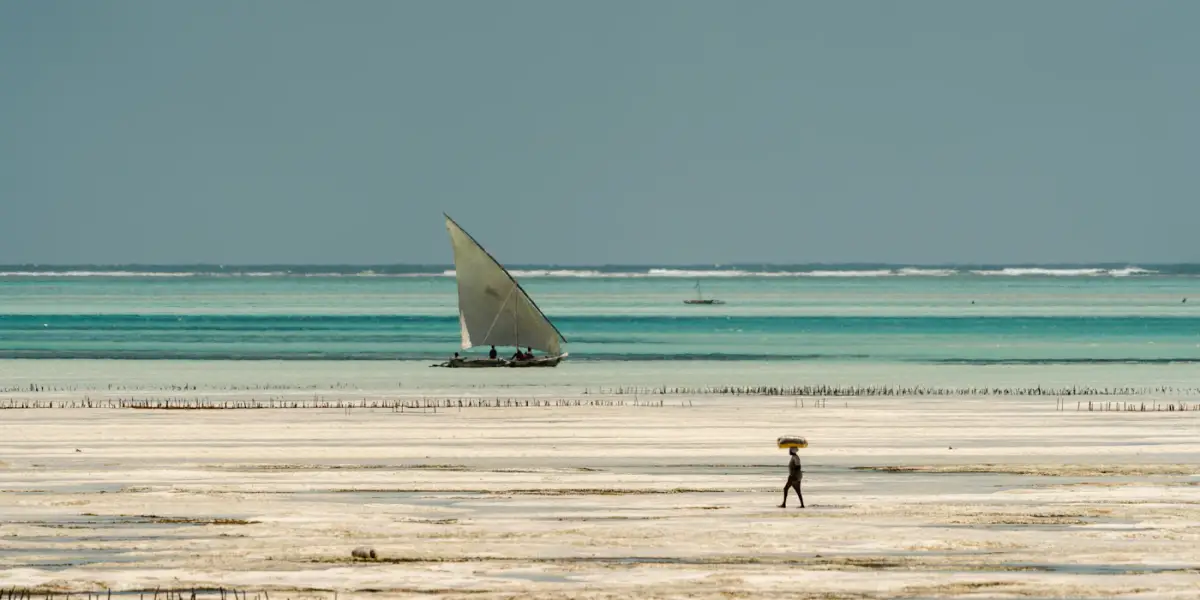
Travel guide from India
Zanzibar
Zanzibar is an island in the Indian Ocean off mainland Tanzania, and flights from India usually connect through a Gulf hub such as Dubai, Doha or Muscat, or through Addis Ababa or Nairobi. Its old town, Stone Town, is a UNESCO-listed Swahili trading port whose buildings blend African, Arab, Persian, Indian and European styles, and Tanzania has a sizeable Indian community descended from colonial-era migrants. Beyond the town lie spice farms, a forest of rare red colobus monkeys and long white beaches with coral reefs offshore.
- Best time
- Jun–Sep
- First trip
- 8–9 nights
- Visa
- e-Visa, 90 days
- Return flights
- from ₹51,904 ●
- Mumbai, checked in the last 48 h
Places to visit in Zanzibar
9 places in the order you would meet them on a first trip. Tap one for what to do there.
Stone Town
CityUNESCO-listed old port of carved doors, sultans' palaces and a slave-market memorial, with a seafront night market.
2–3 nightsabout 30 min from Zanzibar airportBest Jan–Feb, Jun–Sep
Stone Town
CityUNESCO-listed old port of carved doors, sultans' palaces and a slave-market memorial, with a seafront night market.
Stone Town is the old quarter of Zanzibar City, on a promontory on the island's west coast about 5 km north of the airport. Its lanes of coral-stone houses, most of them from the 19th century, grew up on the sea trade between Africa and Asia, and UNESCO listed the town in 2000 for its mix of Swahili, Arab, Indian and European building traditions and for its place in the history of the slave trade and its abolition. It is the natural base for the island's history, food and day trips.
What to do in Stone Town
- Walk the old town. A local guide can lead you past coral-stone houses with carved double doors, the narrow-fronted Indian shops of the old bazaar streets, the Ismaili jamat khana and the Hamamni Persian baths built for Sultan Barghash; cover arms and legs, as Zanzibar is largely Muslim.
- Former slave market. Visitors can go down into the cramped holding cells, where 50 men were kept in one and 75 women and children in the other, beside the Anglican Christ Church that rose on the site in memory of Livingstone's fight against the trade, its altar said to stand where the whipping post was.
- Old Fort. The square fort the Omanis built in the 17th century, where a Portuguese church once stood, has a cultural centre with craft workshops and a small arena for music and dance, and beside it the House of Wonders, Sultan Barghash's 1883 palace, has been closed since 2014 and partly collapsed in 2020.
- Supper at Forodhani Gardens. After sunset, stalls in this seafront garden in front of the Old Fort sell grilled seafood, sugar-cane juice and Zanzibar pizza, a savoury stuffed pancake whose standard filling is beef and egg; quality varies and touts work the crowd.
- Boat to Prison Island. Boatmen on the beach near the ferry port take visitors out to Changuu, a small island that has served as both a prison and a quarantine station, to see giant tortoises whose colony began as a gift from the Seychelles.
Rain peaks in April and May and comes back in November and December; June to September and January to February are the driest months.
Sources: UNESCO World Heritage Centre: Stone Town of Zanzibar (Internet Archive copy), Zanzibar Commission for Tourism: Changuu (Internet Archive copy), Wikivoyage: Stone Town, Wikivoyage: Zanzibar, Wikivoyage: Tanzania (people, climate) (checked 14 Oct)
Spice farms
HeritageDay tripGuided walks through clove, cinnamon, nutmeg and vanilla plantations on the island long called the Spice Island.
about 30 min from Zanzibar airport
Spice farms
HeritageDay tripGuided walks through clove, cinnamon, nutmeg and vanilla plantations on the island long called the Spice Island.
Zanzibar's old place in the spice trade earned it the name Spice Island, and farms in the Kizimbani area and elsewhere on the island run guided walks through their plantations. Guides show how cloves, cinnamon, nutmeg, vanilla, ginger and cardamom are grown and used in cooking and medicine, then hand round tropical fruit to taste. Tours from Stone Town often add the palace ruins at Maruhubi and the Persian baths at Kidichi.
What to do in Spice farms
- Walk a plantation. Guides point out cloves, cinnamon, nutmeg, vanilla, ginger and cardamom growing on the farm and explain how each is harvested and used in the kitchen and in traditional medicine.
- Taste the fruit. Tours usually finish with a tasting of tropical fruit grown on the island, such as jackfruit.
- Maruhubi and Kidichi. Spice tours from Stone Town often stop at the ruins of Maruhubi Palace and at the Persian baths at Kidichi.
- Buy spices with care. Farms and markets sell spices, soaps and oils, but Wikivoyage warns that much of the saffron offered to visitors is fake, with waxy threads like shavings of red crayon.
- Arrange the tour properly. Go through your hotel or a tour office rather than a street tout, who may take the money and disappear, and expect the coconut climber, fruit cutter and palm-leaf weaver who join the walk to ask for tips.
Sources: Zanzibar Commission for Tourism: Spice Farms Tour (Internet Archive copy), Zanzibar Commission for Tourism: When to go (Internet Archive copy), Wikivoyage: Zanzibar (spice tour, buying spices) (checked 15 Oct)
Jozani Forest
WildlifeDay tripZanzibar's only national park, where forest walks find the endangered red colobus, a monkey found nowhere else.
about 1 h from Zanzibar airport
Jozani Forest
WildlifeDay tripZanzibar's only national park, where forest walks find the endangered red colobus, a monkey found nowhere else.
Jozani Forest lies in Jozani–Chwaka Bay National Park, the only national park on Zanzibar Island, which sits within a UNESCO biosphere reserve south-east of Stone Town. The flat reserve mixes groundwater forest, coral-rag forest, mangroves and salt marsh, and it is home to the Zanzibar red colobus, an endangered monkey that lives only on the island. Visitors walk nature trails through the forest, and a visit can take in the mangroves too.
What to do in Jozani Forest
- Red colobus monkeys. The Zanzibar red colobus is endemic to the island, with 5,862 estimated in WCS's first full census, and the curious monkeys will often pose for a photograph.
- Forest trails. Paths lead through the groundwater forest among very large trees, on dark, rich soil that gives way abruptly to broken coral rock at the forest edge.
- Mangrove walk. A visit can include a walk through the park's mangrove forest, which Wikivoyage strongly recommends.
- Other wildlife. Sykes' monkeys and bushbabies live here too, along with the endangered Aders' duiker, and the reserve has recorded 168 bird species.
- Butterfly farm. Just down the road, a community project pays nearby farmers to raise butterflies, and visitors walk among local species in a tropical garden.
Sources: UNESCO Man and the Biosphere Programme: Jozani-Chwaka Bay, WCS Tanzania: Zanzibar red colobus, Zanzibar Commission for Tourism: Wildlife & Nature (Internet Archive copy), Wikivoyage: Zanzibar (Jozani Forest, butterfly centre) (checked 14 Oct)
Paje
BeachSouth-east coast village turned kitesurfing hub, on a long white beach where the sea runs far out at low tide.
3 nightsabout 1 h from Zanzibar airportBest Jun–Sep
Paje
BeachSouth-east coast village turned kitesurfing hub, on a long white beach where the sea runs far out at low tide.
Paje is a village of about 5,000 people on Zanzibar's south-east coast, roughly an hour by road from the airport, that has become the island's kitesurfing centre since its first kite school opened in 2012. The beach is strongly tidal: at the lowest tides you may walk nearly a kilometre to reach the water, while at the highest the sand disappears in places. Behind the hotels it is still a working village, where people gather seaweed, twist coconut-fibre rope and build and repair dhows.
What to do in Paje
- Learn to kitesurf. The kite schools all sit within a kilometre of each other along the beach, so compare a few before signing up for lessons.
- Walk to the reef at low tide. When the water is out you can wade across to the coral reef, but keep an eye on the incoming tide and follow the timing of the locals.
- Swim at high tide. The lukewarm water is best for a swim when the tide is in.
- Beach walk to Jambiani or Bwejuu. Either neighbouring village is about an hour's walk along the sand; go early or late, as the sun is fierce.
- Evening football. Village boys, men and visitors meet on the beach most evenings for a serious game, followed by drinks.
June to September falls between the long rains of March to May, when many Zanzibar resorts close, and the short rains of late October to late December, and June to August has the most comfortable weather.
Sources: Wikivoyage: Paje, Wikivoyage: Zanzibar (east beaches, getting around), Wikivoyage: Tanzania (climate) (checked 14 Oct)
Nungwi
BeachResort village at the northern tip, with dhow builders on the beach, sunset sails, a turtle pool and dives to Mnemba.
3 nightsabout 1 h 30 min from Zanzibar airportBest Jun–Oct
Nungwi
BeachResort village at the northern tip, with dhow builders on the beach, sunset sails, a turtle pool and dives to Mnemba.
Nungwi is a village and small resort town at the northern tip of Zanzibar, 1.5 to 2 hours by road from Stone Town, with hotels and beach bars along its shore. It is still a dhow-building centre: boats take shape on the sand beside the fish market, and around sunset some 50 white-sailed boats head out for a night of deep-sea fishing. Dive centres here run trips to the reefs at Mnemba and Tumbatu.
What to do in Nungwi
- Boatyard and fish market. Go early in the morning to watch boatbuilders shaping dhows on the sand right next to the fish market.
- Sunset dhow cruise. A two-hour sail runs down the coast to Kendwa and back, and some boats will stop so you can jump over the side and snorkel the reef.
- Turtle pool by the lighthouse. Near the lighthouse, a natural pool filled by seawater seeping through the cliff at high tide nurses young turtles picked up on the beach until they can be released.
- Dive Mnemba and Tumbatu. Local dive centres take divers to the reefs around Mnemba and Tumbatu islands.
- Wade out at low tide. When the tide drops you can walk a long way out across the shallows; watch where you step, as sea urchins hide in the sand.
The dry season from June to October brings little rain and calm, clearer water for diving and snorkelling.
Sources: Wikivoyage: Nungwi, Wikivoyage: Zanzibar, Zanzibar Commission for Tourism: When to go (Internet Archive copy) (checked 14 Oct)
Mnemba Atoll
IslandDay tripCoral reef around a private island off the north-east coast, reached by boat for a day of snorkelling or diving.
about 2 h by boat from Zanzibar airportBest Jun–Oct
Mnemba Atoll
IslandDay tripCoral reef around a private island off the north-east coast, reached by boat for a day of snorkelling or diving.
Mnemba is a small island off Zanzibar's north-east coast that is run as an exclusive private eco-resort, and the waters around it, often called Mnemba Atoll, draw snorkellers and divers by boat from the north and east coasts. Wikivoyage suggests it over the badly damaged reefs near Kendwa, and Matemwe, a quiet fishing and seaweed-farming village close to the Mnemba marine area, has places to stay nearby.
What to do in Mnemba Atoll
- Snorkel the reef. The coral gardens are full of colourful reef fish, and the calm, clear water of the dry season gives the best conditions.
- Dive the atoll. Dive centres in Nungwi run trips to the reefs around Mnemba.
- Sail from Kendwa. Full-day trips from Kendwa go round Zanzibar's northern tip in wooden dhows built in Nungwi, which carry engines but also hoist their sails to use the wind.
- Stay near Matemwe. This village has a long sandy beach and sits close to the Mnemba marine area, making it a quieter alternative to the north for reef trips.
June to October, the dry season, brings sunny days and calm water, the best conditions for snorkelling and diving.
Sources: Zanzibar Commission for Tourism: Mnemba (Internet Archive copy), Zanzibar Commission for Tourism: Wildlife & Nature (Internet Archive copy), Wikivoyage: Kendwa (snorkelling trips), Wikivoyage: Nungwi (diving), Wikivoyage: Matemwe, Wikivoyage: Zanzibar (checked 14 Oct)
Kendwa
BeachFine white-sand beach on the north-west coast where the sea stays swimmable at every tide, known for its sunsets.
2–3 nightsabout 1 h 30 min from Zanzibar airportBest Jun–Oct
Kendwa
BeachFine white-sand beach on the north-west coast where the sea stays swimmable at every tide, known for its sunsets.
Kendwa is a small village on the north-west coast, about 3 km south of Nungwi, that exists mostly for the beach hotels facing its fine white sand. The gap between high and low tide is small here, so unlike much of the east coast you can swim at any time of day, and it is known for its sunsets and for a beach party around each full moon. Parents of young children may want to avoid party nights, which draw a younger, louder crowd.
What to do in Kendwa
- Swim at any tide. The sea stays within reach all day, but watch for sea urchins underfoot at low tide.
- Dhow day to Mnemba. Wikivoyage finds the coral gardens off Kendwa damaged and short of fish, and suggests a full-day dhow trip round the northern tip to Mnemba instead.
- Walk to Nungwi at low tide. The 3 km beach walk takes about half an hour when the tide is out, but rocks cut it off at high tide.
- Water sports. Operators on the beach offer parasailing, jet skis, stand-up paddleboards and scuba dives.
- Full-moon party. Smaller and tamer than Thailand's, Kendwa's full-moon parties still draw a large crowd.
June to October is the dry season, with warm days, clear skies and a calm sea for swimming and water sports.
Sources: Wikivoyage: Kendwa, Wikivoyage: Zanzibar (Kendwa Beach), Zanzibar Commission for Tourism: Kendwa (Internet Archive copy) (checked 14 Oct)
Jambiani
BeachLong fishing village on the south-east coast: village walks, caves to explore and dawn trips out with the fishermen.
2–3 nightsabout 1 h from Zanzibar airportBest Jun–Sep
Jambiani
BeachLong fishing village on the south-east coast: village walks, caves to explore and dawn trips out with the fishermen.
Jambiani is a fishing village that stretches for more than 6 km along the south-east coast, just south of Paje, with small hotels, guesthouses and holiday villas spread along the shore. Tourists and villagers share the beach, and most people get around on foot or by bicycle.
What to do in Jambiani
- Walk or cycle the village. Bicycles can be hired around the village, and a village tour shows how local families live and work.
- Kuumbi Caves. South of the village, a track through the bush, best ridden on a hired bike, leads to the Kuumbi caves.
- Swim in a cave pool. About 1.5 km away, a cave holds a pool of very clear water that is good for swimming, with a place for drinks and meals above it.
- Out with the fishermen. Local fishermen take visitors to sea in their dhows early in the morning, and with luck your catch becomes lunch.
- Dinner with a local family. Your hotel can arrange a meal in a village home, and if you ask beforehand you can help cook and learn how Zanzibari dishes are made.
The months between the long rains, March to May, and the short rains, late October to late December, are the dry ones, and June to August is the most pleasant stretch.
Sources: Wikivoyage: Jambiani, Wikivoyage: Paje, Wikivoyage: Tanzania (climate) (checked 14 Oct)
Pemba Island
IslandGreen, conservative sister island half an hour north by small plane, with drift dives, clove farms and few visitors.
2–3 nightsabout 2 h 30 min by flight from Zanzibar airportBest Jun–Oct
Pemba Island
IslandGreen, conservative sister island half an hour north by small plane, with drift dives, clove farms and few visitors.
Pemba lies about 50 km north of Zanzibar across open sea and is far less visited: the few lodges for foreign travellers are in the north, and it keeps a strongly traditional, conservative Muslim culture. Under the Omani sultans it was known as the Green Island, and cloves are still its main export. Outside the lodges few people speak more than basic English and alcohol is not served, so learn some Swahili greetings and dress modestly.
What to do in Pemba Island
- Dive Misali and the west coast. Divers come for drift dives over the wide plate-coral gardens of the west coast and for the marine reserve around Misali Island.
- Humpback whales. In July and August humpback whales on their yearly migration can be seen off the east coast.
- Clove farms. Spice tours can be arranged to farms growing cloves, the crop the island's economy has long depended on.
- Northern forests. Forest reserves in the north shelter animals found only on Pemba, among them the Pemba flying fox.
- Ruined towns. The tourism commission points visitors to the ruins of old Swahili and Shirazi settlements such as Pujini and Chwaka.
The dry season, June to October, is the best time to go; the rainy months run from November to May.
Sources: Wikivoyage: Pemba Island, Wikivoyage: Chake Chake, Wikivoyage: Zanzibar, Zanzibar Commission for Tourism: Pemba (Internet Archive copy), UK FCDO: Tanzania travel advice (checked 14 Oct)
A first trip: 8–9 nights
Spend the first nights in Stone Town, with a boat out to Prison Island and a morning on a spice farm, then cross to Paje on the south-east coast with a stop at Jozani Forest for the red colobus, and finish in the north at Nungwi with a dhow or dive day out to Mnemba. Kendwa suits swimmers who want the sea at every tide, Jambiani a slower village stay and Pemba a few extra days of diving by small plane; avoid the long rains from March to May, the wettest stretch, when many resorts close.
Getting around
Stone Town's alleys are barely wide enough for a bicycle, so explore it on foot; for the beaches most visitors take a taxi or a private car with a driver, agreeing the fare first, and Wikivoyage puts Paje about an hour from the airport and Nungwi or Kendwa about an hour and a half from Stone Town. Daladala minibuses run from Stone Town to all the main villages, but none link the north and the south-east coast directly, so you change in town; if you hire a car you need a temporary Zanzibar driving permit, and driving after dark is best avoided. Pemba is about 30 minutes away by small plane, or around five hours by ferry from Stone Town to Mkoani; the UK travel advice warns of past ferry disasters between the islands and says not to board a ferry that looks overloaded or unseaworthy.
Peak Shoulder Off-season
Zanzibar's tourism commission site could not be reached, so these ratings follow the NASA POWER climate normals: the long rains run March to May, with April bringing over 250 mm on 26 days, more than any other month; June to September is dry and a little cooler at 27 to 28°C; November and December bring shorter rains of around 100 mm; January and February are hot, humid and fairly dry.
Flights to Zanzibar from India
Visa for Indian passports
Indian passport holders need an e-visa for Tanzania, applied for online before travel (allow about 14 days). Visa on arrival (US$50) also works for Indian passports, but queues can be long. e-Visa (US$50) at visa.immigration.go.tz, processed within 10 days; it covers Zanzibar too. Also required: US$44 inbound travel insurance, bought online before you fly.
Before you book, check the Ministry of External Affairs travel advisories for the latest guidance.
Zanzibar: questions
What are the best places to visit in Zanzibar?
Stone Town: UNESCO-listed old port of carved doors, sultans' palaces and a slave-market memorial, with a seafront night market. Spice farms: Guided walks through clove, cinnamon, nutmeg and vanilla plantations on the island long called the Spice Island. Jozani Forest: Zanzibar's only national park, where forest walks find the endangered red colobus, a monkey found nowhere else. Paje: South-east coast village turned kitesurfing hub, on a long white beach where the sea runs far out at low tide. Nungwi: Resort village at the northern tip, with dhow builders on the beach, sunset sails, a turtle pool and dives to Mnemba. Mnemba Atoll: Coral reef around a private island off the north-east coast, reached by boat for a day of snorkelling or diving. Kendwa: Fine white-sand beach on the north-west coast where the sea stays swimmable at every tide, known for its sunsets. Jambiani: Long fishing village on the south-east coast: village walks, caves to explore and dawn trips out with the fishermen. Pemba Island: Green, conservative sister island half an hour north by small plane, with drift dives, clove farms and few visitors.
How many days do you need for Zanzibar?
A first trip takes about 8–9 nights: Stone Town (2–3 nights), Spice farms (1 night), Jozani Forest (1 night), Paje (3 nights), Nungwi (3 nights), Mnemba Atoll (1 night). Spend the first nights in Stone Town, with a boat out to Prison Island and a morning on a spice farm, then cross to Paje on the south-east coast with a stop at Jozani Forest for the red colobus, and finish in the north at Nungwi with a dhow or dive day out to Mnemba. Kendwa suits swimmers who want the sea at every tide, Jambiani a slower village stay and Pemba a few extra days of diving by small plane; avoid the long rains from March to May, the wettest stretch, when many resorts close.
What is the best time to visit Zanzibar?
Peak season is Jun–Sep. Zanzibar's tourism commission site could not be reached, so these ratings follow the NASA POWER climate normals: the long rains run March to May, with April bringing over 250 mm on 26 days, more than any other month; June to September is dry and a little cooler at 27 to 28°C; November and December bring shorter rains of around 100 mm; January and February are hot, humid and fairly dry.
Do Indians need a visa for Tanzania?
Indian passport holders need an e-visa for Tanzania, applied for online before travel (allow about 14 days). Visa on arrival (US$50) also works for Indian passports, but queues can be long. e-Visa (US$50) at visa.immigration.go.tz, processed within 10 days; it covers Zanzibar too. Also required: US$44 inbound travel insurance, bought online before you fly.
How much is a flight to Zanzibar from India?
The lowest return fare FlyBun has seen in the last 14 days is ₹50,717, Mumbai to Zanzibar, for January 2027 departures. Fares change daily.
Places and things to do are written by FlyBun from official tourism, heritage and park sources, linked under each place, last checked 14 Oct. We leave out entry fees and opening hours because they change; check them before you go.
Watch a route and FlyBun alerts you free when its fare drops.