

Travel guide from India
Oman
Oman faces India across the Arabian Sea, and Muscat is a short flight from many Indian cities. The capital is low-rise and traditional rather than glassy, and within a few hours' drive lie mud-brick forts, date oases, the Hajar Mountains, the dunes of the Sharqiyah Sands and a turtle-nesting beach, with the monsoon-green south around Salalah a domestic flight away. Indian links run deep: some Indian families have lived in Oman for more than 150 years, Hindi is understood in some towns, and Omani cooking blends Arabian, Indian and African flavours.
- Best time
- Nov–Mar
- First trip
- 9–10 nights
- Visa
- e-Visa, 30 days
- Return flights
- from ₹16,173 ●
- Mumbai, checked in the last 48 h
Places to visit in Oman
9 places in the order you would meet them on a first trip. Tap one for what to do there.
Muscat
CityThe Grand Mosque, Mutrah's souq and corniche, Old Muscat's palace and forts, and an old Shiva temple.
3 nightsabout 30 min from Muscat airportBest Nov–Mar
Muscat
CityThe Grand Mosque, Mutrah's souq and corniche, Old Muscat's palace and forts, and an old Shiva temple.
Muscat is really several old towns that grew into one along the coast between the sea and the Hajar Mountains: walled Old Muscat around the palace, Mutrah with its harbour and souq, and Ruwi, the business district, with newer suburbs strung along the highway out to the airport. New buildings have to follow traditional Arabian styles, so the skyline stays low. Hindi or Urdu is understood in parts of the city, Al Khuwair is full of inexpensive Indian restaurants, and Ruwi has South Indian vegetarian food.
What to do in Muscat
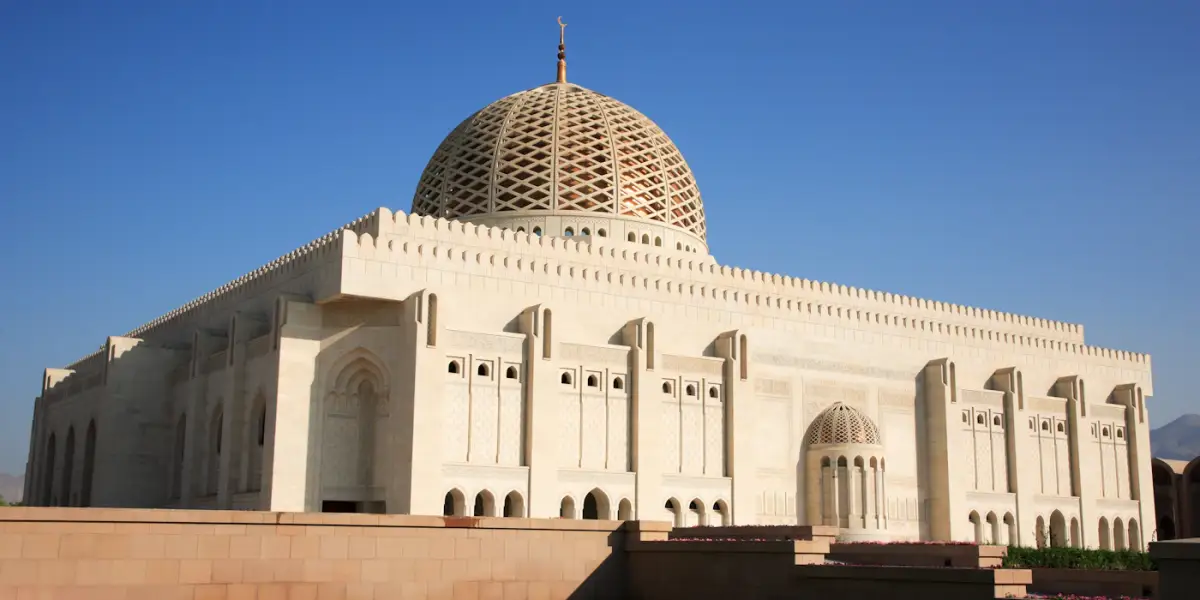
- Sultan Qaboos Grand Mosque. Opened in 2001 and built from about 300,000 tonnes of Indian sandstone, it has a 50 m dome, five minarets and a hand-woven Persian carpet ranked the second largest in the world; visitors are expected to dress with shoulders and knees covered and women's hair covered too.
- Mutrah corniche and souq. Stroll the seafront past the fishing dhows in the harbour, then wander the souq's maze of lanes for silver, spices, frankincense and Omani clothes; Muttrah Fort, first built by the Portuguese in the 1580s, watches over the bay from its hilltop.
- Old Muscat. Al Alam, the ceremonial palace with its blue-and-gold front, stands between the Portuguese-era forts of Al Mirani and Al Jalali; you can photograph it from the gate, then see the National Museum's 7,000-plus objects and the crafts and jewellery at Bait Al Zubair nearby.
- Motishwar Mandir. Oman's Hindu merchant community keeps two temples; one, the old Shiva temple in Muscat known as Motishwar Mandir, was founded more than a century ago by traders from Gujarat and rebuilt in 1999.
- Royal Opera House Muscat. Opened in 2011 as the Gulf's first opera house, it stages opera, ballet, orchestral concerts and Arabic music, and guided tours take you round its Omani-style halls and gardens.
Muscat's winter, November to early March, is mild and dry with averages around 26°C and cool evenings; from June to August the lowlands sit between 35°C and 45°C.
Sources: Experience Oman: Muscat, Experience Oman: Sultan Qaboos Grand Mosque, Sultan Qaboos Grand Mosque (Diwan of Royal Court): General information, Experience Oman: Muttrah Fort, Experience Oman: Leisure activities (markets and shopping), Experience Oman: Al Alam Palace, Experience Oman: Al Mirani Fort, Experience Oman: National Museum, Experience Oman: Bait Al Zubair Museum, Experience Oman: Royal Opera House, Experience Oman: Heritage and culture activities (Omani cuisine), Experience Oman: Weather, Embassy of India, Muscat: India and Oman bilateral relations, Embassy of India, Muscat: Prime Minister visits the old Shiva temple, Motishwar Mandir, Wikivoyage: Muscat, Wikivoyage: Oman (checked 14 Oct)
Wadi Shab
Hill countryDay tripA gorge of green-blue pools reached by a short boat crossing and a rocky walk, ending at a waterfall inside a cave.
about 2 h from Muscat airportBest Sep–May
Wadi Shab
Hill countryDay tripA gorge of green-blue pools reached by a short boat crossing and a rocky walk, ending at a waterfall inside a cave.
Wadi Shab is a narrow, cliff-walled valley off the coast highway between Muscat and Sur, about 170 km from the airport, with water in it all year. A boatman ferries you over the creek at its mouth, then a path runs beside a falaj channel and palm gardens before giving way to boulder-hopping and a string of swimming pools. Most people fit it in on the drive down to Sur.
What to do in Wadi Shab
- Cross by boat and hike in. Local boatmen take you across the water at the entrance under the highway bridge, and the path up to the pools passes irrigation channels, palm plantations and sheer rock; allow about three hours for the round trip.
- Swim to the cave waterfall. Beyond the pools, a short underwater swim through a narrow cave opening brings you into a grotto with a waterfall inside; you need to be able to swim, and Experience Oman advises a life jacket.
- Pack and dress for it. With nothing to buy inside the wadi, carry water and a snack, wear grippy sandals or hiking shoes rather than flip-flops, and wear modest swimwear without changing in the open, since local people find skimpy costumes deeply offensive.
- Bimmah Sinkhole on the way. Just off the same coast road near Dibab, a walled park surrounds a deep hollow of blue-green water half a kilometre from the sea, and swimming is allowed.
Experience Oman puts the best time for the Wadi Shab hike and swim at September to May.
Sources: Experience Oman: Wadi Shab, Wikivoyage: Central Coastal Oman (checked 14 Oct)
Sur
HeritageA seafaring town where wooden dhows are still built by hand, with a maritime museum, forts and an old lighthouse.
1 nightabout 2 h 30 min from Muscat airportBest Oct–Apr
Sur
HeritageA seafaring town where wooden dhows are still built by hand, with a maritime museum, forts and an old lighthouse.
Sur, the main town of South Al Sharqiyah, was founded as a trading port around the 6th century and is still known for its shipyards, where wooden dhows are built in the traditional way. Indian craftsmen have worked alongside Omani ones here: the dhow that Tim Severin sailed from Oman to China in 1980 came out of a Sur yard, made by a mixed team of Omani and Indian shipwrights. It is a handy overnight stop between Wadi Shab and the turtle beach at Ras al Jinz.
What to do in Sur
- Watch dhows being built. At the yards near the bridge to Al Ayjah, shipwrights still build wooden boats by hand; locals call them safeena, ships, rather than dhows.
- Fath Al Khair Center. This maritime museum, opened in 2021, shows navigation tools, manuscripts and boat models, with the Fath Al Khair, Oman's last traditional ghanjah ship, standing in its courtyard.
- Sunaysilah Fort. A fort on a rocky plateau above town with three round towers and one square one, giving wide views over Sur and the sea.
- Al Ayjah lighthouse. Cross the bridge to Al Ayjah, where a restored old lighthouse and watchtowers look back across the water at Sur.
- Qalhat and Bibi Maryam's tomb. About 20 km north of Sur lie the ruins of Qalhat, a medieval port on the trade route to East Africa and Asia and now a UNESCO World Heritage Site, where the domed tomb of Bibi Maryam has stood since about 1311.
Experience Oman gives October to April as the best time to visit Sunaysilah Fort.
Sources: Experience Oman: South Al Sharqiyah, Experience Oman: Fath Al Khair Center, Experience Oman: Al Sunaysilah Fort, Experience Oman: Bibi Maryam Mausoleum, Wikivoyage: Sur, Wikivoyage: Central Coastal Oman (checked 14 Oct)
Ras al Jinz Turtle Reserve
WildlifeWatch endangered green turtles come ashore to nest on guided night and dawn walks on Oman's eastern shore.
1 nightabout 3 h 30 min from Muscat airportBest May–Sep
Ras al Jinz Turtle Reserve
WildlifeWatch endangered green turtles come ashore to nest on guided night and dawn walks on Oman's eastern shore.
On Oman's eastern shore near Ras al Hadd, this reserve protects a beach where endangered green turtles haul out to dig nests and lay eggs, and it is the only official place in Oman where the public can watch them. Set up by royal decree in 1996, it covers about 120 km² with 45 km of coast, and its centre has a museum, research labs and rooms for an overnight stay. The same ground holds remains of settlements more than 4,300 years old, where pottery from the Indus Valley has turned up.
What to do in Ras al Jinz Turtle Reserve
- Night turtle watch. Guides take groups down to the beach every night to watch females dig their nests and lay eggs; keep your distance and leave the torch and camera flash off.
- Dawn walk. A second guided outing in the early morning catches turtles dragging themselves back to the sea after a night of laying eggs.
- Turtle museum. The centre's interactive museum explains the turtles and the reserve's conservation work, a good way for children to understand what they will see on the beach.
- Ras Al Hadd Castle. A 16th-century castle a short drive away whose ceilings were built partly with teak shipped from India, standing near the first point on the Arabian Peninsula to catch the sunrise.
The reserve says May to September is the best time to see hatchlings, and that this stretch of coast stays fairly comfortable in summer at roughly 25–36°C.
Sources: Ras Al Jinz Turtle Reserve: Turtle viewing, Ras Al Jinz Turtle Reserve: About Ras Al Jinz, Ras Al Jinz Turtle Reserve: Responsible tourism, Experience Oman: Ras Al Jinz Turtle Reserve (archaeological site), Experience Oman: About Oman (Ras Al Hadd reserve visitor rules), Experience Oman: Special interests (wildlife spotting), Experience Oman: Ras Al Hadd Castle, Wikivoyage: Central Coastal Oman (checked 14 Oct)
Sharqiyah (Wahiba) Sands
WildlifeA night at a desert camp among dunes that turn from gold to red, with dune drives, camel rides and dark skies.
1 nightabout 3 h from Muscat airportBest Sep–Apr
Sharqiyah (Wahiba) Sands
WildlifeA night at a desert camp among dunes that turn from gold to red, with dune drives, camel rides and dark skies.
The Sharqiyah Sands, also called the Wahiba Sands, spread over about 10,000 km² of dunes up to roughly 100 m high, their colour moving from pale yellow through red to orange as the light changes. Camps lie a short drive into the sand from the inland Muscat–Sur road beyond Ibra, around Al Wasil and Bidiyah, and a night at one is the usual way to see the desert. Wadi Bani Khalid, a green valley of natural pools off the same road, makes a good swim stop on the way in.
What to do in Sharqiyah (Wahiba) Sands
- Stay at a desert camp. Camps range from simple barasti-style huts with shared bathrooms to a five-star camp of suites, and watching the sun set from a dune top is the high point of the evening.
- Dune drive, camel ride or sandboard. Camps and tour firms run 4x4 dune drives, quad biking, camel treks and sandboarding, and in winter hot-air balloons take off over Bidiyah when the weather allows.
- Meet the Bedouin. Camps can arrange a visit to a nearby Bedouin village; Experience Oman asks visitors to respect the tribes' customs and traditions.
- Stargazing. Experience Oman rates North Al Sharqiyah, with its clear and clean night skies, among the best places in the country for stargazing.
- Wadi Bani Khalid. Turn off Highway 23 south of Ibra for a green valley with a large natural pool for swimming; a 20-minute walk upstream past smaller pools brings you to Muqal Cave, where you need a torch.
Experience Oman lists September to April for the Sharqiyah Sands; take plenty of water and sunscreen whenever you go.
Sources: Experience Oman: Al Sharqiyah Sands, Experience Oman: North Al Sharqiyah, Experience Oman: Desert activities, Experience Oman: Wadi Bani Khalid, Wikivoyage: Wahiba Sands, Wikivoyage: Central Coastal Oman (checked 14 Oct)
Nizwa
HeritageOman's old inland capital: a great round 17th-century fort and busy souq, with Bahla and Jabreen forts nearby.
2 nightsabout 1 h 30 min from Muscat airportBest Oct–Apr
Nizwa
HeritageOman's old inland capital: a great round 17th-century fort and busy souq, with Bahla and Jabreen forts nearby.
Nizwa lies among date palms at the foot of the Hajar Mountains, about an hour and a half from Muscat, and was Oman's capital in the 6th and 7th centuries. It is now the most-visited city after Muscat, and the rebuilt old quarter around the fort, Harat Al Aqr, is a warren of stone lanes, small hotels and cafés. It makes the natural base for the forts at Bahla and Jabreen and for day trips into the mountains.
What to do in Nizwa
- Nizwa Fort. Built under Imam Sultan bin Saif Al Ya'rubi in the mid-17th century, its round tower stands 34 m high and 45 m across; climb the narrow, twisting stair past seven defended doors to the top for views over the palm groves.
- Nizwa Souq. Beside the fort, the souq is the place for silver khanjars, pottery, dates and spices, and on Friday mornings it holds its traditional livestock auction.
- Falaj Daris. On the north side of town, one of the five aflaj irrigation channels on UNESCO's World Heritage list, in use since at least 500 CE, runs through a park that suits a picnic.
- Bahla Fort. About half an hour west, Oman's first UNESCO World Heritage Site, listed in 1987, is a huge mud-brick fort on a hill in a palm oasis ringed by more than 12 km of old walls; Bahla is also known for its pottery.
- Jabreen Castle. Built in 1675 as both fort and palace of learning, about 8 km from Bahla, it has painted ceilings, a studded and decorated main gate and rooms such as the Sun and Moon room, with views over the Hajar range.
Experience Oman gives October to April as the best time to visit Nizwa Fort.
Sources: Experience Oman: Al Dakhiliyah, Experience Oman: Nizwa Fort, Nizwa Fort (official site), Experience Oman: Leisure activities (markets and shopping), Experience Oman: Bahla Fort, Experience Oman: Jabreen Fort, Wikivoyage: Nizwa, Wikivoyage: Bahla (checked 14 Oct)
Jebel Akhdar
Hill countryThe 'Green Mountain': a cool plateau of terraced villages, orchards and spring rose fields, reached only by 4WD.
1–2 nightsabout 2 h from Muscat airportBest Mar–May
Jebel Akhdar
Hill countryThe 'Green Mountain': a cool plateau of terraced villages, orchards and spring rose fields, reached only by 4WD.
Jebel Akhdar, the 'Green Mountain', is crowned by the Saiq Plateau, a high tableland of old villages, orchards and terraced gardens clinging to the edges of deep wadis. It runs up to 15°C cooler than the lowlands, so it stays pleasant even in summer, while winter nights can fall below freezing. The road climbs from Birkat Al Mouz, and a police checkpoint on the way up turns back anything that is not a four-wheel drive.
What to do in Jebel Akhdar
- Walk the terraced villages. A marked path of about two hours links the cliff-edge villages of Al Ayn, Ash Shirayjah and Sayq through terraced gardens, with long views into the wadis below.
- Rose season. In spring the slopes turn pink with roses, and you can walk the rose fields and visit old distilleries where villagers still make rosewater.
- Abandoned Bani Habib. Extend the village walk by another 1½ to 2 hours to Bani Habib, where a short path leads to a deserted village of mud-brick houses above its plantations.
- Bait Al Ridaydah on the way up. This 17th-century fort near Birkat Al Mouz, on the road to the mountain, has painted ceilings, carved gypsum and the Falaj Al Khatmain flowing through its courtyard.
March to May is rose season on Jabal Akhdar, when villagers distil rosewater and the air smells of roses; the mountain is also a cool escape in summer.
Sources: Experience Oman: Weather, Experience Oman: Al Dakhiliyah, Experience Oman: Special interests (Oman's fragrant heritage), Experience Oman: Bayt Ar-Ridaydah, Wikivoyage: Hajar Mountains (checked 14 Oct)
Jebel Shams and Wadi Ghul
Hill countryOman's highest mountain: cliff-edge walks above a canyon with 1,000 m walls, plus old villages on the way up.
1 nightabout 3 h from Muscat airportBest Nov–Mar
Jebel Shams and Wadi Ghul
Hill countryOman's highest mountain: cliff-edge walks above a canyon with 1,000 m walls, plus old villages on the way up.
Jebel Shams is Oman's highest peak, and most visitors come for the view from the western rim of the canyon beneath it, Wadi an Nakhur (also called Wadi Ghul, strictly the name of its mouth), whose cliffs rise about 1,000 m. The very top houses an air force site and is closed to the public. The road up from Al Hamra is unpaved in places and can wash out after heavy rain, so a 4WD is the safe choice; it works as a day trip from Nizwa, though rim-top camps and resorts let you stay the night.
What to do in Jebel Shams and Wadi Ghul
- Walk the W6 path to As Sab. An easy hour along an old donkey track leads to As Sab, an abandoned village built straight into the cliff, with a waterfall in the wet season.
- Canyon viewpoints and Al Khitaym. Signposted lookouts give the first views down into Wadi an Nakhur, and the road ends at the goatherds' village of Al Khitaym, where villagers sell rugs and bags woven from goat hair.
- Drive into the canyon. Near modern Ghul a side road heads into Wadi an Nakhur past the abandoned village of old Ghul, then becomes a rough 4WD track under the cliffs to the village of An Nakhur.
- Al Hamra and Misfat al Abriyyin. On the way up, Al Hamra's old quarter of Yemeni-style mud-brick houses and the terraced village of Misfat al Abriyyin, with its falaj channels and a paved road in, are worth a stop.
November to early March is Oman's season for trekking and camping, and in summer the mountains stay up to 15°C cooler than the lowlands.
Sources: Experience Oman: Al Dakhiliyah, Experience Oman: Mountain activities, Experience Oman: About Oman (traditional villages), Experience Oman: Weather, Wikivoyage: Hajar Mountains, Wikivoyage: Nizwa (checked 14 Oct)
Salalah and Dhofar
CityThe far south: misty green hills in the June–September khareef, frankincense sites, a waterfall wadi and long beaches.
3–4 nightsabout 2 h by flight from Muscat airportBest Jun–Sep
Salalah and Dhofar
CityThe far south: misty green hills in the June–September khareef, frankincense sites, a waterfall wadi and long beaches.
Salalah, capital of the southern Dhofar region, is about 90 minutes from Muscat by Oman Air and feels a world away from the north. From June to September the khareef monsoon wraps the coastal mountains in mist and drizzle, greening the hills and filling the wadis at around 20–28°C, which is when visitors pour in to escape the heat elsewhere in Arabia. This is the Land of Frankincense: the trees still grow here, the old ports of Al Baleed and Sumhuram are UNESCO World Heritage Sites, and in town Malayalam is useful alongside Arabic and there is South Indian vegetarian food.
What to do in Salalah and Dhofar
- Wadi Darbat. In the hills above Khor Rori, a ribbon of small lakes refills in the khareef, when the wadi's water pours over a 150 m travertine cliff as a seasonal waterfall.
- Mughsail beach and blowholes. West of town, a long white-sand beach with shaded picnic shelters ends at rocks where blowholes shoot seawater into the air when the sea is rough; in the khareef, waves of 2–3 m often close the beach.
- Al Baleed and the frankincense museum. Walk the ruins of Zafar, the 12th-century trading port Marco Polo visited in 1285, and see the Museum of the Frankincense Land on the history of the port and region.
- Frankincense at Al Haffa souq. The souq in the old seafront quarter is the place for frankincense, where the paler grades are the best, along with myrrh and burners made from local Dhofari clay; haggling is expected.
- Sumhuram and Khor Rori. East near Taqah, the ruins of Sumhuram, a port that traded frankincense with India and China from the 3rd century BCE, sit beside the Khor Rori estuary, where flamingos spend the winter.
Experience Oman picks the June-to-September khareef as the time to visit Dhofar, when mist and light showers cover the plains and mountains.
Sources: Experience Oman: Dhofar, Experience Oman: Weather, Experience Oman: Wadi Darbat, Experience Oman: Al Mughsail Beach, Wikivoyage: Salalah, Wikivoyage: Dhofar, Wikivoyage: Taqah (checked 14 Oct)
A first trip: 9–10 nights
- Muscat · 3n
- →Wadi Shab
- →Sur · 1n
- →Ras al Jinz Turtle Reserve · 1n
- →Sharqiyah (Wahiba) Sands · 1n
- →Nizwa · 2n
- →Jebel Akhdar · 1–2n
Start in Muscat, follow the coast road south past Wadi Shab to Sur and a night at the Ras al Jinz turtle beach, cut inland past Wadi Bani Khalid to a desert camp in the Sharqiyah Sands, and finish in Nizwa and on Jebel Akhdar, roughly two hours' drive from the airport, with a night on Jebel Shams if you have time. The loop is best from October to April; in summer (June to August) the lowlands reach 35–45°C, but that is when hatchlings appear at Ras al Jinz and the June-to-September khareef turns Salalah green, so give the south its own trip then.
Getting around
Oman is best seen by hire car: good roads link Muscat with Nizwa and with Sur, but a 4WD is needed for Jebel Akhdar, the canyon roads around Jebel Shams and many wadi and desert tracks, and rain can turn a dry wadi into a torrent within minutes. Mwasalat buses run from Muscat to Nizwa in about 2 hours 20 minutes and to Sur in about 4 hours 15 minutes. For Salalah, Oman Air flies from Muscat in about an hour and a half, against roughly 12 hours by road.
Peak Shoulder Off-season
Oman's official tourism site calls November to early March the mild, dry season with Muscat averaging about 26°C, recommends autumn as a comfortable time, and puts summer lowland temperatures at 35 to 45°C. The city is pleasant from late October to March; May to September is too hot for daytime outings.
Flights to Oman from India
Visa for Indian passports
Indian passport holders need an e-visa for Oman, applied for online before travel (allow about 5 days). Visa-free up to 14 days with a valid US, UK, Schengen, Canada, Australia or Japan visa (plus hotel, insurance and return ticket). e-Visa at evisa.rop.gov.om, about 1–3 working days.
Before you book, check the Ministry of External Affairs travel advisories and the Embassy of India, Muscat for the latest guidance.
Oman: questions
What are the best places to visit in Oman?
Muscat: The Grand Mosque, Mutrah's souq and corniche, Old Muscat's palace and forts, and an old Shiva temple. Wadi Shab: A gorge of green-blue pools reached by a short boat crossing and a rocky walk, ending at a waterfall inside a cave. Sur: A seafaring town where wooden dhows are still built by hand, with a maritime museum, forts and an old lighthouse. Ras al Jinz Turtle Reserve: Watch endangered green turtles come ashore to nest on guided night and dawn walks on Oman's eastern shore. Sharqiyah (Wahiba) Sands: A night at a desert camp among dunes that turn from gold to red, with dune drives, camel rides and dark skies. Nizwa: Oman's old inland capital: a great round 17th-century fort and busy souq, with Bahla and Jabreen forts nearby. Jebel Akhdar: The 'Green Mountain': a cool plateau of terraced villages, orchards and spring rose fields, reached only by 4WD. Jebel Shams and Wadi Ghul: Oman's highest mountain: cliff-edge walks above a canyon with 1,000 m walls, plus old villages on the way up. Salalah and Dhofar: The far south: misty green hills in the June–September khareef, frankincense sites, a waterfall wadi and long beaches.
How many days do you need for Oman?
A first trip takes about 9–10 nights: Muscat (3 nights), Wadi Shab (1 night), Sur (1 night), Ras al Jinz Turtle Reserve (1 night), Sharqiyah (Wahiba) Sands (1 night), Nizwa (2 nights), Jebel Akhdar (1–2 nights). Start in Muscat, follow the coast road south past Wadi Shab to Sur and a night at the Ras al Jinz turtle beach, cut inland past Wadi Bani Khalid to a desert camp in the Sharqiyah Sands, and finish in Nizwa and on Jebel Akhdar, roughly two hours' drive from the airport, with a night on Jebel Shams if you have time. The loop is best from October to April; in summer (June to August) the lowlands reach 35–45°C, but that is when hatchlings appear at Ras al Jinz and the June-to-September khareef turns Salalah green, so give the south its own trip then.
What is the best time to visit Oman?
Peak season is Nov–Mar. Oman's official tourism site calls November to early March the mild, dry season with Muscat averaging about 26°C, recommends autumn as a comfortable time, and puts summer lowland temperatures at 35 to 45°C. The city is pleasant from late October to March; May to September is too hot for daytime outings.
Do Indians need a visa for Oman?
Indian passport holders need an e-visa for Oman, applied for online before travel (allow about 5 days). Visa-free up to 14 days with a valid US, UK, Schengen, Canada, Australia or Japan visa (plus hotel, insurance and return ticket). e-Visa at evisa.rop.gov.om, about 1–3 working days.
How much is a flight to Oman from India?
The lowest return fare FlyBun has seen in the last 14 days is ₹14,716, Mumbai to Muscat, for October 2026 departures. Fares change daily.
Places and things to do are written by FlyBun from official tourism, heritage and park sources, linked under each place, last checked 14 Oct. We leave out entry fees and opening hours because they change; check them before you go.
Watch a route and FlyBun alerts you free when its fare drops.